
Google Ads vs Facebook Ads for Contractors


Article by
Harry Stanley III
Harry Stanley III is a construction marketing strategist and fractional CMO at H&A Marketing. He has helped construction companies grow through website strategy, SEO, paid advertising, branding, lead generation, CRM systems, and professional content. His past work includes helping Meraki Solar generate an additional $3.7 million in revenue in his first year and supporting American Builders as a fractional CMO. Today, Harry works directly with custom home builders and construction companies to build marketing systems designed to generate qualified leads and measurable growth.
Is a $6.45 click on Google actually cheaper than a $1.75 click on Facebook? Many contractors see the lower price tag on social media and assume it's the better deal, only to end up with a CRM full of leads who never answer the phone. You likely know the frustration of paying for high-intent Google search traffic only to see your budget vanish before lunch, or running Meta ads that generate plenty of likes but zero signed contracts. Deciding between Google Ads vs Facebook Ads for contractors isn't about picking a single winner. It's about understanding how each platform fits into a complex, high-ticket sales cycle.
In this guide, you'll learn how to balance high-intent search with visual social proof to build a lead generation system that actually closes $500k+ construction contracts. We'll break down the 2026 performance data for both platforms and show you how to combine them into a connected marketing system. You will discover why Google captures the immediate need while Facebook builds the luxury "want." We also look at how to pair these ads with a high-performance custom home builder website design to ensure those clicks turn into qualified inquiries and measurable ROI for your firm.
Key Takeaways
- Understand the fundamental difference between capturing active searchers on Google and building desire through visual discovery on Meta platforms.
- Evaluate lead quality over simple volume when comparing Google Ads vs Facebook Ads for contractors to avoid filling your CRM with low-intent inquiries.
- Leverage professional video and drone footage to establish the visual authority required to close high-ticket luxury construction projects.
- Learn how to allocate your ad spend based on whether you need immediate pipeline growth or long-term brand awareness in your target market.
- Recognize that paid traffic is only effective when paired with a high-conversion website and a connected marketing system that tracks leads from click to contract.
Intent vs. Discovery: The Fundamental Difference for Builders
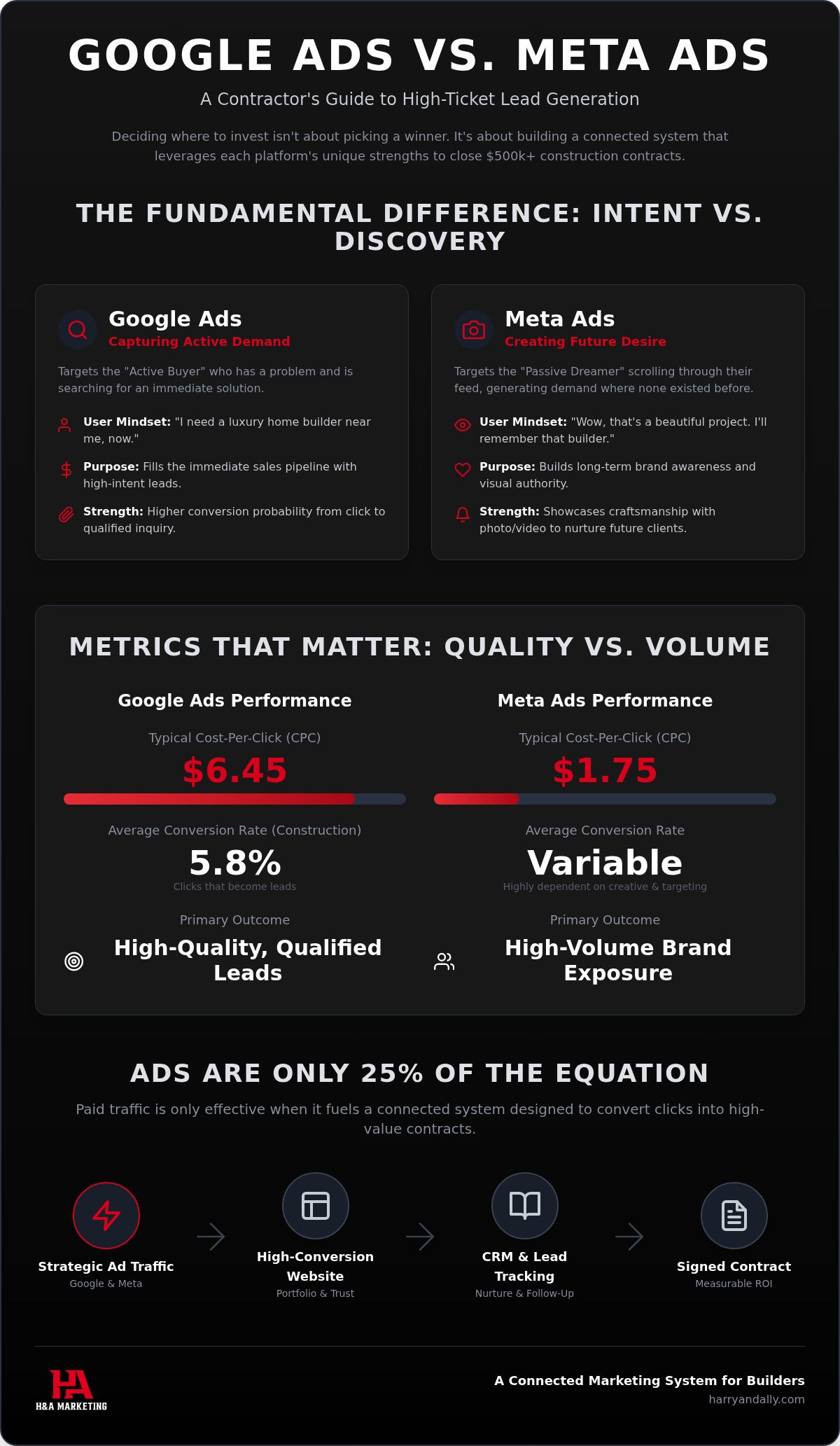
The landscape of online advertising for the construction industry is split into two distinct psychological worlds. When evaluating Google Ads vs Facebook Ads for contractors, the first thing you have to look at isn't the price per click; it's the mindset of the person clicking. Google is built for intent. Facebook is built for discovery. One captures a fire that's already burning, while the other lights the match. To better understand this concept, watch this helpful video:
Google Ads: Capturing High-Intent Search
Google Ads targets the "Active Buyer." These are people typing specific queries into a search bar because they have a problem and want a solution now. This high-intent traffic is the low-hanging fruit of lead generation for construction companies. By bidding on terms like "luxury home builders" or "commercial construction firms," you position your business exactly where the demand already exists.
- Immediate Pipeline: Search ads are the fastest way to fill a gap in your production schedule.
- Negative Keywords: We use these to filter out DIYers looking for "how to build a deck" or low-budget searchers who aren't a fit for $500k+ contracts.
- Direct Response: The user is asking for help, which typically leads to a shorter sales cycle.
Meta Ads: Generating Demand Through Discovery
Meta Ads (Facebook and Instagram) target the "Passive Dreamer." These users aren't looking for a contractor; they're scrolling through their social feed. You reach them through demographic profiling and interest-based targeting, such as people interested in high-end architecture or interior design. It's the digital equivalent of a high-end showroom. By showing off your professional video and photo work, you generate demand where it didn't exist five minutes ago.
We often build "lookalike audiences" based on your current high-value client list. This allows the platform's AI to find similar homeowners who share those same premium interests. While Google captures the "need," Facebook builds the "want" for your specific brand of craftsmanship.
The user's mindset dictates the friction of your lead capture. A Google searcher is often willing to fill out a detailed inquiry because they're actively looking for help. A Facebook user has less patience. Their journey starts with inspiration, so the initial touchpoint needs to be lower friction. Understanding this balance is the first step in deciding where to put your money when comparing Google Ads vs Facebook Ads for contractors.
Lead Quality vs. Lead Volume: Metrics That Matter in 2026
In the construction industry, vanity metrics kill budgets. If you are judging Google Ads vs Facebook Ads for contractors based on cost-per-click alone, you are likely missing the bigger picture of project ROI. A $30 lead from Facebook might look great on a spreadsheet, but if they are looking for a $5,000 repair while you only take on $500k+ custom builds, that lead is effectively worthless. Conversely, a $70 lead from Google search might feel expensive until you realize they are actively looking for a general contractor for a luxury build. We focus on the cost per qualified lead, not just the raw number of inquiries.
The Google Search Premium
Contractors pay more for Google search because the conversion probability is significantly higher. Research shows the average conversion rate for construction on Google is around 5.8%, meaning nearly six out of every 100 clicks turn into a lead. This premium is driven by your Quality Score. Quality Score is Google's rating of the relevance and quality of your keywords, ads, and landing pages; a higher score helps you secure better ad placements at a lower cost. Adhering to FTC guidelines for online advertising is essential for maintaining brand trust and ensuring your ads remain compliant and effective in high-stakes markets.
The Facebook "Tire-Kicker" Challenge
Facebook leads are cheaper, with an average cost-per-click of $1.75, but they often come with a "tire-kicker" problem. Because Meta platforms are interruption-based, people often fill out low-friction lead forms without much thought. To combat this, we use high-friction qualifying strategies. This includes using long-form ad copy that explicitly states your project minimums and using professional media that looks too expensive for a budget-conscious homeowner. By the time they click, they already know you are a premium firm. If you are tired of chasing low-quality inquiries, it might be time to refine your lead generation for construction companies strategy.
Construction has a long sales cycle. A lead captured in August might not sign a contract until February. If you only track immediate conversions, you'll never see the true value of your ad spend. Our connected marketing system tracks every inquiry through your CRM to see which platform actually puts money in the bank. We prioritize pipeline growth and project quality over simple click volume, ensuring your marketing spend targets the $500k+ contracts that move the needle for your business.
Visual Authority: Why Meta Wins the Trust Battle
Luxury construction is a visual industry. You aren't just selling a structure; you're selling a lifestyle, craftsmanship, and trust. While Google captures the logical search for a builder, Meta platforms allow you to demonstrate your authority through high-impact aesthetics. When comparing Google Ads vs. Facebook Ads, the biggest advantage of social media is the ability to stop the scroll with a stunning portfolio. This visual proof is what moves a prospect from "just looking" to "ready to sign."
Effective construction branding relies on showing, not just telling. High-end clients expect to see the quality of your finishes and the scale of your operations before they ever pick up the phone. This is where Meta platforms outperform search engines in the Google Ads vs Facebook Ads for contractors debate. Search results provide links; social media provides proof.
The Power of Jobsite Media
Stock photos are a trust-killer in the luxury market. Sophisticated homeowners can spot a generic image from a mile away. We use professional video and photo services to capture real craftsmanship on your actual jobsites. This authentic content performs better because it humanizes your firm and builds transparency. Showing your crew in action or the precision of a foundation pour creates a narrative of quality that text ads can't replicate.
- Scale and Scope: Leveraging drone footage shows the true scale of commercial or luxury residential projects in a way that ground-level photos never could.
- Behind the Scenes: Raw, high-quality footage of a project in progress builds more trust than a perfectly polished, static image.
- The Portfolio Effect: Using ads to showcase finished projects to a national audience turns your social feed into a digital showroom.
Retargeting: Staying Top-of-Mind During the 6-Month Decision
The decision to build a custom home doesn't happen in a single afternoon. It's a journey that often lasts six months or more. This long sales cycle makes attribution difficult, but it also creates a massive opportunity for retargeting. By using Meta pixels, you can follow people who found you via Google Search and show them visual testimonials or drone tours on their Instagram feed.
This creates an omnipresence strategy. You appear everywhere your prospect looks, reinforcing your brand authority at every stage of their journey. Retargeting effectively shortens the gap between that initial high-intent click and the final inquiry. It ensures that when they're finally ready to pull the trigger, your firm is the only logical choice they remember. If your current ads aren't connecting these dots, you're likely leaving high-value contracts on the table.
Strategic Allocation: Google Ads vs Facebook Ads for Contractors
Deciding how to divide your marketing budget requires a clear look at your current project pipeline. The Google Ads vs Facebook Ads for contractors debate isn't about which platform is better; it's about which one solves your current business bottleneck. We see three common scenarios where the allocation shift is necessary for construction firms.
- Scenario A: The Production Gap. You have a sudden opening in your schedule due to a delayed project. You need leads that close fast. Google Ads is the priority here because it captures people already in the buying phase.
- Scenario B: The Luxury Launch. You're moving into a higher-tier market where nobody knows your name yet. Meta Ads allows you to force your portfolio in front of high-net-worth individuals who aren't yet searching for a new builder.
- Scenario C: The Traffic Paradox. You have a stunning portfolio but your website is a ghost town. Meta Ads can drive high volumes of visual-first traffic to your site, which then allows your Google retargeting to work more effectively.
For most established construction firms, we find the sweet spot is a 70/30 split. Allocating 70% of your budget to Google Search ensures you capture the existing demand in your market. The remaining 30% goes to Meta to build brand awareness and retarget previous visitors. This balance prevents you from becoming over-reliant on a single source of lead generation for construction companies.
The Case for Google Ads Dominance
Google Ads should take the lion's share of your budget when search volume for your specific niche is high. If people are actively searching for commercial steel building contractors or custom home architects, you need to be there. It's also the most effective way to capture traffic from people searching for your competitors by name. When the service is a need rather than a want, Google is the winner. This is especially true for specialized contractors where the technical requirements of the job are the primary search driver.
The Case for Meta Ads Dominance
Meta Ads wins when your project is aspirational. Custom homes, luxury pools, and high-end remodeling are sold on emotion and visual impact. If you've a massive portfolio of professional media but low website traffic, social media is your strongest selling point. It's also the ideal choice if you operate in a market with low search volume. You can't wait for people to search for a service they don't know they want yet; you have to show them what's possible.
Request a marketing audit to optimize your ad spend
The Connected System: Why Ads Are Only 25% of the Equation
Sending paid traffic to a subpar website is the fastest way to burn your marketing budget. When comparing Google Ads vs Facebook Ads for contractors, many firms focus entirely on the ad platform while ignoring the destination. High-intent searchers and visual-first dreamers both end up on your website. If that site doesn't immediately project luxury and competence, they'll leave. This is why custom home builder website design is a non-negotiable part of a connected marketing system.
Ads are merely the engine of your growth. Your website is the vehicle. If the vehicle is broken, the engine is useless. H&A coordinates strategy, creative, and traffic as a single engine to ensure every dollar spent on Google or Meta translates into a project inquiry that fits your ideal client profile.
Landing Pages That Convert Builder Leads
A homepage is designed for navigation; a landing page is designed for conversion. When we run a campaign, we don't send traffic to your generic "About Us" page. We send it to a high-performance landing page built with specific social proof, clear calls-to-action, and a mobile-first design. Conversion Rate Optimization for construction sites is the methodical process of refining these page elements to ensure a higher percentage of visitors become qualified leads. By focusing on the user journey from the first click, we maximize the efficiency of your lead generation for construction companies.
Lead Management: Closing the Gap
The journey doesn't end when a form is submitted. Speed-to-lead is the single most important factor in your ad ROI. Industry data suggests that responding to a lead within five minutes increases the likelihood of a successful connection by a massive margin. We integrate your ads directly with CRM tracking to ensure your team is notified the moment a prospect shows interest. This transparency allows you to see exactly which platform is driving the $500k+ contracts and which is just driving noise.
Automated follow-ups also play a critical role. Since construction has a long sales cycle, you need a system that stays in front of prospects who are still months away from breaking ground. For a deeper look at building these workflows, read our guide on Lead Management for Home Builders. H&A operates as an extension of your business, managing the entire pipeline from the initial Google Ads vs Facebook Ads for contractors debate to the final signed contract.
Building a Dominant Digital Pipeline
Choosing between Google Ads vs Facebook Ads for contractors isn't a binary decision. It's a strategic choice about how to capture high-intent searchers while simultaneously building visual authority with passive dreamers. Success in 2026 demands a connected marketing system that links your ads, professional jobsite media production, and a high-performance website into a single engine. This integrated approach ensures that your brand remains top-of-mind throughout the long construction sales cycle.
As specialized construction marketing experts, H&A Marketing focuses on the metrics that actually impact your bottom line: project quality and pipeline growth. We help you move beyond simple lead volume to build a system that targets $500k+ contracts. You don't have to choose between search intent and social discovery when you have a partner that leverages both to maximize your project ROI. Our team coordinates the high-level strategy and tactical execution so you can focus on what you do best: building.
Your next high-ticket project is already searching or scrolling. It's time to ensure your brand is the one they find, recognize, and trust.
Frequently Asked Questions
Is Google Ads or Facebook Ads better for getting custom home leads?
Google Ads is generally superior for capturing active buyers who are ready to break ground, while Facebook Ads excels at building the long-term desire for luxury projects. When evaluating Google Ads vs Facebook Ads for contractors, the best approach is a connected system that uses both. Google provides the immediate intent, but Facebook's visual nature allows you to showcase the craftsmanship that justifies a multi-million dollar contract. This combination ensures you don't miss high-intent searchers.
How much should a construction company spend on digital ads monthly?
Your monthly budget depends on your specific pipeline goals and market competition. While some small firms start lower, established construction companies often allocate a budget that allows for enough data to optimize performance. The key is not the total dollar amount but the cost per qualified lead. We recommend an allocation that balances high-intent search with visual retargeting to ensure you aren't just buying clicks, but building a predictable lead generation engine for your business.
Why am I getting so many junk leads from Facebook Ads?
Junk leads usually occur because the ad friction is too low or the targeting is too broad. If you use standard lead forms without qualifying questions, you'll attract individuals who aren't ready for a $500k project. To fix this, we use long-form copy and professional media to filter out low-budget inquiries. High-quality visuals act as a barrier, ensuring only those who appreciate premium craftsmanship and have the necessary budget actually submit their contact information.
Can I run Google Ads without a high-quality website?
You can run them, but you'll likely waste your budget. Sending high-cost search traffic to a poor site results in high bounce rates and zero conversions. A professional custom home builder website design is essential to convert that traffic into inquiries. Google's Quality Score also relies on landing page relevance; a poor site actually makes your ads more expensive to run by increasing your cost per click.
How long does it take to see results from a construction ad campaign?
You will often see lead activity within the first 30 days of a campaign, but the true ROI takes longer due to the construction sales cycle. It's common for a lead captured today to take six months to sign a contract. Digital ads are about building a consistent pipeline, not just a one-time spike. We focus on tracking these leads through your CRM to measure long-term project value rather than immediate vanity metrics like likes or clicks.
Do I need professional photos for my Facebook Ads to work?
Yes, professional media is non-negotiable if you want to close high-ticket contracts. Stock photos or low-quality cell phone shots undermine your brand authority and fail to stop the scroll. High-end clients expect to see the level of detail and craftsmanship you provide. Using professional on-site video and drone photography allows you to demonstrate the scale and quality of your work, which is the primary driver of trust on social media platforms for custom home builders.
What are Local Service Ads (LSAs) and are they better than Google Search Ads?
Local Service Ads (LSAs) are pay-per-lead and appear at the very top of Google, while Search Ads are pay-per-click. LSAs are excellent for volume and trust but offer less control over branding and specific keyword targeting. For luxury builders, Search Ads are often better because they allow for more sophisticated messaging and filtering. A connected system typically uses both to dominate the search results and capture every possible high-intent inquiry from qualified homeowners.
How do I track which platform is actually generating my biggest contracts?
Effective tracking requires integrating your ad platforms with a CRM system. By using UTM parameters and lead source tracking, you can follow a prospect from their first click on a Google or Facebook ad all the way to a signed contract. This transparency is vital for understanding the true ROI of Google Ads vs Facebook Ads for contractors. It allows you to shift budget toward the platform that consistently delivers your most profitable and prestigious projects.
