
How Much Should a Construction Company Spend on Marketing?

Article by
Harry Stanley III
Harry Stanley III is a construction marketing strategist and fractional CMO at H&A Marketing. He has helped construction companies grow through website strategy, SEO, paid advertising, branding, lead generation, CRM systems, and professional content. His past work includes helping Meraki Solar generate an additional $3.7 million in revenue in his first year and supporting American Builders as a fractional CMO. Today, Harry works directly with custom home builders and construction companies to build marketing systems designed to generate qualified leads and measurable growth.
Building an effective construction marketing budget often stalls not because builders spend too little, but because they fund isolated tactics instead of an integrated revenue pipeline. When your business depends on six-figure custom builds or commercial contracts with long sales cycles, guessing how much to reinvest often leads to wasted capital and unqualified tire-kickers. You already know that relying strictly on word-of-mouth leaves your project backlog vulnerable to unexpected market shifts, yet spending money on disconnected vendors and uncoordinated ads has likely left you frustrated with poor returns.
You don't need more random promotional noise; you need a clear, defensible plan tied directly to your gross revenue goals. In this guide, you'll discover how to benchmark, allocate, and measure your construction marketing budget across a high-performing connected marketing system. We break down verified industry spend benchmarks, the practical 70-20-10 allocation framework, and the tracking methods you need to safeguard profitability on every signed contract.
Key Takeaways
- Benchmark your annual spend accurately by aligning gross revenue with proven industry standards, balancing steady maintenance at 2% to 4% against aggressive market expansion at 5% to 10%.
- Structure your construction marketing budget across core website infrastructure, targeted search traffic, and premium visual assets rather than uncoordinated tactical experiments.
- Evaluate the true operational trade-offs between burdened internal hiring costs and specialized growth partners built specifically for construction workflows.
- Protect your marketing capital by replacing vanity metrics with closed-loop tracking tied directly to qualified inquiries and high-ticket project profitability.
Benchmarking Your Construction Marketing Budget: Standard Industry Guidelines
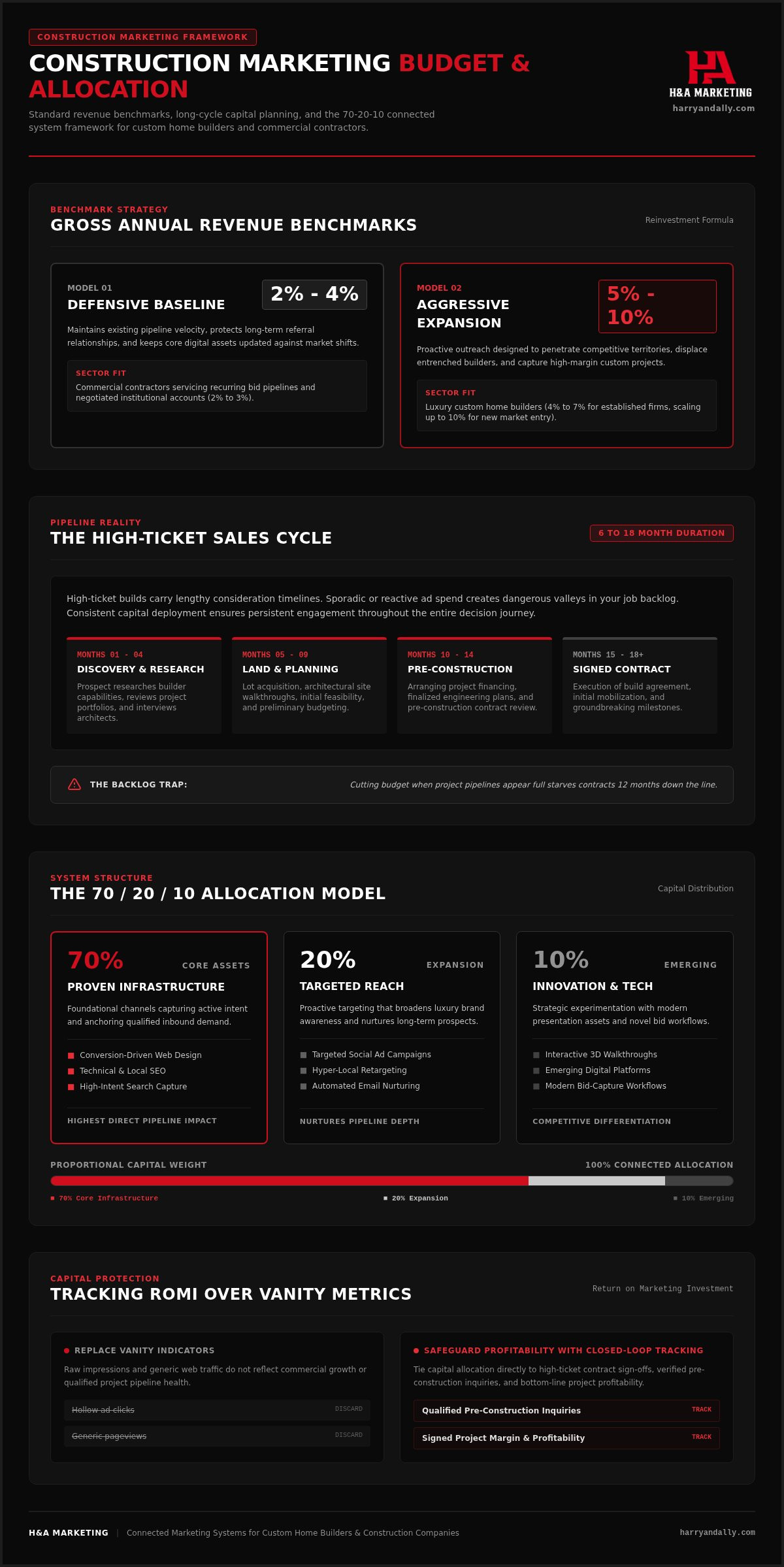
Setting a realistic construction marketing budget begins by deciding whether your business is defending current market share or actively buying future growth. Defensive maintenance budgeting keeps your name familiar among existing referral sources, typically requiring an investment of 2% to 4% of gross annual revenue. Aggressive expansion budgeting models demand 6% to 10% of gross revenue, fueling the proactive outreach necessary to penetrate competitive markets, displace entrenched competitors, and win premium contracts.
Revenue Percentage Formulas for Residential and Commercial Builders
Commercial contractors servicing recurring bid pipelines and negotiated institutional work often operate effectively near the baseline of 2% to 3% of revenue, directing capital toward reputation assets, pre-qualification positioning, and targeted commercial relationships.
Luxury custom builders require a more aggressive allocation. Reaching affluent buyers who commission custom homes requires consistent digital visibility and high-end visual proof. For sustained expansion, the ideal construction marketing budget sits between 4% and 7% of gross revenue for established builders, scaling up to 10% for firms entering competitive territories or launching new architectural product lines.
- Defensive Baseline (2% to 4%): Sustains existing pipeline velocity, protects referral relationships, and updates foundational digital assets.
- Aggressive Growth (5% to 10%): Expands territory, targets high-margin custom projects, and captures market share from competitors.
Factoring in Long Sales Cycles and Deal Sizes
A fatal mistake contractors make is managing their marketing spend like an e-commerce brand expecting immediate conversions. Custom home builds and major commercial developments carry sales cycles spanning 6 to 18 months. Prospects spend months researching capabilities, interviewing architects, securing land, and arranging project financing before ever signing a pre-construction contract.
Sporadic ad spend creates volatile valleys in your job backlog. When you cut marketing because the pipeline feels full today, you starve your pipeline for the coming year. Sustained capital allocation keeps your brand top of mind during the architectural planning stage. This persistent engagement allows you to track long-term metrics such as return on marketing investment (ROMI) accurately, ensuring that steady pipeline investment consistently yields signed contracts rather than hollow clicks.
Allocating Capital Across the Connected Marketing System
Splitting your annual marketing capital across random, disconnected tactics is the fastest way to bleed money. A high-performing construction marketing budget funds an integrated system where strategy, design, search visibility, and visual assets reinforce one another. Instead of viewing marketing expenses as arbitrary line items, high-growth contractors distribute their resources using a structured framework aligned with U.S. Small Business Administration planning guidelines, prioritizing the core infrastructure that directly drives qualified bids.
A balanced allocation typically follows a practical division:
- 70% to Core Infrastructure and Proven Channels: Conversion-driven web architecture, technical SEO, and active search intent capture.
- 20% to Expansion Channels: Targeted social ad campaigns, hyper-local audience retargeting, and automated email nurturing.
- 10% to Emerging Opportunities: Interactive 3D site walkthroughs, emerging digital platforms, and modern bid-capture workflows.
Digital Foundation: Custom Web Design and Strategic Branding
Your digital presence is your primary commercial showroom. Builders investing heavily in ad traffic without anchoring their foundation with high-performance construction web design end up paying for high bounce rates. Affluent custom home buyers expect fast page speeds, clean structural hierarchy, and intuitive project galleries that showcase architectural sophistication.
Applying tactical conversion rate optimization for home builders ensures your traffic actually converts into pre-construction consultation requests. Strategic branding sets you apart from commoditized volume tract builders, establishing your firm as an elite authority before a prospect even submits an inquiry. If you're currently auditing your online presence, use choosing a contractor website design agency to benchmark your core digital assets against modern technical standards.
Targeted Traffic: Construction SEO and Search Advertising
Great website architecture requires consistent, high-intent traffic. Allocate funds toward specialized search engine optimization to capture prospects actively searching for local general contractors and custom residential builders. Organic authority compounds over time, steadily lowering your client acquisition costs as your rankings rise.
To fill near-term pipeline gaps, dedicate a portion of your construction marketing budget to Google Search campaigns. Target high-value, bottom-of-funnel keywords like design-build contractors or high-end custom home builders. This balance pairs immediate bid opportunities with enduring organic search equity.
Visual Proof: Professional Jobsite Photography and Video
In high-ticket construction, prospects buy proof of capability. Dedicate ongoing capital to recurring on-site visual capture using professional video and photo services. High-resolution imagery, drone jobsite footage, and client interview walkthroughs validate clean jobsite management and structural excellence. You can repurpose these visual assets across detailed case studies, proposal presentations, and social channels to shorten prospective client review cycles.
If you want to eliminate disjointed vendors and align your channels into one revenue engine, explore how partnering with harryandally.com can streamline your entire marketing workflow.
In-House Staff vs. Specialized Construction Marketing Agency: The Budget Reality
Deciding how to staff your promotional efforts shapes your entire construction marketing budget. Many contractors assume hiring an internal marketing coordinator gives them greater control over daily output. In reality, modern construction promotion requires a diverse skillset that no single employee possesses, often turning a well-intentioned salary into an expensive operational bottleneck.
The True Overhead of an In-House Marketing Hire
Calculating the real cost of internal marketing staff means looking beyond base pay. According to Salary.com data as of September 2026, the national average base salary for a full-time marketing manager in the United States sits at $121,657. Once you add employer taxes, healthcare benefits, and corporate overhead (a typical 25% to 30% load), the fully burdened employer cost climbs to between $152,000 and $160,000 per year.
That substantial figure does not include your active advertising spend, professional camera gear, or essential software subscriptions. Design programs, enterprise SEO platforms, and CRM licenses can easily add thousands in fixed annual overhead. More critically, an internal generalist cannot realistically excel at technical web development, custom copywriting, paid search bidding, and architectural videography at the same time. Output stalls because one person gets buried under competing priorities.
- Burdened Payroll: $152,000+ annually for a single coordinator before purchasing ad space or gear.
- Skill Gaps: A single hire rarely masters both technical code and high-end creative storytelling.
- Turnover Risk: Departures wipe out your operational momentum, forcing you to restart the costly recruitment cycle.
The Dedicated Agency Model: Cross-Disciplinary Expertise
Partnering with a specialized construction growth team converts heavy fixed payroll into an adaptable operating investment. Rather than depending on one employee's limited hours, you gain immediate access to experienced web designers, media strategists, drone pilots, and copywriters who understand the commercial building space.
As highlighted in Harvard Business Review's analysis on managing marketing budgets, maintaining flexibility while securing high-impact execution protects capital efficiency during shifting market conditions. An agency partnership secures predictable project deliverables on structured monthly retainers, allowing you to scale up promotion during major bid pursuits or pivot resources without staffing disruptions. Specialized construction agencies bring established workflows from day one, ensuring your construction marketing budget drives pipeline equity instead of subsidizing employee training curves.
How to Track ROI and Protect Your Construction Marketing Investment
Measuring marketing success through page impressions, social media likes, or raw click volume is dangerous for construction executives. You don't deposit clicks in the bank; you build equity through signed contracts and funded draws. Protecting your construction marketing budget requires shifting your focus away from vanity metrics and grounding your evaluation in qualified pipeline economics.
Essential Metrics for Custom Builders and General Contractors
High-ticket projects demand a different analytical lens than transactional consumer goods. Custom builders and commercial contractors need fewer total leads, but those inquiries must meet strict criteria regarding land ownership, architectural readiness, and budget alignment. Tracking vanity traffic numbers hides pipeline leaks, while tracking pipeline velocity reveals true commercial health.
- Cost Per Qualified Inquirer: Focus on prospects who match your target project scope and geographical parameters. Industry benchmarks for high-ticket residential building show qualified leads typically range from $110 to $280.
- Cost Per Booked Consultation: Measure the direct spend required to sit down with a viable homeowner or developer, which typically lands between $370 and $700 depending on local market density.
- Customer Acquisition Cost (CAC) vs. Margin: Evaluate total acquisition spend against the net margin produced by the contracted build. Aim for a minimum 3:1 to 5:1 return on marketing investment.
- Pipeline Velocity: Monitor the exact duration from the initial digital touchpoint to the execution of a pre-construction agreement.
Implementing structured systems for lead generation for construction companies gives you the data needed to evaluate these performance indicators objectively.
Closed-Loop Attribution: Connecting Clicks to Contracts
Tracking high-ticket construction leads requires closed-loop attribution. Dynamic call tracking and custom form tracking capture the exact source, campaign, and keyword that prompted a prospective client to reach out. By passing this tracking data straight into your central CRM, your team can track a prospect from their initial search query through preliminary estimating and final contract signing.
Conducting quarterly budget reconciliations ensures you protect your construction marketing budget against underperforming channels. When closed-loop reporting shows that specific search campaigns consistently produce high-margin custom builds while third-party lead directories yield low-margin bids, you can confidently reallocate your capital toward what works.
Building Your 2026 Construction Marketing Plan with H&A Marketing
Allocating capital without a unified system turns growth into a gamble. H&A Marketing acts as an outsourced growth partner for custom home builders and commercial contractors nationwide. We replace fragmented marketing tactics with a connected marketing system that coordinates strategy, creative assets, search traffic, and lead capture into a single engine designed to produce measurable contract opportunities.
Taking the guesswork out of your annual capital allocation starts with building a clear plan. Instead of wondering whether your construction marketing budget is generating a return, our model ties every promotional asset directly to your revenue objectives and job backlog requirements.
Balancing Core Upgrades with Ongoing Retainer Execution
A sound marketing strategy addresses both immediate project needs and long-term positioning. Many builders make the mistake of committing all their capital to short-term ad buys while leaving their primary showroom outdated. We structure your plan to first reinforce your foundational assets, pairing modern web infrastructure with distinctive construction branding that sets your craft apart from volume builders.
Once your core foundation is set, capital transitions smoothly into ongoing retainers. These monthly engagements drive continuous organic search visibility, high-intent paid campaigns, and recurring on-site visual capture. Rather than letting your brand go dark during busy building phases, this structure keeps high-end residential and commercial opportunities flowing steadily into your pipeline.
- Phase One (Foundation): Rebuild your digital showroom, elevate brand positioning, and integrate lead capture mechanisms into your CRM.
- Phase Two (Growth Retainers): Run search engine optimization, execute targeted paid acquisition, and document active job sites with high-resolution photo and drone media.
- Compounding Equity: Turn every marketing dollar into permanent digital assets that protect project margins over time.
Request Your Strategic Marketing Consultation
Custom home building and commercial contracting require positioning that commands respect before an initial meeting takes place. Discerning homeowners and commercial developers conduct extensive research before making contact. If your digital presence fails to convey architectural precision and operational reliability, you lose high-ticket contracts to competitors who present a superior image.
We invite you to sit down with our team to evaluate your current online performance, local visibility, and inquiry quality. Together, we will outline a custom roadmap built specifically around your trade, your target build sizes, and your profit goals. Take control of your construction marketing budget by booking a strategic consultation with H&A Marketing today.
Turn Your Marketing Capital into Long-Term Pipeline Equity
Treating your promotional spend as a sporadic expense only guarantees unpredictable backlogs. Establishing an effective construction marketing budget means funding a connected marketing system tailored specifically for builders, transforming gross revenue into predictable, high-margin contracts. When you benchmark your reinvestment accurately and eliminate disconnected tactics, your pipeline stays insulated against market slowdowns.
True pipeline stability happens when your digital showroom, local organic rankings, targeted paid campaigns, and authentic jobsite media work as a cohesive unit. By backing full-service execution across web design, technical SEO, lead generation, and jobsite photo and video, you turn marketing spend into a compounding business asset rather than an unmeasured overhead line item.
Take the guesswork out of your upcoming fiscal year and build a reliable pipeline that protects your margins on every project you sign.
Frequently Asked Questions
How much should an established construction company spend on marketing annually?
Established contractors typically invest 2% to 4% of gross revenue annually to maintain steady pipeline velocity and defend local market share. Commercial firms with recurring bid networks often stay near the lower bound. If your company plans to enter new territories, target higher-margin custom developments, or outpace regional competitors, expect to allocate between 5% and 8% of gross revenue to fuel active acquisition.
What is the average marketing budget for custom home builders?
Custom home builders typically allocate 4% to 8% of gross annual revenue toward their construction marketing budget. Selling multi-million-dollar builds requires a polished digital showroom, high-end jobsite media, and proactive lead nurturing to guide affluent buyers through 6 to 18-month decision timelines. Aggressive custom builders looking to dominate luxury markets often reinvest up to 10% to secure premium contracts.
Can a general contractor rely solely on word-of-mouth rather than a digital budget?
Relying solely on word-of-mouth is dangerous for growing contractors. Referral networks are inherently unpredictable; firms that depend on referrals for over 80% of revenue often face 30% to 50% pipeline drops when market conditions soften. Digital systems give you control over your inquiry pipeline, ensuring a steady stream of qualified commercial and residential opportunities regardless of referral volume.
How should contractors divide their marketing budget between SEO and paid ads?
An effective split pairs near-term bid capture with permanent brand equity. Allocate roughly 40% of your digital traffic spend to targeted paid search, intercepting prospective clients actively searching for immediate builder consultations. Channel the remaining 60% into search engine optimization, content architecture, and authority building, steadily lowering your acquisition costs over time as organic search rankings compound.
How long does it take to see a tangible return on a construction marketing budget?
Paid search campaigns often produce qualified inquiries within 30 to 60 days, providing near-term pipeline activity. Because commercial and custom residential deals carry lengthy feasibility and architectural phases, realized revenue from your construction marketing budget typically appears within six to nine months. Foundational organic rankings, branding equity, and conversion optimization gain maximum traction over a 12-month window.
What are the biggest mistakes builders make when setting marketing budgets?
The costliest mistake is treating marketing as an on-off switch, cutting capital when busy and scrambling when work slows down. This reactionary habit creates severe pipeline droughts. Other major missteps include distributing dollars across uncoordinated freelancers, failing to invest in high-resolution jobsite visuals, and evaluating campaign success by website traffic rather than qualified pre-construction agreements.
Is it better to hire an in-house marketer or partner with a specialized construction agency?
Partnering with a specialized agency typically delivers superior return on capital. A single in-house marketing coordinator carries a fully burdened cost exceeding $150,000 annually yet cannot master custom web design, technical SEO, paid advertising, and architectural videography simultaneously. A specialized construction marketing agency provides immediate access to an entire cross-disciplinary team on a predictable monthly retainer without internal hiring overhead.
