
10 Features Every Custom Home Builder Website Needs

Article by
Harry Stanley III
Harry Stanley III is a construction marketing strategist and fractional CMO at H&A Marketing. He has helped construction companies grow through website strategy, SEO, paid advertising, branding, lead generation, CRM systems, and professional content. His past work includes helping Meraki Solar generate an additional $3.7 million in revenue in his first year and supporting American Builders as a fractional CMO. Today, Harry works directly with custom home builders and construction companies to build marketing systems designed to generate qualified leads and measurable growth.
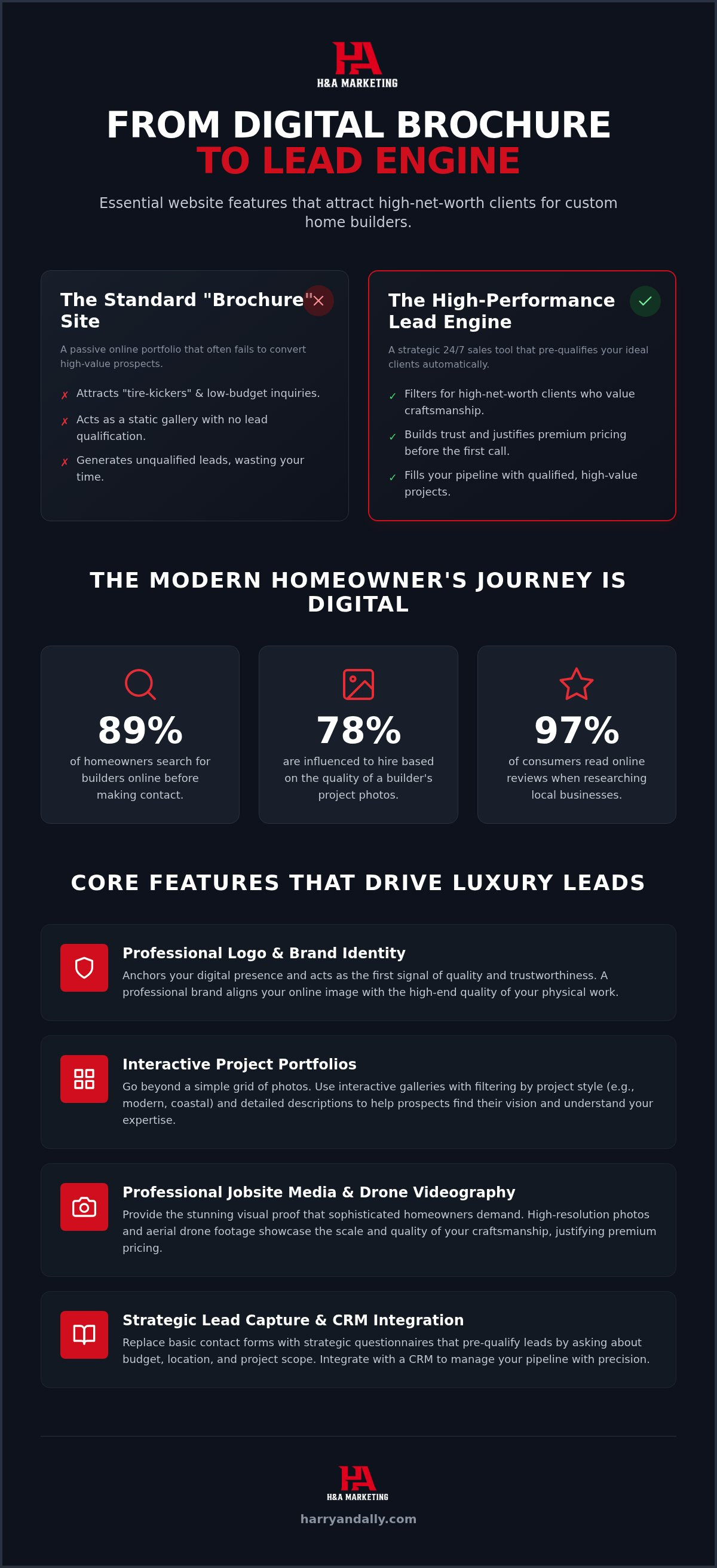
Research shows that 89% of homeowners search for contractors online before they ever pick up the phone, and 78% are influenced to hire specifically by the quality of a builder's project photos. If you're building multi-million dollar estates but your digital presence feels like an afterthought, you're likely leaving your best projects on the table. A standard site often attracts tire-kickers who waste your time, whereas the right custom home builder website features act as a filter to attract high-net-worth clients who value your craftsmanship. You need a site that works as hard as your site supervisor to justify luxury pricing and build trust before the first consultation.
We understand that showcasing complex portfolios and managing a project pipeline is a full-time job. That's why your digital strategy should function as a connected marketing system rather than a static page. In this guide, we'll explore the ten essential elements of high-performance custom home builder website design that transform your brand into a dominant market leader. You'll learn how to implement automated lead capture, professional media displays, and trust-building tools that ensure your website is a lead-generation engine. We'll look at the specific features that bridge the gap between your on-site expertise and your online authority.
Key Takeaways
- Shift your website from a simple digital brochure to a 24/7 sales engine that pre-qualifies high-end prospects before you even pick up the phone.
- Identify the specific custom home builder website features required to showcase luxury craftsmanship and justify premium project pricing.
- Learn how a professional logo and consistent brand identity act as the first signals of quality, anchoring your entire digital presence.
- Discover why professional jobsite media and drone videography are essential for providing the visual proof sophisticated homeowners demand.
- Maximize your conversion rates by integrating strategic lead capture forms with CRM tracking to manage your project pipeline with precision.
Beyond the Digital Brochure: Why Your Website is a Sales Tool
High-ticket construction projects aren't impulse buys. They require months of trust-building before a contract is signed. Your website must function as a 24/7 sales representative that pre-qualifies prospects while you're busy on the jobsite. Most builders view their site as a digital brochure, but this mindset leads to wasted time on low-quality leads. You need to shift the focus to building a lead engine. This requires a deep understanding of the principles of web design, specifically how user experience (UX) reduces friction for high-net-worth individuals who have little patience for clunky interfaces. A professional site builds trust before the first call, acting as an essential extension of your business and justifying your premium pricing.
The High-Ticket Decision Journey
Luxury homeowners conduct extensive online research before they ever make first contact. Research shows that 89% of homeowners search for contractors online, and 46% rely on Google more than any other source. Their journey often starts on a mobile device, where 70% of purchase decisions begin. If your site looks cheap or outdated compared to the homes you build, you've lost the lead before the first call. Generic templates fail to convey the value of custom craftsmanship because they lack the high-fidelity custom home builder website features necessary to showcase complex project details. Your digital presence must align with the physical quality of your work to meet the expectations of sophisticated clients who are looking for a partner, not just a vendor.
Pre-Qualifying Leads Through Content
A successful custom home builder website design strategy prioritizes quality over lead volume. You don't want every inquiry; you want the right ones. By using specific features like detailed project descriptions and process transparency, you can filter out low-budget inquiries and tire-kickers who waste your time. Establishing authority through educational resources and clear project timelines builds confidence in your expertise. Your site should offer a clear "Request a Quote" path that asks the right questions up front, such as budget range and project location. This pre-qualification process ensures that by the time a prospect reaches out, they're already sold on your brand. It transforms your website into a strategic sales tool that manages your project pipeline with precision.
The Core Custom Home Builder Website Features That Drive Luxury Leads
To turn your site into a high-performance lead engine, you must implement specific custom home builder website features that cater to high-net-worth clients. These individuals aren't just looking for a contractor; they're looking for a partner to manage a multi-million dollar investment. Your site must provide the technical sophistication and visual depth that matches your physical craftsmanship. This means moving beyond static images and basic contact forms toward an integrated system that educates, vets, and converts visitors automatically.
Interactive Project Portfolios
High-fidelity imagery is the foundation of a luxury builder's site. However, a simple grid of photos isn't enough. Advanced custom home builder website design utilizes interactive galleries with category filtering. This allows prospects to sort projects by style, such as modern, rustic, or coastal, helping them find their specific vision quickly. Beyond the visuals, every project should include rich metadata. Tagging images with specific materials, architectural styles, and project scopes helps search engines understand your expertise, which is a critical component of a connected marketing system that drives organic traffic.
Testimonials and Social Proof
In high-stakes construction, social proof is the ultimate currency. Research shows that 97% of consumers read online reviews when researching local businesses, and 31% now require a minimum 4.5-star rating before they'll consider a hire. For builders, establishing trust and credibility is paramount. Don't just list quotes on a page. Integrate testimonials directly with project photos to show the human story behind the build. Video testimonials are particularly effective because they're harder to fake and allow potential clients to see the genuine relief and satisfaction of a homeowner who has completed a complex project with your team.
Beyond portfolios and reviews, your site needs functional depth to maintain engagement:
- Interactive "Process" Pages: Map out the journey from dirt to door. This reduces the anxiety of the unknown and positions you as a strategic consultant.
- Mobile-Responsive Design: With 70% of purchase decisions beginning on a smartphone, your site must be fast and flawless on mobile. A poor mobile experience will cause you to lose leads before they ever see your desktop site.
- Integrated Thought Leadership: A blog isn't just for SEO. It's a platform to discuss site management, material selection, and local building trends, establishing you as an industry insider.
If your current digital presence feels like a relic of the past, it may be time to evaluate your website strategy to ensure it's actually working as a sales tool. These features aren't just ornaments; they are the functional components of a system designed to justify your pricing and secure your next big contract.
Why a Professional Logo for Contractors Anchors Your Online Presence
Your logo is often the first signal of your attention to detail. If you're building multi-million dollar estates but your branding looks like a budget clip-art purchase, you create immediate cognitive dissonance for the prospect. A professional logo for contractors serves as the visual anchor for your entire digital presence. It's the foundation upon which the rest of your marketing system is built. This isn't just about brand recognition; it's about establishing a standard of quality that justifies your premium project fees from the very first second a visitor lands on your site.
The Psychology of Luxury Branding
Luxury branding relies on minimalism, restraint, and sophisticated composition. While general contractors often rely on "truck-and-hammer" clichés, custom home builders must project an image of architectural expertise and precision. A clean, modern mark suggests that you understand high-end design and complex site management. This visual differentiation is vital to separate your business from "chuck-in-a-truck" competitors who compete on price rather than craftsmanship. Investing in professional construction branding services ensures your visual identity matches the high-end nature of your physical projects, building trust before the first consultation call.
Visual Identity Beyond the Icon
A logo is more than just a standalone symbol. It dictates the color palette, typography, and overall aesthetic for your entire website. When we develop specific custom home builder website features, we use the logo's visual language to inform the layout, button styles, and use of white space. This creates a cohesive user experience that feels intentional and high-end. Consistency across the jobsite, business cards, and the digital header reinforces your reliability as a builder. If your branding is disciplined, prospects assume your project management will be as well.
Perception is reality in the luxury market. A well-designed visual identity increases the perceived value of your services. It signals that you are an industry insider who values professional execution in every facet of business. Your logo must also be technically versatile, scaling perfectly from a tiny browser favicon to a massive jobsite banner without losing clarity. This level of detail is a hallmark of professional design and is essential for maintaining a dominant presence in a competitive local market. By coordinating your branding with your digital strategy, you create a seamless narrative of quality that follows the homeowner throughout their entire decision journey.
Showcasing Craftsmanship: High-Performance Portfolios and Jobsite Media
Stock photos are a death sentence for custom builders. If a prospect sees a kitchen on your site that they've seen on five other contractor sites, your credibility vanishes instantly. Original, high-fidelity media is one of the most critical custom home builder website features. It proves you can actually execute what you promise. Research shows that 78% of homeowners were influenced to hire a contractor specifically because of the before-and-after photos in their website portfolio. High-net-worth clients expect to see your specific work, not a generic representation of it.
The Power of Video and Drone Footage
Drone videography isn't just a luxury gimmick. It's the only way to capture the full scope of a custom estate and the surrounding property. It allows potential clients to see your site management and architectural scale in a way a static ground shot cannot. Time-lapse videos are another high-conversion feature that showcases the entire building process from excavation to final walkthrough. This demonstrates your project management skills and jobsite discipline. Utilizing professional video and photo for builders tells the story of the build, humanizing the process for homeowners who are about to embark on a long, complex journey.
High-Fidelity Project Galleries
Structure your galleries to serve the homeowner's decision journey. Organize by room type or architectural style so prospects can find relevant inspiration quickly. Don't just post pictures; add descriptions that highlight specific materials, engineering challenges, or unique client requests. This provides context and boosts your authority. Every image must be optimized for speed while maintaining luxury quality. Using descriptive alt-text ensures your visual assets contribute to your organic search rankings.
"In-progress" media is a powerful trust signal that many builders overlook. It shows a clean jobsite, organized materials, and a safe working environment. High-end clients value order. Showing that your sites are well-managed during the messiest phases of construction builds a level of confidence that a finished gallery alone cannot achieve. It proves you respect the property and the process as much as the final product. This transparency is what separates a professional firm from a standard contractor.
Book a professional jobsite media shoot
Converting Clicks to Contracts: Lead Capture and CRM Integration
A beautiful portfolio and a sharp logo are essential prerequisites, but they don't sign contracts. Your website must be a conversion machine. Many builders fail because they rely on a single, buried contact page that prospects never find. To capture luxury leads, you need a system that meets prospects where they are in their research phase. This is where strategic custom home builder website features like integrated lead capture and CRM synchronization become your most valuable business assets. These tools bridge the gap between a casual visitor and a signed contract.
Strategic Lead Capture Points
Don't force a "Request a Quote" button before a visitor has seen your work. Place CTAs naturally at the end of project galleries or process descriptions where interest is at its peak. For those early in the decision journey, use gated content like a "Custom Build Planning Guide" to capture information from prospects who aren't ready for a call but are clearly in the market. Implementing lead generation for construction requires a nuanced approach that respects the homeowner's pace. Multi-step forms are particularly effective; they allow you to gather project location and budget details without overwhelming the user with a wall of text.
The Role of CRM in Construction Sales
A website inquiry is just the start of a long-cycle sales process. If that lead sits in an email inbox for three days, you've likely lost the project. Research shows that 78% of customers hire the company that responds to their inquiry first. A connected marketing system links your custom home builder website design directly to a CRM, automating the transition from inquiry to project estimate. This ensures every lead is tracked, assigned, and acknowledged immediately. It removes the human error that often plagues busy construction firms.
Tracking lead sources allows you to measure exactly which marketing efforts drive the highest ROI. Automated follow-up sequences keep your brand top-of-mind during the months of deliberation that often precede a custom build. By coordinating your site with a back-end system, you eliminate the risk of leads falling through the cracks. This level of automation doesn't just save you time; it projects a level of professional organization that high-net-worth clients expect. When your digital systems are as disciplined as your jobsites, you build the trust necessary to close high-ticket contracts.
Building Your Digital Sales Engine
Your website should be the strongest member of your sales team. It's the first place sophisticated homeowners look to verify your expertise and the last place they go before signing a multi-million dollar contract. By implementing these essential custom home builder website features, you transform a generic page into a high-conversion engine. High-fidelity project galleries and drone footage provide the visual proof required for luxury projects, while professional branding sets the tone for a disciplined build process.
Coordinating your strategy, creative, and lead capture into a connected marketing system removes the friction from the homeowner decision journey. This approach allows you to focus on the jobsite while your digital presence handles pre-qualification and nurturing. H&A Marketing specializes in luxury custom home builder growth, acting as an extension of your team to ensure your marketing is as precise as your craftsmanship.
Request a free marketing audit for your construction business
Aligning your digital presence with your physical craftsmanship isn't just a marketing upgrade; it's a business necessity. We're ready to help you build a system that reflects the true value of your work and secures your project pipeline for years to come.
Frequently Asked Questions
What features does a custom home builder website need to be successful?
A successful site requires a combination of visual proof and technical functionality. Essential custom home builder website features include high-resolution project galleries with category filtering, integrated client testimonials, and a mobile-responsive design. You also need a connected marketing system that links your site to a CRM for automated lead capture. These elements work together to build trust and justify luxury pricing before you ever have a discovery call.
How much does a professional logo for contractors cost?
We provide fixed-price packages for logo creation and visual identity development rather than variable hourly rates. Professional branding is an investment in your company's perceived value and attention to detail. A high-end logo sets the color palette and typography for your entire digital presence. This ensures your brand looks as professional on a jobsite banner as it does on a smartphone screen, helping you stand out from budget-focused competitors.
Should I use stock photos on my construction website?
You should avoid stock photos whenever possible. Original photography is non-negotiable for custom builders because 78% of homeowners are influenced to hire specifically by the quality of a builder's own project photos. Stock images create a generic impression that can damage credibility in the luxury market. Using real jobsite media and professional drone footage proves you can execute complex designs, providing the authentic visual proof that sophisticated clients demand.
How do I optimize my builder portfolio for search engines?
Optimization starts with descriptive alt-text and high-quality metadata for every image. You should tag photos with specific architectural styles, materials used, and project scopes to help search engines understand your expertise. Organizing your portfolio by room type or project style also improves the user experience. Fast loading times are equally important; your high-fidelity assets must be optimized so they don't slow down the mobile research phase for potential clients.
Is a CRM necessary for a custom home building business?
A CRM is essential for managing the long sales cycles typical of custom home building. It automates the transition from a website inquiry to a project estimate, ensuring you respond to leads immediately. Since 78% of customers hire the company that responds first, this automation provides a significant competitive advantage. It also allows you to track lead sources and measure the ROI of your marketing efforts without manual data entry.
What is the best way to showcase luxury homes on a website?
The most effective way to showcase luxury craftsmanship is through professional video production and drone videography. Drone shots capture the full architectural scale of a custom estate in ways static photos cannot. You should also use interactive galleries that allow users to filter by style or room type. This guided experience helps high-net-worth individuals find their specific vision quickly, keeping them engaged with your brand for longer periods.
How can I make my construction website generate more high-quality leads?
High-quality leads come from pre-qualifying prospects through multi-step forms. Instead of a basic contact page, use forms that ask for project location and budget ranges. This filters out tire-kickers and ensures you only spend time on serious inquiries. Strategic placement of Call-to-Action buttons at the end of project descriptions also helps. Providing educational resources, like custom build planning guides, can capture early-stage leads who aren't quite ready for a call.
How often should a home builder update their website features?
You should update your website media as soon as projects are completed to keep your portfolio fresh. From a technical standpoint, you should review your site features at least annually to ensure compliance with the latest accessibility standards, like WCAG 2.1 Level AA. Mobile performance and loading speeds should be monitored continuously. Regular updates to your blog or project descriptions also help maintain your search engine authority and demonstrate that your business is active.
