
Builder Referral Marketing to Win High-End Clients

Article by
Harry Stanley III
Harry Stanley III is a construction marketing strategist and fractional CMO at H&A Marketing. He has helped construction companies grow through website strategy, SEO, paid advertising, branding, lead generation, CRM systems, and professional content. His past work includes helping Meraki Solar generate an additional $3.7 million in revenue in his first year and supporting American Builders as a fractional CMO. Today, Harry works directly with custom home builders and construction companies to build marketing systems designed to generate qualified leads and measurable growth.
More referral requests won’t fix an unpredictable pipeline if past clients and professional partners don’t know when or how to introduce the right prospect. Effective custom home builder referral marketing starts with a strong client experience and a clear, natural path to make that introduction.
Referrals are valuable for custom builders, but they can be difficult to forecast. A happy homeowner may not think to recommend you, and a promising introduction can lose momentum if your team doesn’t acknowledge it or follow up. The answer isn’t to pressure people to send more names. It’s to make referrals easy to give and easy to handle.
This guide shows you how to build a practical referral system for past clients and complementary professionals. You’ll learn how to invite introductions without making them awkward, respond promptly and professionally, and track whether referrals become qualified project opportunities. Clear project information, a strong portfolio, and consistent marketing can also support trust before and after an introduction, so referrals work alongside a steadier growth system.
Key Takeaways
- Build custom home builder referral marketing around qualified project introductions, not simply a higher volume of names.
- Use natural project milestones to invite introductions without disrupting active construction or the client relationship.
- Choose referral appreciation that fits your brand, client expectations, and project economics.
- Set up a simple process to identify advocates, make introductions easy, and assign clear follow-up.
- Track referral source, project fit, next action, and sales progress to understand which introductions are worth pursuing.
Why Custom Home Builder Referral Marketing Needs More Than Word of Mouth
Word of mouth can make your name familiar. Referral marketing gives that trust a next step. For a custom builder, it’s the deliberate process of creating a positive client experience, making it easy for someone to introduce a prospective homeowner, and responding in a way that moves the conversation forward.
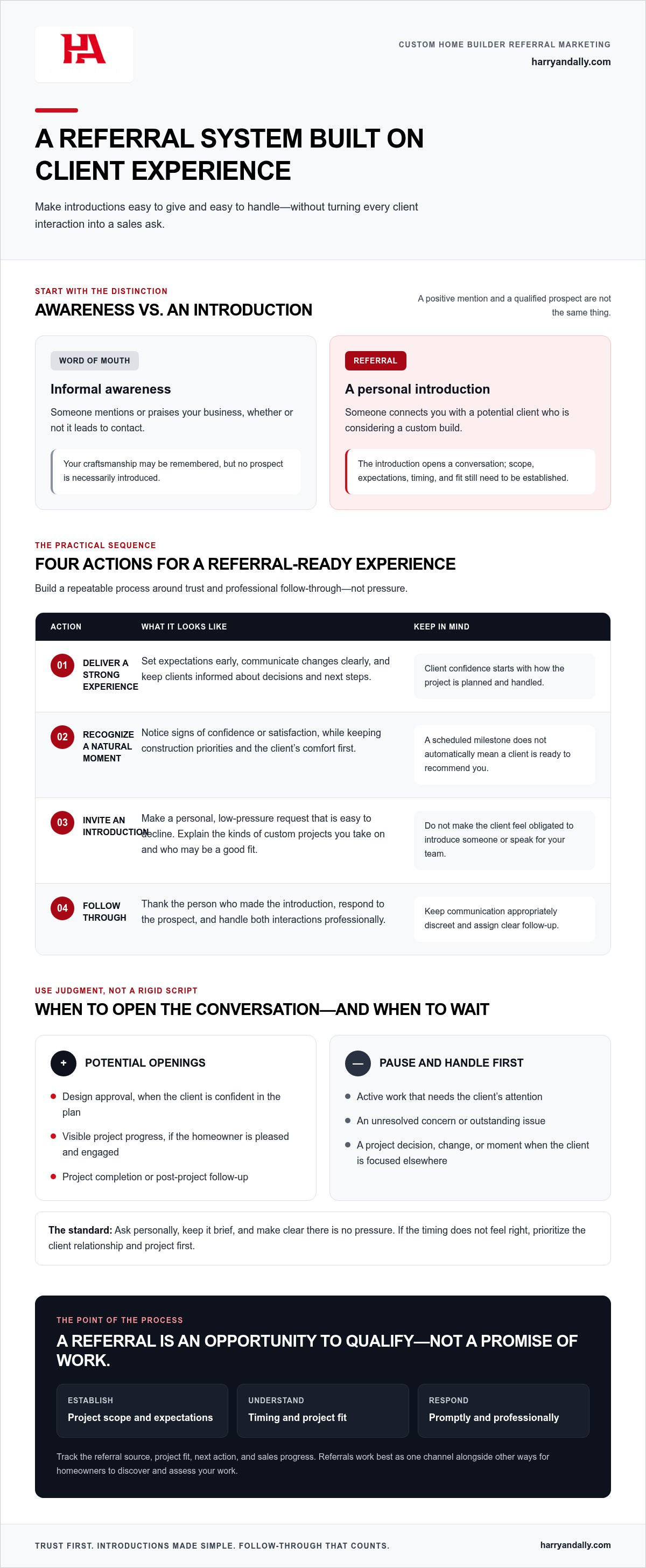
A referral is a personal introduction to a potential client, while word-of-mouth awareness is any informal mention of your business, whether or not it leads to contact. That distinction matters. Someone might praise your craftsmanship at a gathering, but a qualified introduction connects you with a homeowner who is actively considering a custom build and has a project that may fit your work.
What referral marketing means for a custom home builder
The path usually starts with a homeowner’s experience of planning, communication, and construction. When that experience earns their confidence, they may introduce you to a friend, colleague, or family member considering a similar project. The introduction opens the door, but a conversation still needs to establish scope, expectations, timing, and fit.
This differs from an inquiry through search or paid advertising. A referred prospect arrives with context from the person making the introduction. A search or ad inquiry usually begins with the homeowner finding your business while researching options. Neither source guarantees a good fit, a signed contract, or a smooth sales process. Treat each as an opportunity to qualify, not a promise of work.
The broader idea behind Referral Marketing is using recommendations to encourage new business. For builders, the practical test is whether an introduction leads to a useful conversation, not simply whether someone passes along your name.
Why referrals can be valuable, and why they are not a complete pipeline
A custom home is a high-trust decision. Prospective clients are choosing a partner for a complex, personal project, so a recommendation from someone they trust can help your company earn a place on their shortlist. But that introduction is only one part of their decision. Homeowners may still review your portfolio, compare your approach, and look for clear information about the kinds of projects you take on.
Referrals also arrive on someone else’s schedule. A past client may be delighted with the finished home but know no one ready to build. A professional contact might make an introduction months after a homeowner first started researching. If your pipeline depends on a small circle of advocates, quiet periods can leave you with little visibility into what may come next.
That’s why custom home builder referral marketing works best as one channel in a broader, measurable approach. Connect referrals to project fit and sales progress while maintaining other ways for homeowners to discover and assess your work. A coordinated marketing approach can help you understand how referrals fit alongside other sources of qualified opportunities.
Build a Custom Home Builder Referral System Around Client Experience
A referral-ready client experience gives homeowners clear expectations, consistent communication, and confidence in how their project is being handled, without assuming they’ll make an introduction. That experience is the foundation. A repeatable process helps your team recognize when a referral conversation feels appropriate and handle any introduction professionally.
Build that process around four actions:
- Deliver a strong experience. Set expectations early, communicate changes clearly, and keep clients informed about decisions and next steps.
- Recognize a natural moment. Look for signs of confidence or satisfaction, while keeping construction priorities and the client’s comfort first.
- Invite an introduction. Make a personal, low-pressure request that’s easy to decline. Don’t frame it as an obligation.
- Follow through. Thank the person who made the introduction, respond to the prospect, and keep both interactions professional and appropriately discreet.
This sequence gives custom home builder referral marketing structure without turning every client interaction into a sales ask. The point is to be prepared, not persistent.
Find referral moments across the homeowner journey
Timing matters. Design approval may be a natural moment to acknowledge a client’s confidence in the plan, while visible progress can prompt a conversation if the homeowner is pleased and engaged. Project completion and post-project follow-up may also offer an opening. Avoid interrupting active work or raising referrals during unresolved concerns. Ask personally, keep it brief, and make clear that there’s no pressure.
Use judgment rather than a rigid script. A milestone on the schedule doesn’t automatically mean the client is ready to recommend you. Pay attention to the relationship and the project context. If the client is focused on a decision, a change, or an outstanding issue, handle that first and revisit the conversation only if it later feels appropriate.
Make introductions easy for clients and partners
Give advocates a simple way to describe your work: the kinds of custom projects you take on, what your process generally involves, and which homeowners are likely to be a good fit. For example, a past client should be able to explain whether you focus on custom builds rather than renovations, without having to speak for your team or promise a particular outcome.
Then provide a clear destination, such as a relevant project page or contact form, where a prospect can share basic project information. Keep the next step clear and make sure the team knows who will respond. A well-organized lead intake process can connect introductions with useful inquiry details and a defined follow-up. The advocate makes the connection, and your team takes it from there.
Referral Incentives or Relationship-Building: Choose What Fits Your Builder Brand
A referral approach sends a message about your company. A formal reward can show appreciation in a clear, structured way. A personal thank-you can keep the relationship at the center. Neither approach is right for every builder. Choose one that fits your brand, suits client expectations, and makes sense for the economics of high-value projects.
Don’t judge the program by introductions alone. A contact who isn’t planning a suitable project is different from a prospect whose goals and expectations align with your work. Track whether referrals fit your project type and lead to a real conversation, not just how many names come in.
When a formal referral reward program may fit
A reward program may suit a builder who wants a consistent way to recognize introductions. Keep the terms easy to understand and explain them before someone participates. Define what counts as an introduction, how your team will acknowledge it, and when recognition takes place. Avoid language that suggests a reward guarantees a project or gives the referring person control over your sales process.
Before launching, consider the administrative work: someone must communicate the terms, record the source, and make sure recognition happens as described. If the process is hard to explain or manage, it may create more friction than value. Keep the focus on clarity and appreciation, not on prompting clients to recommend you regardless of fit.
When personal recognition may better protect trust
For a relationship-led builder, a sincere thank-you may feel more natural than a formal incentive. Be specific about appreciating the introduction, and follow up in a way that respects the client’s privacy. Depending on the relationship, that could mean a personal note or an appropriate project update. Don’t share details about the prospect without permission.
Every touchpoint shapes how people experience your business. Consistent language, visuals, and communication help appreciation feel like an extension of your company, not a disconnected marketing tactic. A clear brand identity can support a consistent experience across referral conversations and other client interactions.
Use this comparison to choose a starting point, then assess the quality of the conversations it supports:
| Approach | Client experience | Administrative effort | Potential fit |
|---|---|---|---|
| Direct reward | Clear, tangible recognition | Requires defined terms and consistent tracking | Builders comfortable with a formal program |
| Personal recognition | Direct and relationship-focused | Requires thoughtful, timely follow-through | Builders who value personal client relationships |
| Relationship-first appreciation | Ongoing, without tying thanks to a reward | Requires consistent communication over time | Builders focused on long-term client and partner trust |
Whichever approach you choose, evaluate referral quality in stages: introduction received, project fit reviewed, conversation started, and opportunity progressed. That keeps custom home builder referral marketing grounded in business value and trust, rather than rewarding activity that may never align with your work.
How to Launch and Measure Custom Home Builder Referral Marketing
A referral process only works if your team can keep it moving. Start with a clear picture of the projects you want, then make sure every introduction has an owner, a recorded source, and a defined next step. This keeps custom home builder referral marketing focused on suitable opportunities rather than a rising count of names.
- Define ideal projects. Note the project types, scope, and client expectations that align with your work.
- Map potential advocates. Identify past clients and professional partners who understand your approach and may know homeowners planning a compatible project.
- Create the introduction path. Give advocates a simple way to connect a prospect with your team and share relevant context.
- Assign follow-up. Decide who acknowledges the introduction, records it, and keeps the conversation moving.
Set up a referral process the team can maintain
Name one person responsible for acknowledging introductions and logging their source, even if other team members handle later conversations. Use a short intake prompt to capture the referrer, relationship, project type, what the prospect is considering, and the next action. Keep the response process consistent, but make each message personal. A referred homeowner should hear that you understand why you were connected, not receive a generic reply.
Follow-up may extend across a longer decision process. Record the agreed next step and when the team should revisit the conversation, rather than treating silence as a closed opportunity. For broader context on keeping prospects engaged, see this guide to lead generation for construction companies.
Measure referral quality without invented benchmarks
Track the stages separately: introduction received, project fit reviewed, qualified conversation, consultation, proposal, and signed project. These stages show where opportunities progress or stall. An introduction that doesn’t match your work still counts as an introduction, but it shouldn’t be treated as equivalent to a qualified conversation or a project moving forward.
For each referral, record the source, fit, next action, and current stage. Over time, compare sources using your own history. Past clients may introduce homeowners with one kind of project; a design professional may connect you with another. Look for patterns in fit and progression, not a universal benchmark. Review whether introductions receive timely acknowledgment and whether the team completes its next actions.
Use what you learn to refine the process. If introductions often lack useful context, improve the guidance advocates receive. If conversations stall after the first contact, review the follow-up steps. Place referrals alongside other channels in your reporting to understand how each contributes to qualified opportunities. For a wider view of construction lead generation, compare referral activity with the other ways prospects find and evaluate your business.
For a practical discussion of tracking leads, see H&A Marketing’s lead tracking approach for construction businesses.
Connect Referrals to a Stronger Marketing System With H&A
A referral introduces a builder, but the homeowner still needs to understand the company behind the recommendation. Clear branding, relevant project content, useful website information, and a straightforward way to get in touch help carry the introduction into the next step. Each piece should reinforce the same message: what kind of work you do, how you approach it, and what a prospective client can expect from an initial conversation.
Give referred homeowners a clear next step
Make your website the place an introduced prospect can quickly assess fit. A focused page can explain your process, show projects that reflect your work, and point to a clear contact path. Strong project photos or video add context to the recommendation, while consistent branding helps the experience feel connected from the introduction onward. A well-planned construction web design experience can make those details easier for prospects to find.
That clarity matters for premium projects. A prospect may want to compare the style, scale, and level of customization in your portfolio before deciding whether to reach out. Keep project descriptions accurate and specific, and make the next step easy to understand without suggesting that every inquiry is a fit.
Coordinate referral activity with the rest of the pipeline
Referral introductions shouldn’t sit apart from other marketing activity. Record where a prospect came from, capture the information your team needs, and connect it to follow-up. This gives you a way to see how referrals progress while keeping the personal context that came with the introduction.
H&A Marketing’s connected marketing system coordinates strategy, creative, traffic, and lead capture across construction-focused marketing. For custom home builder referral marketing, that can mean aligning brand messaging and project visuals with website design, SEO, social media management, and lead generation. Referrals remain personal, while the surrounding system helps prospects find useful information and gives your team a consistent way to manage incoming interest.
SEO can help homeowners discover your work while researching builders. Social media can support a consistent presence, while project photos and video give referred and non-referred prospects a clearer view of your work. When your website, content, and lead capture work together, you can review more than inquiry volume: you can see which prospects fit your projects and how opportunities progress.
A referral system doesn’t replace the rest of your marketing. It works best when the experience after an introduction is as clear and professional as the recommendation itself. If you’re ready to discuss how your marketing channels can work together, request a free quote from H&A Marketing.
Make Your Next Referral Introduction Easier to Act On
Choose one improvement to put into practice next: clarify which projects are the right fit, make it easier for advocates to connect prospects with your team, or tighten how you track introductions. A small, well-owned step gives your referral process direction without turning genuine relationships into a campaign.
Custom home builder referral marketing can support growth, but it shouldn’t have to carry the whole pipeline. H&A Marketing provides digital marketing services for construction companies, helping builders coordinate the way their brand, website, content, and lead generation support business goals.
If you’re ready to consider how that could work for your construction business, start with a conversation about your priorities and where your current marketing needs better coordination.
A clear next step can turn good intentions into steady progress. Keep building on what already works.
Frequently Asked Questions
Is referral marketing effective for custom home builders?
It can be an effective source of qualified conversations when introductions match the builder’s project type and client expectations. For custom home builder referral marketing, effectiveness isn’t measured by recommendations alone. Review whether referred homeowners are actively considering a build, understand your approach, and progress to a meaningful discussion. A referral can open the door, but clear information and a good fit still matter as the homeowner evaluates their options.
Can a custom home builder generate referrals without offering a reward?
Yes. A builder can encourage introductions through a good client relationship and thoughtful, personal appreciation without tying thanks to a reward. For example, after a past client connects you with a prospective homeowner, thank them directly and acknowledge the time they took to make the connection. Keep appreciation genuine and proportionate. The goal is to respect the relationship, not create an expectation that every recommendation earns something.
When should a builder ask a client for a referral?
Ask when the client’s experience and the conversation suggest they’re comfortable recommending your work, not simply because a calendar reminder says it’s time. If a homeowner says they’re pleased with the design process, that may create a natural opening. If they’re waiting on answers or dealing with a concern, focus on resolving it. A referral request should feel optional and never take priority over the client’s project.
What should a custom home builder track in a referral program?
Track who made the introduction, the prospect’s project goals, how well the project fits your work, and what action the team takes next. Also record the opportunity’s stage, such as first conversation, consultation, proposal, or signed project. This helps distinguish a name shared in passing from a viable opportunity. Keep notes factual and useful for follow-up, and limit access to information to the team members handling the inquiry.
How do you make a referral program feel genuine rather than transactional?
Make the relationship more important than the referral count. Don’t bring up introductions in every client interaction or make appreciation sound conditional on winning a project. Thank people for connecting you, even if the prospect isn’t the right fit, and avoid putting pressure on them to persuade someone. A genuine program gives advocates accurate language about your work and lets them decide whether an introduction feels appropriate.
Are referrals enough to keep a custom home builder’s pipeline full?
Usually, referrals alone are difficult to plan around because introductions depend on when clients and professional contacts know someone considering a build. A builder can complement referrals with channels that help homeowners discover and assess the business during their own research, such as search visibility and a clear project portfolio. Track each source and the quality of its opportunities. That gives you a more grounded view of pipeline activity than relying on introductions alone.
