
Commercial Roof Restoration Marketing: How to Fill Your Pipeline

Article by
Harry Stanley III
Harry Stanley III is a construction marketing strategist and fractional CMO at H&A Marketing. He has helped construction companies grow through website strategy, SEO, paid advertising, branding, lead generation, CRM systems, and professional content. His past work includes helping Meraki Solar generate an additional $3.7 million in revenue in his first year and supporting American Builders as a fractional CMO. Today, Harry works directly with custom home builders and construction companies to build marketing systems designed to generate qualified leads and measurable growth.
A full pipeline takes more than a steady stream of referrals. Commercial roof restoration marketing works when useful educational content, a credible website, and a strong reputation help facility managers and property owners understand why your company is worth considering. Together, these elements can turn early research into qualified conversations about restoration and replacement projects.
Commercial roofing decisions aren’t made on impulse. Prospects want confidence that you understand their building’s needs, can explain their options clearly, and have the experience to do the work. Your marketing should address those concerns before they’re ready to request a proposal.
Build that confidence with content that answers real roof restoration questions, a website that earns trust and makes the next step clear, and customer feedback and project examples that strengthen your reputation. When these pieces work together, they can support better-qualified leads, consistent follow-up, and a healthier sales pipeline.
Key Takeaways
- Create educational content that helps facility managers understand roof conditions, restoration options, and when replacement may make more sense.
- Make your website clear, credible, and easy to use so prospects can quickly assess your commercial roofing expertise and take the next step.
- Compare restoration and replacement by considering roof condition, project disruption, and the needs of the building, not just the initial scope.
- Build a consistent pipeline by pairing targeted outreach with a clear process for tracking prospects and following up.
- Connect search visibility, useful content, and a strong online reputation to attract better-fit restoration and replacement opportunities.
1. Educational content and thought leadership
Commercial roofing prospects need more than a claim that restoration saves money. They need clear information about roof condition, possible options, and questions to raise before approving a project. Useful educational content shows facility managers how your business approaches the work, not just what it installs.
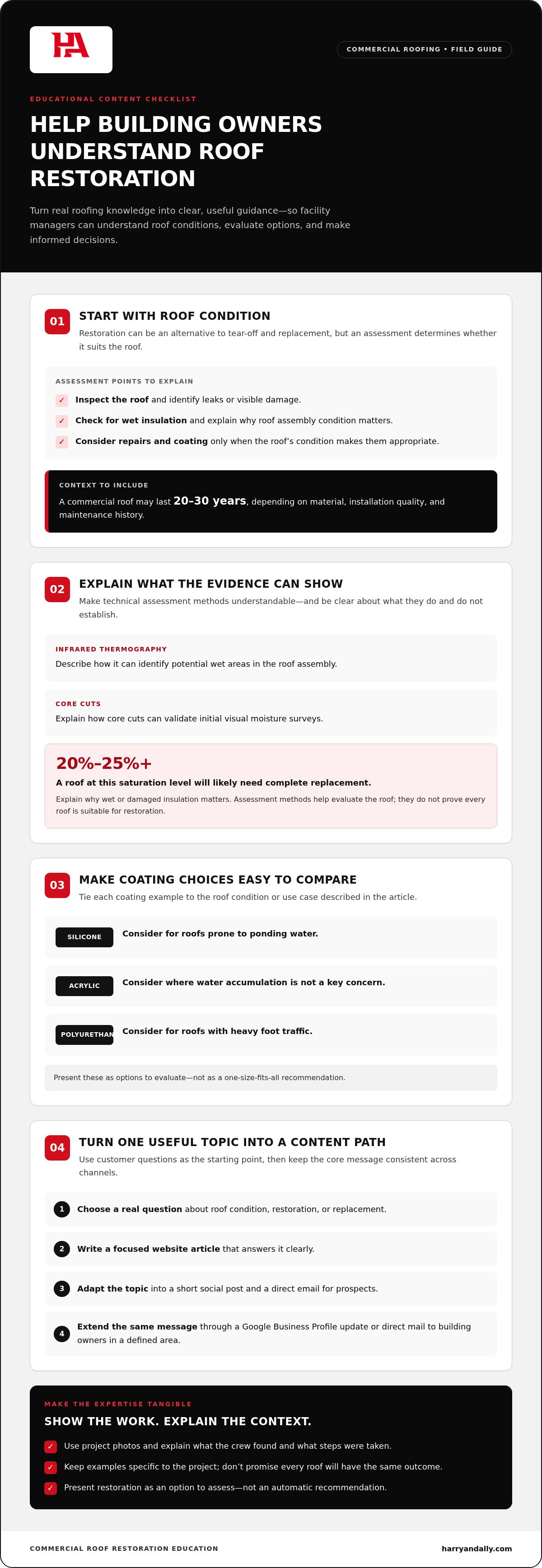
Start with the decision behind the search. A commercial roof may last 20 to 30 years, depending on material, installation quality, and maintenance history. Explain that restoration can be an alternative to tear-off and replacement, but the roof’s condition affects whether it’s suitable. A simple article could walk through the assessment: inspect the roof, identify leaks or damage, check for wet insulation, and determine whether repairs and coating make sense.
Use specific examples to make technical topics easier to understand. A post about recurring leaks can explain why repeated repairs may mean replacement deserves consideration. Another can describe how infrared thermography identifies potential wet areas and how core cuts can validate initial visual moisture surveys. Make clear that these are assessment methods, not proof that every roof is suitable for restoration.
Roof condition also creates useful content angles. A commercial roof that is 20%-25% saturated or more will likely need complete replacement. Explain why wet or damaged insulation matters, and show how visual and nondestructive testing help contractors assess the assembly. For coating education, compare silicone for roofs prone to ponding water, acrylic where water accumulation is not a key concern, and polyurethane for roofs with heavy foot traffic.
Turn each article into a practical content path. Use customer questions as keywords, then create a focused website article, a short social post, and a direct email for prospects. A Google Business Profile update can point readers to an assessment checklist. Direct mail can introduce the same topic to building owners in a defined area. Keep the message consistent across digital and offline channels, with details relevant to facility managers and their buildings.
Thought leadership works best when it reflects real roofing experience. Share project photos with context, explain what the crew found, and describe the steps taken without promising every roof will have the same outcome. Weather damage can deteriorate a roof’s surface coating, according to the U.S. Bureau of Labor Statistics. For a cohesive plan to connect educational content with prospect outreach, explore commercial roofing marketing.
Keep educational content tied to the roof’s actual condition. Commercial roof restoration can be an alternative to a full tear-off and replacement, but an assessment is needed to determine whether it’s suitable. Explain that restoration is an option to evaluate, not an automatic recommendation. Clear, measured information helps facility managers consider their next steps.
The Launch plan includes monthly blog content of 800 words. That format can give a business room to explain the assessment question in a focused article, clarify why suitability matters, and support a consistent educational voice. Keep the central point direct: restoration may be considered, but an assessment determines whether it fits the roof. This helps the content stay informative without suggesting that one solution applies to every building.
2. Commercial roofer website and reputation foundations
A commercial roofing website should help building owners decide what to do next. Make restoration, replacement, coatings, and inspection services easy to find. Give each service its own clear page with the process, project examples, and a direct inquiry option. Visitors should quickly understand which buildings and roofing needs you handle.
Speed matters, too. A roofing company website should load in under 3 seconds on desktop and mobile devices. Keep pages focused, compress large photos, and test inquiry forms on phones. If a prospect can’t view project photos or submit details easily, a slow page creates friction before your team can respond.
Organize the site around the questions owners ask during a project. A restoration page, for example, can explain how an inspection informs the scope, which coatings may be considered, and how the proposal is organized. A replacement page can outline the steps from the first conversation to project planning. Avoid implying that every roof needs the same solution.
Use authentic photos to make the work tangible. Show a finished roof, relevant details, and crews following an organized jobsite process. Add brief captions identifying the project type and work performed. Specific images and descriptions give visitors more context than generic stock photos and help them connect your commercial roofing experience to their building.
Your Google Business Profile is another reputation touchpoint. Keep the business name, phone number, service descriptions, and hours consistent with your website. Add recent project photos and answer common questions in plain language. Roofing companies are advised to respond to every customer review within 48 hours. A concise reply should acknowledge the reviewer and address their specific feedback professionally.
Trust can affect which company gets considered. Nearly 40% of people searching for local services choose the first business they view as trustworthy. Make trust visible with clear contact details, relevant project examples, and specific descriptions of your inspection and follow-up process. Don’t rely on broad claims like “best quality”; show what your team does.
Give every inquiry a trackable path. Record its source, building type, requested service, next action, and follow-up date. Distinguish a coating inquiry from a replacement request, for example, and note whether an inspection or proposal is pending. This helps you see where advertising generates conversations and where prospects stall.
When website design, project photos, and lead tracking need a more cohesive strategy, explore commercial roofing marketing as a connected way to strengthen your online presence.
3. How does roof restoration compare with roof replacement in cost, lifespan, and downtime?
Restoration and replacement involve different scopes, so compare the work included, not just the proposal total. Restoration involves repairing localized leaks or damage before applying a protective coating. Replacement removes the existing roof system and installs a new one. The right comparison starts with the roof’s condition, insulation, and repair history.
Restoration can avoid a full tear-off when the assembly is structurally sound and has no wet or damaged insulation. The scope may involve fewer removal tasks, but repairs, preparation, coating choice, and access still affect project cost. Replacement has a broader scope that includes roof removal and installation. Before comparing totals, review each proposal’s included work, exclusions, disposal, and repair allowances.
Neither option has a useful lifespan figure without considering the roof system and its condition. Commercial roofs can last 20 to 30 years, depending on material, installation quality, and maintenance history. Restoration doesn’t make underlying damage disappear. Ask how the assessment addresses moisture, existing repairs, and future maintenance. A replacement also needs sound installation and an appropriate maintenance plan to support its service life.
Downtime depends on the work sequence and weather. Restoration generally leaves the existing system in place while crews repair areas and apply coating. Replacement includes tear-off and installation, which can mean more activity around the building. For an occupied facility, discuss access, noise, material staging, tenant operations, and protection of interior spaces before work begins.
Coating cure conditions also matter to scheduling. Silicone restoration products typically need 45 minutes before they can get wet. Acrylic restoration material needs 24 to 48 hours before it can get wet. These intervals affect when crews can proceed around weather exposure. Include the selected coating’s cure requirements and the project sequence in the restoration schedule.
Roof condition sets the boundary. A commercial roof with 20%-25% saturation or more will likely need complete replacement. Recurring leaks that repairs cannot resolve also point toward replacement rather than another coating cycle. Infrared thermography can locate potential wet areas, while core cutting can validate an initial visual moisture survey. Those findings help explain why a proposed restoration or replacement fits the building.
In most cases, building codes limit a structure to no more than two existing roof systems. This can affect whether another roof layer is an option. Compare restoration and replacement based on inspection findings, scope, coating cure time, disruption, and long-term maintenance needs, rather than assuming one option has a cost or lifespan advantage.
Building owners should compare the work and expected disruption against the condition findings, rather than letting a promotion decide the scope. When partnering with H&A Marketing, contractors learn to position their services effectively so that clients understand the true value behind each proposal detail and verification of required work.
Where foot traffic is heavy, polyurethane roof coatings can be suitable because they offer impact resistance. Ask whether the proposed coating matches how the roof is used, and compare it with the repair and replacement scopes.
4. Roofing marketing
Commercial roofing marketing works best when each channel targets a defined buyer and project need. A building owner considering restoration needs different information from a facility manager planning replacement. Choose the audience, service, and next action for each campaign. Then track qualified inquiries, inspections, proposals, and closed work, not just clicks. A commercial roof restoration marketing strategy should connect outreach to projects your crews can deliver.
Pay-per-click advertising can reach prospects actively searching for roofing contractors. Create separate campaigns for restoration, roof coating, and replacement. Send each ad to a matching page with a relevant call to action. Treat this as a planning approach, then compare actual revenue and lead quality with campaign spending.
Direct mail can reach building owners and key contacts in a defined area. Commercial roofing campaigns typically send thousands of mail pieces to targeted prospects in a selected area. Make each piece specific, such as an invitation to discuss restoration planning or roof replacement. A campaign may pay for itself if it generates one large job, but tracking responses is essential. Use a dedicated phone number or inquiry method to attribute each conversation.
Timing can give outreach a practical hook. Roofing companies are advised to send seasonal promotions in early spring and early fall. Spring repair specials are advised for February or March, before the busy season starts. Tie the message to a specific service and follow-up plan, not an unsupported promise. Record who responded, which property they manage, and whether an inspection or proposal followed.
Telemarketing can start conversations with owners who haven’t submitted an online inquiry. Experienced phone marketers tend to be more successful, and they should know roofing well enough to answer prospects’ questions. Prepare a concise script about restoration and replacement. Train callers to capture the building’s concerns and decision process. Dedicated follow-up and tracking help nurture early conversations instead of letting them get lost.
Keep the message consistent across channels. Whether prospects receive direct mail, see a search ad, or speak with a caller, they should encounter the same service focus and next step. Route each response through an intake process that records its source, requested work, and follow-up status. Review that information regularly. If calls generate inquiries but few inspections, refine qualification and scheduling before expanding the campaign.
A strong plan aligns audience, message, channel, and measurement. Connect outreach to qualified restoration and replacement opportunities through commercial roofing marketing, then adjust campaigns based on pipeline activity.
5. Digital marketing
More than 90% of people searching for local services begin online. Commercial roofing contractors can use that behavior to reach property owners researching restoration before requesting proposals. Build a commercial roof restoration marketing plan around service pages, useful search content, and clear inquiry paths. Give each digital channel a specific purpose, such as attracting facility managers or generating conversations about a defined roofing project.
Search engine optimization helps your pages appear for relevant roofing searches. Long-tail keywords account for more than 50% of roofing-related searches. Target specific phrases that reflect commercial intent, such as “warehouse roof restoration contractor” or “commercial roof coating company.” Create focused pages for the work you want, with distinct details for each buyer need. A property manager researching coatings needs more than a broad roofing homepage.
Google Ads can complement organic search by reaching prospects actively looking for contractors. Create separate campaigns for restoration, coating, and replacement, then send each to a matching page. Track calls and form submissions by campaign, and review whether inquiries become qualified inspections and proposals. If ads attract residential requests or unsuitable projects, refine targeting and clarify your commercial services in the ad copy.
Social media gives prospects a view of your people, projects, and expertise. 76% of buyers say social media content impacts their purchasing decisions. Share a project update, a crew-at-work photo, or a short explanation of a roofing detail. Keep posts relevant to commercial property owners. Direct interested readers to a related service page, where they can take a useful next step.
Connect digital inquiries to a consistent tracking process. Record the source, requested service, building type, and next action in your lead tracker. For example, distinguish a warehouse coating inquiry from Google Ads from a replacement question through social media. Compare channels by qualified opportunities and proposal activity, not raw lead totals. This helps reveal which campaigns attract projects that fit your business.
Follow-up moves prospects from initial interest toward a sales conversation. Assign a next action to every inquiry, such as gathering property details, arranging an inspection, or preparing a proposal. Use reminders to keep open opportunities moving, and review pending inquiries and proposals regularly. This turns digital activity into a trackable process rather than a collection of disconnected clicks and messages.
An effective digital strategy connects search, paid ads, social content, lead capture, and follow-up. Review these channels together to see where suitable prospects engage and where they drop off. Then make focused adjustments to targeting, page content, or follow-up so your online presence supports qualified restoration and replacement opportunities.
H&A Marketing: Website Design
H&A Marketing helps commercial roofing contractors connect a credible website with search visibility and lead generation. If your site doesn’t clearly explain restoration and replacement, or inquiries aren’t becoming qualified conversations, a focused redesign can give prospects a clearer path forward.
Website Design can organize service pages, project examples, and inquiry steps around the needs of property owners and facility managers. Search Engine Optimization helps those pages target relevant roofing searches, while Logo Design & Branding keeps your business identity consistent. Lead Generation can align prospect capture with the projects you want to pursue.
The goal is a practical system, not a website in isolation. Ready to strengthen your commercial roofing pipeline? Contact H&A Marketing to discuss your next step.
Build a pipeline that supports your next stage of growth
Decide which kind of commercial work you want more of, then align your marketing with that goal. A contractor focused on restoration may need a different message and prospect journey from one prioritizing replacements. Clear priorities make commercial roof restoration marketing more deliberate and give your team a useful basis for evaluating incoming opportunities.
H&A Marketing can connect website design, logo design and branding, and search engine optimization to the commercial roofing work you want to pursue. That coordination gives prospects a consistent experience, from their first search to the point they contact your team. It also helps you assess whether your online presence reflects your expertise and makes the next step clear.
Start with one practical improvement: clarify a service page, strengthen project examples, or make inquiry tracking easier for your team. Progress comes from a focused plan and steady execution.
Your next qualified opportunity can begin with a clearer message and a well-coordinated plan.
H&A Marketing and Commercial Roof Restoration Marketing
H&A Marketing offers Website Design, Logo Design & Branding, Search Engine Optimization, Lead Generation, Social Media Management, and Video & Photo to help businesses market commercial roof restoration.
Turn to H&A Marketing when you’re ready to strengthen your online presence, reach potential customers, and showcase your services through your website and social channels.
Frequently Asked Questions
How can roofing contractors market commercial roof restoration services effectively?
Focus your message on the building owner’s decision, then connect marketing activity to your sales process. For example, create a short intake form that asks about property type, known roof concerns, and project timing. Use those details to route inquiries to the right estimator and prepare relevant follow-up. Review proposal outcomes with your sales team, then refine the audience and message based on which prospects fit your restoration work.
