

Article by
Harry Stanley III
Harry Stanley III is a construction marketing strategist and fractional CMO at H&A Marketing. He has helped construction companies grow through website strategy, SEO, paid advertising, branding, lead generation, CRM systems, and professional content. His past work includes helping Meraki Solar generate an additional $3.7 million in revenue in his first year and supporting American Builders as a fractional CMO. Today, Harry works directly with custom home builders and construction companies to build marketing systems designed to generate qualified leads and measurable growth.
A monthly newsletter is a practical starting point for staying visible to commercial roofing clients. The best commercial roofing email newsletter ideas give property managers a useful reason to read, from seasonal roof-care reminders to project updates and customer stories.
When crews, proposals, and active projects need attention, a newsletter can easily slip down the priority list. But a consistent schedule doesn’t require a constant stream of promotions. A focused email with timely advice or a clear example of your work can keep your company top of mind when a property manager is planning a restoration or replacement.
This article covers how often to send, what to include in seasonal, educational, and customer-focused emails, and how to make each message relevant to commercial properties. You’ll also find ways to keep content manageable and connect it to the projects you want to win.
Key Takeaways
- Start with a monthly newsletter cadence you can maintain, then plan topics around your commercial roofing workload and clients’ needs.
- Use seasonal updates to make timely services and business news relevant to property managers.
- Show the quality of your work with customer feedback and project stories that build trust.
- Connect helpful maintenance guidance with email and social content to keep your expertise visible between projects.
- Make referral and follow-up messages part of a broader plan for nurturing relationships and future opportunities.
1. Seasonal services, offers, and business announcements
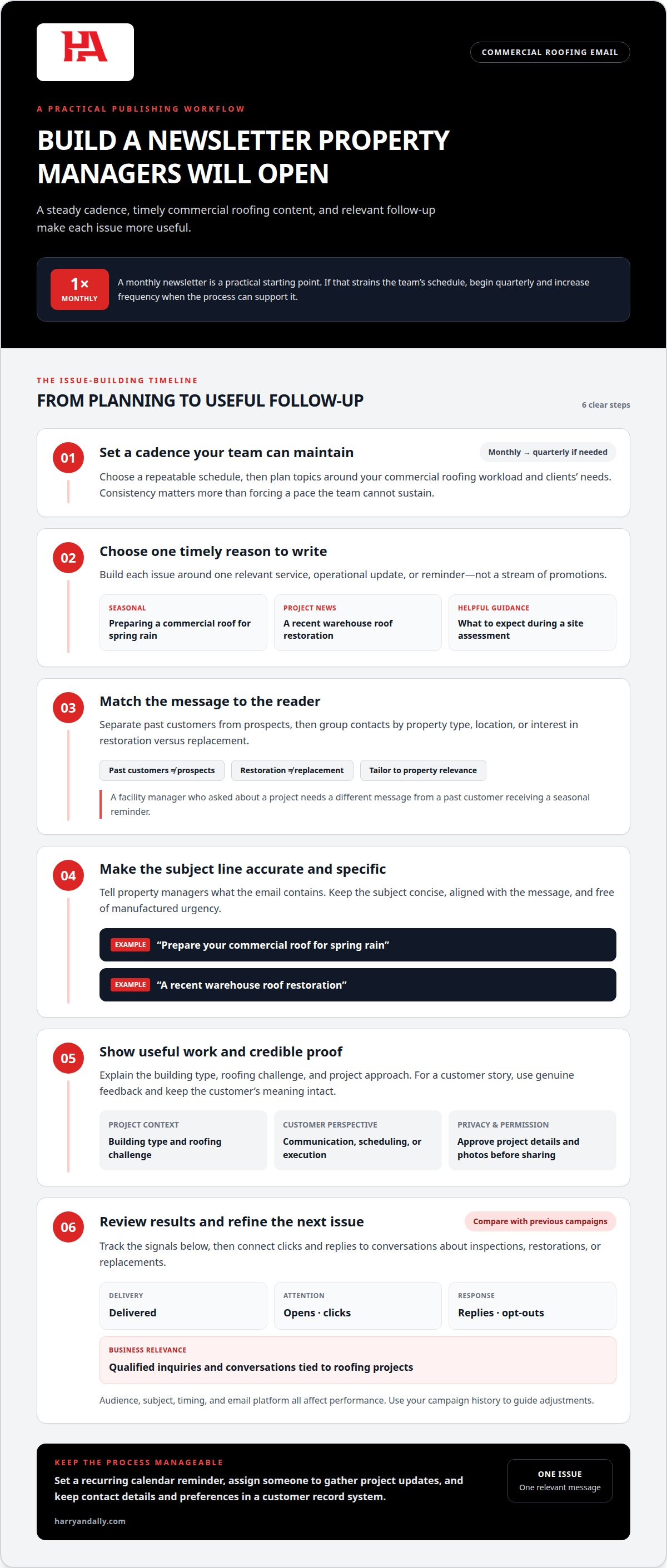
A monthly newsletter is a practical starting cadence for a commercial roofing business. Send it consistently, and build each issue around one timely service, operational update, or reminder for property managers. The strongest commercial roofing email newsletter ideas connect seasonal needs with work your team is prepared to discuss. If producing a newsletter monthly strains your schedule, start quarterly and increase frequency when your process can support it.
Make seasonal offers relevant to a facility’s needs. Before a period of heavy rain, for example, explain how a roof inspection can help identify visible concerns before they disrupt building operations. For planned restoration or replacement work, describe what property managers can expect, such as a site assessment, project planning, and communication during the work. Keep examples focused on commercial properties.
Business announcements give subscribers another concrete reason to open an issue. Share a completed commercial roofing project, a team update, a new service area, or a community project. Explain why the news matters to a facility manager. A project announcement could describe the building type, roofing challenge, and approach, while protecting private customer information.
Make every email recognizable and relevant to its audience. Use a consistent sender name, a subject line that accurately previews the message, and copy tailored to the reader’s interests. For example, send a restoration project update to contacts interested in restoration instead of sending the same broad message to every subscriber.
Effective subject lines tell property managers what an email contains. Try “Prepare your commercial roof for spring rain” or “A recent warehouse roof restoration.” Keep the subject concise and aligned with the message, and don’t imply urgent damage when the email contains routine advice.
Track delivery, opens, clicks, replies, opt-outs, and qualified inquiries. Compare each metric with your previous campaigns, then connect clicks and replies to conversations about inspections, restorations, or replacements. Audience, subject, timing, and email platform all affect performance, so use your campaign history to guide adjustments.
Segment subscribers by their relationship with your business and the relevance of the message. Separate past customers from prospects, then group contacts by property type, location, or interest in restoration versus replacement. These commercial roofing email newsletter ideas are more useful when each message fits its audience. A facility manager who requested project information needs a different email from a past customer receiving a seasonal reminder.
Use one clear call to action, such as “Request a commercial roof assessment” or “See the completed project.” A focused next step helps readers respond without competing links. Keep the message connected to your broader commercial roofing marketing, including the project details and follow-up your sales team can use.
Keep operations organized, too. Set a recurring calendar reminder, assign someone to gather project updates, and maintain contact details and preferences in a customer record system. Keep your business information consistent across local business directories, so property managers see the same company name, phone number, and service details when they move from an email to a directory listing.
2. Customer testimonials and reviews
A property manager evaluating roof restoration wants evidence of dependable work, clear communication, and well-managed projects. A genuine testimonial can address those concerns more directly than a broad claim about quality. Use customer feedback in newsletters to show how a commercial roofing project was handled, keeping the customer’s experience at the center.
Ask for a review after the project is complete and the customer has had time to experience the finished work. Make the request personal: mention the building or project, thank them for working with your team, and provide a direct way to leave feedback on Google Business Profile or your Facebook Business Page. A simple request is easier to act on than a long form with several steps.
Help customers provide useful details without scripting their response. Ask what challenge prompted the roofing work, how your team communicated during the project, and what the finished restoration or replacement means for their facility. Their answers can produce specific testimonials that matter to other property managers. Don’t edit their words into claims they didn’t make.
With permission, feature a short excerpt in an email and link to the full review on its original platform. Pair the feedback with a relevant project photo, such as a completed roof area or a crew coordinating work onsite. Commercial project photography can help make the proof more visual, provided the customer and property details are approved for sharing.
- Keep the customer’s wording accurate and preserve its original meaning.
- Identify the project context without revealing private building or contact details.
- Choose testimonials that address different concerns, such as communication, scheduling, or project execution.
Pay attention to reviews after publication, too. Assign a team member to monitor Google Business Profile and Facebook for new feedback. Thank customers for positive reviews with a brief, specific reply, such as recognizing their comments about project communication. Avoid copying the same response under every review. A personal acknowledgment shows that someone read it.
For critical feedback, respond calmly and address the issue without arguing in public. Acknowledge the concern, avoid sharing private project details, and move the conversation to a direct channel when a detailed discussion is needed. Record the concern internally and route it to the person responsible for resolving customer issues. A thoughtful response gives future readers a clearer view of how your roofing business handles feedback.
Include customer updates selectively instead of turning every newsletter into a review roundup. Rotate a testimonial, project photo, and short explanation of the work across issues. This keeps proof relevant to each message and gives property managers concrete examples to consider when weighing restoration or replacement plans.
3. Seasonal offers promoted through email and social media
A seasonal offer works best when it matches a property manager’s planning priorities. Before a rainy season, promote a commercial roof inspection or targeted repair service. Ahead of planned capital projects, feature restoration and replacement options. Explain who the offer suits, what the next step involves, and how to respond. That context helps subscribers judge its relevance without making every email feel like a sales pitch.
Subscriber-only offers can reward an existing audience and give an email a clear purpose. For example, offer subscribers a preferred rate on an inspection or a defined repair package. State the offer’s scope, eligibility, and expiration only when those terms are set. Avoid vague claims like “limited time” without a real deadline. Property managers need enough detail to decide whether an offer fits the building and budget cycle.
Connect an offer to a seasonal concern instead of presenting a discount on its own. A spring message might explain what an inspection can reveal after winter weather, then invite readers to schedule an assessment. A fall email could outline repair options before wet conditions arrive. Keep claims measured: describe the service and its purpose without promising a specific result for every roof.
Project photos can make seasonal promotions more concrete. Use an approved image of a completed commercial restoration, coating application, or replacement, then add a short caption describing the project. A finished-roof photo can support an inspection offer by showing the type of property your crew serves. Choose images that accurately represent the work, and get permission before identifying a customer or property.
Coordinate the campaign across email and social media without copying the entire newsletter into every post. Send subscribers the full offer and its details. Then use Facebook or Instagram to share a project image, a seasonal reminder, and a link back to the offer information. A focused social media campaign can keep the same message recognizable across channels while adapting the format to each audience.
Google Business Profile can support local visibility with a timely update or project post. Keep the wording consistent with the email and make the response step clear. For example, direct readers to call or submit an inquiry through a channel your team actively monitors. Don’t publish an offer with different terms on another platform.
Plan the campaign as a simple sequence: choose the seasonal need, define the offer, select a relevant project image, and prepare matching email and social copy. After sending, review replies and qualified inquiries alongside clicks. If property managers respond to inspection content but ignore discounts, shift the next promotion toward practical guidance and a clear assessment request.
4. Educational blogs, videos, and maintenance tips
Useful educational emails give property managers a reason to read beyond a service offer. Explain commercial roofing topics in plain language, then link each newsletter to a deeper blog post or short video. For example, an article about planning a roof replacement can outline how building use, project scope, and scheduling shape the conversation.
Keep advice specific to commercial facilities. A warehouse roof, retail center, and office building may have different access needs and operating schedules. Use a short example to show why a maintenance plan should account for roof condition, drainage, and how the property is used. Avoid homeowner-focused tips that don’t apply to facility managers or commercial building owners.
What seasonal commercial roofing maintenance tips can go in a newsletter? Before wet weather, remind readers to watch for visible drainage issues, debris, or interior signs of water intrusion, and explain when a professional assessment is appropriate. Before colder conditions, remind readers to review known roof concerns and plan any needed work around building operations.
Make each tip practical without asking readers to perform risky roof work. Suggest documenting a ceiling stain from inside the building, noting when it appeared, and reporting it to the facilities team. For a roof inspection, explain what information helps your crew prepare, such as the property address, roof access process, and a description of the concern. That gives readers a useful next step without turning the newsletter into a technical manual.
Short videos can demonstrate a concept that’s hard to explain in a paragraph. A roofer might show how water moves toward a drain or describe what a property manager can expect during a site assessment. Keep the narration focused, add captions for viewers watching without sound, and avoid presenting a general example as a diagnosis of the viewer’s roof.
- Pair one maintenance tip with one related blog or video.
- Use a clear title, such as “What to document after noticing a ceiling stain.”
- End with a relevant next step, such as reading a project-planning guide or requesting an assessment.
Educational content can also address common planning questions. A blog post could explain the difference between roof restoration and replacement at a high level, then outline the factors considered during an evaluation. Another email might walk through project phases, from initial discussion to work planning and closeout. These updates help property managers prepare informed questions and set internal expectations.
Turn one well-developed topic into several useful formats. Adapt a blog post about drainage maintenance into a newsletter summary, a short video script, and a social post. Keep the core advice consistent, but tailor each version to its format. Commercial readers need examples tied to facility operations and larger project decisions, rather than homeowner-focused residential guidance.
5. Referral programs and customer testimonials
A referral campaign can turn a strong commercial roofing relationship into an introduction to another property decision-maker. Make the request specific: invite a satisfied client to connect you with a facility manager planning a roof restoration, coating, or replacement. A clear description helps clients recognize the right opportunity without pressuring them to recommend your company broadly.
Set the program terms before announcing it in a newsletter. Explain who can refer a prospect, which projects qualify, how the introduction should happen, and when any reward applies. A non-cash thank-you or defined service-related incentive can recognize a referral. Keep the terms consistent in every email and follow-up so clients know what to expect.
Use a customer success story to show why a referral might help someone in the client’s community. Structure the story around the property’s challenge, the roofing company’s response, and the practical impact. For instance, describe how a facility team approached a planned replacement, coordinated project details, and worked toward a clear scope. Share only approved project information, and never invent a customer quote or outcome.
Make the referral step easy to complete. Include a dedicated link or a reply prompt, such as “Introduce us to a property manager planning a roof project.” Then record the referring customer, prospect, property type, and next sales step in your contact-tracking process. This helps your team connect the introduction to the resulting conversation and follow up appropriately.
- Keep the referral request focused on commercial roofing projects.
- State eligibility and reward terms plainly in the campaign.
- Track introductions through the sales conversation, not just the first reply.
Use testimonials as context, not decoration. A short customer statement can accompany a story about a completed project, while a project summary can explain the challenge and approach in your own words. Keep testimonials accurate, identify the project only with permission, and connect the story to a relevant next step for readers facing a similar planning decision.
Review referral activity as part of campaign follow-up. Note which message prompted an introduction, whether the prospect manages a commercial property, and whether the project fits your restoration or replacement focus. If introductions are unclear, revise the referral prompt. If readers engage with project stories, feature another approved example that addresses a different facility concern.
H&A Marketing
H&A Marketing helps commercial roofing contractors connect useful newsletter content with a broader plan to attract qualified restoration and replacement projects. When email topics, project stories, and referral campaigns need to support a clearer sales pipeline, coordinated marketing can tie each message to the right audience and next step.
That work can include lead generation, search engine optimization, website design, and branding, shaped around your commercial roofing priorities. A consistent message across your emails and online presence gives property managers a clearer picture of your work and how to start a conversation. Explore lead generation for commercial roofing contractors as part of your approach.
Build a Newsletter That Supports Your Next Growth Stage
Put these commercial roofing email newsletter ideas to work by choosing a cadence your team can sustain and connecting each issue to a clear business priority. For commercial roofing contractors, that might mean supporting relationships with property managers, reinforcing expertise in roof restorations, or keeping replacement projects in view during longer planning cycles.
Strong email content works best as part of a consistent presence, not as a standalone task. H&A Marketing can align your newsletter with website design, logo design and branding, and search engine optimization, keeping your message clear across the channels property managers use to evaluate contractors. The right mix depends on your goals, audience, and current marketing priorities.
Take a practical next step: discuss how your newsletter can fit into a focused marketing plan for your roofing business.
A steady, relevant message gives your team another way to build recognition and support future project conversations.
Frequently Asked Questions
How often should roofers send a newsletter?
A monthly newsletter is a practical cadence for staying in touch with customers and prospects. If your team can’t consistently prepare useful content each month, start with a quarterly send and build a repeatable process. For example, schedule a planning meeting before each quarter, gather project updates and service priorities, then prepare the issue in advance. A sustainable rhythm matters more than frequent emails without relevant information.
What should you include in a roofing newsletter?
Include one main message, a useful detail, and a clear next step. A commercial roofing issue might explain a project-planning consideration, share a brief team update, or point readers to a new educational article. Give each element a purpose: help a property manager understand a decision, see how your team works, or take an action. Keep unrelated announcements out of the same email.
What topics should a commercial roofing email newsletter cover?
Cover topics that matter to facility managers and property owners, such as planning a roof restoration, evaluating replacement timing, coordinating work around building operations, and understanding roof coating options. You can also explain how a commercial roofing project moves from an initial conversation to a defined scope. Choose topics based on questions your sales team hears, then use each email to answer one clearly.
What commercial roofing newsletter content helps generate leads?
Content that connects a property concern with a relevant next step can support lead generation. For example, explain what information helps prepare for a commercial roof assessment, then invite readers to submit their property details. Track whether the email leads to a qualified inquiry, project discussion, or proposal opportunity. This helps your team judge content by its contribution to the sales pipeline, not clicks alone.
How often should a commercial roofing company email its newsletter?
Use a monthly schedule if your team can keep each issue relevant and consistent. If monthly production competes with estimating, jobsite coordination, or customer follow-up, send quarterly while you establish a workable editorial process. Set recurring deadlines for choosing a topic, gathering accurate project information, and preparing the email. A planned quarterly send is more useful than an irregular burst of messages followed by long gaps.
What email newsletter examples do commercial roofing companies use?
Useful examples include a seasonal inspection reminder, a short explanation of restoration versus replacement planning, a project update, or a link to a maintenance article. A newsletter could also feature a team announcement or briefly explain what property managers can prepare before discussing a roof assessment. Keep each example relevant to commercial buildings and make the next step clear, such as reading more or starting a project conversation.
