

Article by
Harry Stanley III
Harry Stanley III is a construction marketing strategist and fractional CMO at H&A Marketing. He has helped construction companies grow through website strategy, SEO, paid advertising, branding, lead generation, CRM systems, and professional content. His past work includes helping Meraki Solar generate an additional $3.7 million in revenue in his first year and supporting American Builders as a fractional CMO. Today, Harry works directly with custom home builders and construction companies to build marketing systems designed to generate qualified leads and measurable growth.
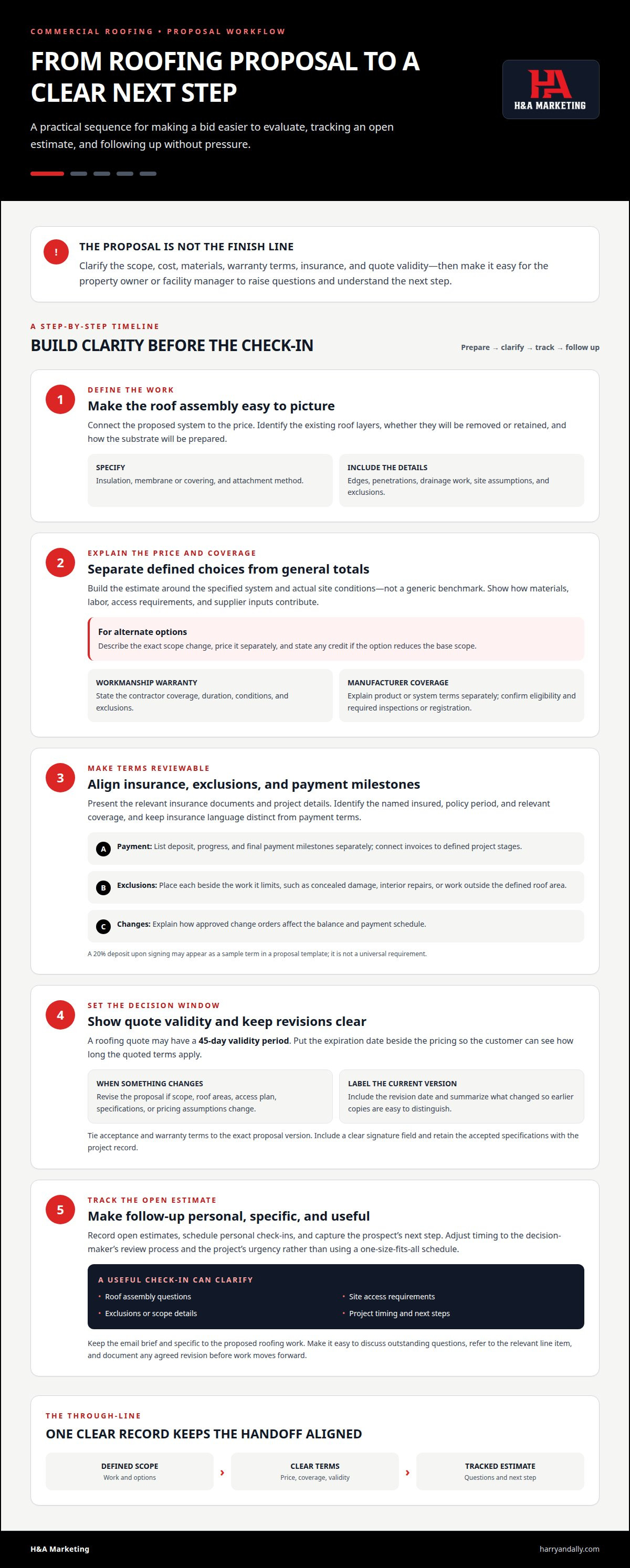
The proposal isn’t the finish line. A commercial roofing proposal follow-up should clarify the scope, costs, materials, warranty terms, insurance, and quote validity, then make the next step easy for the property owner or facility manager. A roofing quote may state a 45-day validity period, so follow-up should also account for when its terms expire.
When you’re managing restorations and replacements, silence after a bid can leave a promising project stalled. A thoughtful check-in can uncover questions about the roof assembly, access, exclusions, or timing without pressuring the decision-maker.
Learn how to review a proposal before sending it, follow up on an open estimate, and address cost or scope questions clearly. We’ll cover the details that make a bid credible, practical follow-up timing and messaging, and how coordinated marketing and lead tracking can help keep qualified commercial roofing opportunities moving.
Key Takeaways
- Make the scope easy to evaluate by clearly describing the roof system, site assumptions, exclusions, and any alternate options.
- Separate workmanship commitments from manufacturer coverage, and explain the conditions tied to each.
- Use a consistent process to record open estimates, schedule personal check-ins, and capture each prospect’s next step.
- Adjust follow-up timing to the decision-maker’s review process and the project’s urgency, rather than relying on a one-size-fits-all schedule.
- Write follow-up emails that are brief, specific to the proposed roofing work, and focused on making it easy to discuss outstanding questions.
Materials, warranties, and cost breakdown
A proposal is easier to assess when the roof assembly is clearly connected to the price. Identify the existing roof layers, whether crews will remove or retain them, and how they’ll prepare the substrate. Then specify the insulation, membrane or covering, attachment method, edge details, penetrations, and drainage work. For a commercial replacement, these details show what the base price includes and where different options change the scope.
Build the cost breakdown around the specified system and actual project conditions, not a generic benchmark. Show how materials, labor, access requirements, and supplier inputs contribute to the estimate. If you offer an alternate membrane or insulation option, describe the exact change and price separately. State any credit that applies if an option reduces the base scope. This lets the property owner compare defined choices instead of unexplained totals.
Keep workmanship terms separate from manufacturer coverage. The contractor’s workmanship warranty addresses covered installation issues, while manufacturer coverage applies to products and systems under its terms. State the coverage offered, its duration, what it covers, and any exclusions or conditions. Confirm system eligibility and required inspections or registration before promising manufacturer coverage. Don’t make the two warranties sound interchangeable.
Tie acceptance and warranty terms to the exact proposal version. Include a clear signature field and explain how the customer accepts the scope, price, and selected options. If the customer changes materials or scope before signing, issue a revised document instead of relying on an email thread. Keep the accepted version with the project record so the construction team can follow the approved specifications.
- List each major material and the roof area or assembly it applies to.
- Separate labor and material amounts where the estimate supports a clear breakdown.
- Describe exclusions beside the work they affect, such as concealed substrate damage.
- Record the selected system and warranty documents with the signed proposal.
Clear terms matter across a changing workforce. According to the U.S. Bureau of Labor Statistics, twenty percent of U.S. roofers were self-employed in 2025. The U.S. Bureau of Labor Statistics projects U.S. roofer employment to grow 5% from 2025 to 2035. For roofing contractors, a consistent template helps keep material descriptions, warranty language, and approval steps aligned across estimators and crews.
Before sending the proposal, compare every inclusion with the exclusions and selected warranty terms. Check that each alternate has a defined scope and price, and that the signature accepts the correct version. During the commercial roofing proposal follow up, answer questions by referring to the relevant line item, then document any agreed revision before work moves forward.
Insurance, terms, and quote validity
Clarify warranty coverage, exclusions, insurance documentation, and the payment schedule before presenting the proposal. A roofing proposal template may state a 20% deposit upon signing, while the contractor sets progress and final payment terms for the project.
Insurance and Payment Terms
Show which insurance documents apply to the project and identify the named insured, policy period, and relevant coverage details. Keep the proposal’s payment structure separate from insurance language. State whether payment is tied to signing, completed phases, or final acceptance, and describe how approved changes affect the balance. A 20% deposit upon signing can appear as a sample term, not a universal requirement.
Explain warranties and exclusions in plain language. Separate workmanship coverage from manufacturer coverage, then state what each covers and excludes. For example, identify whether the proposal excludes concealed damage, interior repairs, or work outside the defined roof area. Match each exclusion to the project scope so it doesn’t contradict an included task. Clear terms help the property owner understand what the quoted price covers.
Insurance records should support the proposed work, not create confusion. Present the relevant certificate or policy information with the proposal, and align the named parties and project details across documents. If the customer requires specific coverage documentation, record that requirement and its status. Keep payment milestones equally clear: connect each invoice to a defined project stage, and explain how approved change orders affect payment.
- Identify the insurance documents and project details included.
- List deposit, progress, and final payment milestones separately.
- Place each exclusion beside the scope item it limits.
Quote Validity and Proposal Revisions
A roofing quote may be given a validity period of 45 days. Put the expiration date beside the pricing and explain that the quoted terms apply through that date. This gives the property owner a clear decision window and helps contractors flag open estimates before pricing needs review.
Revise or resend the proposal when the project scope, roof areas, access plan, specifications, or pricing assumptions change. Create a new document version when the customer selects a different option or requests a scope adjustment. Label the revision date and summarize what changed so the customer can distinguish the current proposal from earlier copies.
Use a consistent structure in proposal software, including version, issue date, expiration date, and acceptance method. Integrations with estimating or customer-tracking software can help keep these fields consistent. Add images only when they clarify a site condition or proposed work area. Before resending, compare the new scope, exclusions, payment terms, and insurance attachments with the prior version. Then direct the customer to the current signature field and acceptance steps.
Tracking and automating follow-ups on open estimates
A reliable follow-up process connects each commercial estimate to its next action, owner, and decision status. Use a roofing business CRM or organized tracking system to keep open proposals from disappearing between inspection and approval.
Follow-Up Timing and Frequency
There’s no universal number of follow-ups for every commercial project. Build a sequence around the prospect’s review process: confirm the proposal arrived, ask whether the scope needs clarification, follow up on the agreed decision date, then request a status update if the estimate remains open. Stop when the prospect declines, approves, or asks you to pause contact.
Record each action against the estimate, not just the contact. Useful fields include property name, inspection date, proposal version, decision-maker, last contact, next action, and reason for delay. If a facility manager says a roof replacement must wait for an internal budget review, schedule the next task around that milestone instead of sending generic reminders.
Automation should prompt a person to follow up, not pretend to build a relationship. Set reminders when a proposal is sent, when a promised decision date passes, and when quote validity is nearing its end. Assign each task to a specific estimator or salesperson, then log the result after contact.
Follow-Up Email Templates
A useful email template keeps the structure consistent while making the message specific to the property. Reference the inspection, roof area, and proposal version, then ask one clear question. For example: “I’m following up on the replacement estimate for the north roof area. Would it help to review the proposed scope or options together?”
Save separate templates for delivery confirmation, scope clarification, decision-date follow-up, and a close-the-loop message. Personalize each before sending. Mention a relevant detail, such as photos documenting a rooftop condition, and link the message to the correct estimate record. Avoid attachments that repeat the full proposal unless the recipient needs a fresh copy.
Keep the template brief and focused on a next step. A simple request to discuss an exclusion or confirm the review timeline gives the recipient a useful way to respond. Track replies and update the estimate status so another team member doesn’t send a duplicate message.
Phone Follow-Up
Start the call by identifying the property and proposal, then explain why you’re calling. Ask whether the recipient has questions about the inspection findings, scope, or estimate. This keeps the conversation useful rather than demanding an immediate decision. If they’re unavailable, ask when a brief follow-up would suit them and record that preference.
Handle objections by clarifying what’s behind them. If pricing is the concern, ask which scope item needs review; if timing is the issue, ask which project milestone matters. Don’t argue or make an unsupported promise. Summarize the concern, agree on a specific next action, and document it in the estimate record.
How soon should you follow up after sending a commercial roofing proposal?
For a commercial roofing proposal, follow up when the recipient can have a useful conversation about it. If you presented the estimate in person, use the end of the meeting to agree on whether a technical review would help. If you sent it by email, make your first contact useful by offering to walk through the recommendation rather than asking for an immediate yes or no.
Proposal reviews can involve people with different priorities. A facility manager may focus on roof access and building operations, while an owner may need to understand the investment and project scope. Offer a joint review so decision-makers hear the same explanation and can raise concerns directly. This can prevent separate conversations from creating conflicting assumptions.
Use the first follow-up to make the proposal easier to discuss:
- Offer a short call to explain the recommended approach.
- Ask whether another stakeholder should join the review.
- Bring attention to the proposal page or drawing most relevant to their concern.
- Close by asking what would make the recommendation easier to evaluate.
A roof restoration proposal may include technical terms that aren’t familiar to every decision-maker. Explain the practical meaning of the recommendation, such as how the proposed work addresses the observed roof condition. Keep the explanation consistent with the written scope so a verbal discussion doesn’t create different expectations.
If the recipient asks for time to review the document independently, respect that preference. Don’t call again simply because you haven’t received an answer. Instead, make the next contact purposeful, such as offering to explain a specific section or include another stakeholder in a review.
Choose the communication method that suits the conversation. Email works well for a brief clarification, while a call or meeting can help when the customer needs to discuss several parts of the proposal. Keep follow-up focused on helping the property team understand its options. A calm, useful conversation makes it easier to assess the recommendation and decide how to proceed.
Before a follow-up conversation, make sure the proposal gives the recipient enough detail to assess the recommendation. It should identify the property, customer contact, inspection date, roof areas, drawings, specifications, and addenda used to prepare it. It should describe the included roof assembly, including existing-layer removal or retention, substrate preparation, insulation, membrane or covering, attachment, edge details, penetrations, and drainage-related work. The estimate should also be based on the specified system, site conditions, supplier inputs, labor, and access requirements, not generic benchmark prices. These details give you a clear basis for explaining the recommendation and answering questions without changing the scope.
If the recipient asks about coverage or alternatives, make sure the written terms support your explanation. The proposal should separate contractor workmanship terms from manufacturer coverage and verify system eligibility and required inspections or registration before promising manufacturer coverage. It should state the exact change to the base system and the price for each alternative. For an occupied commercial building, it should record agreed access hours, staging locations, deliveries, equipment access, protection measures, and areas that must remain usable. Use the follow-up to clarify any points the customer wants to discuss, and keep the conversation aligned with the proposal. This helps the recipient compare options and consider how the work fits the property’s needs.
What is the best follow-up email template for a commercial roofing proposal?
The strongest email makes the proposal easy to circulate within the customer’s organization. A property manager may understand the roof recommendation, while an owner or finance reviewer may see only a forwarded message. Give them a concise decision brief that explains what approval covers and where to find supporting details.
Use this format when the main contact needs to bring the recommendation to an internal review:
Subject: Decision brief: Commercial Property roof proposal
Hi John,
For your internal review, the attached proposal recommends restoration for the main office building. The recommendation is based on recent core sample findings. Approval would cover complete membrane replacement and drainage upgrades.
The proposal also includes an alternative coating option. The main distinction is upfront material cost versus long-term warranty length. Please use proposal version 3.2 for review.
If useful, I can provide a short summary for the approval packet or clarify a particular item for your reviewers. Let me know which would help your process.
Regards,
H&A Team
This format is useful when the decision-maker isn’t the person who arranged the inspection. It gives the contact a ready-to-forward explanation instead of asking them to rewrite the contractor’s recommendation. Keep the summary aligned with the actual proposal. Don’t introduce a new benefit, scope item, or commitment that the approved document doesn’t contain.
Make the subject line descriptive enough to remain identifiable in a forwarded thread. Including the property name and “decision brief” helps distinguish the message from routine project correspondence. If the proposal has more than one version, include its identifier in the email and attachment filename. That reduces the chance that reviewers discuss an outdated draft.
Before sending, consider what an internal reviewer needs to understand the request without a live explanation. A short description of the building area, recommended approach, and decision being requested can provide that context. Keep technical backup in the attached proposal rather than crowding the email with specifications.
Use a commercial roofing proposal follow-up email to support the customer’s approval process, not manufacture urgency. A clear, forwardable summary helps the contact explain the recommendation accurately and gives reviewers a direct route to the relevant proposal details.
When reviewers ask what the work includes, point them to the scope of work section instead of restating a broad promise in the email. The roofing proposal template includes an inspection and assessment, removal, repair, installation, and cleanup in its scope of work section. Use those scope items to anchor a brief explanation of the work submitted for approval, and ensure the email summary reflects the proposal’s actual selections. If a reviewer needs more detail about a stage, refer them to the relevant proposal language rather than expanding the scope in the message.
This keeps the email focused while giving the contact a practical way to answer questions during review. It also helps distinguish work covered by the proposal from items that may need clarification before approval. Keep the wording neutral and specific: describe the proposed work, identify where its details appear, and invite the reviewer to ask about anything that remains unclear. A useful follow-up supports an informed decision without implying that the proposal includes work beyond its stated scope.
H&A Marketing
H&A Marketing helps commercial roofing contractors build a stronger path from first inquiry to submitted proposal. If qualified restoration and replacement opportunities are inconsistent, or prospects struggle to understand your company’s expertise, coordinated marketing can strengthen the pipeline before follow-up begins.
Website design, search engine optimization, lead generation, and logo design and branding can work together to make your business easier to find and your services clearer to property owners and facility managers. A focused commercial roofing marketing strategy can connect those efforts with the projects you want to pursue. Contact H&A Marketing to discuss a marketing approach for your roofing business.
Turn Every Proposal Into a Clear Next Step
A disciplined commercial roofing proposal follow-up process keeps your sales pipeline connected to the work you want to win. Make each interaction useful, record what the prospect needs, and give the decision-maker a clear way to respond. Over time, that consistency can help your team focus on qualified commercial restoration and replacement opportunities.
When your marketing needs to support that pipeline from the first impression onward, H&A Marketing can align website design, logo design and branding, and search engine optimization with your commercial roofing business. The goal is a clearer, more consistent presence for the property owners and facility managers you want to reach.
Keep the next step simple, stay consistent, and give each promising opportunity room to move forward.
Frequently Asked Questions
What should a commercial roofing proposal follow-up include?
Include any administrative details the recipient needs to move the proposal through the approval process. For example, reference the project code or purchase-order number they provided, and include requested vendor paperwork if it’s part of their process. Keep these items separate from the roofing recommendation itself. This helps the recipient handle internal procedures without confusing administrative requirements with the scope or terms of the proposed work.
