
Construction Lead Generation Strategies That Work


Article by
Harry Stanley III
Harry Stanley III is a construction marketing strategist and fractional CMO at H&A Marketing. He has helped construction companies grow through website strategy, SEO, paid advertising, branding, lead generation, CRM systems, and professional content. His past work includes helping Meraki Solar generate an additional $3.7 million in revenue in his first year and supporting American Builders as a fractional CMO. Today, Harry works directly with custom home builders and construction companies to build marketing systems designed to generate qualified leads and measurable growth.
More inquiries won’t fix a construction pipeline if they’re the wrong projects or nobody follows up. Effective construction lead generation connects marketing channels to a clear process for identifying project fit and moving promising prospects toward a sales conversation. If inquiries are uneven, don’t match your capabilities, or are hard to trace back to marketing, the problem may be how the pieces work together.
Construction decisions often take time, so a new inquiry isn’t the only sign that marketing is working. Your team also needs a practical way to track fit, follow-up, and progress through the pipeline. The goal is to recognize promising opportunities without treating every form submission or phone call as a qualified lead.
This article explains how to connect your website, SEO, paid ads, social media, and project photos or video; define which projects are worth pursuing; and create a consistent handoff from first contact to sales. It also covers the pipeline signals that help you assess progress while prospects are still making decisions, so marketing and sales activity support the same goal: better-fit construction opportunities.
Key Takeaways
- Focus construction lead generation on projects that fit your company’s capabilities, not just a higher inquiry count.
- Connect project-fit criteria, marketing channels, inquiry capture, qualification, and follow-up in one repeatable process.
- Choose channels based on buyer intent and how each can help you reach your target project audience.
- Track inquiry source, project fit, response, sales stage, and outcome to understand pipeline progress.
- Coordinate your website, SEO, social media, and visual content around shared marketing goals.
Construction lead generation starts with project fit, not raw lead volume
Some months bring a steady stream of inquiries; others leave the calendar quiet. Even a busy inbox can hide a pipeline problem if people are asking for work your company doesn’t do, the scope isn’t a fit, or they aren’t ready to discuss a project. The useful measure isn’t attention alone. It’s whether marketing attracts prospective buyers with a credible path to becoming the right kind of customer.
Construction lead generation is the process of attracting prospective project buyers, capturing their inquiries, and qualifying them against the work your company wants to win. Qualification matters because a name and email address don’t tell you whether a project fits your services, capacity, or business goals.
Construction covers distinct sectors and types of work, as the Construction Industry Overview illustrates. Define fit around your own operation. A commercial contractor pursuing tenant improvements may value a different scope, buyer role, and timeline than a firm focused on large infrastructure work. More contacts won’t solve a mismatch between your marketing and the projects you can deliver.
What counts as a qualified construction lead?
A qualified lead shows signs that the opportunity aligns with your work. Consider whether the requested service matches your capabilities, whether the project scope is realistic for your company, whether you’re speaking with a decision-maker or someone involved in evaluating firms, and whether the timing supports a useful next step.
A marketing lead has shown interest; a sales-ready construction opportunity has enough project fit and buying context to justify a focused conversation. Someone researching options may need helpful information before they’re ready to talk. A prospect who shares a defined need and asks about next steps may be further along. Set qualification criteria around the projects your company wants, rather than relying on a universal score. If you need a clearer process for turning inquiries into sales conversations, construction lead generation support can connect inquiry capture with follow-up.
Why construction buyers need more than one touchpoint
A significant construction commitment can involve research, comparisons, and input from several people. A buyer may identify a need, review firms’ websites and project examples, compare capabilities, and reach out when the scope and timing become clearer. Engineers, developers, procurement teams, or owners may each influence the decision.
Make each touchpoint answer a real buyer question. Clear positioning explains what work you do. Relevant project proof helps prospects assess whether your experience fits their needs. Consistent follow-up keeps a conversation moving without treating an early researcher like a ready-to-buy prospect. Together, these elements give buyers a stronger basis for deciding whether to speak with your team.
How a connected construction lead-generation system works
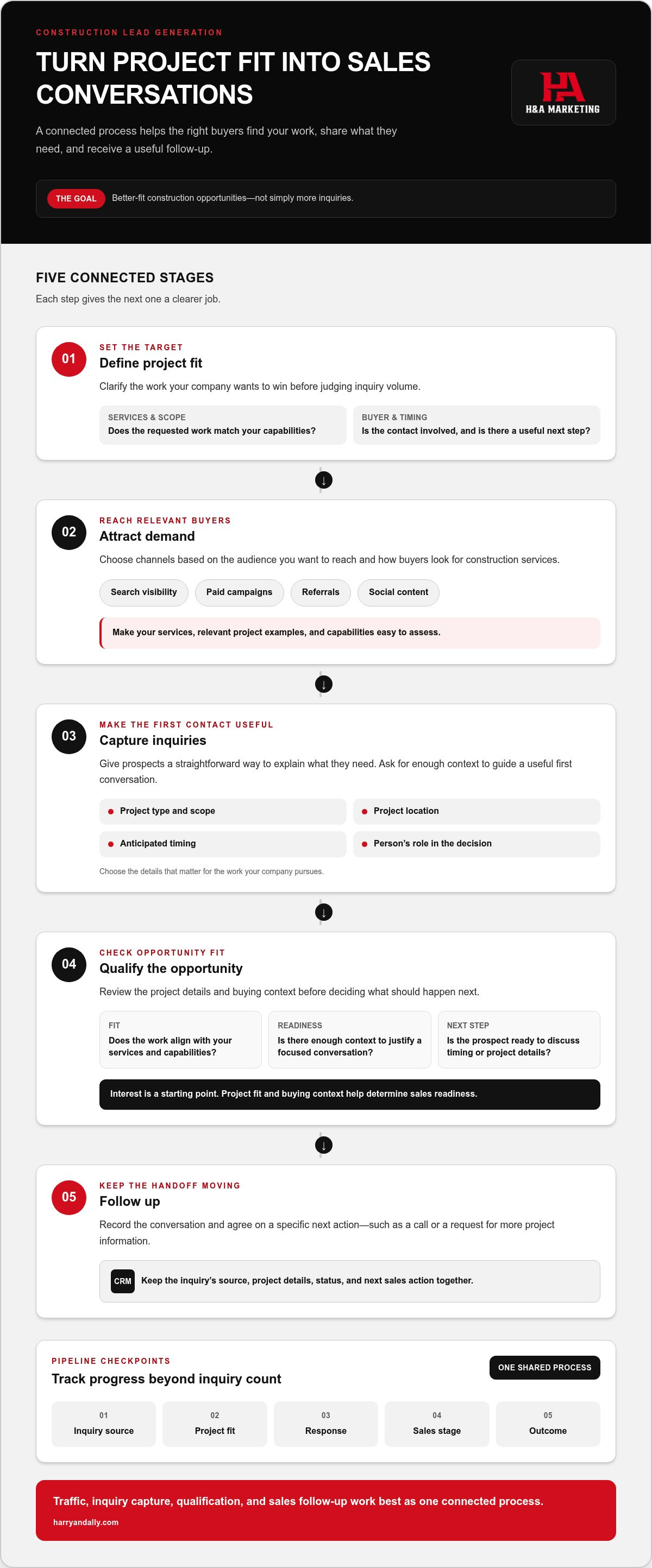
A dependable system gives each step a clear job. Start with the projects your company wants, then make it easy for the right buyers to find you, understand your work, share their needs, and hear back from your team. If one step is missing, marketing can attract attention without creating a useful sales conversation.
- Define project fit. Clarify the services, scope, buyer roles, and timing that align with your business.
- Attract demand. Use search visibility, campaigns, referrals, and social content to reach relevant audiences.
- Capture inquiries. Give prospects a clear, straightforward way to explain what they need.
- Qualify the opportunity. Review project details and readiness before deciding on the next step.
- Follow up. Record the conversation and agree on a specific action, such as a call or a request for more project information.
Positioning and proof make this sequence more effective. State the types of construction work you handle and show relevant completed projects, capabilities, or jobsite visuals. A commercial buyer evaluating a contractor for a defined scope should be able to recognize the fit without sorting through unrelated services. Industry resources from the Associated General Contractors of America can also help contractors stay connected to information and issues relevant to the industry.
Lead generation works when traffic, inquiry capture, and sales follow-up operate as one process, not as separate marketing tasks.
Connect the website, search visibility, and campaign traffic
Your website is where prospects assess your services, experience, and fit. Organize pages around the work you want, explain why your approach is relevant, and make the next step easy to find on desktop and mobile. A well-planned construction company website can present that information clearly. SEO supports discovery when buyers research a construction need over time. Paid campaigns can reach a more specific audience and direct them to a focused page rather than a general homepage.
Make lead capture and follow-up part of the same process
A short form should collect enough context to guide a useful first conversation without asking prospects to complete a lengthy questionnaire. Consider requesting the project type, general scope, location, anticipated timing, and the person’s role in the decision. Choose the details that matter for the work your company pursues.
Then record each inquiry in your CRM with its source, project details, status, and next sales action. That creates a usable handoff: an inquiry from a campaign needs a response, an early-stage prospect may need relevant information, and an active opportunity may need a scheduled discussion. Keep the next step visible rather than relying on someone to remember it.
If your website, campaigns, and follow-up process need a more coordinated approach, explore construction lead generation support built around those connected steps.
Compare construction lead-generation channels by buyer intent
Channels play different roles in a construction pipeline. Search can reach buyers actively researching a need; social content can make your work familiar before they’re ready to contact you. Referrals come through relationships, while paid campaigns can put a specific offer in front of a defined audience. The right mix depends on the projects you want, the buyers involved, and what your team can follow up on consistently.
| Channel | Likely buyer intent | Useful role | What to measure |
|---|---|---|---|
| Organic search | Researching a service, contractor, or project need | Build visibility for relevant searches over time and direct prospects to useful service pages | Qualified inquiries by landing page, search visibility, and project fit |
| Google Ads | Actively looking for a solution or contractor | Test focused messages and reach people searching for specific work | Cost and volume of inquiries, plus fit and sales-stage progress |
| Meta Ads | May not be actively searching yet | Introduce a relevant project or service to a selected audience | Inquiry quality, response, and movement toward a sales conversation |
| Referrals | Arriving through a trusted relationship | Generate opportunities through existing business connections | Referral source, project fit, and outcomes |
| Social content | Learning about a company and its work | Build familiarity by showing expertise, project progress, and completed work | Relevant engagement, website visits, and assisted inquiries |
When search, paid campaigns, and social content can help
Organic search can meet prospects as they research a construction need. A useful SEO approach for construction companies connects those searches to clear pages about services and relevant project experience. Paid campaigns can test a focused message with a defined audience, while social content helps people recognize your work before they’re ready to request a conversation. Compare channels by the opportunities they contribute, not clicks alone.
Match proof to the construction project being sold
Proof should help a buyer picture your company doing the work they need. A commercial developer may look for relevant project scale, coordination, and experience with similar scopes. A homeowner considering a custom build may care more about design detail, finish quality, and the builder’s process. Neither audience needs a generic gallery that leaves the project context unclear.
Use project photography and video to show the finished work, important details, and, where useful, progress on site. Add a brief description of the project type and your role so prospects can assess relevance. Professional construction photo and video can make this visual proof easier to share across your website and marketing channels. For projects where safety is part of the buyer’s evaluation, OSHA’s construction industry resources provide general safety information. Keep claims about your own practices accurate and specific.
For construction lead generation, choose channels based on the buyer’s likely intent, then judge performance by whether each channel contributes to suitable projects and meaningful sales progress. No single channel is best for every firm or project type.
Build a measurable construction lead-generation plan
A useful plan starts with a business goal, not a list of marketing tactics. Pick one project type you want more of, define the buyers involved, and decide what a suitable opportunity looks like. Then select channels that can reach those buyers and give your team a practical way to track what happens after an inquiry arrives.
- Set a project-fit goal. Choose a specific type of work, such as commercial renovations or custom home projects, that aligns with your services and capacity.
- Define the audience. Identify who may start, influence, or approve the project, and what information they need to take a next step.
- Choose suitable channels. Match search, paid campaigns, referrals, or social content to how that audience discovers and evaluates firms.
- Agree on tracking. Use shared CRM fields and sales stages so marketing and sales can follow the same opportunity from inquiry to outcome.
Track each inquiry’s source, project fit, response, current sales stage, and final outcome. Include a short, consistent note about why an opportunity fits or doesn’t. That context helps you distinguish a channel bringing relevant prospects from one producing activity without suitable projects.
Choose useful metrics without relying on vanity numbers
Traffic, clicks, and form submissions can show whether people are engaging with marketing, but they don’t tell the whole story. Pair them with indicators such as qualified inquiries, completed first conversations, opportunities advancing through stages, and outcomes. These are different signals: early indicators show activity, while sales outcomes show what became of it. Neither guarantees a return.
Use CRM stages with plain definitions, such as new inquiry, contacted, qualified, active opportunity, and closed or inactive. Compare results with your company’s own baseline over comparable periods. That gives you a more useful reference than an unsupported industry benchmark.
Improve the system through regular review
Set a recurring review that fits your sales cycle. Look at which channels produce inquiries aligned with target projects, where prospects stop progressing, and whether follow-up actions are recorded. Long decision cycles can mean an inquiry needs continued, relevant communication before its eventual outcome is clear. For ideas on maintaining contact with prospects, see this guide to lead nurturing for home builders.
Review the handoffs, too. Does the form ask for useful project context? Does the inquiry reach the right person? Is the next action clear? Fix friction in those steps before adding another channel. Change one part of the process at a time, then review whether inquiry fit or sales progression shifts. A focused review helps your team make decisions from pipeline evidence rather than raw activity.
How H&A Marketing connects construction lead generation
Construction marketing works harder when each activity supports the same business goal. H&A Marketing’s connected marketing system brings strategy, creative, traffic, and lead capture together around the project types your company wants to pursue. The goal is a coordinated process, not a collection of disconnected tasks or a promise of a particular result.
Coordinate the work instead of treating every channel separately
Start with clear positioning: what your company builds or delivers, which projects fit, and what helps buyers understand your experience. Carry that message from your website into SEO, campaigns, and social content. Keep the proof consistent, too. The project examples and capabilities that help a buyer assess your website should reinforce the same message when they encounter your company through another channel.
Each service can play a distinct role in that shared plan. Website design gives prospects a place to assess your work and take a next step. SEO helps relevant buyers discover your business through search. Lead generation connects traffic to inquiry capture, while social media management keeps useful content in circulation. Professional photo and video make project work easier to show and assess.
Clear lead capture connects marketing activity to sales follow-up. A prospect should be able to share enough project context for your team to decide what happens next. Record the inquiry and assign a follow-up action, rather than letting it disappear between a campaign, an inbox, and a sales conversation. Marketing and sales should use the same definition of a suitable opportunity.
For construction teams, a collaborative marketing partner can coordinate specialized work while staying aligned with active projects and business priorities. Your team brings knowledge of its capabilities, capacity, and target work; marketing brings strategy and execution across the channels involved. That division keeps decisions grounded in the projects you actually want to win.
Choose a practical next step for your construction company
Before adding another tactic, write down the project types you want more of and where the current pipeline gets stuck. Are the right prospects finding the company? Does the website make its services and experience clear? Can you identify which channel brought an inquiry? Does each lead have an owner and a next action? These questions can reveal whether the gap is visibility, fit, capture, or follow-up.
Review the website, traffic sources, inquiry details, and sales follow-up together. Look for mismatches, such as a campaign promoting one service but sending buyers to a general page, or inquiries arriving without enough context for a useful response. That review gives you a practical starting point for construction lead generation and a clearer brief for what marketing should support.
H&A Marketing can work with your construction company to discuss its marketing priorities and provide a free quote. Bring your target project types and the pipeline challenge you most want to address.
Put your next growth priority into motion
Choose one pipeline issue to tackle first. Perhaps your company needs more inquiries for a particular project type, clearer visibility into where prospects come from, or a stronger handoff from marketing to sales. A focused priority gives your team a practical way to decide what to adjust and what to measure next.
Construction lead generation is easier to manage when the plan reflects how your company wins work. H&A Marketing specializes in marketing tailored to construction companies, with a connected marketing system that coordinates strategy, creative, traffic, and lead capture. Start with your business priorities, not a preset package of tactics.
If you’re ready to align marketing with the projects you want to pursue, identify the pipeline challenge you most want to address and consider a practical first step.
A clear priority gives your team direction and turns a growth goal into work you can act on.
Frequently Asked Questions
What is construction lead generation, and how does it work?
Construction lead generation is the organized work of bringing prospective buyers into a company’s sales process. A contractor might promote a particular service, publish relevant project examples, and provide a clear way for an interested buyer to start a discussion. The approach should reflect how that work is purchased. For public-sector opportunities, for example, procurement requirements and bid calendars may shape the message and timing more than broad promotional content.
How can a construction company get more qualified leads?
Make your company’s focus and credibility easy for a potential buyer to assess. A concise capability statement, relevant project references, and clear descriptions of the work you take on can help decision-makers decide whether to include your firm in a conversation or bid process. Keep these materials current and specific to the audience. Avoid broad claims, and make sure every credential or project detail you publish is accurate and supportable.
Is paid advertising worth it for construction companies?
Paid advertising may be worth testing when a company has a clear service to promote, a page that answers buyer questions, and staff capacity to handle resulting inquiries. Before launch, decide what action counts as a useful response, such as a request to discuss a defined scope. Set a spending limit the business can sustain, and decide in advance what evidence would justify continuing, revising, or stopping the test.
Can construction companies generate leads without paid ads?
Yes. Past clients, business relationships, industry events, and useful project updates can all help keep a firm visible without buying ads. For instance, a contractor can reconnect with former clients when it adds a service relevant to their facilities, or share a project update that explains a construction challenge and the team’s role. Keep outreach useful and specific, rather than sending generic announcements that give recipients no reason to respond.
How long does construction lead generation take to produce inquiries?
There’s no dependable timeline that applies to every company. Results depend on factors such as how established the company’s online presence is, the type of work being promoted, buyer planning cycles, and the channel used. An inquiry can also arrive well before a project is ready to move forward. For bid-driven work, align outreach with published procurement calendars and track the time from first contact to bid invitation or award.
What should a construction company track to measure lead quality?
Beyond basic contact details, record what helps your team make better pursuit decisions: service line, project delivery type, whether the company was invited to bid, whether it submitted a proposal, and why it chose not to pursue or lost the opportunity. These details can reveal whether marketing is reaching the right kind of buyer and whether the company’s pursuit process is a good match for the work coming in.
How much should a construction company spend on lead generation?
Set spending based on the business’s capacity to support the full effort, not just its ability to fund ads. Account for the time needed to prepare project materials, maintain relevant pages, handle inquiries, and develop proposals. A campaign can create extra work without helping the business if estimating or sales staff are already stretched. Start with a manageable scope and review whether the effort is producing opportunities worth pursuing.
Why are construction marketing leads not turning into projects?
Sometimes a promising inquiry stalls during estimating or the proposal stage, rather than at initial contact. Review recent opportunities and note whether the bid was submitted on time, the scope was understood, the proposal addressed the buyer’s needs, and the client selected another firm or postponed the work. Look for recurring reasons, such as limited capacity or a poor match with the bid requirements. Then adjust pursuit decisions or proposal materials accordingly.
