
Contractor SEO: How to Rank High and Win More Jobs


Article by
Harry Stanley III
Harry Stanley III is a construction marketing strategist and fractional CMO at H&A Marketing. He has helped construction companies grow through website strategy, SEO, paid advertising, branding, lead generation, CRM systems, and professional content. His past work includes helping Meraki Solar generate an additional $3.7 million in revenue in his first year and supporting American Builders as a fractional CMO. Today, Harry works directly with custom home builders and construction companies to build marketing systems designed to generate qualified leads and measurable growth.
More website traffic won’t help if the inquiries are for projects your construction company doesn’t want. Effective contractor SEO connects the searches your best-fit clients make with clear service pages, proof of your work, and a simple path to get in touch.
It’s reasonable to question where limited marketing time and budget should go. Rankings, visits, and clicks can look promising, but they matter most when they lead to relevant project conversations and a healthier sales pipeline.
This guide explains how to prioritize SEO around the services and projects you want, improve visibility for relevant searches, and track progress beyond traffic totals. You’ll see how your website, search visibility, creative, and lead capture work together as a connected marketing system, so you can focus on the signals that show whether SEO is attracting the right opportunities.
Key Takeaways
- Prioritize the services and project types your company wants more of, then shape your search strategy around how prospective clients look for that work.
- Use contractor SEO to connect relevant searches with clear service pages, project evidence, and useful next steps.
- Separate service pages, project examples, and educational content so each helps prospective clients answer a different question.
- Set practical SEO priorities based on your website’s current condition, business focus, competition, and available resources.
- Track whether search visibility is contributing to qualified inquiries and pipeline progress, not just more website visits.
Contractor SEO: Connecting Visibility to Better Projects
For a construction company, search visibility has value when it helps the right prospective clients understand what you build, see evidence of your work, and take a useful next step. That’s the practical purpose of contractor SEO: improving your visibility in relevant unpaid search results and making it clear how a potential client can learn more or start a conversation.
SEO activity is the work that helps your business appear for relevant searches. The business outcome is a qualified project inquiry that fits your services, capacity, and goals. Rankings and website visits can show whether people are finding you, but they don’t tell the whole story. A visit from someone researching a service you don’t provide is different from an inquiry about a project your team is equipped to pursue.
Search engine optimization includes work that helps search engines understand and present web pages. For a broader overview, see What is Search Engine Optimization (SEO)? For builders, the business-specific question is whether the information people find supports a credible evaluation and a relevant project conversation. H&A Marketing’s SEO approach connects that visibility to the rest of the marketing path.
How construction buyers use search during a long decision
A prospective client may not be ready to call after one search. They may compare your service expertise with their project needs, review completed work, and look for signs that your process fits the project. Useful website content answers practical questions: what types of work you take on, how you approach a project, and what experience your portfolio demonstrates.
Search can support this evaluation, but it doesn’t replace referrals, direct conversations, or consistent sales follow-up. A clear page can give a referred prospect somewhere useful to continue their research; detailed project evidence can help explain your capabilities before a first meeting. The goal is to make each search touchpoint relevant to the buyer’s next question, not to force an immediate inquiry.
Why traffic alone is a weak contractor SEO target
A rising visit count may look encouraging, but it can include people looking for information unrelated to your services or project type. That activity can add little to business development. A smaller number of inquiries may be more useful if they match the work you want, fit your project capacity, and progress into meaningful sales conversations.
Review search performance alongside signals from your inquiry and sales process. For example, note which service pages visitors use before contacting you, what work an inquiry concerns, and whether it advances to a substantive project discussion. These details help distinguish visibility from business value.
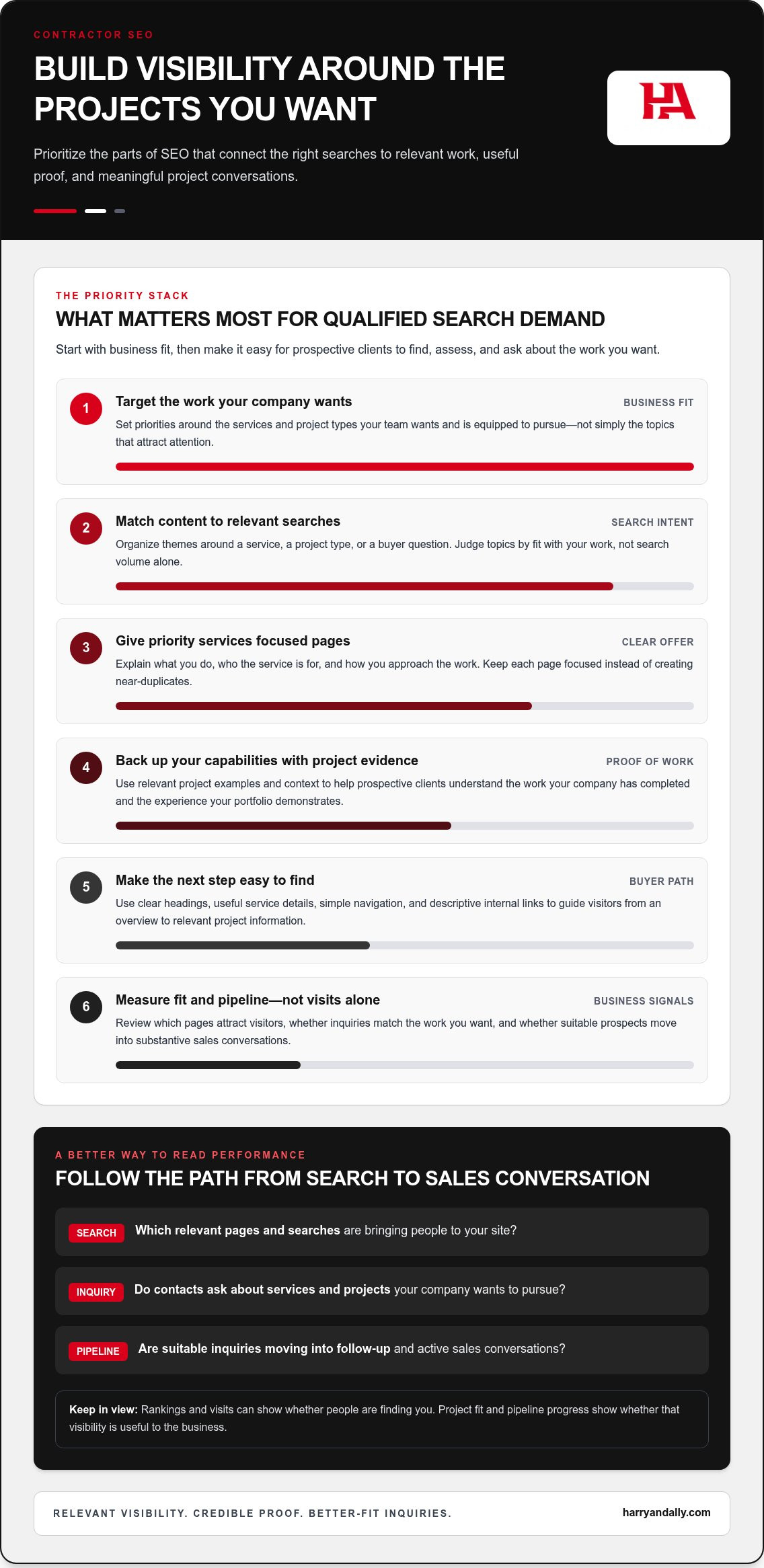
- Search signals: Which relevant pages and searches are bringing people to your site?
- Inquiry signals: Do contacts ask about services and projects your company wants to pursue?
- Pipeline signals: Are suitable inquiries moving into follow-up and active sales conversations?
That view keeps SEO accountable to project fit and pipeline contribution, not traffic for its own sake.
How Contractor SEO Turns Construction Expertise Into Searchable Website Content
Your website should translate the work your company actually wants into pages that prospective clients can find and understand. Start with the services you provide, the project types you’re equipped to take on, and the questions buyers ask before starting a conversation. Those business priorities point to relevant search themes. Each theme should then lead to a useful page, not simply another phrase to add to existing copy.
Give every priority service its own focused page, so buyers can quickly understand what you do and why it fits their project. A service page explains scope and approach. A project page shows relevant completed work and context. Educational content answers planning questions, such as what to consider before beginning a particular type of build. Each has a distinct purpose; combining them into one broad page can leave visitors searching for basic answers.
Match search intent to services, projects, and buyer questions
Group search themes around three useful starting points: a service, a project type, or a buyer question. For example, a company offering commercial renovations might organize content around renovation services, examples of relevant commercial projects, and questions about planning work in an occupied building. These are illustrative themes, not a reason to claim experience or capabilities the company doesn’t have.
Prioritize themes by business fit, not search volume alone. A popular topic has little value if it attracts people looking for work your team doesn’t pursue. Keep one strong page for each clear service and audience; avoid near-duplicates that change a few words but serve the same purpose. That keeps your site focused and gives visitors a clear route to relevant information.
Make construction websites useful to buyers and search engines
Build each page around a straightforward question: what does the company do, who is the service for, and what should a prospective client do next? Use a clear heading, plain-language service details, relevant project context, and a direct next step. Organize related pages through simple navigation and descriptive links. This helps a visitor move from a service overview to supporting project evidence without guessing where to look.
Structure matters for people and search engines. Clear headings and descriptive page titles help identify what a page covers; well-organized internal links make related content easier to find. Strong construction website design supports that structure by connecting page layout, navigation, and lead capture to the way buyers evaluate a builder or contractor.
Before publishing, check that each page has a distinct job, reflects the company’s actual services, and answers a real buyer question. Construction-specific marketing resources from the Construction Marketing Association can also inform how you approach industry communication. If your website’s pages don’t clearly connect services, project proof, and next steps, consider discussing the structure as part of a broader marketing strategy.
Which Contractor SEO Priorities Matter Most for Qualified Search Demand?
There’s no universal checklist that should come first for every construction company. A site with unclear service pages has a different need from a site whose key pages are hard to access or whose content doesn’t reflect the work the company wants to win. Prioritize based on your services, current website condition, competitive pressure, and the time and people available to do the work.
Think in separate workstreams. Website clarity makes your services easy to understand. Useful content answers buyer questions and shows relevant expertise. Technical accessibility helps search engines reach and interpret important pages. Location-based search helps connect your business with relevant geographic demand. For a broader look at local SEO strategy for construction, keep location work tied to the places and projects your business genuinely serves.
| Priority | Purpose | Practical first action |
|---|---|---|
| Website clarity | Explain services and make relevant information easy to find. | Review key pages and navigation from a prospective client’s point of view. |
| Relevant content | Address real service needs, project types, and buyer questions. | Identify a priority service page that lacks useful detail or project context. |
| Technical accessibility | Help search engines access and understand important pages. | Check whether priority service pages can be reached through the site and are available for indexing. |
| Location-based search | Connect relevant services with geographic intent. | Review whether location information reflects the company’s actual market and work. |
Separate foundational fixes from ongoing content work
Start with the foundation. If a priority service page is missing, difficult to reach, unclear, or unavailable for indexing, adding more articles won’t fix that gap. Review whether important pages load for visitors, appear in the site structure, and clearly describe the services offered. Addressing these issues makes it easier for both prospective clients and search engines to understand what the company does.
Then build and maintain useful service and project content. A service page can explain scope and approach; project evidence can add context about the work. Technical maintenance keeps the site accessible, while content improvements keep it accurate and relevant as business priorities evolve. They support each other, but they’re different jobs.
Prioritize by business fit, not SEO trend
Start with the services and project types the company wants to grow. Check whether existing pages represent that work accurately and address the questions buyers are likely to have. If a page attracts attention but describes a service you’re not pursuing, it may deserve less attention than a core offering that’s poorly explained.
Ranking movement is a search signal, not proof of commercial value. Pair it with what you learn from inquiries and sales conversations: whether the work fits, whether it’s viable for your team, and whether the opportunity progresses. That keeps contractor SEO focused on business priorities rather than activity for its own sake.
How to Build a Contractor SEO Plan You Can Measure and Maintain
A useful contractor SEO plan starts with the work you want to win, not a list of trending tactics. It turns business priorities into a manageable set of website improvements, content tasks, and checks, then connects search activity to the inquiries your team handles. You don’t need to tackle every opportunity at once. You do need clear ownership and a way to see whether the work is helping.
Set priorities before choosing SEO tasks
Begin by identifying the services and project types you want to grow, the qualities that make a project a good fit, and your team’s capacity to take on new work. Then review the pages that support those priorities. Check whether they describe your actual services, answer likely buyer questions, and make the next step clear. Look at available search data to see which pages are appearing and where useful information may be missing.
Turn that review into a focused work list. For example, a company seeking more commercial renovation work might first clarify its renovation service page and strengthen it with relevant project context before expanding educational content. Assign an owner to each task: a company lead can confirm service details, while a marketing or web lead can handle page updates and tracking. Keep tasks realistic alongside active projects and ongoing business demands.
For each action, write down the reason it matters and what you’ll review later. This helps prevent the plan from becoming a collection of disconnected edits.
Track signals that help contractors make decisions
Use available website analytics and lead records together. Search and website data can show which pages receive impressions, visits, and engagement. Your inquiry records can show what service a prospect asked about, whether the project matched your goals, and what happened after the first conversation. Neither view tells the full story alone.
- Visibility: Are priority service pages appearing for relevant searches?
- Engagement: Are visitors exploring useful service or project information?
- Inquiry fit: Do incoming requests match your services, project preferences, and capacity?
- Pipeline context: Do suitable inquiries progress into follow-up and active sales discussions?
Search inquiries become more meaningful when they’re connected to the wider process of capturing, qualifying, and following up with potential clients. Track how each contact enters your pipeline, what follow-up takes place, and whether the conversation develops into a suitable project opportunity.
Review these signals consistently, then adjust the plan based on what you learn. If a page attracts attention but the inquiries aren’t a fit, revisit its message and audience. If a priority service page isn’t being found, examine its content and accessibility before simply publishing more. Ranking changes can inform decisions, but they don’t guarantee project opportunities.
Assign one person to keep the work list current and coordinate input from the people who understand services, projects, and sales. That simple ownership makes SEO easier to maintain without setting arbitrary performance targets.
Consider discussing a practical construction SEO plan for your company.
Make Contractor SEO Part of a Connected Marketing System
Search is one point in a project decision, not the whole journey. A prospective client may discover your company online, review its work, and take time before making contact. Marketing works more coherently when your message stays consistent across those steps and each one helps a suitable prospect decide what to do next.
That takes coordination. Your positioning explains the work you want. Creative makes that work tangible. Traffic brings prospective clients to relevant information, and lead capture gives them a clear way to start a conversation. If each activity runs on its own, you can end up with a mismatch between what a prospect sees in an ad, what a page promises, and what your team follows up on.
Connect search visibility with the rest of the buyer journey
Your website should help a visitor understand your services and find a sensible next step. Professional photos and video can add real project context, showing details that are difficult to convey in a short description. Use visuals that support the specific service or project story on the page, rather than treating imagery as decoration.
Once an inquiry comes in, CRM tracking can help your team record its source, details, and follow-up as the sales conversation develops. That’s useful when a prospective client needs time to evaluate a substantial project. Coordinating these pieces gives your marketing a consistent path from discovery to inquiry and follow-through.
When a construction company benefits from coordinated support
Look for practical signs of fragmentation: different channels describe your company in different ways, project imagery isn’t connected to relevant service pages, or inquiry records don’t capture enough information to understand where opportunities came from. These gaps can make marketing harder to manage and leave sales teams without useful context.
Coordinated support brings strategy and execution into one plan. H&A Marketing specializes in digital marketing for construction companies, aligning website design, SEO, advertising, CRM tracking, branding, and photo or video with your business priorities. The aim is not to promise a particular ranking or project. It’s to make the work connected, clear, and accountable to the kinds of inquiries your company wants.
Before bringing in added support, consider whether each marketing activity has a clear role, whether your team can trace inquiries into follow-up, and whether your materials reflect the work you’re pursuing. If those pieces need coordination, H&A’s SEO services can be part of a collaborative strategy for your construction company.
Start a conversation about connecting your marketing to the projects you want to pursue.
Put Your Next SEO Move to Work
Choose one practical next step: identify a service you want to grow, then decide what your team needs to improve or learn to support that goal. A focused decision is easier to act on than a long wish list, and it gives your team a clear place to begin.
Keep the plan flexible. As project priorities shift and you learn from sales conversations, revisit the work and adjust what deserves attention. Steady, informed decisions will serve your business better than chasing every new SEO tactic.
If you’re ready to discuss a strategy tailored to your construction company, request a free quote.
Build from what you know about your business and move forward with confidence.
Frequently Asked Questions
How long does contractor SEO take to show results?
Contractor SEO usually takes sustained work, and there isn’t a reliable date when every company should expect results. Timing depends on factors such as your website’s starting condition, competition for the services you offer, and how consistently useful improvements are made. Watch for early signs, such as important pages becoming easier to find or more relevant visitors reaching them, then assess whether qualified inquiries follow over time.
Is SEO worth it for a contractor who already gets referrals?
It can be, because referrals and search can support different parts of how prospects evaluate your company. A referred owner may still visit your website to review relevant experience, while a new prospect may discover your firm through a service search. Make sure your site reinforces the reputation behind referrals with current project details and clear service information. SEO can complement referral-based business development, rather than replace relationships that already work.
Can a small contractor compete with larger construction companies in search?
Yes, a smaller contractor can focus on a narrower set of services and project types instead of trying to cover everything a larger firm offers. Build pages around the work you’re best positioned to deliver, and make your specific experience easy to assess. For example, a specialist contractor can explain its role on a particular project type more clearly than a broad company page. Search competition still varies, so results aren’t guaranteed.
Does contractor SEO work for commercial construction companies?
Yes. Commercial firms can use SEO to explain services and project experience to owners, developers, or other decision-makers researching potential partners. Be precise about the type of commercial work your company pursues, your role in completed projects, and the questions a buyer may need answered before requesting a discussion. Avoid presenting a residential-focused message if commercial opportunities are the priority; the pages should reflect the audience and work you want.
How often should a contractor update website content for SEO?
Update content when there’s a meaningful reason, not simply to meet an arbitrary publishing schedule. Review pages after a service changes, a project adds relevant proof, or your team notices that prospects keep asking questions the website doesn’t answer. Also correct outdated details promptly. A brief review of priority pages as part of regular marketing maintenance can help keep information accurate without creating thin pages or publishing articles that don’t serve buyers.
Can contractor SEO help during a seasonal slowdown?
It can support future demand, but it shouldn’t be treated as an instant fix for a quiet period. Use slower stretches to strengthen pages for the services you want to promote, add useful project context, and address gaps that make it harder for prospects to evaluate your company. Keep the focus on opportunities that fit your capacity and business plans. Search visibility may develop over time, so avoid relying on it as a short-term lead guarantee.
