
Website Design for Custom Home Builders: Win More Leads

Article by
Harry Stanley III
Harry Stanley III is a construction marketing strategist and fractional CMO at H&A Marketing. He has helped construction companies grow through website strategy, SEO, paid advertising, branding, lead generation, CRM systems, and professional content. His past work includes helping Meraki Solar generate an additional $3.7 million in revenue in his first year and supporting American Builders as a fractional CMO. Today, Harry works directly with custom home builders and construction companies to build marketing systems designed to generate qualified leads and measurable growth.
A polished portfolio can still lose the right homeowner. Website design for custom home builders has to do more than display finished homes. It should explain what makes your approach distinctive, what clients can expect from the building process, and which projects are the right fit. Otherwise, an impressive gallery may attract inquiries without setting clear expectations.
Strong visuals matter, especially when homeowners are comparing builders and considering a major investment. But your website also needs to answer practical questions, build confidence in your experience, and make the next step clear. The goal isn’t simply to get more inquiries. It’s to help suitable homeowners recognize the value of working with you.
This article shows how to shape your website around the way homeowners research, compare, and choose a building partner. You’ll see how portfolio stories, process details, local SEO, and lead capture can work together to present a credible business, set expectations, and encourage better-fit conversations.
Key Takeaways
- Shape your website around the questions homeowners ask as they discover, compare, and assess custom builders.
- Use project stories to show more than finished homes: communicate your design strengths, craftsmanship, and approach.
- Evaluate website design for custom home builders by brand fit, usability, search readiness, ownership, and measurement.
- Plan your website project with clear business goals, useful project imagery, service details, and answers to common homeowner questions.
- Connect website design with SEO, advertising, CRM tracking, and visual content so marketing efforts support better-fit inquiries.
Why Website Design for Custom Home Builders Must Sell the Building Experience
A custom home builder’s website should do more than display finished houses. It needs to help a prospective client judge whether your expertise, process, and project scope fit what they have in mind. That takes more than polished photography. Visitors need enough context to understand what the images represent and how your team approaches the work.
Builder website design is the practice of turning project evidence and process information into a clear path for homeowners to assess credibility and project fit. That definition shifts the goal from collecting every possible inquiry to helping the right prospects start a conversation with realistic expectations.
A custom build involves meaningful decisions well before construction begins. Homeowners may be comparing design approaches, looking for evidence of relevant experience, and trying to understand what working with a builder involves. Clear, easy-to-follow information gives them a stronger basis for those comparisons. It also helps distinguish an inquiry that matches your project scope from one based on assumptions your site could have addressed.
What makes custom home builder web design different?
Each home reflects its owners, site, priorities, and design choices. A gallery can show the finished result, but context helps explain the thinking and expertise behind it. Give each featured project a short story: describe the homeowner’s goals, the design priorities, and the details that demonstrate your approach. Keep the information grounded in what you can accurately share.
Organize those stories around the questions a future client may have:
- Expertise: Does the work reflect the design and construction experience I need?
- Process: How does this builder guide a project from early planning toward a finished home?
- Fit: Does the builder’s approach align with my priorities and expectations?
Good principles of web design help make that information easy to find and understand. For builders, this means pairing strong visuals with useful labels, readable page layouts, and clear routes to project and process details. The website supports a longer decision journey. It doesn’t need to push a homeowner into an immediate sale.
What should a builder website help a homeowner decide?
Before reaching out, a visitor should be able to form a basic picture of your business: the kind of homes you build, the priorities that guide your work, and what an early conversation might cover. A clear process overview can explain the stages you use without suggesting every project follows an identical path.
Website design for custom home builders should make the next step clear while helping both sides start with useful context. A prospective client may need to know what information to prepare, such as a rough project vision, preferred location, or questions about the building process. A focused contact page can invite relevant details and explain what happens after submission, without promising a particular outcome.
That clarity helps set expectations before the first conversation. H&A’s construction website design connects builder-specific messaging with the structure homeowners need to evaluate a potential fit.
Build a Custom Home Builder Website Around the Homeowner Decision Journey
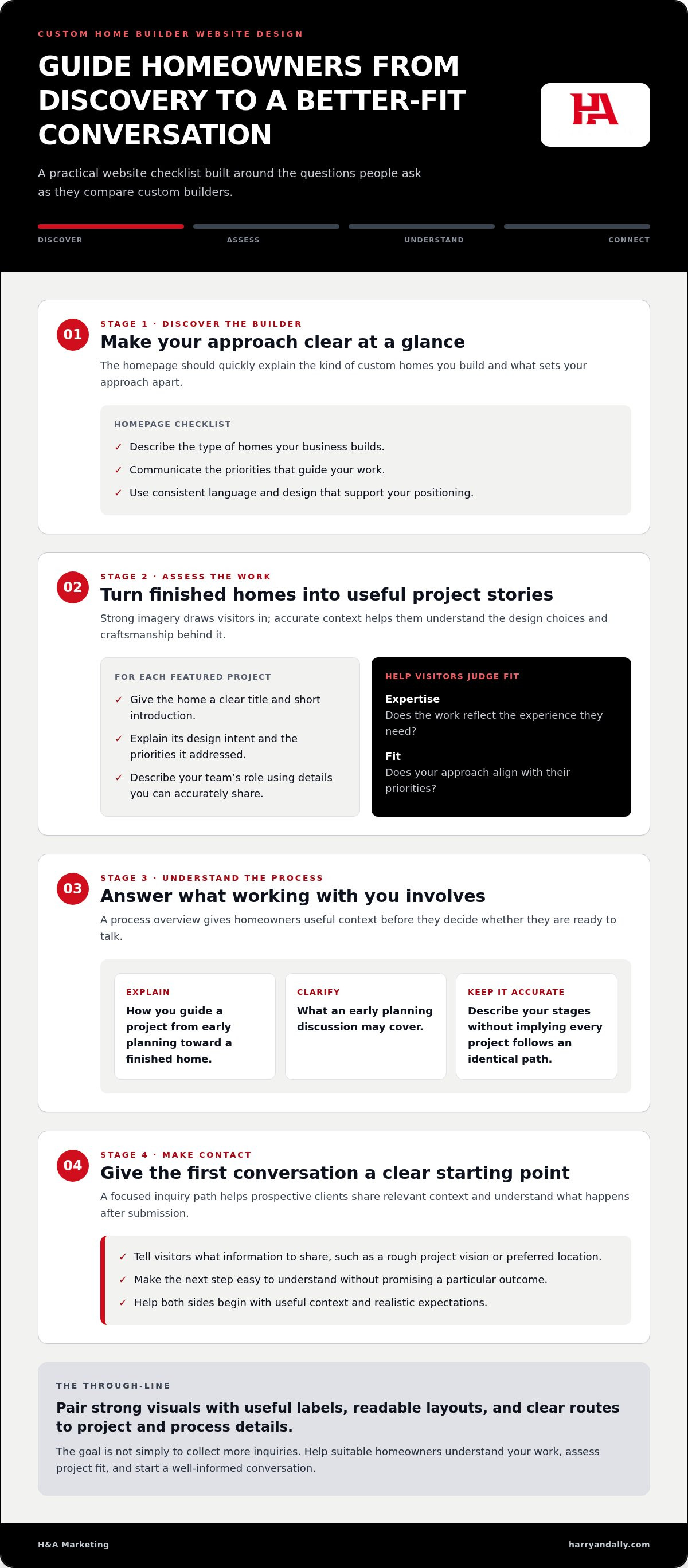
Homeowners rarely move from first visit to inquiry in a single step. They may discover your business through a search, compare your work with other builders, look for clues about your process, then decide whether they’re ready to talk. Website design for custom home builders should support that sequence, giving visitors a clear next step at each stage without pushing them to inquire before they have enough context.
A journey-led website turns each homeowner question into a useful next step, from finding the right project story to starting a well-informed conversation.
- Discover the builder: A clear homepage explains what kind of custom homes you build and what sets your approach apart.
- Assess the work: Portfolio pages help visitors find projects that reflect their design interests and priorities.
- Understand the process: A dedicated overview answers what to expect before, during, and after early planning discussions.
- Make contact: A focused inquiry path tells prospective clients what information to share and how to begin.
Keep the experience consistent from page to page. If your positioning is refined and design-led, the language, typography, spacing, and calls to action should support that impression. Avoid mixing premium visuals with generic promises or cluttered navigation. Every page should make it easier to understand your work, not compete for attention.
Use portfolio storytelling to show scope and craftsmanship
Strong project imagery draws visitors in; concise, accurate context helps them understand what they’re seeing. For each featured home, explain its design intent, the priorities it addressed, and your team’s role. For instance, note how the layout supports the owners’ stated needs, if that detail is accurate and appropriate to share. Useful custom home builder website examples can offer portfolio patterns to consider, but adapt the structure to your projects and brand rather than copying another builder’s presentation.
Give each project a clear title and a short introduction before visitors explore the gallery. Add captions where they clarify a design choice or detail. Don’t imply that your team completed work outside its role, or claim an outcome that you can’t substantiate. Specific, factual descriptions build a more credible portfolio than broad claims about exceptional quality.
Make the path from research to inquiry feel clear
Use navigation labels homeowners can understand at a glance, such as “Projects,” “Our Process,” and “About.” Connect related pages so a visitor can move from a project story to the process behind your work without hunting through menus. Place calls to action where they fit naturally: invite visitors to discuss a project after they’ve had a chance to review your approach, and keep the wording direct.
“Talk about your custom home project” sets a clearer expectation than “Learn more.” A brief contact form can request relevant starting details, such as the project location, goals, and current stage of planning. This gives a prospective client a straightforward way to share context without implying that submitting a form guarantees a particular result.
Thoughtful builder-focused website design brings the story, navigation, and inquiry path together so homeowners can assess fit and decide when they’re ready to take the next step.
How to Evaluate Website Design for Custom Home Builders
A site can look refined and still leave homeowners unsure what you build, how your projects differ, or what to do next. Evaluate the full experience, not just the home page or visual style. The right approach depends on your project mix, brand, and ability to keep useful content current. A beautiful design alone can’t establish project quality or predict future inquiry volume.
Use this comparison to weigh the trade-offs. “Connected custom strategy” means the website’s messaging, design, search structure, inquiry path, and measurement are planned to work together.
Use the matrix as a starting point, not a scorecard. Review custom home builder website features for additional items to consider, then judge each against your business priorities.
Compare design approaches against business priorities
A focused builder with a tightly curated portfolio may need a simple structure: a concise overview, selected projects, process information, and a clear inquiry path. A builder with varied home styles or project types may need more pathways, so visitors can find relevant work without sorting through one long gallery. In either case, judge more than polish: can homeowners understand the offer, navigate easily, and see how to take a suitable next step?
Judge whether the website supports qualified opportunities
Check that the site clearly states the kinds of projects you pursue and how you work. Keep inquiry forms focused, inviting useful context such as project goals and planning stage without demanding details a homeowner may not have yet. Track where inquiries come from and assess their fit against your project scope. These signals help guide future improvements; they don’t guarantee a particular volume or quality of leads.
For website design for custom home builders, the strongest evaluation connects brand fit with practical ownership and measurement. Make sure the site can be maintained and reviewed as your portfolio and priorities change.
Plan a Custom Home Builder Website Project From Brief to Launch
A clear project sequence keeps design decisions tied to business needs. Before choosing page layouts or writing copy, agree on what the site needs to communicate, who it should reach, and how you’ll assess whether it’s serving the business. For website design for custom home builders, that means planning for the homeowner’s questions and your team’s practical needs from the start.
- Set business goals and positioning. Define the projects you want the site to represent, the strengths that distinguish your approach, and the types of inquiries that are a good fit. Be specific: a focus on architect-led custom homes calls for different messaging than a business pursuing a broader mix of projects.
- Map pages to homeowner questions. Create a page plan around what visitors need to understand, such as your work, process, team, and next steps. Connect each page to an appropriate action, whether that’s exploring a project, learning about your approach, or sharing an inquiry.
- Prepare content and creative. Gather approved portfolio images, accurate project details, service information, and answers to questions homeowners commonly raise. Build messaging around evidence you can support. Coordinate written project context with professional builder photo and video when visual content can clarify the work or strengthen the portfolio story.
- Build for search and lead capture. Use clear page titles, descriptive headings, and useful copy that reflects the services and project focus of your business. Make calls to action easy to find. Plan how inquiry details and their source will be recorded, so website activity can be reviewed alongside follow-up.
- Review, launch, and refine. Before launch, check that navigation works, copy is accurate, forms submit correctly, and key pages are easy to use on mobile. After launch, review engagement and inquiry quality, then adjust content or pathways when those signals reveal confusion or a mismatch.
Prepare the strategy, content, and creative inputs
Bring the people closest to the projects into planning. They can clarify what the company builds, how the work is approached, and which homeowner concerns deserve a direct answer. For each featured project, organize the images and verified details together. That makes it easier to shape a consistent story instead of writing captions from memory late in production.
Launch with measurement and a connected marketing plan
A website works best as part of a connected marketing system. SEO can help homeowners find relevant pages; paid traffic can direct audiences to focused information; lead capture gives interested visitors a clear way to respond. Review which pages people engage with, where inquiries originate, and whether those inquiries align with your project focus. Use what you learn to guide sensible updates, not to assume every change guarantees a result.
Discuss a website strategy for your building business
Turn Website Design Into a Connected Marketing System With H&A
A website is more useful when the work around it points in the same direction. For a custom home builder, that means aligning the brand story, project content, search visibility, advertising, and inquiry follow-up around the kinds of homes and clients the business wants to attract. H&A Marketing brings these pieces together as a connected marketing system for construction businesses, coordinating strategy, creative, traffic, and lead capture.
Connect the website to the rest of the marketing system
Each part has a distinct role. Website design gives homeowners a place to understand your work and take a next step. SEO helps relevant pages appear for people researching builders and custom-home services. Google and Meta Ads can direct prospective clients to focused pages, while CRM tracking helps organize inquiries and record how they reached you. Lead generation connects those activities to practical capture and follow-up.
Consistent messaging matters at every handoff. A homeowner who sees an ad about architect-led homes should land on a page that explains that focus, shows relevant project work, and offers a clear way to inquire. If the website, ad, and follow-up communicate different priorities, the journey feels disjointed. Professional photo and video can support the same story by giving visitors a closer look at the homes and the details that represent your work.
These channels need a shared plan, not just a collection of services. Decide which project types matter most, then align page topics, search content, campaign messaging, and inquiry questions around that focus. The broader guide to marketing for custom home builders offers additional context for thinking beyond the website alone.
Make the next step practical for a busy builder
Marketing coordination should make decisions easier, not add another disconnected task to your week. A collaborative partner can help organize the strategy, creative, traffic, and lead capture, while you provide the business knowledge that gives the work substance: which projects represent your strengths, what homeowners often misunderstand, and which opportunities best fit your team.
Start by bringing three things to a strategy conversation: your website goals, the challenges you see in your current marketing, and the project types you want to attract. That gives the discussion a practical center. It also helps connect design choices to business priorities, from how the portfolio is presented to what information an inquiry form should collect.
H&A’s custom home builder website design brings builder-focused strategy and creative into the website planning process. If you’re ready to discuss your goals and current challenges, explore the service and start a conversation about the right direction for your site.
Give Your Website a Clear Job to Do
Your next website decision doesn’t have to start with colors, layouts, or a new gallery. Start with the projects you want to attract and the questions homeowners need answered before they reach out. That focus gives website design for custom home builders a practical direction, and helps keep future marketing decisions tied to your business priorities.
Website design is H&A Marketing’s primary service, and H&A works with construction businesses nationally. Your website can also connect with SEO, lead generation, branding, and visual content, giving each part of your marketing a shared purpose. The goal is a clear, credible online experience that helps suitable homeowners understand your business and choose a confident next step, without promising a particular result.
A thoughtful plan is a strong place to begin. Build a site that reflects the work you want to be known for and gives the right clients a clear way to move forward.
Frequently Asked Questions
How much does website design for custom home builders cost?
Costs vary with scope, not just the number of pages. A proposal can separate strategy, design and development, content migration, integrations, and any visual production so you can see what’s included. Clarify which ongoing expenses, such as hosting or maintenance, are separate from the initial project. H&A Marketing provides website design, and a project-specific quote is more useful than a generic price range that may describe a different scope.
How long does it take to design a custom home builder website?
There’s no standard turnaround that fits every project. The work can take longer if the existing site has many pages to review, content needs substantial editing, or several people need to approve decisions. Before the project starts, agree on review dates, who gives final approval, and how feedback will be consolidated. Prompt, clear decisions help prevent avoidable pauses without requiring rushed approvals.
Can a custom home builder website attract better-qualified leads?
Yes, it can support better-fit inquiries, though it can’t qualify every project by itself. State who your firm is best suited to serve and what an initial conversation typically covers, without implying every request will be accepted. You might also provide a simple planning worksheet that helps homeowners organize their goals before reaching out. That can make early discussions more focused, while your team confirms project fit directly.
Should custom home builders use a template or a custom-designed website?
Choose the approach that fits how your team will manage the site after launch. Test routine tasks before deciding: can staff add a project, update a team bio, or revise a page without disrupting the layout? A template may support straightforward edits, while a custom-designed site may better match a more specific content workflow. Factor in who will maintain pages and how often your portfolio changes.
What content should a custom home builder prepare for a website project?
Along with project descriptions and brand information, gather the original image files and confirm which photos are approved for public use. Keep notes about project names, design details, and the roles of people or partners involved so captions stay accurate. Check that team members’ titles and biographies are current. A simple content inventory can help identify missing materials before page production begins and reduce last-minute substitutions.
Does a custom home builder website need SEO from the start?
Yes. If you’re replacing an existing site, document the current page addresses before making changes. Decide which pages should keep their URLs and where any retired pages should lead, so useful existing paths aren’t discarded without a plan. Also make sure new pages can be found and indexed. H&A’s SEO services can coordinate search planning with website work.
How can a builder measure whether a website is working?
Set up measurement before launch and test it. Submit a test inquiry, confirm it reaches the right inbox or CRM, and check that its source is recorded once rather than duplicated. Then connect inquiries to later sales stages, such as a meeting or proposal, using a consistent process. Because custom-home decisions can take time, compare groups of inquiries by the date they first arrived instead of judging the site on a short snapshot.
