

Article by
Harry Stanley III
Harry Stanley III is a construction marketing strategist and fractional CMO at H&A Marketing. He has helped construction companies grow through website strategy, SEO, paid advertising, branding, lead generation, CRM systems, and professional content. His past work includes helping Meraki Solar generate an additional $3.7 million in revenue in his first year and supporting American Builders as a fractional CMO. Today, Harry works directly with custom home builders and construction companies to build marketing systems designed to generate qualified leads and measurable growth.
More marketing activity won’t fix a commercial roofing pipeline if no one is setting the direction. A fractional CMO for roofing companies provides senior marketing leadership on a flexible basis, connecting customer acquisition goals with business growth. Rather than simply adding another person to execute tactics, this role sets priorities and oversees the work.
That distinction matters when SEO, paid campaigns, website updates, jobsite photos, and lead follow-up operate in separate lanes. Commercial roof restorations and replacements involve considered buying decisions, so marketing must reach facility managers and property owners, attract qualified enquiries, and support consistent follow-up throughout the sales process.
You’ll learn what this leader is responsible for, how an engagement can move from a baseline review to strategy and ongoing oversight, and what to expect from the working relationship. We’ll also explain how a fractional CMO coordinates internal teams and marketing vendors, evaluates campaign performance, and connects activity to measures such as inspections booked, estimates advanced, and revenue by channel. The goal is a clear, coordinated marketing system, not more disconnected tasks.
Key Takeaways
- Look for senior marketing leadership when your commercial roofing activity lacks a clear strategy, not simply another person to handle tasks.
- Track qualified enquiries, scheduled inspections, estimate conversion, customer acquisition cost, and revenue by channel to see what is contributing to booked work.
- Expect the engagement to move from reviewing the baseline and setting priorities to overseeing execution and assessing results.
- Connect marketing decisions with sales follow-up so facility managers and property owners receive a consistent path from first enquiry to proposal.
- Set clear priorities and performance expectations for marketing vendors, with campaigns aligned to the restoration and replacement work you want to win.
What does it mean to be a fractional CMO for roofing companies?
A fractional CMO provides senior marketing leadership on a flexible basis. The role sets strategic direction and aligns marketing decisions with commercial roofing goals.
CMO, Manager, and Agency Roles
A marketing manager often coordinates execution, while an agency handles agreed services such as advertising or SEO. A fractional CMO sets priorities across those roles and connects their work to restoration, coating, and replacement goals. For a contractor hiring its first dedicated marketing resource, understanding the difference helps clarify whether the immediate need is leadership, daily execution, or both.
When assessing a fractional CMO, look for someone who can translate business goals into a focused plan and coordinate the people responsible for carrying it out. They should also establish how progress will be measured, including qualified project enquiries, customer acquisition cost (CAC), and sales close rate. These measures are more useful when reviewed by service line and lead source.
Marketing claims in the United States should be truthful and supportable, and campaigns should follow applicable advertising and privacy requirements. State rules and campaign details can affect what applies, so avoid unsupported promises about savings, insurance outcomes, or project results.
To assess a fractional CMO, consider their understanding of commercial roofing sales and how they connect marketing activity with business outcomes. Ask how they’ll define qualified opportunities, set priorities, and communicate with internal staff and vendors. Clarify decision-making responsibilities and access to lead information before work begins. Risks include unclear ownership, limited visibility into sales outcomes, and recommendations that exceed the company’s ability to respond.
Seasonal and Local Market Planning
Seasonal planning should reflect historical demand, local buying patterns, and available sales and project capacity. A CMO can adjust campaign emphasis as needs change, rather than keeping restoration and replacement messages unchanged all year.
Local planning also means aligning service-area information and campaign targeting with the contractor’s actual markets. For example, roof-coating messages should reach property owners considering that service, while replacement campaigns address a different project need. This focus helps marketing attract more relevant engagement.
Vendor coordination makes the strategy actionable. The CMO briefs specialists on the target audience, campaign purpose, and intended outcome, then checks whether execution matches the plan. For example, a lead-generation campaign should be assessed by whether enquiries meet the contractor’s commercial project criteria, not just by enquiry volume. Clear handoffs help the sales team respond consistently.
Review performance by channel and project type to see where qualified opportunities originate. If one source brings relevant restoration enquiries while another attracts replacement prospects, that distinction can guide future priorities. Connecting lead-source records with sales outcomes helps leadership make decisions based on actual pipeline contribution. The same process can show whether campaign changes improve engagement or simply shift activity between channels.
Fractional CMO engagement timeline and expectations
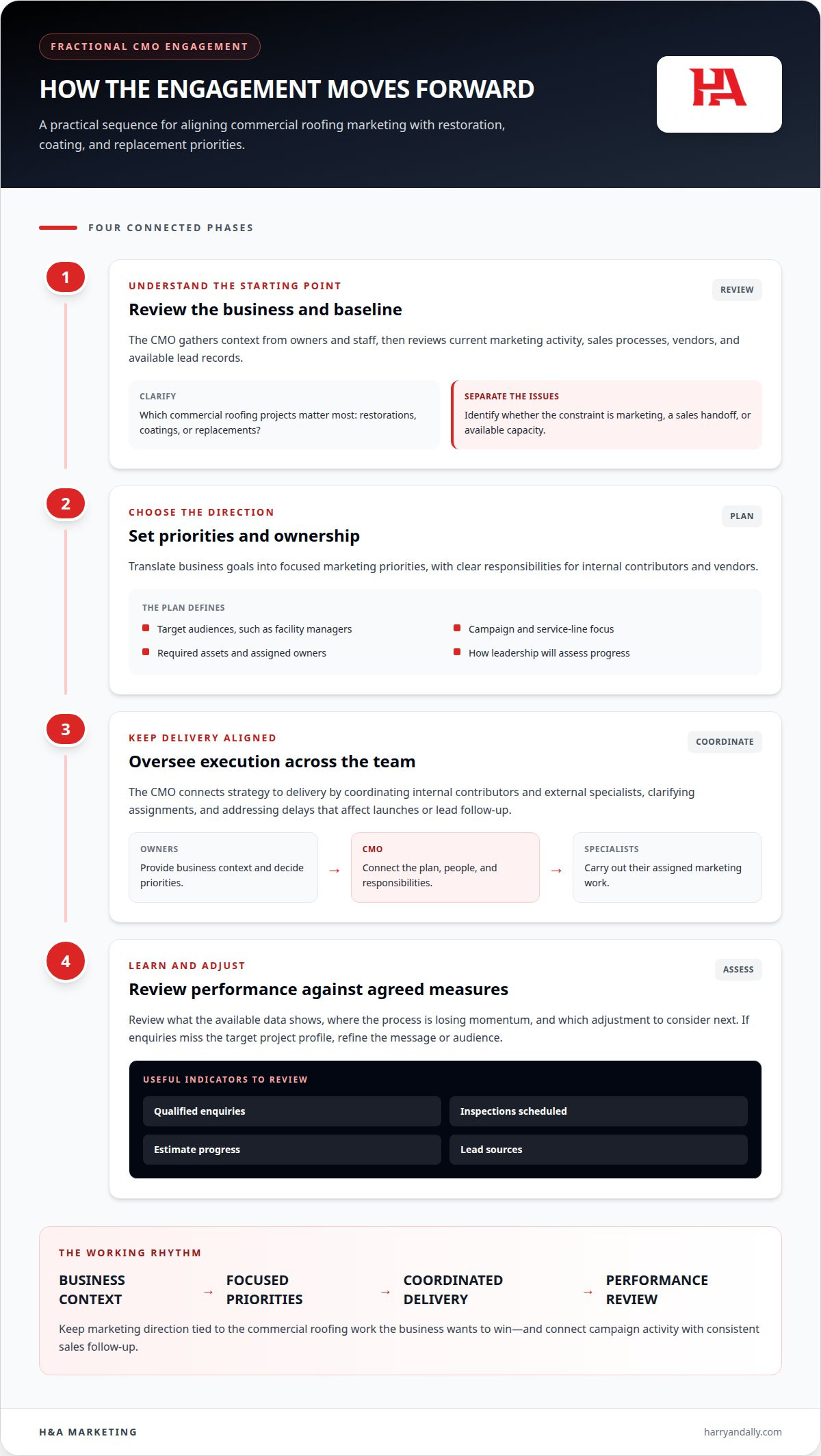
A fractional CMO engagement should move from understanding the business to directing focused marketing work. It begins with information from owners and staff, then builds toward strategic decisions, execution oversight, and performance reviews. Clear expectations keep the engagement tied to commercial priorities, rather than a calendar full of disconnected tasks.
The opening phase establishes the company’s starting point. The CMO reviews marketing activity, sales processes, current vendors, and available lead records. Owners explain which commercial roofing projects matter most, such as restorations, coatings, or replacements. This context helps distinguish a marketing problem from a sales handoff issue or a capacity constraint.
Next, the CMO sets strategic priorities and defines responsibilities. The plan should identify target audiences, campaign focus, required assets, and the person responsible for each action. For example, if facility managers are a priority, service messaging, website content, and enquiry handling might all be tailored to their needs. The team should understand what is being produced and how leadership will assess progress.
During execution oversight, the CMO coordinates internal contributors and external specialists. This can include reviewing campaign direction, clarifying vendor assignments, and resolving delays that affect launch or lead follow-up. Owners provide business context and decide priorities, while marketing specialists carry out their assigned work. This division keeps strategic leadership connected to day-to-day delivery.
Performance reviews compare activity with the engagement’s agreed measures. Useful indicators may include qualified enquiries, inspections scheduled, estimate progress, and lead sources. The CMO explains what the available data shows, where the process is losing momentum, and which adjustment to consider next. If a campaign attracts enquiries outside the contractor’s target project profile, the response may be to refine the message or audience.
There is no universal timetable for meaningful results. The pace depends on the starting condition of the marketing system, the channels involved, the company’s sales follow-up, and how quickly decisions and campaign changes can be made. Paid campaigns, website updates, and organic search also produce different kinds of progress, so expectations should reflect the work being done.
Engagement scope and fees depend on leadership needs, vendor coordination, channel complexity, and the level of execution oversight required. Before work starts, clarify access to marketing and sales information, decision-making responsibilities, communication cadence, and what each review will cover. A useful update connects completed actions to current priorities without overwhelming owners with activity reports.
At each review, the CMO and company leadership should decide what to continue, change, or stop. That creates a practical cycle of direction, execution, and learning. Contractors considering a more coordinated commercial roofing marketing approach can use this structure to set clear expectations from the start.
Fractional CMO responsibilities for roofing companies
A fractional CMO turns commercial roofing goals into a coordinated marketing plan. For restoration, coating, and replacement work, that means setting direction, choosing channels, and connecting campaigns with sales follow-up. The focus is on generating demand for actual projects, not attention without qualified opportunities.
The CMO manages channel strategy across organic search, paid ads, social media, website content, and jobsite photography or video. They decide how each channel supports outreach to facility managers, visibility among property owners, and the company’s commercial project goals. Specialists may carry out the work, while the CMO keeps priorities and performance connected.
Seasonal planning starts with historical demand and the company’s capacity to respond. A CMO can shift campaign emphasis as local conditions and customer needs change, while coordinating messages for roof restoration, coatings, or replacement. That direction helps avoid sending the same offer to every prospect all year.
Local search work includes keeping the Google Business Profile’s contact details, service areas, and roofing services accurate. The CMO can also coordinate city-specific service pages and review requests after completed projects. For a contractor expanding into a nearby market, these steps help align local visibility with the areas crews can serve.
Website and SEO priorities should answer questions commercial buyers raise before requesting an inspection. A page about roof restoration can explain the service, show relevant project photography, and give facility managers a clear next step. A CMO can coordinate SEO strategy and execution around these pages, then monitor search visibility, traffic, and enquiries.
Paid campaigns need distinct audiences and landing pages. For example, a roof replacement campaign should not automatically use the same message as a coating campaign. The CMO reviews targeting, campaign results, and budget allocation, then directs specialists toward the channel and offer that best fit the company’s goals.
Marketing must also connect with the sales process. The CMO can establish lead qualification criteria, organize enquiries by service need, and review response times with the sales team. A facility manager requesting a replacement assessment needs a clear handoff, while an early-stage coating enquiry may call for different follow-up.
Performance reviews should connect channel activity to business outcomes. Track qualified enquiries, scheduled inspections, estimate conversion, customer acquisition cost, and revenue by marketing channel. If a campaign generates clicks but few relevant inspections, the CMO can investigate its audience, message, landing page, and sales handoff before recommending additional spend.
That accountability creates a consistent cycle: set priorities, coordinate execution, review results, and adjust direction. If campaign data shows that another channel generates more qualified opportunities, the CMO can recommend shifting budget toward it. The decision should reflect lead quality and pipeline contribution, not clicks alone.
Vendor accountability and campaign strategy
For a commercial roofing contractor, a fractional CMO connects campaign strategy with vendor execution. Each specialist needs a defined audience, deliverable, and business outcome, from restoration enquiries to replacement opportunities.
The CMO begins by mapping vendors to the work they own. An SEO specialist may improve service-page visibility, while an advertising partner manages Google Ads. A website team supports landing pages and enquiry paths. The CMO sets shared priorities, clarifies handoffs, and checks whether each assignment supports the contractor’s commercial goals.
Campaigns should reflect distinct services and buyer needs. A roof restoration campaign for facility managers needs different messaging from a replacement campaign for property owners. The CMO can align each audience with a focused landing page, relevant project examples, and a clear enquiry action. This gives vendors a specific brief instead of a broad request for more leads.
Accountability starts with an agreed measurement plan. For paid campaigns, review search terms, targeting, spend, landing-page activity, and qualified enquiries. For SEO, monitor local search visibility, relevant website traffic, and customer enquiries. Then connect those results to scheduled inspections and estimates so the team can see whether marketing activity advances real opportunities.
A practical review begins with the contractor’s last ten booked jobs. The CMO traces each job to its originating channel, campaign, or referral source, then compares patterns in project fit and sales progress. If that history shows replacement work coming from one source and restoration enquiries from another, campaign priorities can reflect the actual pipeline.
Optimization needs a clear decision rule, not endless adjustments without a defined outcome. If a roofing marketing channel’s cost per lead has not improved after two rounds of optimization, the CMO can recommend pausing it. Before making that decision, review lead quality, service fit, landing-page relevance, and sales follow-up. A low-cost enquiry has little value if it never becomes a qualified inspection.
Vendor reports should support decisions, not merely document activity. The CMO can request a concise summary of completed work, campaign performance, issues, and next actions. For example, if Google Ads generates enquiries for work outside the contractor’s target services, the advertising partner can refine keywords and messaging. The CMO then checks whether the change improves qualified engagement.
Clear ownership keeps execution moving. The CMO assigns each action to a vendor or internal lead, defines the expected deliverable, and follows up on unresolved blockers. A website update, campaign change, and sales handoff can all affect a prospect’s journey. Coordinating those tasks helps contractors judge marketing by the outcomes it supports, not by isolated vendor activity.
Fractional CMO services for roofing companies
For commercial roofers, fractional CMO services should connect strategy with the work that generates qualified opportunities. The leader aligns website content, search visibility, paid campaigns, project photography, and sales follow-up around restorations, coatings, and replacements. The value is coordination: every activity supports a defined audience and business goal.
A fractional CMO can help generate and qualify leads by defining the target project and buyer, then aligning campaign messages with that profile. They can also establish qualification criteria, organize enquiries by service need, and coordinate follow-up so sales staff can prioritize relevant opportunities.
For example, a facility manager researching roof restoration needs a different path from a property owner seeking a replacement proposal. A CMO can shape service pages around those needs, make calls to action clear, and ensure enquiry information reaches the right sales contact. Conversions depend on the connection between relevant traffic, useful content, and a responsive sales process.
Search strategy can support both immediate visibility and sustained demand. Google Ads can target commercial roofing searches in the contractor’s service area, while SEO builds useful pages around services and recurring buyer questions. The CMO sets priorities between these channels based on target markets, sales capacity, and the projects the company wants to attract.
Creative work should make the contractor’s expertise tangible. Jobsite photography and video can show completed restoration or replacement projects, explain the work process, and give prospects relevant proof. A CMO coordinates this content with website pages, social posts, and campaign creative so each project story can support several connected marketing activities.
Branding also shapes how commercial buyers understand the company. Consistent language, visual identity, and service descriptions help a facility manager recognize what the contractor does and where it works. The CMO can align these elements across proposals, digital campaigns, and the website, rather than treating each as a separate design task.
Lead tracking and follow-up complete the system. A CMO can work with the team to define how enquiries are recorded, assigned, and advanced from first contact to inspection or estimate. That visibility helps distinguish a low-quality form submission from a commercial opportunity that warrants timely sales attention.
Use connected services when the gap spans multiple channels. If the website attracts visitors but fails to convert relevant prospects, the CMO can prioritize changes to messaging, project examples, and enquiry paths. If campaigns bring in the wrong work, adjust targeting and landing pages before increasing spend. The goal is a measurable system tied to qualified pipeline and revenue.
Discuss your commercial roofing marketing strategy
H&A Marketing
H&A Marketing helps commercial roofing contractors connect marketing priorities with practical execution. If you need a clearer path from reaching facility managers to generating qualified enquiries, coordinated website design, SEO, lead generation, and branding can support that goal. The right starting point depends on the gap: a website that fails to convert, low visibility for restoration and replacement services, or enquiries that don’t match your target projects.
H&A can align those priorities into a connected commercial roofing marketing approach focused on relevant opportunities, not activity alone. Schedule a free strategy session with H&A Marketing to discuss your marketing needs.
Set the Next Marketing Priority
A fractional CMO for a roofing company can turn scattered marketing decisions into a clear direction. Start by identifying the bottleneck affecting your commercial pipeline, whether it’s how your company appears to facility managers, how buyers understand your services, or how marketing supports sales conversations.
H&A Marketing helps commercial roofing contractors strengthen the elements behind that plan, including website design, logo design and branding, and SEO. The right starting point depends on your business goal and where prospects lose momentum. A focused discussion can connect those priorities to a practical plan for reaching property owners and facility managers.
With a clear priority and coordinated follow-through, your team can move forward with greater focus and build a marketing system around the commercial work you want to win.
Frequently Asked Questions
Can you work with my existing marketing team?
Yes, a fractional CMO can work alongside your existing marketing team and vendors. Start by clarifying who owns each task, such as writing service-page content, managing campaigns, or following up with facility managers. For example, an in-house coordinator might handle project information while specialists manage SEO or advertising. Clear responsibilities help prevent duplicate work and give your team one direction to follow.
How long before I start seeing results?
Roofing clients typically start seeing traction within 6-8 weeks, though the kind of progress depends on the work underway. A revised enquiry process may show early operational changes, while stronger organic visibility takes longer to build. For a commercial contractor, useful early signs include more relevant inspection requests or clearer lead-source records. Evaluate progress against the starting baseline, not against activity alone.
What does a fractional CMO do for a roofing company?
A fractional CMO provides senior marketing leadership without serving as a full-time employee. For a commercial roofer, that can mean setting priorities for restoration and replacement campaigns, aligning internal staff and specialists, and connecting marketing decisions to sales needs. The role also helps leadership decide what to address first, such as unclear service messaging, missed enquiries, or campaigns attracting projects outside the company’s target profile.
What results and KPIs should roofing companies expect from a fractional CMO?
Set expectations around measurable progress, not a promised number of jobs. A useful scorecard can include qualified enquiries, inspections scheduled, estimates issued, estimate conversion, customer acquisition cost, and revenue by source. For example, if more enquiries arrive but few fit the company’s commercial project profile, the team can examine targeting and qualification. Compare performance with a baseline and review changes alongside sales capacity.
How does a fractional CMO compare with a full-time CMO or marketing agency for roofers?
A full-time CMO provides dedicated leadership, while a fractional CMO supplies senior direction on a flexible basis. An agency typically executes specific services, such as SEO or advertising, within an agreed scope. A commercial roofer may choose fractional leadership when multiple specialists need coordination but a full-time executive role is not the right fit. The deciding factor is whether the company needs strategic oversight, execution, or both.
What should a fractional CMO's first 90 days look like at a roofing company?
The first 90 days should move from assessment to action and review. Early work establishes the baseline across marketing, lead handling, and sales; the next phase sets priorities and briefs the people responsible for execution. Later, the CMO reviews campaign and pipeline signals, identifies bottlenecks, and proposes the next cycle’s priorities. Owners should expect clear decisions, accountable assignments, and a review grounded in company data.
How much does a fractional CMO cost for a roofing company?
The fee depends on leadership needs, vendor coordination, channel complexity, and the level of execution oversight required.
