
Local SEO for Commercial Roofers: How to Rank in Your Service Area


Article by
Harry Stanley III
Harry Stanley III is a construction marketing strategist and fractional CMO at H&A Marketing. He has helped construction companies grow through website strategy, SEO, paid advertising, branding, lead generation, CRM systems, and professional content. His past work includes helping Meraki Solar generate an additional $3.7 million in revenue in his first year and supporting American Builders as a fractional CMO. Today, Harry works directly with custom home builders and construction companies to build marketing systems designed to generate qualified leads and measurable growth.
A strong commercial roofing reputation doesn’t help if local property owners can’t find your company when they need a restoration or replacement. Local SEO for commercial roofers combines service-area keywords, Google Maps visibility, useful website content, and relevant local backlinks so nearby decision-makers can discover and evaluate your business.
Referrals and relationships matter: commercial roofing projects often depend on trust, timing, and a clear fit for the building. Local search can also help facility managers and property owners find your services as they research their options. A well-rounded approach makes it easier for them to understand your work and decide what to do next.
This guide explains how roofing SEO works, how to distinguish commercial-intent searches from residential ones, and what can strengthen visibility in Google Search and Maps. You’ll also learn how to build credible local backlinks, evaluate an SEO partner, and connect search activity to qualified project inquiries, not just website traffic.
Key Takeaways
- Choose keywords that signal commercial projects, such as roof restoration or replacement, and connect them to the locations you serve.
- Strengthen your Google Business Profile and website so facility managers can quickly understand your services and contact your team.
- Build local visibility through relevant, credible backlinks rather than chasing link volume.
- Use a website audit to spot technical issues, unclear service pages, and barriers that can prevent qualified prospects from reaching out.
- Evaluate an SEO partner by how clearly they explain their strategy and connect search activity to meaningful roofing inquiries.
Commercial versus residential roofing keywords
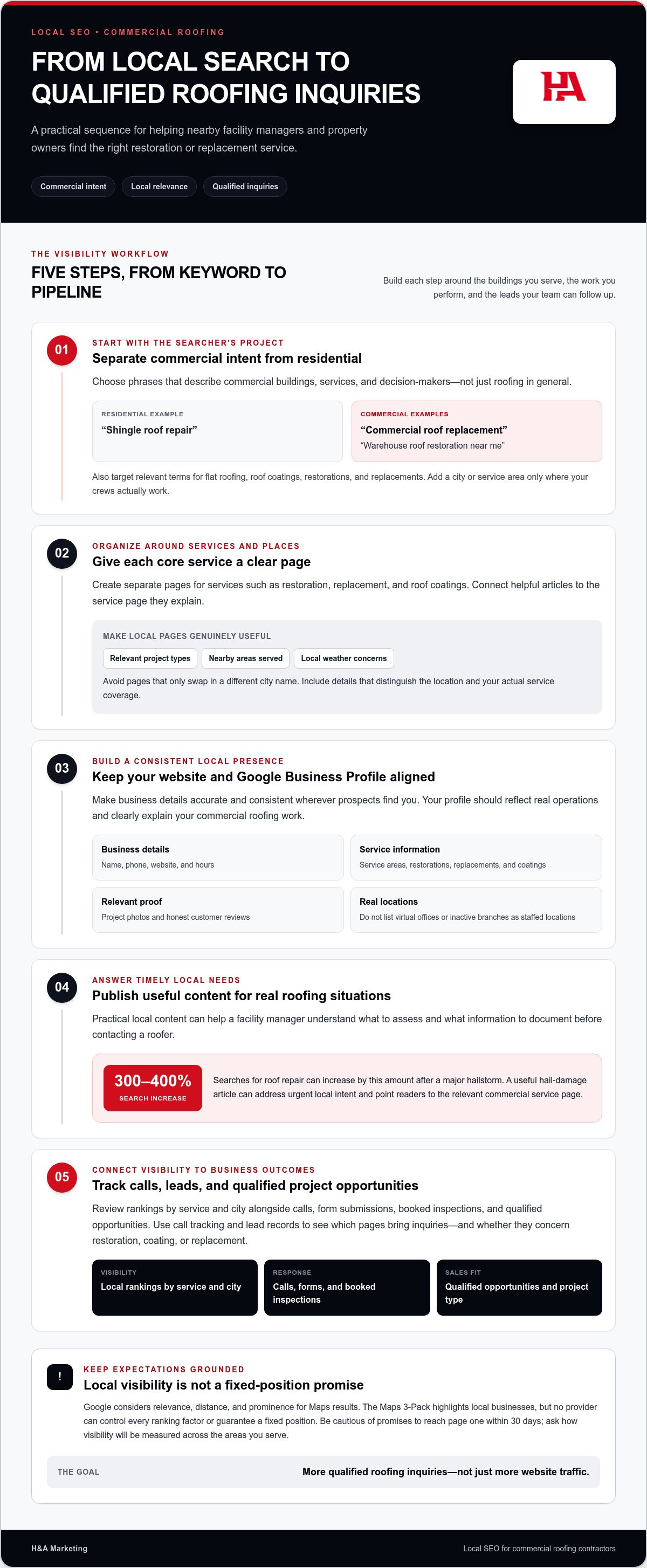
Local SEO for commercial roofers works best when keywords reflect the buildings, services, and decision-makers you target. Build local relevance with accurate service-area pages, a complete Google Business Profile, useful roofing content, and internal links between related pages. Measure whether these efforts generate calls and qualified inquiries, not just visibility.
Commercial and residential searches often describe different projects. A homeowner may search for “shingle roof repair,” while a facility manager may look for “commercial roof replacement” or “warehouse roof restoration near me.” Target phrases related to flat roofing, roof coatings, commercial restorations, and replacements. Add a city or service area only if it reflects where your crews actually work.
Search intent reveals where a prospect is in the customer journey. Someone searching for “commercial roof leak repair” may need a prompt assessment, while “commercial roof restoration versus replacement” suggests they’re researching a project. Create separate pages for core services, then support them with practical articles. For example, a guide to coating an aging flat roof can link to your commercial restoration page.
Write service-area pages with details that distinguish each location, not just a swapped city name. Include relevant project types, nearby areas served, and examples of local weather concerns. A post about hail damage can explain what facility managers should document after a storm. Searches for roof repair can increase by 300-400% after a major hailstorm, so timely, useful content can address urgent local intent.
Local ranking depends on relevance, prominence, and how clearly your business information supports the search. Keep your company name, address, phone number, service details, and website consistent across your site and Google Business Profile. Google’s AI Overviews often list 2 or 3 roofers by name before regular search listings, making clear service information and credible local signals valuable. For guidance on improving search visibility, explore search engine optimization.
Measure rankings, calls, and leads together. Review local keyword positions by service and city, then compare changes with calls, form submissions, booked inspections, and qualified opportunities. Use call tracking and lead records to identify which pages generate inquiries, and note whether each prospect is interested in restoration, coating, or replacement. This connects search activity to the sales pipeline.
- Map each commercial service to a specific keyword and location.
- Link supporting articles to the service page they help explain.
- Review rankings alongside calls and qualified project inquiries.
What Should I Look For In a Professional Roofing SEO Company?
Choose a partner who can explain Google Business Profile setup, Maps visibility, reviews, and lead tracking in practical terms. If you’re a service-area roofer, keep your profile accurate about your business, contact details, and the areas where crews work. Don’t present virtual offices or inactive locations as staffed branches.
Google Business Profile Setup and Optimization
Start with ownership, accurate business details, and a profile that reflects your commercial roofing work. Check the business name, phone number, website, hours, service areas, and primary category for accuracy. Use the available service and description fields to clarify whether you handle commercial restorations, replacements, or roof coatings. Every detail should match your website and actual operations.
Ask how the profile will be maintained after setup. A useful process includes updating service information, adding relevant project photos, and checking for incorrect edits. If your company stops offering a service, remove outdated profile details so they don’t continue attracting mismatched inquiries.
Maps 3-Pack Visibility
The Maps 3-Pack displays local businesses prominently in Google results, but no provider can control every ranking factor or promise a fixed position. Google considers whether a business fits the search, its distance from the searcher, and its prominence. Ask an SEO company how it will improve profile relevance and local prominence, then how it will report visibility across the cities you serve.
Be cautious of a promise to reach page one within 30 days. A credible provider explains its work, reporting method, and realistic milestones without guaranteeing a ranking. Look for separate tracking of searches such as “commercial roof replacement” and “roof restoration” in your target areas. One ranking snapshot cannot show visibility across every location.
Reviews and Business Information
Google reviews help prospective customers assess a roofing company before making contact. Develop a consistent process for requesting honest feedback after completed work, and respond professionally to reviews. A reply can clarify the project type or show that your team takes concerns seriously, without disclosing private project details.
Make sure your business name, phone number, and website match across your profile and website. An outdated phone number on one listing, for example, could send a facility manager to the wrong contact. A strong SEO partner will identify mismatches and explain how corrections are monitored.
Organic Traffic and Business Growth
More organic traffic matters only when it reaches the right pages and leads to relevant inquiries. Ask for reporting that separates commercial roofing visitors from unrelated traffic, then connect page activity with calls, form submissions, and qualified project opportunities. A page attracting searches for residential shingle repairs may increase visits without supporting a commercial bid pipeline.
Set a baseline before work begins. Review traffic to restoration and replacement pages, their search visibility, and the inquiries they generate. Compare those measures over time, accounting for the location and service behind each lead. A useful SEO strategy connects performance with sales conversations, not just sessions or impressions.
Use these criteria to assess an SEO partner’s plan and reporting. For a closer look at SEO strategy for construction companies, focus on how the work connects local visibility with qualified commercial roofing inquiries.
Local SEO and Google Maps visibility for roofing contractors
Google Maps visibility takes more than adding a city name to a roofing business profile. Strong local SEO connects an accurate Google Business Profile with relevant website pages and clear service information, helping nearby prospects understand what your company handles.
Start with the profile. Enter the correct business name, phone number, website, hours, and service details. Choose categories that accurately describe the roofing business, and keep the profile aligned with the website. If you serve multiple areas without staffed offices, represent your service area accurately instead of creating profiles for places where you don’t operate.
Next, make it easy for Google and potential customers to connect each service with your business. A commercial roof replacement page should explain the work, identify the markets served, and provide a clear way to contact your team. Add relevant project photos and keep business details consistent wherever your company appears online.
Google algorithm updates can affect local visibility, but reacting to every ranking change can send a campaign off course. Compare performance over time and note when a profile, service page, or major site element changes. If a Maps listing shifts, review its accuracy, the searches affected, and whether calls or qualified inquiries changed too. This gives contractors a clearer basis for action than one isolated ranking check.
Google Local Services Ads are paid placements, separate from organic Maps results. Availability and eligibility vary by location and business category, so roofing contractors shouldn’t assume these ads are available to them. Use Google’s setup process to see whether your category and service area qualify. If they do, track ad inquiries separately from organic profile calls to see which channel generates relevant roofing leads.
- Review profile accuracy and service details when your operations change.
- Compare Maps visibility for specific roofing services and target areas.
- Separate paid Local Services Ads leads from organic inquiries.
A useful roofing SEO campaign connects its activities to sales outcomes. Track calls, form submissions, requested services, and service locations, then assess whether inquiries fit commercial restoration or replacement work. Your agency should explain what it changed and how it measures progress, without promising a fixed Maps position.
Maps is one part of a broader commercial roofing marketing system. Keep the profile, organic search work, and lead tracking connected, so visibility supports the projects your team wants to win.
Local backlinks and white-hat link building
For commercial roofing companies, strong local backlinks come from relevant, credible organizations, not sheer volume. Avoid paid link schemes, spam directories, and exchanges designed solely to manipulate rankings. These shortcuts can undermine your SEO strategy and business credibility.
Local Backlinks and Authority Building
A backlink is a link from another website to yours. Links from a local business association, commercial property group, or community organization can connect your roofing company with its market. Relevance matters: a local facility-management association is a stronger fit than an unrelated website with no connection to roofing or your service area.
Build authority by contributing something useful. Share a practical commercial roof maintenance guide with a local property-owner group, or offer storm-preparation advice to a community publication. If an organization references your expertise, its link can help readers find your company and understand your work. A backlink can support visibility, but it doesn’t replace useful pages and accurate business information.
Backlinking and Directory Listings
Directory listings can help customers find your business and reinforce consistent company details. Start with relevant trade associations, local business directories, and commercial property organizations. Check that each listing has the correct company name, phone number, website, and service area. Correct outdated listings rather than creating duplicate entries that confuse prospects.
A directory link is useful when the directory serves a real audience or connects meaningfully to your industry or community. Ask your SEO company to explain why each proposed listing fits your target market. Request the directory name, audience, listing details, and whether the link is paid. Skip directories that accept every business without meaningful review.
Use a simple outreach strategy to build links naturally:
- List local associations and organizations relevant to commercial property.
- Offer useful expertise, such as a roof maintenance checklist for facility managers.
- Ask partners to link to a specific, helpful resource, not a generic homepage.
- Record each outreach contact and the resulting link for follow-up.
Assess backlinks for relevance, placement, and context. A link in an article about maintaining a commercial building has a clearer connection than one buried on an unrelated page. Don’t insist on using exactly the same keyword in every link. Natural wording may include your company name or the title of the resource.
Competition varies by service area, so prioritize relationships that fit your market rather than copying another roofer’s link list. Earn links through genuine expertise and useful local contributions. This builds authority over time while keeping your backlink profile aligned with the commercial roofing work you want to generate.
What Is Search Engine Optimization for Roofers?
Search engine optimization makes roofing companies easier to find and contact. For commercial contractors, that means connecting service pages, technical site health, and clear conversion paths with restoration and replacement searches.
A website audit should assess whether search engines can crawl and understand important pages. Check for broken links, duplicate titles, missing page descriptions, slow-loading pages, and mobile usability issues. Confirm that each commercial service has a dedicated page instead of squeezing coatings, restorations, and replacements into one broad description. A technical issue on the replacement page can limit its visibility even when its content is relevant.
Mobile access matters because facility managers may research contractors from a phone between site visits. Use responsive design so pages adjust to phone and tablet screens. Test the contact form, phone link, and quote request process on a mobile device. A form that fails after submission can waste qualified search traffic.
Conversion optimization makes the next step clear. Add a phone number and quote request option to service pages, and explain what information you need. For example, ask prospects for the building location, roof concern, and requested service. This helps your team distinguish a commercial replacement inquiry from a homeowner seeking shingle repair.
Each page should answer the intent behind its search. A facility manager comparing restoration and replacement options needs practical guidance, while someone searching for commercial roof replacement needs a direct way to discuss the project. Add internal links between related pages, such as a coating guide and the service page it supports. This structure helps visitors and search engines find relevant information.
AI search optimization starts with clear, specific, well-organized answers. State the services, building types, and locations your business serves, then support your claims with useful project details. Make each page’s main point easy to identify rather than hiding it in slogans. When an AI Overview names a source, accurate service information gives readers a useful next step on your site.
For local SEO for commercial roofers, combine technical checks with pages built around qualified commercial work. Track organic traffic, calls, form submissions, and the service requested. A brand-new roofing website typically takes 3-6 months to show meaningful traffic increases from SEO. During that period, use audit findings to resolve site barriers and improve service-page clarity.
Review your website’s technical health and conversion paths with a search engine optimization audit.
H&A Marketing: Website Design
H&A Marketing helps commercial roofing contractors connect website design with SEO and lead generation. Turn to the team when your site doesn’t clearly explain your commercial restoration and replacement services, or when local visitors can’t find a useful next step.
A well-structured website gives each service space to answer customer questions, while clear navigation helps facility managers find relevant information. Pair that structure with search engine optimization and branding that presents a consistent, professional identity. Lead generation then focuses on turning relevant visits into inquiries your team can evaluate.
Explore commercial roofing marketing to see how these elements work together. To discuss your website and local search strategy, contact H&A Marketing or visit harryandally.com.
Build a Local Search System Your Team Can Maintain
Make your next step practical: choose the commercial roofing services and locations that matter most, then assign someone to review search activity and incoming inquiries regularly. This keeps local SEO for commercial roofers connected to the work your crews want, rather than treating visibility as a goal on its own.
When your website or brand doesn’t support your plan, H&A Marketing can bring website design, logo design and branding, and search engine optimization together. The goal is a clear online presence that helps facility managers understand your commercial roofing work and take the next step. Your team brings the market knowledge; a focused marketing strategy gives that expertise a stronger path to local prospects.
Start with the gap holding your pipeline back, whether it’s an unclear service page, an outdated website, or search visibility that doesn’t match your target area. A practical next step can make local growth easier to manage.
Build a stronger connection between local discovery and the commercial projects your business is ready to pursue.
Frequently Asked Questions
What Is Roofing SEO?
Roofing SEO helps people discover a roofing company’s website and local listings through relevant searches. For a commercial contractor, that might mean helping a facility manager find information about roof restoration and a clear way to discuss a building. The work includes understanding buyer needs, improving website content, and measuring whether search activity leads to useful business conversations.
How Does Google Decide Which Roofer to Show on Page One or at the Top?
Google selects results based on how well a business or page matches a search and its context. Results can differ for someone searching broadly for a commercial roofer and someone looking for a specific nearby service. Paid placements are separate from organic rankings. Compare results for the actual services and locations you target instead of relying on one search from your office.
What Is Local SEO and Why Is It Important for Commercial Roofers?
Local SEO helps a roofing company appear in relevant searches tied to its service area. It matters because property managers researching a roof problem need contractors who handle commercial buildings and the project type involved. For example, a commercial roof restoration page can distinguish that service from residential repairs and give prospective customers a relevant starting point.
When Will Roofing SEO Start Bringing in Leads?
Roofing SEO can take six months to begin producing results, depending on local competition. Traffic and leads may not rise together: a page may start appearing in searches before it generates a qualified inquiry. Track meaningful milestones, including relevant impressions, service-page visits, calls, and project-fit inquiries. This helps distinguish steady search improvement from a short-term change in website activity.
How should commercial roofers optimize their Google Business Profile?
Keep the profile accurate and aligned with your actual operations. Review contact details, service information, hours, and photos whenever they change. Make commercial services clear so property managers can distinguish restoration or replacement work from residential roofing. Check that customers reach a working phone number and the right website page when they contact your company.
What local SEO keywords do commercial roofing customers search for?
Commercial customers may search by service, building type, and location. Examples include “TPO roof replacement for warehouses,” “commercial roof coating contractor,” and “office building roof restoration.” Use these phrases as research prompts, then give each page one clear subject. Don’t target a term simply because it sounds popular. The best fit reflects the projects your crews perform and the customers you want to reach.
How can commercial roofers improve local rankings with service-area pages?
Create a service-area page only when it can offer useful, distinct information. Explain which commercial roofing services you provide there, the types of properties you work on, and how prospects can discuss a project. Avoid near-identical pages that only swap location names. Property managers should find practical reasons the page applies to their building, not repeated blocks of generic roofing copy.
How do reviews affect local SEO for commercial roofing companies?
Reviews give prospective customers firsthand insight into working with a roofing company and can support its reputation in local search. Ask customers for honest feedback after a project without scripting reviews or rewarding positive comments. Respond professionally and protect confidential project details. A thoughtful reply to a concern can show future readers how your team handles communication when a project presents challenges.
