
Roofing Contractor Marketing: Proven Growth Guide


Article by
Harry Stanley III
Harry Stanley III is a construction marketing strategist and fractional CMO at H&A Marketing. He has helped construction companies grow through website strategy, SEO, paid advertising, branding, lead generation, CRM systems, and professional content. His past work includes helping Meraki Solar generate an additional $3.7 million in revenue in his first year and supporting American Builders as a fractional CMO. Today, Harry works directly with custom home builders and construction companies to build marketing systems designed to generate qualified leads and measurable growth.
More roofing leads won’t fix a marketing system that sends the wrong prospects to your sales team. Effective roofing contractor marketing connects local visibility with a clear website experience, relevant inquiries, and timely follow-up, so each step supports the kind of work your company wants to win.
If your website, search presence, advertising, and follow-up feel disconnected, you’re not alone. It’s also frustrating when inquiries don’t match your services or priorities, or when you can’t tell which efforts are producing qualified opportunities. More activity isn’t the goal. Better-fit projects and a clearer view of what’s working are.
This guide shows how to build a practical, connected plan around your services, capacity, and growth goals. We’ll cover how to prioritize channels, make it easier for the right prospects to inquire, and track those inquiries through follow-up. The aim is a system your team can improve over time, not a pile of marketing tactics working in isolation.
Key Takeaways
- Set growth priorities around the roofing services, project types, and workload your team can support, not just inquiry volume.
- Use roofing contractor marketing channels according to their role, then measure how they contribute to qualified inquiries and sales conversations.
- Track the path from raw inquiry to won work so you can see where prospects fit, progress, or drop off.
- Build a manageable plan by choosing priorities, defining the audience, selecting channels, and creating the assets needed to support them.
- Coordinate strategy, creative, traffic, and lead capture so your website, search presence, social content, and jobsite visuals work toward the same goals.
Roofing Contractor Marketing Starts With the Right Growth Goal
Marketing should support the roofing work your company is equipped and motivated to take on. That starts with a clear business goal, not a target for more clicks, social followers, or form submissions. A company focused on commercial projects needs a different prospect mix and sales process than one prioritizing residential repairs or replacements.
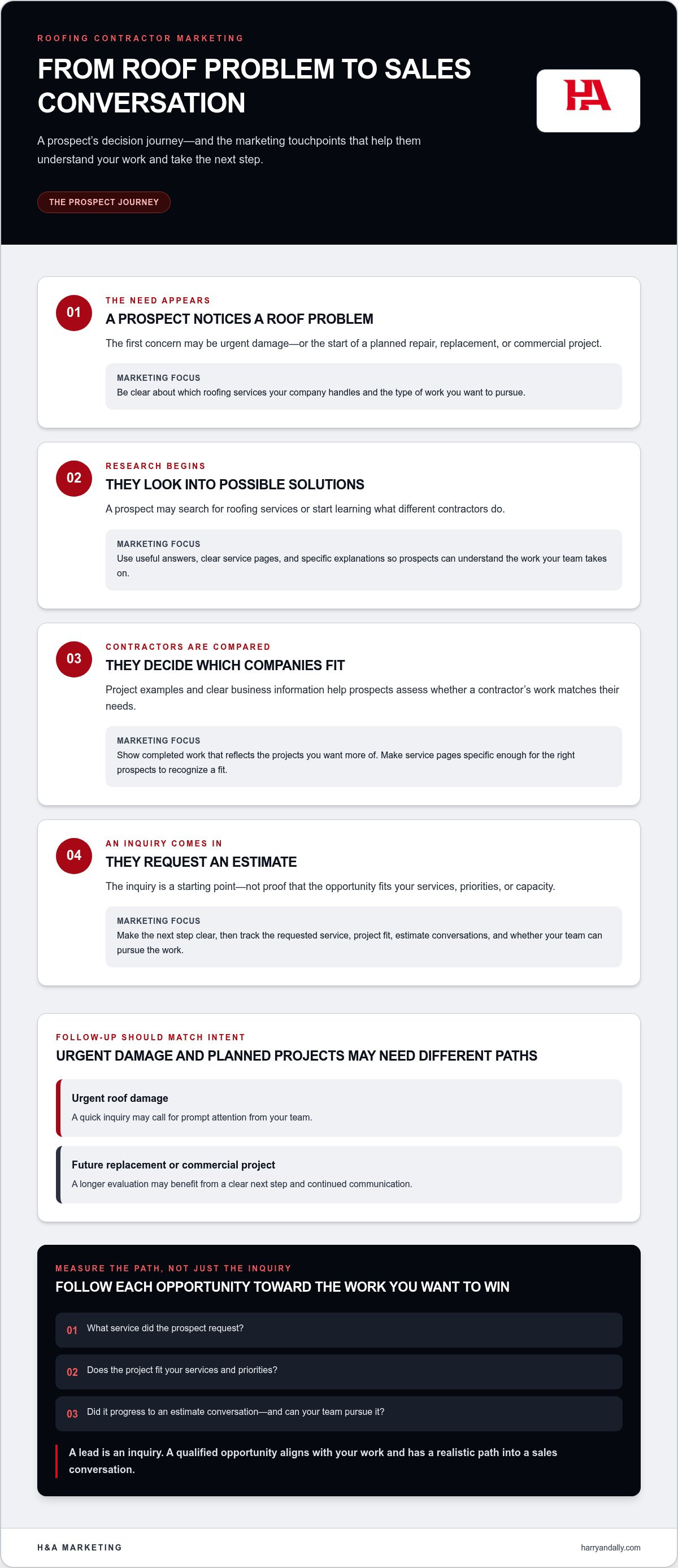
Roofing contractor marketing is the coordinated work of attracting suitable prospects, helping them understand your services, identifying which inquiries fit, and following up as they consider a project. A lead is an inquiry. A qualified opportunity is an inquiry that aligns with your services and priorities and has a realistic path into a sales conversation. More inquiries alone don’t show whether marketing is supporting the work you want to win.
Set success measures that connect marketing to operations: the service requested, project fit, estimate conversations, and whether your team has capacity to pursue the opportunity. A surge in repair requests may be less useful than a steadier flow of replacement projects if replacements are your current priority. The right measure depends on your business, so agree on what a good opportunity looks like before judging a campaign.
Set goals around roofing work you want to win
Start by naming the services you want to promote, such as repairs, replacements, or commercial roofing where those fit your business. Then define the customer or decision-maker who is a strong match, including the type of property, project need, and timing your team can serve. Tie campaign goals to crew capacity and the way your sales team handles and advances inquiries. That keeps promotion aligned with delivery.
Map the roofing customer’s decision journey
A prospect may first notice a roof problem, then research possible solutions, compare contractors, and decide when to request an estimate. Urgent damage can prompt a quick inquiry; a planned replacement or commercial project may involve a longer evaluation. Useful answers, clear service pages, and project photos help prospects understand your work as they compare options. A focused construction company website can make those services and next steps easier to follow.
Show work that reflects the projects you want more of, and make each service page specific enough to help the right prospect recognize a fit. The broad context of Roofing includes different materials and approaches, so your marketing should clearly explain which work your company handles rather than imply that every roofing need is the same. A prospect who is still researching may need clear information before they’re ready to speak with sales.
Build follow-up around intent, not assumptions. An urgent repair inquiry may need prompt attention from your team, while someone researching a future replacement may benefit from a clear next step and continued communication. When you distinguish those paths, you can assess marketing by the opportunities it creates and supports, not simply by the number of names in an inbox.
Build Roofing Visibility Across Search, Ads, and Referrals
Each marketing channel plays a different role. Search can reach people actively looking for roofing services. Paid campaigns can put a specific offer in front of selected audiences. Social content can show the quality and scope of completed work, while referrals introduce prospects through existing relationships. A balanced roofing contractor marketing plan chooses channels based on priority services, target prospects, and the team’s capacity to respond.
Match roofing channels to the prospect’s intent
Think about what a prospect is doing when they encounter each channel. Someone searching for a roofing contractor may be ready to compare options. Someone seeing a project post may simply be learning what your company does. Referrals bring familiarity, but they’re still one source to record and assess alongside other inquiries.
Google Search and a Google Business Profile can help prospects discover your company when looking for roofing services. Visibility varies, so don’t treat a channel’s presence as a promise of rankings or inquiries. Track what happens after discovery: which service the prospect needs, whether it fits, and whether the conversation progresses.
| Channel | Purpose | Useful roofing content | What to measure |
|---|---|---|---|
| Organic search and Business Profile | Support discovery when prospects seek roofing services. | Service pages, project examples, and clear business information. | Relevant inquiries, requested service, and qualified conversations. |
| Paid campaigns | Promote a priority service to a defined audience. | Service-specific ads that lead to a matching page. | Inquiry quality and progression, not clicks alone. |
| Social media | Show work and build familiarity over time. | Completed projects, process photos, and concise explanations. | Engagement alongside referral traffic and inquiries. |
| Referrals | Generate introductions through customer and business relationships. | Shareable project examples and a clear description of services. | Lead source, project fit, and resulting sales conversations. |
Connect visibility to a useful website experience
A channel earns attention; the website needs to make the next step clear. Create distinct pages for the services you want to promote, and explain what each includes and whom it serves. Use project imagery that reflects your work, concise proof such as relevant experience or customer feedback you can substantiate, and a straightforward inquiry path. The site should carry the same message as the search result, ad, or social post that brought the prospect there.
Keep the content useful and accurate. Industry resources such as the National Roofing Contractors Association can help readers find roofing information, while your own pages should make your services and completed work easy to understand. Make sure the inquiry form captures enough detail for your team to route a request without creating unnecessary friction.
There’s no need to be everywhere at once. Choose channels your team can maintain and follow up on, then review their contribution to qualified opportunities. If your visibility and website experience need a more coordinated plan, talk with H&A Marketing about your strategy.
Will Roofing Marketing Bring Better Projects, Not Just More Leads?
Marketing can create visibility and inquiries, but it can’t guarantee that every prospect will match your services, become a customer, or produce profitable work. Lead volume alone doesn’t show whether a campaign is helping your business. To judge results fairly, track what happens after someone responds and use criteria that reflect the roofing work you want to pursue.
Qualified opportunity measures are more useful than clicks alone because they show whether marketing is creating conversations your team can realistically turn into the right projects.
Use consistent stages to make that path visible:
- Raw inquiry: A call, form submission, or other request for contact.
- Service-fit lead: An inquiry that matches the roofing services your company provides and the type of project you’re seeking.
- Sales conversation: Your team has connected with the prospect and learned enough to assess the request.
- Estimate: The opportunity has moved to a defined proposal or estimating step.
- Won work: The prospect has agreed to move forward with your company.
These stages help separate marketing activity from sales outcomes. A channel may create inquiries that rarely fit your services, while another may generate fewer responses that progress further. Neither pattern tells the whole story on its own. Review both channel activity and opportunity progress, then look for where prospects are dropping out.
Assess lead quality using company-specific criteria
Define fit around your actual operating priorities. Consider whether the request is within the service area you serve, aligns with your project types, fits your schedule, and supports commercial or other priorities. A residential repair request and a commercial replacement inquiry may require different handling. Neither is automatically valuable or unqualified; the right assessment depends on your company’s focus and capacity.
For each inquiry, record a brief reason for its status. It might fit a service you don’t prioritize, fall outside your service area, need work on a different timeline, or progress to an estimate. If it stalls, note where and why when you know. This context helps you spot patterns without treating every call or form as an equivalent sales opportunity.
Use tracking to learn what contributes to progress
Use your chosen tracking system to record the inquiry source and update its stage as your team follows up. Keep the labels simple and consistent so marketing and sales are describing the same journey. Review website, SEO, and advertising activity alongside the quality and progression of inquiries. If a campaign attracts attention but not service-fit conversations, the audience, message, or landing page may need adjustment.
Industry coverage from Roofing Contractor Magazine can provide broader context on roofing business topics, but your own pipeline records show how opportunities move through your sales process. A connected view of visibility, inquiries, and follow-up gives your team a more practical basis for decisions. That’s the aim of lead generation for construction companies: connect marketing activity to opportunities your business can assess and pursue.
Create a Roofing Marketing Plan Your Team On Run
A useful roofing contractor marketing plan is one your team can maintain while managing jobs, estimates, and customer follow-up. You don’t need to launch every channel at once. Choose a small number of business priorities, then connect each marketing task to the service you want to promote and the people available to carry it out.
Use this sequence to turn your priorities into a workable plan:
- Set priorities. Choose the service or project type the business wants to support, taking crew availability and sales capacity into account.
- Define the audience. Describe the property owner or decision-maker you want to reach, the need they have, and the conditions that make a project a good fit.
- Select channels. Pick channels that suit that audience and your team’s ability to manage them. Consider construction lead generation strategies when deciding how channels can work together.
- Build the assets. Prepare a relevant service page, project imagery, campaign message, and clear inquiry path before directing attention to the offer.
- Track execution. Assign an owner to each task and note key milestones, such as when a page is ready, creative is approved, and a campaign is active. This makes it easier to spot delays and keep the plan moving.
For example, if commercial roofing is the priority, align the audience, page content, project visuals, and inquiry path around commercial decision-makers. Avoid pairing a broad message with a form that gives your team too little context about the request. If crews are already committed, set a realistic level of promotion and make sure the team can support the work being advertised.
Choose a focused campaign around a roofing priority
Start with one service or audience. Build the campaign around the questions that prospect is likely to ask, then use page content and project imagery that help them assess relevance. Give them a clear next step, such as submitting an inquiry or requesting an estimate. A specific message and a matching page make the campaign easier to manage and refine.
Set a review rhythm and improve deliberately
At a regular planning check-in, compare the campaign’s progress with the work plan. Are page updates, creative, and channel activity moving on schedule? Has crew availability or the company’s service focus changed? If a task is stalled, identify the decision or resource holding it up before adding another tactic. For search visibility tied to service areas, local SEO for construction can be part of the plan, with content and business information kept aligned as priorities change.
Keep the review focused on one practical adjustment at a time. That could mean clarifying who owns a task, revising a page before promotion begins, or pausing activity that no longer matches the company’s workload. A manageable plan gives your team room to adapt without spreading effort across too many initiatives.
Connect Roofing Strategy, Creative, Traffic, and Lead Capture
Roofing contractor marketing works best as a connected system, not a collection of separate tasks. Strategy sets the priorities. Creative gives prospects a clear reason to trust your company. Traffic brings the right audience to your message. Lead capture makes inquiries visible to the team responsible for responding and moving opportunities forward.
Each part should support the same roofing priority. If you want to promote commercial work, for example, the website content, campaign message, project visuals, and inquiry path should all speak to commercial decision-makers. If those pieces tell different stories, a prospect can arrive with the wrong expectations or struggle to find a useful next step.
Think of the system as a working handoff:
- Strategy identifies the service, audience, and business capacity the plan should support.
- Creative shapes clear messaging and uses project visuals that reflect the work you want to show.
- Traffic uses channels such as SEO, social media, and advertising to put that message in front of prospects.
- Lead capture gives prospects a straightforward way to inquire and helps your team record what happens next.
For example, search content can answer questions about a priority service, while a related social post highlights a relevant completed project. Both can point to a page that explains the service and makes the next step clear. Consistent calls to action and source tracking help connect that activity to the sales process. Construction SEO can be one part of this shared plan, supporting useful service content and discovery without promising rankings or lead outcomes.
Coordinate marketing work instead of managing disconnected tasks
Keep the service priority as the link between your website, campaign message, and visual assets. Use consistent language and a clear inquiry path across channels, then make sure incoming requests are recorded in a way your team can follow. This coordination helps prevent separate marketing activities from creating gaps between what prospects see and how your sales process responds.
H&A works with construction companies as a collaborative marketing partner, coordinating strategy, creative, traffic, and lead capture around business priorities. The aim is to make the parts support one another, while keeping the plan grounded in the roofing company’s services and capacity.
Choose a practical next step for your roofing business
Before adding another tactic, identify the clearest bottleneck. Is the priority service hard to understand online? Are the right prospects not finding the company? Do inquiries arrive without enough detail, or is follow-up difficult to track? Naming the gap gives an initial strategy discussion a practical focus: services, capacity, lead fit, and what your team needs to measure.
A connected plan doesn’t need to change everything at once. Start with the point that’s limiting progress, then decide which marketing pieces should work together to address it.
Make Your Next Marketing Move Count
The next step doesn’t have to be a full marketing overhaul. Choose one point where progress is getting stuck, such as reaching the right roofing prospects, helping them understand your services, or seeing what happens after they inquire. Then decide what a useful improvement would look like for your team and how you’ll track it.
That focus gives your roofing contractor marketing a clear direction. H&A Marketing specializes in digital marketing for construction companies and can work with you to shape a connected plan around your priorities, capacity, and opportunity tracking. The goal is a practical next move your team can support, not more activity for its own sake.
With a clear priority and a plan built around it, your team can move forward with greater focus and confidence.
Frequently Asked Questions
How can a roofing company get more qualified leads?
Help prospects self-identify before they reach your sales team. For example, make your service descriptions clear about the kinds of roof work you handle, and use form options that distinguish a repair request from a replacement or commercial inquiry. You can also prepare a short call-handling prompt so staff collect the same useful project details. These steps make roofing contractor marketing more relevant to the prospects your team can serve.
Is SEO worth it for roofing contractors?
SEO may be worth investing in if your company can commit to building and maintaining useful content. To assess whether it’s gaining traction, review the search terms and pages appearing in Google Search Console, then compare that activity with visits to the related pages on your website. This can show whether your content is becoming more visible for the topics you chose, even before you assess its contribution to sales.
Can social media help a roofing company win projects?
Yes. Social media can give a prospect something concrete to share with a spouse, property owner, or colleague who is part of the decision. A short project post can explain the type of work completed and link to the relevant service information on your site. Keep the content accurate and focused on your company’s actual work. Social media can support consideration, but it shouldn’t be treated as proof that a project is won.
What should a roofing company track in its marketing?
Make your records usable by the people who rely on them. Choose a consistent way to record phone calls and web inquiries, avoid creating separate records for the same project, and assign an owner and next action to open opportunities. This helps prevent a promising request from getting lost between marketing and sales. Keep the process simple enough that staff can follow it during a busy workday.
How do roofing contractors market commercial services?
Make it easy for a commercial decision-maker to understand your experience without relying on broad claims. Organize project examples by relevant building or work type, and explain the scope your company handled in plain language. Give the prospect a clear way to share project details, such as the property type and the work under consideration. This creates a more useful starting point for a commercial conversation than a general roofing message.
Does a roofing company need a marketing agency to grow?
Not necessarily. First, list the marketing tasks your team can handle consistently and the ones that keep slipping because of limited time or expertise. Then decide whether you need help with a defined project, such as website design, or ongoing coordination across several efforts. A partner is most useful when responsibilities are clear and marketing activity can be aligned with your company’s priorities and sales process.
