
SEO for Home Builder Portfolios: Turning Project Galleries into Lead Engines (2026)


Article by
Harry Stanley III
Harry Stanley III is a construction marketing strategist and fractional CMO at H&A Marketing. He has helped construction companies grow through website strategy, SEO, paid advertising, branding, lead generation, CRM systems, and professional content. His past work includes helping Meraki Solar generate an additional $3.7 million in revenue in his first year and supporting American Builders as a fractional CMO. Today, Harry works directly with custom home builders and construction companies to build marketing systems designed to generate qualified leads and measurable growth.
Most custom home builders treat their project galleries like digital coffee table books. They look stunning, but they're effectively invisible to the people who are actually searching for a builder. If your high-end photography isn't backed by a strategic approach to SEO for home builder portfolios, you're essentially hiding your best work from your most qualified leads.
You probably invested thousands in professional jobsite media only to see those pages sit at the bottom of search results or slow your site to a crawl. It's frustrating to watch competitors with inferior craftsmanship outrank you simply because their technical foundation is stronger. This guide shows you how to bridge that gap. You'll learn how to optimize high-resolution images for Google's updated 2026 Core Web Vitals and structure your gallery to capture high-intent search traffic. We'll also explore how high-performance custom home builder website design integrates these assets into a connected marketing system that turns casual browsers into project inquiries. By the end, you'll have a clear roadmap to transform your portfolio from a static gallery into a high-performance lead engine.
Key Takeaways
- Learn why high-end photography alone isn't enough for Google and how to eliminate "thin content" by adding project narratives.
- Discover the technical balance between luxury image quality and the strict 2026 Core Web Vitals required for top rankings.
- Identify how to structure individual project pages as high-conversion landing pages that target specific, high-intent search terms.
- Establish a repeatable 5-step workflow to ensure every new build contributes to your SEO for home builder portfolios as soon as it’s completed.
- Understand how professional jobsite media and drone footage integrate into a connected marketing system to build neighborhood authority.
The Thin Content Trap: Why Most Home Builder Portfolios Fail at SEO
A stunning master suite remodel is a work of art, but to a search engine, it's just a nameless file. Many builders fall into the "thin content" trap by creating pages that consist of ten high-resolution images and a three-word title like "Modern Farmhouse Kitchen." In the context of Search engine optimization (SEO), thin content refers to pages that provide little to no value to the user because they lack substance. If your project page has a lower word count than a social media caption, Google struggles to understand what the project is, where it’s located, or why it’s relevant to a homeowner’s search query.
Craftsmanship is visual, but search is textual. Without a narrative, you're forcing Google to guess. This leads to poor rankings and missed opportunities. To fix this, you must pivot from a "Gallery" approach to a "Case Study" approach. A gallery is a dead end; a case study is a lead engine. By providing context, technical specs, and a project story, you turn a simple photo into a searchable asset that answers specific questions from high-intent prospects.
Why Visual Quality Isn’t Enough for Google
Search crawlers don't have eyes. They rely on metadata, alt text, and the surrounding copy to index your work. If your portfolio is just a wall of images, the "dwell time"—the amount of time a user spends on your page—often suffers. Users might glance at a photo and bounce back to the search results if there's no information to keep them engaged. High bounce rates tell Google your page isn't helpful, which can cause your rankings to drop. This is especially true following the March 2026 Core Update, which fully integrated the "Helpful Content" system into Google's core ranking logic. Your portfolio needs to be more than pretty; it needs to be informative.
The E-E-A-T Framework for Custom Projects
Google evaluates content based on Experience, Expertise, Authoritativeness, and Trustworthiness (E-E-A-T). You can demonstrate these qualities through detailed project narratives:
- Experience: Describe the specific materials used, such as reclaimed white oak flooring or custom-poured concrete countertops. This proves you were actually on the jobsite.
- Authority: Detail the challenges you solved. Did you manage a tight lot line or integrate a complex geothermal HVAC system? Explaining the "how" builds professional authority.
- Trust: Use project stories to show the homeowner's journey. When prospects see how you handled a specific vision, they feel more confident in your process.
Effective SEO for home builder portfolios relies on this blend of high-end video and photo assets and expert commentary. When you combine visual proof with technical descriptions, you create a page that satisfies both the human user and the search algorithm.
Technical Image Optimization: Making Portfolios Crawlable and Fast
High-resolution photography is the backbone of a luxury builder's brand, but unoptimized files are the primary cause of slow site speeds. In March 2026, Google tightened the Largest Contentful Paint (LCP) threshold to 2.0 seconds. If your project gallery lags beyond that mark, your search visibility will suffer. This technical balance is the cornerstone of successful SEO for home builder portfolios. You don't have to sacrifice aesthetics for performance. By using next-gen formats like WebP or AVIF, you can maintain the crisp detail of your craftsmanship while significantly reducing the data payload on your server.
Search engine crawlers rely on text to interpret visual data. This starts with your file naming conventions. Avoid generic labels like "final-edit-1.jpg" and use descriptive, hyphenated strings such as "modern-farmhouse-kitchen-marble-backsplash.webp". When writing Alt Text, focus on the specific details of the build. Instead of repeating your primary keyword, describe the scene: "Custom-built walnut cabinetry with integrated lighting in a luxury master suite." This provides the context Google needs for effective indexing without triggering spam filters.
Structured Data and Image Schema for Builders
Using Schema.org Version 30.0 allows you to speak directly to search algorithms. By implementing ImageObject and CreativeWork schema, you can explicitly link your photos to specific services like "custom home construction" or "bathroom remodeling." This technical layer increases the chances of your work appearing in Google Image Rich Results and AI Overviews. If your current site lacks these technical foundations, our team can help you integrate them into a high-performance construction web design that prioritizes both beauty and crawlability.
Mobile-First Portfolio Performance
Homeowners do the majority of their early-stage research on mobile devices. A mobile-responsive portfolio must do more than just shrink images; it must handle interaction efficiently. Roughly 43% of websites currently fail the 200ms Interaction to Next Paint (INP) threshold. To stay ahead, optimize your image sliders to prevent Cumulative Layout Shift (CLS). Assigning fixed aspect ratios to your gallery containers ensures the page doesn't "jump" as high-res images load, providing the seamless experience that luxury clients expect.
Architecting Project Pages for High-Intent Search Terms
Ranking for broad terms like "home builder" or "construction company" is a long-term play that often pits you against national directories and massive firms. However, ranking for specific project types is a strategic shortcut to high-intent leads. Effective SEO for home builder portfolios requires a shift in how you categorize your work. Instead of generic titles, you must target the specific features homeowners are searching for during their inspiration phase. When a prospect searches for a "modern farmhouse master suite with vaulted ceilings," they aren't just browsing; they're defining the scope of their future project.
Your project pages should function as high-conversion landing pages rather than simple photo galleries. This means moving beyond the visual and into the technical. Every project entry is an opportunity to capture long-tail traffic that your competitors are likely ignoring. By the spring of 2026, data showed that 60.1% of views on high-end listings came from buyers outside their current market. A well-architected portfolio ensures that these relocating prospects find your craftsmanship first, regardless of where their search begins.
The Anatomy of an Optimized Project Page
A high-ranking project page follows a strict header hierarchy to signal relevance to search engines. Your H1 tag should include the primary project style and location, while H2 tags should break down specific rooms or architectural features. This structure allows you to integrate project specs like square footage, material choices, and unique construction challenges as searchable data points. To keep the user journey moving, integrate "Call to Action" elements naturally within the narrative. A simple "Inquire about a similar build" button placed after a description of a custom kitchen prevents the visual flow from breaking while providing a clear path for lead capture.
Targeting Long-Tail Construction Keywords
Specificity wins in the 2026 search environment. A query like "luxury kitchen remodel with quartz islands" is far more valuable than "kitchen builder" because it indicates a prospect who has already made key design decisions. These users are closer to the hiring phase. Use your project descriptions to answer the "how" and "why" of the build. This approach helps your content surface in AI Overviews, which became the default Google experience in May 2026. A custom home builder website design that prioritizes these long-tail narratives turns every completed project into a permanent search asset. By linking these individual portfolio pieces back to your primary service pages, you create a web of internal authority that tells Google exactly what you build and where you excel.
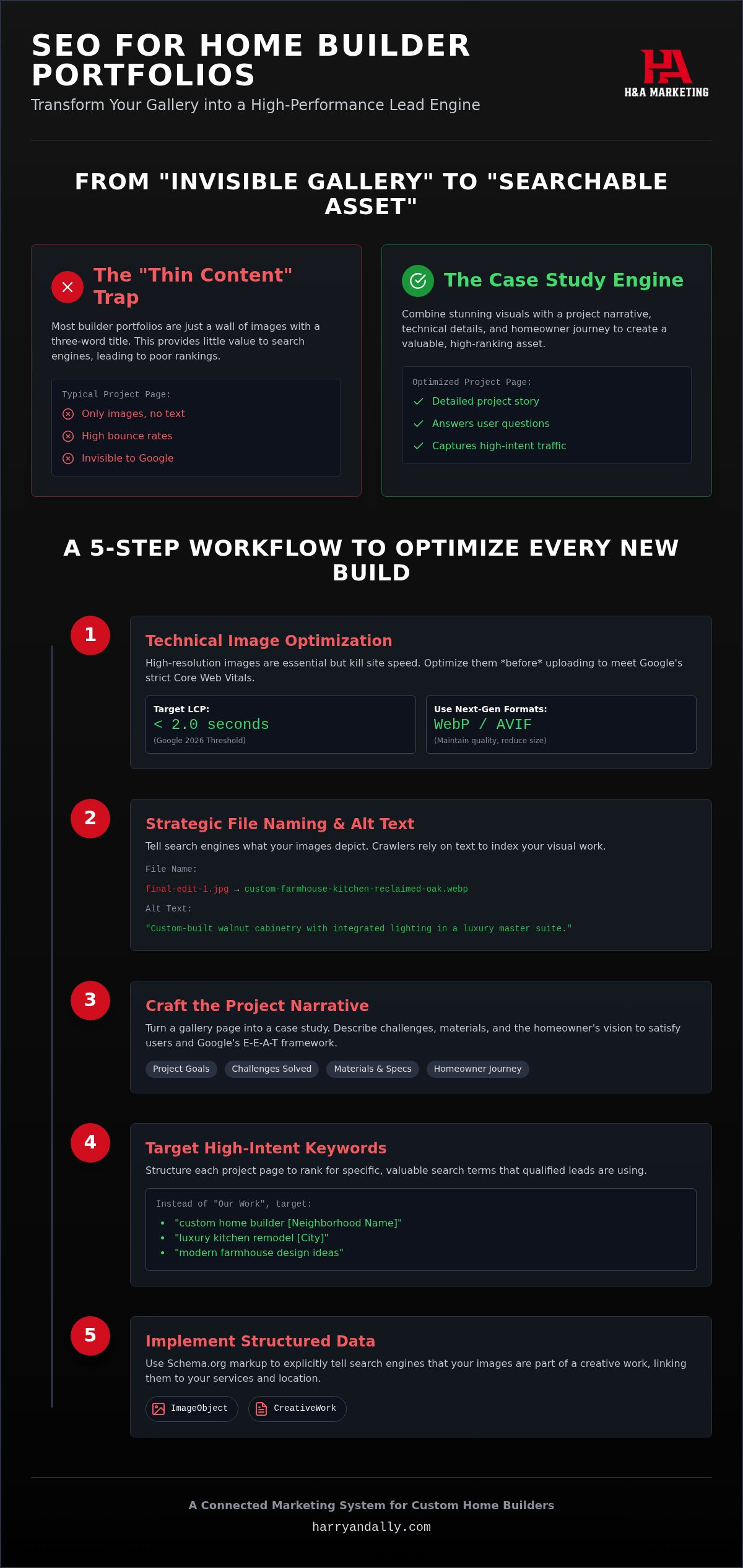
A 5-Step Workflow to Optimize Every New Build Entry
A successful project doesn't end when the homeowner moves in. For your digital presence, that's just the beginning. Most builders treat their websites as static brochures, but a high-performance portfolio requires a repeatable system. By integrating marketing into your project close-out checklist, you ensure that your hardest work continues to generate leads long after the jobsite is cleared. This structured approach to SEO for home builder portfolios turns every completed contract into a permanent recruitment tool for your next high-ticket client. Without a workflow, you're leaving your search visibility to chance.
Step 1-2: Media Selection and Technical Prep
Quality beats quantity every time. Select 10 high-impact photos that showcase your core specialties, such as custom millwork or luxury outdoor living spaces. Avoid the temptation to upload every shot from the photographer's gallery. Excess images only serve to slow down your page load speeds and dilute the user's focus. Once selected, batch process these images to meet the 2026 Core Web Vitals standards discussed earlier. Each file needs descriptive metadata and a clear completion summary. For instance, write a single sentence defining the project scope: "This custom lakefront estate in the modern craftsman style was completed in June 2026." This provides a chronological and topical anchor that search crawlers can easily categorize within your custom home builder website design.
Step 3-5: Narrative, Linking, and Launch
Google's 2026 algorithm updates prioritize first-hand credibility and expert depth. Use a "Problem-Solution-Result" framework for your project narrative to satisfy these requirements. Explain the client's specific needs, the architectural hurdles you overcame, and the final outcome. This storytelling builds trust with prospects while providing the "helpful content" Google demands for top-tier rankings. Within the text, include internal links to your primary service pillars and educational resources like our deep dive into construction SEO.
Once the page is live, distribution is key. Sync your portfolio entry with your social media management to ensure the new project is shared across Instagram and LinkedIn. Finally, don't wait for Google to find the page on its own. Manually submit the new URL through Google Search Console to trigger immediate indexing. This ensures your new build starts ranking for high-intent local queries as quickly as possible, moving it from a hidden gallery to a lead-generating asset.
Request a custom SEO strategy for your building company
The Connected Marketing System: Integrating Media and SEO
Visuals are the heartbeat of a luxury portfolio, but they only provide value if they're part of a connected marketing system. Professional video and photo production doesn't just make your work look good; it fuels the technical engine that drives your search rankings. When you embed high-quality video on a project page, you aren't just showing off a kitchen remodel. You're increasing the "dwell time" of your visitors. Since 65% of people are visual learners, they're far more likely to engage with a video walkthrough than a wall of text. Longer visits tell Google that your content is valuable, which directly supports the goals of SEO for home builder portfolios.
Drone footage adds another layer of authority by providing geographic context. It shows the home in relation to the landscape or the neighborhood, establishing you as a dominant player in specific premium markets. This isn't just about a pretty view. It's about building a narrative of "neighborhood authority" that AI-driven search engines can recognize and reward. By integrating these assets, you move beyond a simple gallery and into a strategic lead capture system.
Jobsite Media as an SEO Asset
Capturing progress shots and "behind the scenes" content does more than fill a social media feed. It builds first-hand credibility, a key signal in Google's 2026 algorithm updates. When you document the technical challenges of a build, you prove your expertise to both humans and crawlers. High-quality media also acts as a magnet for backlinks. Architects, interior designers, and local news outlets are significantly more likely to link to a page that features professional-grade assets. Leveraging drone photography allows you to showcase the scale and craftsmanship of a project from angles that traditional photography cannot reach, providing a unique perspective that keeps users on the page longer.
Scaling Growth with a Specialized Partner
Managing this entire loop is a full-time job that most builders don't have the bandwidth to handle. There's a massive difference between a general agency and a specialized construction marketing agency. A generalist might understand keywords, but they don't understand the nuances of a custom home build or the long sales cycles of the construction industry. At H&A Marketing, we function as an extension of your business. We coordinate the strategy, the creative production, and the technical traffic management. This connected approach ensures that your media isn't just sitting in a folder; it's actively working to capture leads. Moving from a static gallery to a high-performance lead engine requires a partner who understands both the art of the build and the science of SEO for home builder portfolios.
Building Your Digital Legacy
Your project gallery shouldn't just sit there looking pretty. It needs to work as hard as your crew does. By moving beyond simple photo uploads and embracing a structured approach to SEO for home builder portfolios, you transform static images into high-ranking search assets. We've explored how technical optimization, long-tail keyword targeting, and detailed project narratives create a competitive advantage that AI-driven search engines reward.
Success in 2026 requires a connected marketing system that integrates professional photo and video with specialized construction industry expertise. H&A Marketing bridges this gap by coordinating your strategy, creative production, and lead capture. We ensure your high-end craftsmanship gets the visibility it deserves without sacrificing the luxury aesthetic of your brand. It's time to turn your past projects into your future pipeline.
Request a Marketing Audit for Your Portfolio
You've built the homes. Now, let's build the system that makes sure the world sees them. We're ready to help you dominate your local market and capture the high-intent leads your business deserves.
Frequently Asked Questions
How many photos should I have in a project portfolio for the best SEO?
Aim for 10 to 12 high-impact photos per project entry rather than dumping an entire photographer's gallery. Excess images often lead to slow load times, which can trigger a penalty under the 2026 Largest Contentful Paint (LCP) thresholds. By selecting only the best shots, you maintain a luxury aesthetic while ensuring the page remains fast and responsive. This balance is critical for effective SEO for home builder portfolios.
Does a video gallery slow down my website and hurt my rankings?
Video galleries only slow down your site if they aren't optimized or are hosted directly on your server. Using professional video production that is correctly embedded can actually improve your rankings. Video content significantly increases dwell time, as prospective clients spend more time watching a walkthrough than scrolling through photos. This engagement tells Google your content is helpful, which can boost your overall search visibility.
Can I rank for luxury home building keywords without a lot of text on the page?
Ranking for high-intent luxury keywords without a text-based narrative is nearly impossible in 2026. Google's "Helpful Content" system requires context to understand your expertise. You should include at least 300 to 500 words of descriptive text per project. Detail the materials used, the architectural style, and the specific construction challenges you solved. This narrative provides the searchable data points that simple images cannot offer.
What is the best way to write Alt Text for construction photos?
The best way to write Alt Text is to be highly descriptive without resorting to keyword stuffing. Instead of using "home builder kitchen," describe the actual craftsmanship. Use phrases like "Custom walnut cabinetry with waterfall quartz island in a modern farmhouse kitchen." This approach helps search engines index your work for specific design features while providing accessibility for users with screen readers.
How often should I update my portfolio to keep Google interested?
You should aim to update your portfolio at least once every quarter to signal to Google that your business is active. Fresh content is a secondary ranking signal that encourages search crawlers to return to your site more frequently. Every time you complete a new build, follow a repeatable workflow to add it to your site. This consistent growth builds long-term authority in your specific construction niche.
Should I use a separate page for every project or one big gallery?
You should always use a separate page for every project rather than one large gallery. Individual project pages allow you to target specific long-tail keywords like "modern craftsman estate" or "luxury master suite remodel." A single gallery page creates a "thin content" problem where Google cannot distinguish between your different types of work. Separate pages function as dedicated landing pages for high-intent leads.
What is the most important SEO factor for a home builder portfolio in 2026?
The most important factor in 2026 is the intersection of page speed and first-hand credibility. You must pass the Interaction to Next Paint (INP) threshold of 200ms while providing original, expert project descriptions. Google's algorithm now prioritizes content that proves you actually did the work. Combining technical performance with a deep project narrative is the most effective strategy for SEO for home builder portfolios.
How does professional photography impact my conversion rate, not just my SEO?
Professional photography is the primary tool for building trust during a long sales cycle. While SEO brings traffic to the page, high-quality visuals convert that traffic into inquiries. Luxury homeowners need visual proof of your attention to detail before they commit to a high-ticket project. Professional media justifies your pricing and positions your company as a premium builder, which is essential for increasing your project ROI.
