


Article by
Harry Stanley III
Harry Stanley III is a construction marketing strategist and fractional CMO at H&A Marketing. He has helped construction companies grow through website strategy, SEO, paid advertising, branding, lead generation, CRM systems, and professional content. His past work includes helping Meraki Solar generate an additional $3.7 million in revenue in his first year and supporting American Builders as a fractional CMO. Today, Harry works directly with custom home builders and construction companies to build marketing systems designed to generate qualified leads and measurable growth.
More website traffic won’t help if facility managers can’t tell whether you handle the roof project they need. For commercial roofing contractors, knowing how to write website copy means creating clear, search-focused pages that explain restoration and replacement services, show relevant project experience, and make the next step easy to understand.
Commercial roofing buyers need more than broad claims about quality. They want to see which roof types and projects you handle, how your work fits their property, and what information to provide when they inquire. Your website copy should answer those questions with specific details, not vague language.
This guide explains how to research your business and audience, build credible project stories, give each page a clear purpose, and write SEO copy that connects searches with the right services. You’ll also see how calls to action and inquiry details can turn a visitor’s interest into a more useful conversation about commercial roof restoration or replacement.
Key Takeaways
- Ground website copy in the contractor’s services, ideal commercial roofing buyers, and the details that distinguish restoration and replacement work.
- Turn completed projects into credible proof by explaining the challenge, constraints, work performed, and supported outcomes.
- Give every page a clear purpose and next step, then connect related service and project pages to guide prospective customers.
- Make inquiry instructions specific so facility managers and property owners know what information to share about their roofing needs.
- Use relevant search language naturally and build pages around the questions commercial roofing buyers need answered.
How a professional researches a construction business before writing its website copy
Start with the work you want to win, not a generic construction template. If you run a commercial roofing company, distinguish roof restoration, coating, and replacement projects. Identify the properties you serve, the decision-makers involved, and your target service area. These details shape the information visitors need to see.
When preparing to write your website copy, begin with a focused briefing. Define your ideal projects, common customer concerns, sales conversations, and why prospects choose your company. For example, a facility manager considering restoration may want to understand your assessment process, while an owner planning a replacement may prioritize relevant project experience and clear next steps.
Separate verified business facts from broad claims. Review your service descriptions, project records, proposals, and customer questions. If you work on occupied commercial properties, explain what that means for a project. If a claimed capability lacks supporting detail, provide a specific example rather than making a sweeping promise.
Buyer-intent keyword research connects your business details with the terms prospective customers use. A search for “commercial roof replacement” signals a different need from a search for “roof leak repair.” Group keywords by intent, then map them to relevant pages. Terms about restoration belong with restoration information, not buried on a general homepage.
SEO research also helps you understand how a search term frames the visitor’s problem. A facility manager seeking roof coating information needs a page explaining the service, suitable project context, and inquiry path. A phrase like “commercial roofing contractor near me” may indicate a search for a provider in a particular area. Make sure your copy answers that intent accurately, without repeating keywords unnaturally. An SEO content strategy can align page topics with those search needs.
Before drafting, turn your research into a page brief. Identify the audience, main service, supporting proof, target search intent, and desired next step. The brief keeps a replacement page focused on replacement work instead of drifting into unrelated services. It also gives you a clear basis for reviewing the draft.
Use revisions to resolve factual gaps and improve clarity, not simply add more copy. Correct technical terms, confirm project details, and flag statements that overstate the work. Then tighten headings, remove repetition, and check that each page answers its intended buyer’s questions. This collaboration makes your finished website more precise and useful.
Project stories, case studies, and testimonials as proof of work
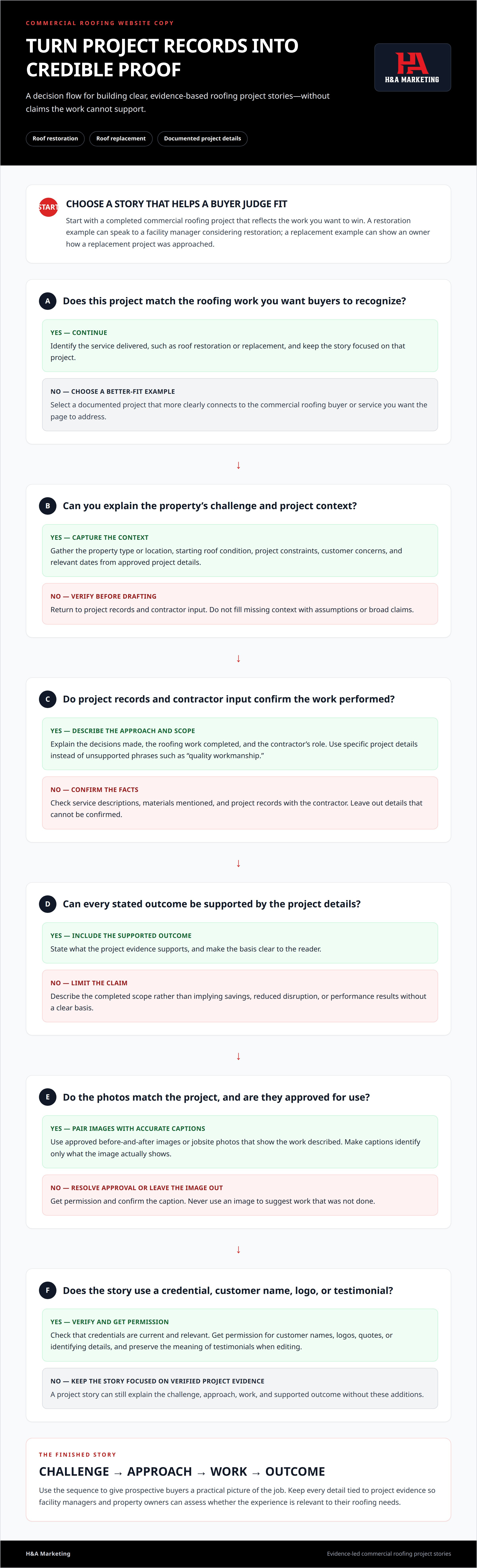
A professional helps a commercial roofing contractor turn project records and client input into clear, evidence-based stories. That means showing a commercial property’s challenge, the roofing work performed, and the outcome without adding claims the project cannot support.
Each story should give a prospective buyer a practical picture of the job. A roof restoration example might describe the building’s starting condition, project constraints, decisions made, and completed work. A replacement story can explain how the contractor approached the scope and what the property owner needed from the project.
Start with a focused interview and supporting materials. Gather the project location or property type, service delivered, relevant dates, customer concerns, and approved project details. Then organize the information into a sequence: challenge, approach, work, and outcome. This structure explains the contractor’s role without relying on broad claims like “quality workmanship.”
Before publication, compare each statement with project records and contractor input. Confirm service descriptions, materials mentioned, and any stated outcome. A claim about reduced disruption, for example, needs a clear basis in the project details. If the evidence supports only the completed scope, say that rather than implying savings or performance results.
Photos can add useful context when they match the project described. A writer can pair approved before-and-after images with captions identifying the work shown. Jobsite commercial roofing photography can also document details that written copy may not convey, such as roof conditions or the scale of a replacement. Permission and accurate captions matter; an image should never suggest work that wasn’t done.
Handle credentials, client names, logos, and testimonials carefully. Check that each credential is current and relevant, and get permission before using a customer’s name, quote, or identifying details. Preserve the customer’s meaning in a testimonial. Editing for length must not turn a specific comment into a stronger endorsement.
How can a professional help commercial roofing contractors write project case studies and testimonials? They can interview the contractor, shape project evidence into a readable narrative, and prepare customer feedback for approval. This process gives each story a clear purpose while keeping its claims tied to documented roofing work.
Relevant project stories can attract buyers looking for similar work. A facility manager evaluating restoration can see a matching example, while an owner planning replacement can review a different project. Clear details help visitors judge fit before making an inquiry and support more focused conversations about scope and timing.
Case studies work best when they answer buyer questions, not when they read like advertisements. Before publication, have the contractor review project facts, image permissions, and testimonial wording. With that foundation, each story can show what the commercial roofing contractor does and why its experience matters to a prospective customer.
Planning the purpose and next step for each page
A commercial roofing website should include a homepage, separate restoration and replacement pages, project examples, and contact information. A compelling homepage quickly identifies the work, the commercial customers served, and the next step, such as requesting a project conversation.
Planning the Purpose and Next Step for Each Page
A professional maps each page to one audience need and one primary action. A restoration page might help a property manager understand the service and submit project details. A replacement page can address a different scope and guide visitors toward an estimate inquiry. The contractor and writer agree on the page’s audience, message, supporting proof, and next step before drafting.
A clear plan shows how the pages work together. The homepage introduces the business, service pages answer specific questions, and project pages demonstrate relevant experience. Internal links can guide a visitor from restoration information to a matching project story. The structure should reflect the contractor’s actual services and how commercial buyers evaluate roofing work.
Professional Website Page Outlines
Outline each page before writing the full copy. For a roof replacement page, plan sections for the service scope, suitable project context, process, proof, and inquiry instructions. Have the contractor review the outline for missing details and inaccurate assumptions before expanding it into finished copy.
For the homepage, the first screen should quickly explain that the business handles commercial roof restoration and replacement. The outline can then place service links, project evidence, and a clear contact route in an order that supports a visitor’s next decision. Construction web design should make this page structure easy to follow.
Connect page performance with meaningful inquiries. Track which pages lead visitors to inquiry forms or phone calls, then compare patterns across the homepage, restoration page, and replacement page. This helps distinguish pages that attract attention from those that support real sales conversations.
Search visibility is another useful signal, but rankings alone don’t show whether a page serves the right buyer. Review search queries alongside page engagement and inquiry activity. If a replacement page attracts visitors seeking residential repairs, refine its wording and search focus to reflect commercial project intent.
Measurement should guide revisions. If visitors reach a service page but rarely proceed to the inquiry step, the page may need clearer scope details, stronger project evidence, or more direct instructions. If a project page brings relevant inquiries, use its structure to inform related case studies. Each adjustment should address a specific behavior rather than add copy without purpose.
A documented outline and measurement plan keep the site accountable to business goals. The contractor can see which pages support commercial roofing inquiries and where content needs attention. This creates a clearer path from search discovery to a qualified conversation.
Writing clear calls to action and inquiry instructions
A commercial roofing page should make the next step obvious. On a roof replacement service page, a call to action could invite a facility manager to discuss a project. Explain which details can help start the conversation, such as property type, roof concern, and project location.
Clear instructions reduce guesswork. A professional matches the request to the page’s purpose: a restoration page can invite questions about restoration, while a replacement page can ask about replacement needs. The form should collect information that helps the contractor understand the inquiry, not every detail that might eventually matter during a site assessment.
Useful form prompts might include:
- Property location and type
- Whether the inquiry concerns restoration, coating, or replacement
- A short description of the roof concern or project goal
- The best way to follow up
Give every form field a clear purpose. If a visitor can’t tell why the form asks for information, clarify the prompt or remove the field. A phone number field, for example, should come with a clear explanation of how the contractor will use that contact detail.
Headings help visitors scan service pages before reading every paragraph. A commercial roof restoration page might use sections titled “Restoration Services,” “Project Fit,” and “Request a Project Discussion.” Keep paragraphs short and focused on one point. Bullets work well for scope details, while an ordered list suits a process where sequence matters.
Concise copy names the service, explains what it covers, and guides the next action. Replace “We deliver exceptional solutions for every need” with a specific statement about commercial roof restoration or replacement. Describe the work accurately, using terms facility managers recognize. Direct wording helps visitors distinguish the service from unrelated roofing work.
What common website copy mistakes should commercial roofing contractors ask a professional to avoid? Vague claims, repeated keywords, unclear service descriptions, and calls to action that say only “Learn more” can leave visitors unsure what to do. A professional should also remove unsupported promises and form questions that don’t help the contractor understand the inquiry.
Calls to action should match the visitor’s decision point. A reader comparing restoration options may be ready to discuss a property, not submit a full bid package. A straightforward prompt such as “Discuss a commercial roof restoration” sets a clear expectation without implying an immediate estimate or project outcome.
Keep the inquiry path consistent across the homepage, service pages, and contact page. If the restoration page asks for project details, the contact form should allow visitors to provide the same context. This helps the contractor connect the initial request with the service the visitor viewed and makes follow-up conversations more relevant.
Commercial roofing website SEO copy
SEO copy should connect a commercial roofing buyer’s search with a page that answers their need. A facility manager searching for roof restoration should find specific restoration information, not a broad homepage that mixes every service together.
Commercial roofing website copy should reflect the audience and project type. Commercial buyers often prioritize relevant experience, professionalism, and project fit. For a commercial roofer, focus pages on restoration, coating, or replacement rather than unrelated services.
Local SEO keywords work best when they reflect the company’s actual service area and buyer intent. Use a phrase like “commercial roof replacement near me” in relevant page titles, headings, and copy only when it accurately describes the service area. Local references should add useful information, not appear repeatedly in awkward keyword lists.
Start keyword research with the services the contractor wants to promote and the questions buyers ask. Terms such as “commercial roof restoration” and “commercial roof coating” can signal different needs. Group related searches by intent, then assign each group to an appropriate page. This keeps one page from trying to rank for unrelated services.
Make each page’s topic clear to visitors and search engines. Place the main service phrase naturally in the page title, meta description, heading, and opening paragraph. Use related terms where they help explain the work. Repeating the same phrase in every sentence makes copy harder to read and doesn’t clarify the offer.
Useful SEO copy explains what the contractor does, who the service suits, and how to start an inquiry. A replacement page could describe the project context and the company’s approach, show relevant work, and direct facility managers toward a project discussion. The strongest structure follows buyer questions rather than adding text to reach a word count.
Separate service pages help match search intent more precisely. A roof restoration page can explain restoration, while a replacement page covers replacement. Internal links can connect those pages with related project examples, helping visitors find supporting information and navigate the site. Update content when services, project examples, or target markets change.
Judge SEO by relevance, not traffic alone. A page attracting visitors who need services outside commercial roofing may not support a commercial roofing pipeline. Reviewing search queries alongside inquiry details can reveal mismatches. Then refine the page’s language, service focus, or local references to better reflect the projects the contractor wants.
Strong SEO copy makes commercial roofing services easy to find and understand. Search engine optimization should support useful pages, accurate service details, and clear inquiry paths, not keyword repetition.
H&A Marketing: Website Design
H&A Marketing helps commercial roofing contractors turn website copy into a clearer path for restoration and replacement inquiries. Its website design brings page structure, service messaging, and visitor actions together, helping facility managers quickly understand the work you handle and how to start a conversation.
Turn to H&A when your website doesn’t clearly distinguish commercial roofing services, support qualified inquiries, or reflect the projects you want to win. Search engine optimization can align service pages with relevant searches, while lead generation strengthens the path from discovery to inquiry. Logo design and branding can also create a consistent business identity across the site.
The next step is a conversation about your commercial roofing services, target customers, and website priorities. Contact H&A Marketing to discuss your commercial roofing marketing.
Make Your Website Support the Work You Want to Win
Start your next website decision with the commercial roofing projects you want more of. If restorations or replacements are a priority, make sure your online presence supports those goals and gives prospective customers a clear reason to continue the conversation.
Choosing how to write website copy for a construction company means connecting clear positioning with a useful next step. H&A Marketing offers website design, logo design and branding, and search engine optimization to help commercial roofing contractors build that foundation. The right focus depends on what your current pages communicate and which parts of your marketing need attention.
Bring your priorities, services, and ideal project types to a conversation about what your website should do next. A focused strategy can turn your business goals into a clearer direction for your online presence.
Make it easy for property owners and facility managers to inquire about the commercial roof restorations and replacements you want to pursue.
Frequently Asked Questions
What is SEO copywriting for a commercial roofing contractor website?
SEO copywriting makes a commercial roofing contractor’s website useful to search engines and prospective customers. It connects a search topic, such as commercial roof replacement, with a page that clearly explains the service and who it suits. Strong copy helps the right visitors assess whether the contractor handles their type of project, rather than chasing traffic from searches unrelated to the company’s work.
What is content writing for commercial roofing contractors?
Content writing for commercial roofing contractors creates useful material, from service descriptions to project updates and buyer resources. It might explain how roof restoration differs from replacement or answer questions facility teams ask before planning roof work. The writer translates industry knowledge into clear language while keeping technical statements accurate and relevant to the reader.
What should commercial roofing service and project pages say?
A service page should clarify the roofing work offered and the customers or properties it serves. A project page should show how a specific job relates to that service, using only details the contractor can support. For example, a commercial roof replacement story can describe the property context and completed scope, helping a prospective buyer judge whether the contractor’s experience fits their project.
What information should commercial roofing service pages include?
Include the roofing service scope, intended customer, relevant project conditions, and the best way to begin an inquiry. A commercial roofing page can distinguish restoration from replacement and explain what details help the contractor understand a property’s needs. Give related roofing services their own pages, so a facility manager seeking coating information doesn’t have to sort through unrelated services.
What website copy builds trust with commercial roofing customers?
Trust grows from specific, supportable information. Describe the roofing work plainly, identify who the service is designed for, and use project details that accurately represent completed jobs. A commercial roofer can explain how a project’s scope addressed the customer’s stated need without promising the same outcome elsewhere. Clear instructions about the next contact step also help visitors understand what follows an inquiry.
What calls to action work best for commercial roofing websites?
The best call to action names a relevant next step and fits the page. A commercial roof replacement page might invite a property manager to discuss a replacement project, while a contact page can offer a broader inquiry option. Pair the prompt with a short explanation of what details to share, such as property type and roofing concern, so prospective customers can start a focused conversation.
