
Hire a Fractional CMO for Construction Growth

Article by
Harry Stanley III
Harry Stanley III is a construction marketing strategist and fractional CMO at H&A Marketing. He has helped construction companies grow through website strategy, SEO, paid advertising, branding, lead generation, CRM systems, and professional content. His past work includes helping Meraki Solar generate an additional $3.7 million in revenue in his first year and supporting American Builders as a fractional CMO. Today, Harry works directly with custom home builders and construction companies to build marketing systems designed to generate qualified leads and measurable growth.
What if your next marketing hire could connect the work already being done to the projects you want to win? For construction companies, more activity doesn’t always mean a stronger pipeline. Inquiries may not match your project types, budgets, or capacity, while owners are left coordinating vendors and chasing updates. A fractional CMO for construction companies can provide senior marketing leadership without a full-time executive hire. The value comes from turning strategy into coordinated, measurable work.
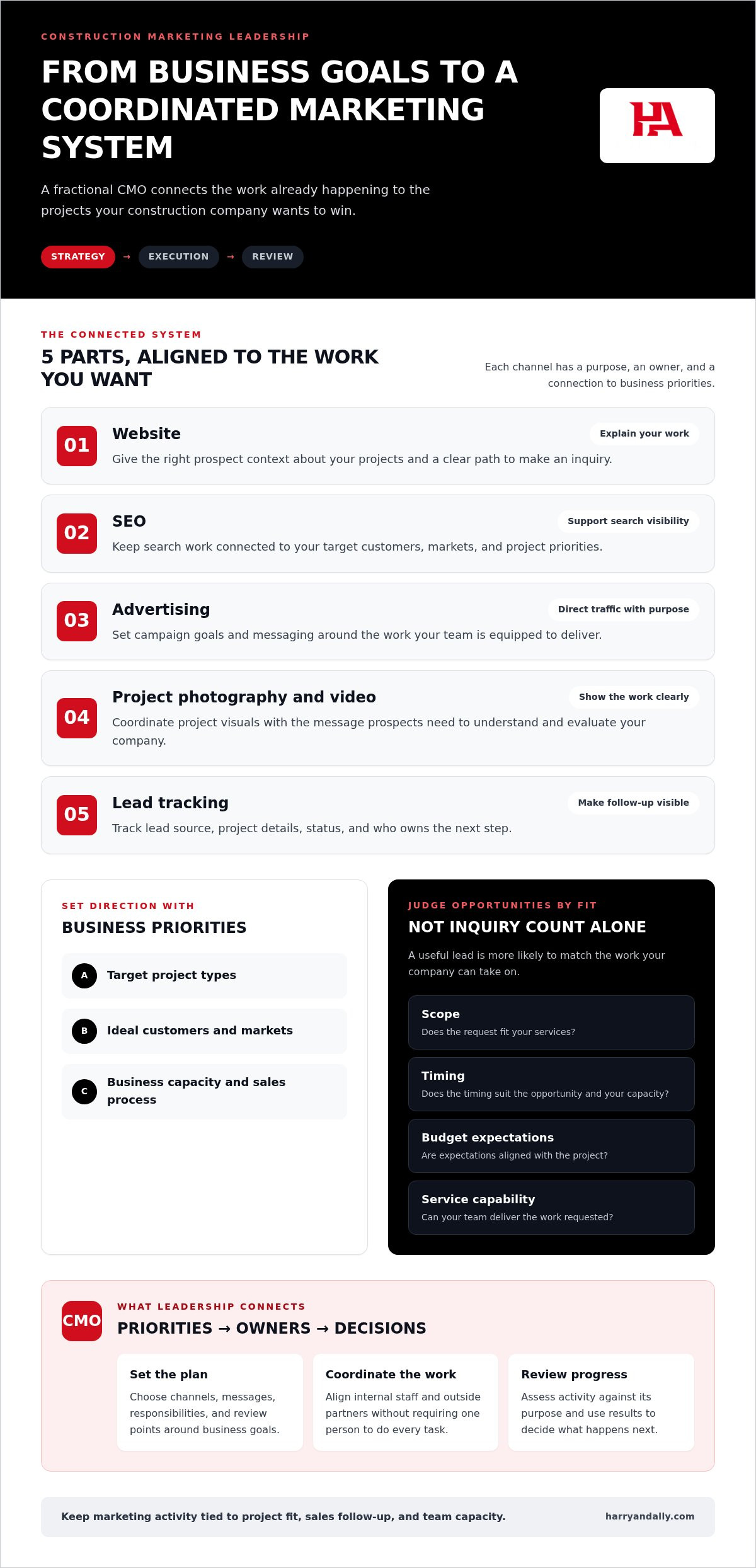
That leadership should connect your market position and business priorities to how prospects find, evaluate, and contact your company. It means aligning your website, SEO, advertising, project photography and video, and lead tracking with the work your team is equipped to deliver.
In this article, you’ll learn what responsibilities and outcomes to expect, how to compare a fractional CMO with a full-time hire, consultant, or agency, and what to assess before choosing a model. You’ll also see how to connect marketing decisions to qualified opportunities, project fit, and progress your team can track, not just a higher count of inquiries.
Key Takeaways
- A fractional CMO for construction companies should connect marketing priorities to the projects your business can deliver, not just offer high-level advice.
- Clear ownership helps coordinate marketing contributors, sales handoffs, and performance reviews.
- Compare fractional leadership, a full-time hire, a consultant, and an agency based on the support and execution your team needs.
- Evaluate candidates on construction experience, scope, measurement, and how they’ll communicate progress.
- A connected marketing system aligns strategy, creative, traffic, and lead capture across channels.
Why Construction Companies Consider a Fractional CMO
Running a construction company means balancing project delivery, estimating, sales, and decisions about where marketing time and money should go. Work may be steady, yet marketing can still get handled in spare moments or split among vendors who aren’t working from the same priorities. A fractional CMO provides marketing leadership on a part-time or scoped basis, helping connect those decisions to the pipeline without leaving the owner to manage every marketing task.
Fractional CMO leadership is senior marketing direction delivered on a part-time or defined-scope basis, with priorities tied to the company’s business goals. The general model is described in What is a Fractional Executive? For a construction business, its usefulness depends on whether that direction reflects the work you want, the clients you serve, and the projects your team can take on.
Where construction marketing leadership fills a real gap
A website vendor may focus on site updates, an advertising provider on campaigns, and an internal salesperson on following up with prospects. Without shared priorities, those efforts can pull in different directions. Reports may count clicks or inquiries without showing whether that interest matches your target work.
Marketing leadership sets a clear frame: which project types to pursue, who the target customer is, what markets make sense, and how much work the team can handle. Those decisions guide channel choices and messaging. They also give vendors and staff a common direction, rather than leaving the owner to reconcile recommendations between jobsite demands.
Why lead quality matters more than raw inquiry volume
For high-ticket construction projects, an inquiry is only a starting point. A useful lead is more likely to fit your scope, timing, budget expectations, and service capabilities. If your team specializes in commercial work, for example, a residential request may increase the inquiry count without advancing the pipeline. Review leads for fit and next steps, not just volume.
Prospects may need time to compare options, understand your approach, and build confidence before they’re ready for a sales conversation. Relevant, consistent information can help them evaluate your company and give your sales team useful context when contact happens. The goal isn’t to pressure every prospect. It’s to make the next step clear and relevant.
Marketing leadership should connect the path from first inquiry to sales follow-up. Clear lead details and a shared view of status make it easier to spot where prospects are stalling or where inquiries don’t fit. H&A’s construction lead generation system focuses on coordinating lead flow with the needs of construction businesses.
What a Fractional CMO Should Own in a Construction Marketing System
For a fractional CMO for construction companies, ownership means turning business priorities into coordinated marketing work and keeping that work moving. The leader sets direction, assigns responsibilities across internal staff and outside partners, and connects performance reviews to decisions that matter. They don’t need to build every page or run every campaign themselves, but they should make sure each piece has a purpose and an accountable owner.
Channel management focuses on individual tasks. Marketing leadership connects those tasks to company priorities and keeps contributors aligned. That distinction matters when website updates, SEO, paid traffic, lead tracking, and project visuals are handled by different people. Without coordination, activity can increase while the team still lacks a shared view of what each channel is meant to support.
From business goals to a practical construction marketing plan
Start with the company’s target project types, ideal customers, business capacity, and current sales process. These inputs shape the work that follows. Market research and competitive analysis can inform planning; the SBA Business Planning Resources provide guidance on those areas.
Next, translate priorities into a working plan: which channels support each goal, what messages need to be developed, who is responsible for delivery, and when the team will review progress. For example, a near-term campaign may call for updated project information and a clear inquiry path, while search visibility and brand development need sustained work.
Set review points that fit the work. Check campaign activity against its stated purpose, and assess longer-term projects for progress and direction. The aim isn’t to treat every channel as interchangeable. It’s to make sure the team knows what each one is expected to contribute and what decision comes next.
How leadership connects marketing activity to sales follow-up
Marketing ownership also means agreeing with sales on how incoming prospects are handled. Define what information the team needs at intake, who records it, and who owns the next step. A CRM can help keep lead source, project details, status, and assigned follow-up visible to the people working the opportunity. Keep the process compatible with the company’s sales habits so tracking supports the work instead of adding unnecessary administration.
The website has a specific role: give the right prospect enough context to understand your work and make an inquiry. A marketing leader can coordinate page priorities, messaging, and lead capture with the people handling website work, then review whether the experience supports the sales process. Construction web design can bring those website elements into focus.
Good ownership is visible in the routine: contributors know their responsibilities, sales understands the handoff, and leadership has a regular time to review work and make adjustments. That structure keeps marketing decisions connected to business operations instead of letting each task move forward on its own.
Fractional CMO vs. Full-Time Hire, Consultant, or Marketing Agency
The right model depends on the work marketing needs to do and who can manage it internally. A fractional CMO for construction companies can provide ongoing senior direction, but that doesn’t automatically include implementation of every campaign or channel. Before choosing, clarify who sets priorities, who does the work, and who checks whether it’s moving forward.
Fractional CMO
Leadership access: Ongoing, part-time or scoped. Execution capacity: Directs internal staff or external partners; hands-on delivery depends on scope. Continuity: Regular strategic oversight. Internal management: Needs a company contact who can make decisions and coordinate with the leader.
Full-time marketing executive
Leadership access: Embedded in the business. Execution capacity: Leads internal teams and partners, with delivery depending on available resources. Continuity: Day-to-day organizational presence. Internal management: Requires the company to support a permanent executive role and its broader responsibilities.
Consultant
Leadership access: Usually focused on a defined project or specific challenge. Execution capacity: May recommend a plan without managing its ongoing delivery. Continuity: Often tied to the engagement. Internal management: The company typically owns follow-through after the project ends.
Marketing agency
Leadership access: Usually focused on the services and channels in its scope. Execution capacity: Can deliver channel work such as website, SEO, or lead generation. Continuity: Ongoing work depends on the engagement. Internal management: Someone must keep the work aligned with sales needs and other marketing activity.
When a full-time marketing executive may fit better
A permanent executive may make sense when marketing requires sustained internal team leadership, frequent coordination across departments, and broad ownership of company decisions. Consider how often marketing choices need executive input, whether there’s a team to lead, and how much work depends on being embedded in daily operations. The key is whether the workload and decision volume justify a permanent role, not a generic company-size rule.
When a consultant or agency may be the better fit
A consultant can suit a defined need, such as reviewing positioning or shaping a plan, especially when your team can manage implementation afterward. An agency can be a strong fit when you need skilled execution in particular channels. But if each provider works from separate priorities, website updates, search visibility, media, and lead capture may not reinforce one another. Assign a clear owner for coordination and review.
These models can work together. A fractional leader can set direction and coordinate execution with an agency or internal team, while the delivery partner handles agreed channel work. To prevent a plan from stalling, define who owns each task, what access or approvals they need, and how progress will be reviewed. For example, pair a campaign with clear lead capture and a process for routing inquiries to sales.
If lead capture is a key part of the execution gap, H&A’s construction lead generation can be part of a coordinated approach. Match the model to your goals, available capacity, and ability to manage the work, rather than choosing by title alone.
How to Evaluate a Fractional CMO for Construction Companies
Choose a leader who can connect marketing decisions to the projects your business wants and has capacity to deliver. Use this framework to assess whether a fractional CMO for construction companies can own the right work, coordinate execution, and report progress in terms your sales team can use.
- Set the goals. Name the project types, target buyers, and business priorities marketing should support. “Get more leads” is too broad. Define what a suitable opportunity looks like for your company.
- Check construction experience. Look for an understanding of bid cycles, commercial opportunities, project portfolios, or the homeowner decision process, depending on your work. Ask how that experience informs channel and messaging choices.
- Define the scope. Agree on who owns strategy, channel coordination, vendor direction, sales handoffs, and reporting. Clarify what the CMO will execute directly and what they’ll coordinate through your team or partners.
- Discuss implementation. Ask how recommendations become assigned tasks, who approves work, and how obstacles get resolved. A plan needs clear owners and follow-through, not just a presentation.
- Agree on measurement. Establish what will be tracked, how information will be collected, and what decisions reporting should inform. Useful indicators include qualified inquiries, project fit, lead source, and movement through the pipeline.
- Set communication expectations. Decide who meets, what gets reviewed, and how time-sensitive choices are handled. Your team should know what’s on track, what needs a decision, and what changes are recommended.
Set the right scope and signs of progress
Build the scope around project type, capacity, target buyers, and the sales cycle. Agree on baseline tracking, review cadence, decision rights, and reporting that leads to a next step. If organic visibility is a priority, specify how search work will support qualified demand and which pages or topics matter. Construction-focused SEO can be part of that broader plan.
Measurement helps the team make informed adjustments; it can’t guarantee a particular number of inquiries or projects. A practical report might show whether leads fit the intended work, where they came from, and whether they progressed to a meaningful sales stage. That’s more useful than a channel summary with no connection to pipeline decisions.
Check for construction-specific strategic thinking
Listen for recommendations that reflect how your buyers choose and how your team sells. For a commercial contractor, that might mean connecting bid opportunities and relevant project proof to follow-up. For a custom builder, it may mean helping homeowners understand your process and portfolio. Photo and video should support that story, not sit apart from the website, messaging, and lead path.
Review the proposed plan as a connected system: Does the message match the work shown? Does the website make the next step clear? Does sales know how to follow up? Those details show whether the leader is thinking beyond isolated channels.
How H&A Marketing Connects Strategy and Execution for Builders
For builders considering a fractional CMO for construction companies, leadership is only part of the equation. Marketing also needs coordinated execution. H&A Marketing’s connected marketing system brings strategy, creative, traffic, and lead capture into one plan, aligning each piece with the construction work you want to pursue.
What coordinated construction marketing can bring together
Your website and brand should make your capabilities clear. Search visibility and traffic can put that message in front of potential buyers, while lead capture gives them a clear next step. H&A coordinates these functions through its construction-focused services:
- Website design and branding create a consistent presentation of your company, projects, and services.
- SEO and lead generation support visibility and a clear path for prospects to inquire.
- Social media management keeps company updates and project stories connected to broader marketing priorities.
- Photo and video production can show the work, people, and process behind your projects.
Jobsite photography and video can provide useful material for a project portfolio, website pages, and campaigns. Visuals that show completed work and the details behind it help prospective clients understand your experience before they reach out. H&A’s construction photo and video services can support that visual storytelling as part of a coordinated marketing plan.
Coordination matters because a polished website, active social accounts, or advertising campaign can each operate in isolation. Shared priorities align what the company says, what its project imagery shows, where traffic goes, and how inquiries are captured. The goal is a connected system, not a collection of unrelated marketing tasks. Reporting then gives the team a practical basis for deciding what to maintain, adjust, or prioritize next.
A practical next step for owners and builders
Before discussing marketing support, write down the projects you want more of, the buyers you want to reach, and the lead-flow issues that need attention. Note where prospects tend to stall, what information sales needs, and which marketing pieces already support your goals. These details help shape an approach across website design, branding, SEO, lead generation, social media, and visual content.
H&A works with construction businesses to coordinate these pieces around shared priorities, helping owners keep their attention on building while marketing has a clearer direction. Discuss your company’s needs and request a free quote to explore a practical next step.
Choose the Marketing Support That Fits Your Next Stage
Start by identifying the marketing decision that keeps slipping behind project demands. Is it choosing which work to pursue, coordinating vendors, or seeing whether inquiries are moving toward real opportunities? A fractional CMO for construction companies should help bring focus to that specific business need, with clear ownership and a way to review progress.
You don’t need to solve every marketing challenge at once. Define the projects you want to attract, the capacity you can support, and where prospects need better information or follow-up. Those priorities give you a practical starting point for deciding the right level of leadership and execution.
With the right support in place, marketing can have a clearer direction while you focus on delivering strong work. Start with the next priority, then build from there.
Frequently Asked Questions
What does a fractional CMO do for a construction company?
A fractional CMO helps a construction company turn business plans into marketing decisions and a workable schedule. If the company plans to pursue a different mix of projects, for example, the CMO can translate that shift into a marketing brief, planned content, and review checkpoints. A fractional CMO for construction companies should also help leadership see which decisions need attention now and which can wait.
Is a fractional CMO a good fit for a small construction business?
It can be a fit if the owner can name a point person to share project and sales information, review recommendations, and approve work. Consider whether your team can provide those inputs consistently. If every decision depends on an owner who is rarely available, even a strong marketing plan may stall. Start by assigning someone to keep information and approvals moving.
How is a fractional CMO different from a marketing agency?
A fractional CMO can shape the brief an agency works from and review whether its deliverables meet the company’s needs. The brief might specify which project details a landing page must explain and what action a prospect should take. The agency then works within its agreed service scope. Clear briefs and review steps help prevent revisions caused by different assumptions about the audience or message.
Can a fractional CMO help construction companies get better leads?
A fractional CMO can help the team learn from leads that don’t progress, then use those patterns to refine how the company presents its work. Sales notes may show that prospects misunderstand a project’s scope or assume the company provides a service it doesn’t. Updating page language or inquiry questions can set clearer expectations. Review changes with sales so marketing reflects the conversations prospects actually have.
How does a fractional CMO measure marketing performance for builders?
For longer sales cycles, performance reviews should account for the time between an inquiry and a decision. Compare inquiries by source and track how each group progresses, rather than judging a channel only by this month’s signed work. Keep marketing-sourced inquiries distinct from opportunities marketing may have influenced. That context helps avoid drawing conclusions before prospects have had time to move forward.
When should a construction company hire fractional marketing leadership?
Consider bringing in leadership before a major change in direction, such as adding a project category or changing the type of buyer the company wants to reach. This gives the team time to define what needs to change in its messaging and materials before launching activity. Leadership can also help when marketing decisions are repeatedly deferred because no one owns priorities or prepares recommendations.
Does a fractional CMO handle marketing execution or only strategy?
The scope can include hands-on work, coordination, or both. One engagement might involve planning a campaign calendar and reviewing drafts, while a separate delivery team creates the pages and assets. Clarify what the CMO personally produces and what they oversee. Spell out responsibilities, approvals, and expected work products at the start so the team knows how execution will happen.
