
Why Custom Home Builder Websites Fail to Generate Leads

Article by
Harry Stanley III
Harry Stanley III is a construction marketing strategist and fractional CMO at H&A Marketing. He has helped construction companies grow through website strategy, SEO, paid advertising, branding, lead generation, CRM systems, and professional content. His past work includes helping Meraki Solar generate an additional $3.7 million in revenue in his first year and supporting American Builders as a fractional CMO. Today, Harry works directly with custom home builders and construction companies to build marketing systems designed to generate qualified leads and measurable growth.
What if your most impressive portfolio piece is actually your biggest business liability? You've spent decades perfecting the art of the $2 million build, yet having a custom home builder website not generating leads remains a constant source of frustration. It's a common problem in the luxury tier of the industry. You see high-quality traffic hitting your pages, but the phone stays silent; or worse, you're stuck fielding inquiries for small remodels that don't fit your expertise. You deserve a digital presence that works as hard as your project managers do.
I understand the exhaustion that comes from relying solely on inconsistent word-of-mouth referrals while your website sits idle. This article will show you exactly how to identify the critical friction points in your digital presence and transform your site from a static brochure into a high-performance lead engine. We'll explore why luxury buyers drop off, how to reflect your craftsmanship through professional media, and how a connected marketing system handles lead nurturing during the long sales cycle. By the end, you'll have a roadmap to build a predictable pipeline of high-intent buyers who recognize your value before they even pick up the phone.
Key Takeaways
- Learn why generic copy fails to engage high-ticket buyers and how to align your content with the real-world 18-month decision journey.
- Discover how editorial-grade photography and drone media establish the visual proof required for multi-million dollar contracts.
- Identify the specific technical and design friction points causing a custom home builder website not generating leads and how to fix them.
- Implement a "Luxury UX" audit to ensure your site speed and mobile experience reflect the premium quality of your craftsmanship.
- Shift from manual outreach to a connected marketing system that uses CRM automation to nurture high-intent prospects over the long term.
Diagnostic: Why High-End Builder Websites Fail to Convert
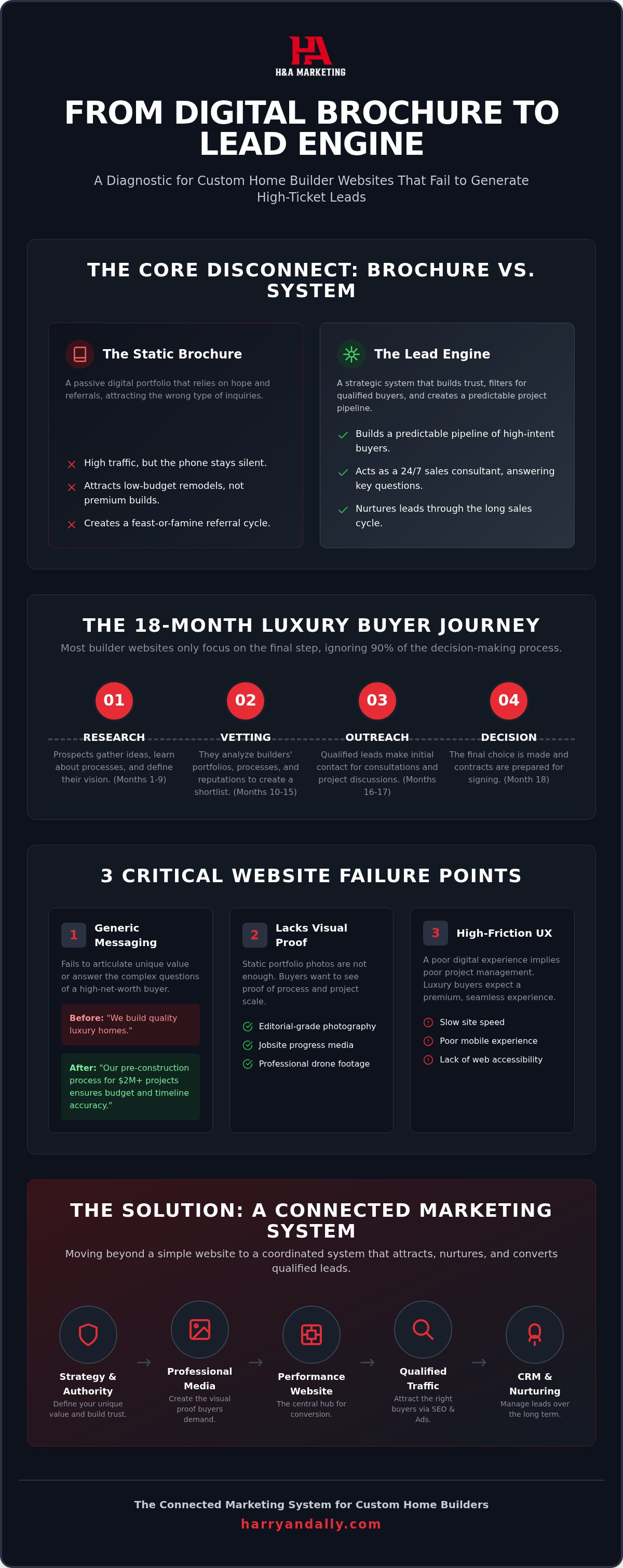
Most builders treat their website like a digital brochure. They showcase a few high-resolution photos and wait for the phone to ring. If you have a custom home builder website not generating leads, the problem isn't your portfolio; it's the lack of a conversion system. You've mastered the job site, but your digital presence is likely stuck in the past. High-end buyers don't make decisions based on a gallery alone. They're looking for proof of process, reliability, and authority.
In 2026, Google’s AI Overviews prioritize what they call "Information Gain." If your site just says "We build luxury homes," you're providing zero unique value to the search engine or the user. You need to articulate exactly how you build, why your materials matter, and how you manage the complexities of a $2 million project. A beautiful gallery is no longer enough to establish authority; you need a site that acts as a strategic asset.
The sales cycle for a custom build often spans 18 months. Most websites fail because they only cater to the "ready to build today" crowd. A robust lead generation strategy captures prospects at the research stage, keeping you top of mind until they're ready to break ground. Without this, you're losing potential clients before they even reach your contact page.
There's a massive difference between high traffic and qualified intent. In competitive markets, the benchmark cost per click for builder keywords can reach $45. Driving that expensive traffic to a site with generic copy is a direct hit to your ROI. You don't need more eyes on your page; you need a site that filters for high-ticket interest and eliminates low-budget distractions.
The Disconnect Between Craftsmanship and Digital Presence
Luxury buyers associate digital quality with physical quality. If your custom home builder website design looks like a template from a decade ago, they'll assume your project management is equally outdated. You build the architecture; we build the authority. Relying on word-of-mouth referrals creates a dangerous feast-or-famine cycle that limits your growth. Trust Friction is the gap between viewing a portfolio and booking a consultation; it's the invisible wall where your craftsmanship fails to translate into a signed contract.
Misalignment with Luxury Buyer Expectations
High-net-worth individuals look for more than just aesthetics. They want to know your pre-construction process, your vendor selection, and your communication style. Your website must act as a 24/7 sales consultant that answers these questions before the first meeting. With average 30-year fixed mortgage rates at 6.71% as of September 2026, buyers are more deliberate than ever. They're looking for a strategic partner, not just a contractor. Transparency isn't just a courtesy; it's a requirement for winning high-ticket bids.
The Visual Proof Checklist: Portfolio vs. Progress
A high-end gallery is the baseline for any luxury builder; it isn't the differentiator. If you are struggling with a custom home builder website not generating leads, your visuals might be too static. Luxury buyers in 2026 are highly analytical. They don't just want to see a finished kitchen; they want to see the precision that went into the framing, the cleanliness of your job site, and the scale of your management. Static, stock-like photos often feel impersonal and fail to build the deep trust required for an eight-figure investment.
Professional video and photo services are non-negotiable trust signals. While your competitors rely on iPhone shots from their superintendents, editorial-grade media separates the true craftsmen from the volume builders. Beyond aesthetics, your site must remain functional for all users. Adhering to web accessibility standards ensures that your high-end portfolio is usable and navigable for every potential client, which reinforces your reputation for professional excellence.
Transforming the Portfolio into a Narrative
Moving from "Finished Room" shots to project storytelling changes how prospects perceive your value. Instead of a grid of disconnected images, use your website to walk them through the journey from raw land to a custom estate. Incorporating drone footage allows you to showcase site management and the sheer scale of your projects from angles that traditional photography can't reach. This level of detail increases dwell time and directly impacts conversion rates by keeping users engaged with your brand longer. For a deeper dive into this strategy, read our guide on Visual Storytelling: Photo and Video for Home Builders.
Leveraging Real-Time Job Site Media
Process trust is built before the first site visit. By showcasing safety, organization, and daily progress through high-quality media, you remove the "black box" of construction. Job site media serves as objective evidence that your project management claims aren't just marketing fluff; they are daily realities on your active builds. This transparency is exactly what high-net-worth individuals look for when vetting a partner for a multi-year project. Capturing the human element through short, professional "meet the builder" videos further breaks down barriers, making you a person rather than just a logo. If your current media doesn't reflect your actual quality, consider how professional photo and video services can bridge that gap and start turning visitors into inquiries.
Authority Signals: Building Trust Before the First Call
Building a luxury home is an emotional and financial marathon. If you find your custom home builder website not generating leads, you likely have an authority gap. Before a prospect ever picks up the phone, they've already conducted a deep background check on your brand. They aren't just looking for 5-star reviews; they're looking for signs that you are a market leader who can navigate the complexities of a multi-million dollar build. Authority is built through a combination of search dominance, strategic reputation management, and technical credibility.
In the high-ticket construction world, your website must answer the "hard questions" before they are asked. This includes detailing your pre-construction phase, your approach to budget transparency, and how you handle the 18-month decision window typical for custom builds. When you position yourself as a thought leader rather than just a contractor, you move the conversation away from price and toward value. Technical credibility signals, such as certifications and safety standards, provide the professional foundation that luxury buyers expect as a baseline.
Winning the Search Engine Authority Battle
Establishing market dominance starts with a specialized approach to SEO. For custom builders, this isn't a volume game. You don't need thousands of visitors looking for "home decor ideas"; you need the ten visitors per month who are searching for high-intent terms like "luxury custom estate builders." Optimizing your portfolio for both local and national visibility ensures that you capture these high-value prospects wherever they begin their journey.
Current search trends in 2026 show that "Zero-Click" optimization is becoming vital. With AI Overviews often occupying the top of the page, your content must be authoritative enough for Google to cite it directly. This builds brand equity and trust before the user even clicks through to your site. By providing clear, data-backed answers to complex building questions, you establish yourself as the primary expert in your region.
The Review Strategy for Luxury Builders
Standard testimonials are for small-scale trades. For custom home builders, your review strategy must focus on "The Experience" rather than just "The House." A prospect wants to know how you managed their expectations, how your team communicated during the framing stage, and how you handled the inevitable challenges of a complex site. Managing this digital reputation across Google and industry-specific platforms is a critical part of a connected marketing system.
Trust is also heavily influenced by visual consistency. If your reviews praise your attention to detail but your website photos are grainy or poorly lit, you create a disconnect that kills conversions. High-end imagery acts as a silent testimonial to your professionalism. You can see how this works in practice by reviewing our guide on Luxury Home Builder Photography, which explains how to capture the aesthetic required to close $5M+ leads.
Conversion Infrastructure: Removing Friction from the UX
High-net-worth individuals have little patience for poor digital experiences. If you're struggling with a custom home builder website not generating leads, the friction usually starts at the user interface. A clunky, slow, or confusing site doesn't just frustrate visitors; it signals a lack of professional precision. In the luxury market, your website is the first "room" a client enters. If the lighting is bad and the layout is confusing, they won't stay to see the rest of the house.
A "Luxury UX" audit focuses on speed, mobile-first architecture, and intuitive navigation. You must move beyond the generic "Contact Us" page. Instead, use strategic lead capture like "Request a Design Consultation" or "Download Our Project Planning Guide." Incorporating interactive elements is also vital. Research from Zillow indicates that 71% of home buyers prefer 3D tours over static photos. Providing these tools, alongside clear floor plans and project maps, keeps high-intent buyers engaged with your brand longer.
Filtering is just as important as capturing. Don't be afraid to use pricing context and project minimums on your site. By clearly stating that you specialize in builds starting at $2 million, you filter out "tire-kickers" and small remodel inquiries. This ensures your sales pipeline is filled with qualified buyers who respect your time and expertise.
Streamlining the Path to Inquiry
Most builder contact forms are too long or too vague. A luxury buyer wants to feel like they're starting a professional relationship, not filling out a support ticket. Your custom home builder website design should prioritize a frictionless path to inquiry. Implement micro-conversions for users who are still early in the 18-month decision journey. Offering a high-value PDF guide on "Navigating the Custom Build Process" allows you to capture contact information long before they're ready to request a formal bid.
Technical Performance for High-End Users
Technical performance is a direct reflection of your brand's reliability. Over 60% of builder research now happens on mobile devices, often on premium hardware with high-resolution displays. You must optimize your editorial-grade imagery to load instantly without losing the crisp detail that showcases your craftsmanship. Test your site speed on the latest mobile devices to ensure that the navigation is responsive, the scroll is fluid, and the high-res visuals don't cause the page to lag.
Request a conversion audit for your builder website
The Connected Marketing System: Scaling Beyond Referrals
A custom home builder website not generating leads is often the result of "siloed marketing." You might have a talented photographer, a separate SEO vendor, and a web designer who doesn't truly understand the high-end construction market. These pieces rarely talk to each other. To scale beyond inconsistent referrals, you need a connected marketing system. This architecture coordinates your creative assets with your traffic sources and lead capture tools. It transforms your site from a static digital flyer into a high-performance engine that tracks every dollar of ROI from the initial click to the final signed contract.
Effective lead generation for construction companies requires more than just a contact form; it requires a backend infrastructure designed for the 18-month sales cycle. By integrating a CRM like GoHighLevel or LeadConnector, you ensure that no prospect falls through the cracks. This system allows you to measure exactly which marketing channels are driving your most profitable projects, providing the data you need to invest your marketing budget with total confidence.
The Role of a Fractional CMO in Builder Growth
Builders often hire vendors for one-off tasks, but they rarely have a strategist coordinating the entire vision. A fractional CMO acts as your growth partner, ensuring your custom home builder website design aligns perfectly with your Google Ads strategy and your professional drone footage. This managed system provides long-term value by building a brand that dominates your local market while you focus on managing the job site. It's the difference between a one-dimensional service and a comprehensive strategy that handles creative, traffic, and lead capture as one single unit.
Automation as a Sales Multiplier
Automation isn't about being impersonal; it's about being omnipresent. Lead nurturing sequences can educate prospects on your building process while you're busy at a site meeting or managing vendors. These automated touchpoints keep your brand top-of-mind during the long decision-making window typical for $2M+ builds. Using sophisticated data tracking, you can identify "hot leads" based on how they interact with your portfolio, allowing you to reach out exactly when their intent is highest. CRM integration prevents lead leakage by ensuring every inquiry is logged, tracked, and nurtured without requiring constant manual effort from your office staff.
Building a Digital Engine for Luxury Growth
Transforming your digital presence is more than a design update; it's about installing a connected marketing system that works as hard as your field crews. A custom home builder website not generating leads is often just a symptom of disconnected strategies. By aligning editorial-grade media with CRM automation and high-intent search visibility, you bridge the gap between a simple portfolio view and a signed contract. Success in the luxury market depends on establishing authority long before the first consultation takes place.
H&A Marketing serves as your specialized growth partner, bringing together professional on-site production teams and LeadConnector integration experts. We handle the technical complexities of your digital presence so you can focus on delivering world-class craftsmanship. It's time to move beyond the feast-or-famine cycle of referrals and build a predictable engine for high-ticket growth.
Request a Free Marketing Audit for Your Construction Business
You've spent years perfecting your trade. We're here to ensure your digital presence finally reflects that same level of excellence. Let's build something remarkable together.
Frequently Asked Questions
Why does my home builder website get traffic but no leads?
Your site likely suffers from a disconnect between high-end craftsmanship and digital execution. If you have a custom home builder website not generating leads, you're probably missing a clear path to inquiry or failing to answer the hard questions luxury buyers ask. Traffic alone doesn't pay the bills; you need a conversion infrastructure that filters for high-intent buyers and uses editorial-grade media to validate your project management claims before the first call.
How much should a custom home builder spend on a new website in 2026?
Investment levels vary based on your growth goals and the complexity of your portfolio. Rather than viewing a website as a one-time expense, high-end builders should treat it as a core business asset within a connected marketing system. A professional build includes specialized strategy, CRM integration, and high-resolution media production. Focusing on the lowest price often results in a static brochure that fails to produce a measurable return on your investment.
Do I really need professional photography for every project?
Yes, professional photography is a non-negotiable trust signal for the luxury market. Buyers associate the quality of your digital presentation with the quality of your construction. Using amateur or outdated photos creates trust friction that turns away qualified prospects. High-quality visual assets, including drone footage and on-site production, are essential components of a custom home builder website design that actually converts visitors into high-ticket clients.
What is the best CRM for custom home builders to track leads?
We recommend utilizing a CRM system specifically integrated for construction workflows, such as LeadConnector or GoHighLevel. These platforms allow you to track every lead from the initial click to the signed contract. By centralizing your communication, you prevent lead leakage and can automate follow-up sequences. This ensures you stay top-of-mind during the long 18-month decision cycle common in the custom home building industry, ultimately improving your overall marketing ROI.
How long does it take for SEO to start generating construction leads?
SEO is a long-term strategy that typically begins showing measurable results within three to six months. Success in the construction niche depends on targeting high-intent keywords rather than just chasing broad traffic volume. By consistently producing authoritative content that answers buyer questions and optimizing your technical performance, you build a lead engine that reduces your dependency on paid advertising. Regular audits are necessary to maintain dominance as search engine algorithms evolve.
Should I put my pricing or project minimums on my website?
Including project minimums is a strategic way to filter out tire-kickers and unqualified inquiries. Transparency regarding your entry point establishes authority and respects both your time and the prospect's. Luxury buyers appreciate knowing they are looking at a builder who handles their specific project scale. This clarity helps ensure that the leads hitting your CRM are high-intent individuals ready for a $2M plus investment rather than small-scale remodel seekers.
What features are essential for a luxury home builder website?
A luxury builder site requires more than just a gallery; it needs a UX focused on speed and mobile-first design. Essential features include:
- Editorial-grade project stories and high-resolution video.
- Interactive floor plans or 3D tours.
- Seamless CRM integration for lead capture.
- Clear process transparency and authority signals like certifications.
How can I generate leads without relying on word-of-mouth referrals?
Transitioning to a connected marketing system allows you to build a predictable pipeline independent of word-of-mouth. This involves coordinating search engine optimization, targeted ads, and professional content production into a single unit. When your digital presence reflects your craftsmanship and your backend handles lead nurturing automatically, you create a sustainable growth model. This approach ensures your business remains resilient regardless of fluctuations in your traditional referral networks or the local market.
