
Choosing a Contractor Website Design Agency: The 2026 Buying Guide

Article by
Harry Stanley III
Harry Stanley III is a construction marketing strategist and fractional CMO at H&A Marketing. He has helped construction companies grow through website strategy, SEO, paid advertising, branding, lead generation, CRM systems, and professional content. His past work includes helping Meraki Solar generate an additional $3.7 million in revenue in his first year and supporting American Builders as a fractional CMO. Today, Harry works directly with custom home builders and construction companies to build marketing systems designed to generate qualified leads and measurable growth.
Most custom home builders spend years perfecting their craft, only to let a cheap, template-based website undermine their brand authority before a prospect even picks up the phone. It's a common frustration to watch competitors with inferior portfolios win luxury projects simply because their digital presence looks more established. You likely recognize that effective website design for home builders requires more than just a few photo galleries and a contact form. It needs to reflect the precision of a high-ticket build while filtering out the budget shoppers who drain your estimating team's time and energy.
We agree that your website should be a high-performance lead engine, not a static digital brochure that sits idle. Finding a partner who understands the long sales cycles and specific nuances of the construction industry is the difference between a wasted investment and a scalable pipeline. This 2026 buying guide will show you how to vet a custom home builder website design partner that prioritizes measurable ROI. We'll dive into the technical standards for 2026, from Core Web Vital benchmarks to essential CRM integrations, so you can stop guessing and start building a connected marketing system that works as hard as you do.
Key Takeaways
- Transition from a static digital brochure to a high-performance conversion engine that acts as your 24/7 sales representative.
- Discover why effective website design for home builders requires industry-specific expertise to navigate 6- to 18-month sales cycles and luxury buyer expectations.
- Identify the core features that qualify prospects automatically, ensuring your team only spends time estimating high-ticket, high-margin projects.
- Learn how to vet agencies based on their ability to integrate "connected marketing systems" like CRM tracking, SEO, and professional jobsite media.
- Understand the difference between fixed-fee project builds and monthly managed partnerships that prioritize long-term pipeline growth over simple aesthetics.
The Evolution of Contractor Website Design: From Brochure to Lead Engine
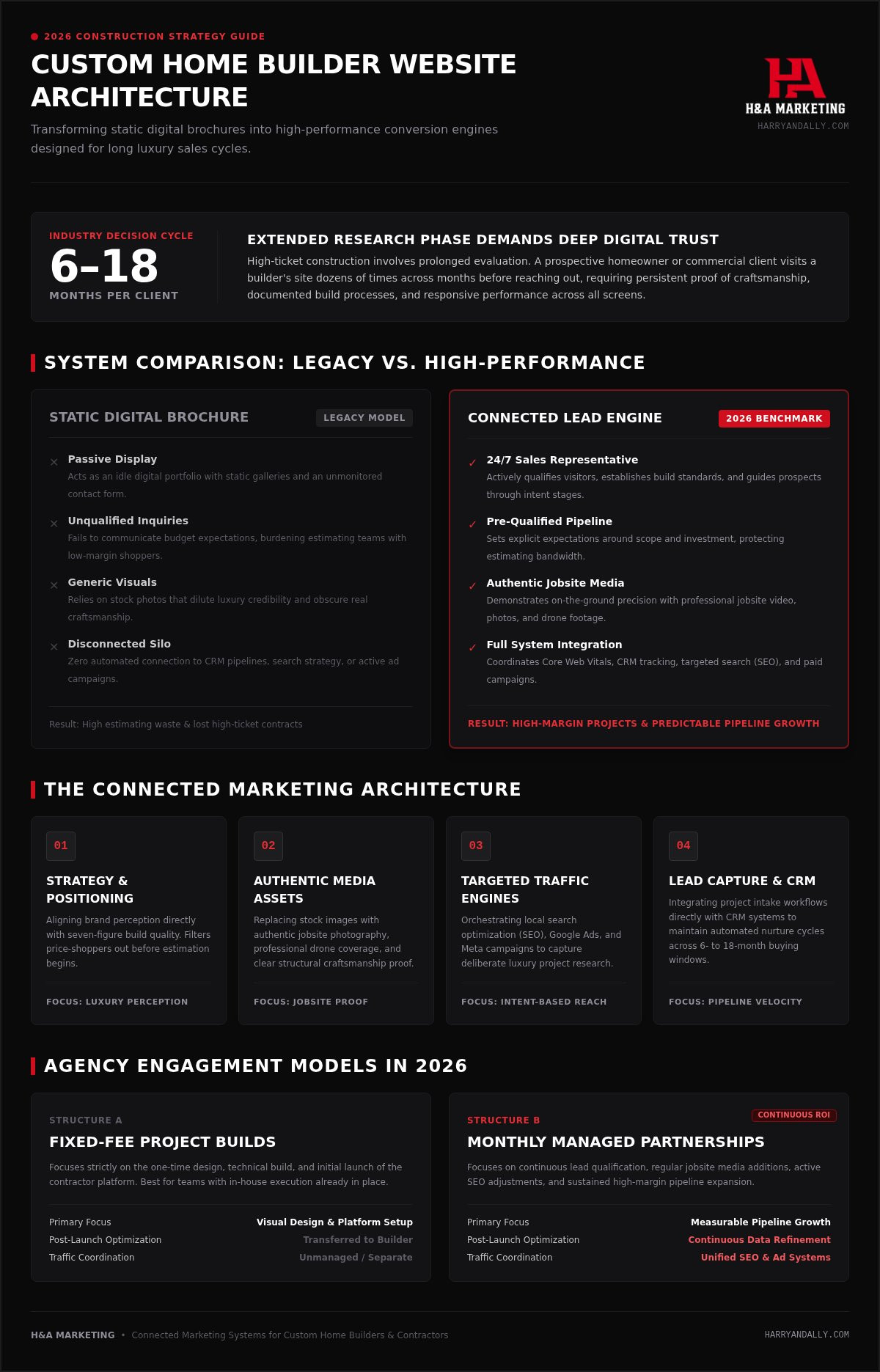
The shift in website design for home builders reflects a fundamental change in how homeowners buy. A decade ago, a digital brochure with a few static photos was enough to stay competitive. In 2026, your website must function as your 24/7 sales representative. It doesn't just show your work; it qualifies your leads. While a traditional brochure site sits passively, a modern conversion engine actively moves prospects through a funnel by addressing their specific project requirements and financial expectations.
This evolution introduces the "Connected Marketing System" as the new industry standard. It's no longer about having a pretty site in isolation. Your digital presence must coordinate strategy, creative assets, and lead capture into one seamless operation. If your site isn't integrated with your CRM or backed by a deliberate traffic strategy, it's a digital liability rather than an asset. Unlike high-volume service trades that prioritize "book now" buttons, luxury construction requires a user experience that fosters deep exploration and builds massive trust.
To better understand how these design tactics attract high-paying clients, watch this helpful video:
Why High-Ticket Construction Demands Premium Positioning
For custom builders, the visual quality of your website directly impacts your perceived project value. If you're bidding on a seven-figure home but your site looks outdated, you've already lost credibility. Luxury buyers expect a premium experience that mirrors the quality of your builds. This means moving away from generic stock imagery. Authentic jobsite storytelling using professional photo and drone video builds a level of trust that stock photos can't touch. It shows you're actually on the ground, managing the details they're about to pay for.
The Long Sales Cycle: Designing for the Research Phase
The decision journey for a custom home or major renovation can last 18 months. Your website must serve as both a luxury portfolio and a technical resource during this extended research phase. Prospects will visit your site dozens of times before reaching out. To support this journey, your site needs a foundation in responsive web design to ensure your portfolio looks flawless on a tablet at a kitchen table or a desktop in a professional office.
An effective custom home builder website design provides the "proof" homeowners need to move from inspiration to inquiry. It shouldn't just show the finished product; it should explain your process, your standards, and your expertise. By positioning your site as a comprehensive resource, you stay top-of-mind throughout their entire decision-making process.
Essential Criteria for Choosing a Contractor Website Design Agency
Generalist agencies often struggle with website design for home builders because they apply high-volume retail tactics to high-ticket construction projects. A boutique agency might create a beautiful layout, but if they don't understand your pre-construction process, the site won't convert. You need a partner that functions as a strategic ally, coordinating your digital presence with your actual business operations. By aligning your site with home builder digital marketing best practices, you ensure your investment pays off through qualified leads rather than just traffic volume.
A full-funnel approach is required for success in 2026. This means your agency must handle more than just aesthetics. They should integrate strategy, creative, traffic generation, and lead capture into a single connected system. Design decisions should be data-driven, utilizing heatmaps and conversion tracking to see exactly where luxury prospects drop off. If an agency cannot explain how they use data to iterate on your design, they are simply guessing with your marketing budget.
Vetting for Industry Insider Knowledge
Ask potential agencies how they handle high-resolution portfolios without sacrificing speed. They should be able to explain how professional construction photography and video assets are optimized for the web. If they don't understand the difference between a spec home and a custom estate, they aren't the right fit. Your agency should know how to present a luxury portfolio that speaks to a homeowner's aspirations while providing the technical proof of craftsmanship they require.
Technical Standards for 2026
Performance is the baseline for modern credibility. Your site must hit specific Core Web Vitals targets, such as a Largest Contentful Paint (LCP) under 2.5 seconds, to satisfy both Google and impatient users. Integration with CRMs like GoHighLevel or LeadConnector is mandatory for tracking leads through an 18-month sales cycle. Security is equally vital. Protecting client project data and blueprints is a non-negotiable requirement that generalist agencies often overlook.
Avoid proprietary CMS traps that keep your business hostage. You must own your site and its data. A transparent agency uses standard platforms like WordPress and provides full access to your analytics. This allows for a collaborative partnership where you can see measurable progress. If you're ready to move beyond a basic brochure, it might be time to discuss a specialized construction web design strategy that actually builds your pipeline.
Core Features of a High-Performance Construction Website
A high-performance site moves beyond aesthetics to solve specific business problems. For custom builders, the goal isn't necessarily more leads; it's better leads. Your website design for home builders must include dynamic filtering that allows users to browse by project type, such as coastal estates or modern renovations. This self-segmentation helps prospects understand if you're the right fit for their specific vision before they ever hit your inbox. It acts as a primary filter, saving your estimating team hours of wasted time on unqualified inquiries.
Integrating social proof like live jobsite updates and video testimonials provides the technical proof luxury homeowners require. When planning an overhaul, consult Forbes Advisor's website redesign guide to ensure your new architecture supports these high-intent features without breaking your search rankings. A strategic foundation in SEO ensures you aren't just visible, but visible to those ready to invest in a high-ticket build. Your site should coordinate these elements into a single, connected system that builds trust automatically.
The Portfolio: Showcasing Quality Over Quantity
Structure your project pages to tell a complete story. Don't just show the finished kitchen; show the architectural blueprints and the framing stage. Using drone photography is essential for showing the scale of large custom estates and their relationship to the surrounding landscape. This level of detail is a core component of construction SEO, as it provides the unique, authentic content Google rewards in 2026. High-quality media proves your craftsmanship in a way that stock photos never could.
Conversion Optimization for Builders
Your call-to-action (CTA) strategy should reflect the long sales cycle of construction. A "Request a Quote" button is often too aggressive for someone in the early inspiration phase. Instead, try "Schedule a Strategy Call" or "Download Our Custom Build Guide." This educational approach reduces friction and establishes your authority early. For a deeper dive into specific components, review these 10 features every custom home builder website needs. By focusing on helpfulness, your custom home builder website design becomes a tool that helps prospects make an informed decision, rather than just a sales pitch.
The Buying Process: How to Vet and Onboard an Agency
The discovery phase is the most critical part of the onboarding process. It's where your specific growth goals meet the agency's strategic vision. You aren't just looking for a new look; you're identifying the project types that drive your highest margins. A successful agency will ask about your ideal contract value and your geographic targeting before they ever open a design file. This ensures the website design for home builders is tailored to attract custom estate clients rather than small-scale repair work.
When you evaluate proposals, look for a clear distinction between the build phase and the growth phase. Some agencies offer fixed project fees for the initial development, while others prefer monthly managed retainers that include ongoing strategy. In 2026, a "set it and forget it" approach is a recipe for stagnation. High-performance construction websites require a minimum of 8 to 12 weeks to develop properly. This timeline allows for deep strategy, professional content creation, technical testing, and stakeholder feedback.
Analyzing the Agency Portfolio
Don't just look for a "pretty" site. You need to see design diversity that proves the agency doesn't rely on cookie-cutter templates. Check their existing client sites for speed and mobile responsiveness. Most importantly, verify the integration of lead generation systems. A portfolio should demonstrate how an agency handles complex navigation and high-resolution media without breaking the user experience. If every site they build looks identical, they aren't designing for your specific brand; they're fitting you into a box.
Understanding the Marketing System Integration
Your website is the hub of your marketing, but it shouldn't exist in a vacuum. It must interact seamlessly with your SEO and paid ads strategies. This coordination ensures that the traffic you pay for actually lands on a page designed to convert. A true growth partner understands that branding and digital presence must be unified. When vetting an agency for custom home builder website design, ensure they are prepared to manage the post-launch maintenance and hosting required to keep your system running at peak performance.
Request a marketing strategy audit for your construction company
H&A Marketing: Your Growth Partner for High-Ticket Construction Success
H&A Marketing operates as a strategic ally rather than a detached vendor. We understand that high-ticket construction firms don't need more noise; they need a system that captures qualified interest. Our "Connected Marketing System" is built on four pillars: Strategy, Creative, Traffic, and Capture. This isn't just about website design for home builders; it's about building a digital infrastructure that supports your sales team and validates your project margins. We act as a fractional CMO for your business, providing the high-level strategy and tactical execution required to dominate your specific market. We focus exclusively on luxury custom builders and national construction firms that require a professional, specialized approach to growth.
Beyond Web Design: A Holistic Approach
Effective marketing requires coordination across multiple channels to be truly effective. We ensure your construction branding is reflected in every digital touchpoint, from your website to your jobsite media. Our team uses professional photo and drone assets to fuel your social media management, providing authentic, real-time proof of your craftsmanship. This high-quality content then feeds into our advanced SEO for construction strategies. We don't just target generic terms; we build authority around the specific project types and luxury levels that drive your business.
The H&A Difference: Built for Builders
We address the critical gap most generalist agencies miss: the seamless integration between your website and your internal sales system. A website is only successful if it feeds a managed, tracked pipeline. Our systems connect directly to your CRM, allowing your team to track leads through the entire 6- to 18-month homeowner decision journey. We prioritize high-ticket ROI and project quality over vanity metrics like raw traffic volume or social media "likes." You get no-nonsense communication and results-oriented project management that respects the traditional values of the construction industry while pushing for modern digital dominance.
If you're ready to stop treating your online presence as a digital brochure and start building a high-performance lead engine, the next step is a strategy discussion. We offer a comprehensive marketing audit to identify where your current system is leaking leads and how to optimize your website design for home builders for maximum impact. To learn more about our specific approach to the luxury market, explore our specialized custom home builder website design services. Our goal is to provide the professional relief that comes from delegating specialized tasks to experts who truly understand your trade.
Building Your Digital Competitive Advantage
Choosing the right agency is the difference between an expensive digital brochure and a scalable pipeline. You've seen how high-performance website design for home builders must integrate CRM tracking and professional jobsite media to validate your project quality. In 2026, your digital presence must move from passive visibility to a proactive, connected marketing system that filters for high-ticket ROI.
H&A Marketing provides the specialized construction focus you need to navigate long sales cycles and high homeowner expectations. We coordinate strategy, creative, and lead capture into one seamless operation. This allows you to focus on the build while we handle the digital heavy lifting. It's time to delegate these specialized tasks to a partner that understands the stakes of a luxury build.
Discuss your strategy with H&A Marketing
Your next landmark project starts with a website that proves you're the only logical choice for high-end clients. We're ready to help you build that growth engine today.
Frequently Asked Questions
How much should a custom home builder website cost in 2026?
Pricing for professional web development varies based on complexity, integration requirements, and the depth of the portfolio. High-end custom builds that include CRM synchronization and localized service pages typically require a significant upfront investment. According to industry benchmarks, bespoke agency builds can range from $8,000 to over $50,000 for multi-division companies. It is best to request a custom quote to understand the specific costs associated with your business goals and project scale.
Do I need a specialized contractor website design agency or can a local agency do it?
A specialized agency understands the unique nuances of the construction industry, such as long sales cycles and the importance of pre-qualifying high-ticket leads. While a local generalist might build a functional site, they often lack the industry-specific knowledge required for effective website design for home builders. Specialized partners act as strategic allies, coordinating your digital presence with your actual business operations to ensure the site attracts luxury prospects rather than budget shoppers.
How long does it take to design and launch a construction website?
A high-performance construction website typically takes 8 to 12 weeks to design, develop, and launch. This timeline allows for a comprehensive discovery phase, professional content creation, and technical integrations with your CRM. Rushing this process often results in a generic brochure site that fails to convert. Quality development requires time for strategic planning, stakeholder feedback, and rigorous testing to ensure the site performs as a lead engine from day one.
What is the best platform for a home builder website?
WordPress remains the industry standard for home builder websites due to its flexibility, ownership transparency, and robust SEO capabilities. It allows for seamless integration with construction management software and sales CRMs. Unlike proprietary systems that keep your data hostage, an open-source platform ensures you maintain full control of your digital asset. This foundation supports the high-resolution media and dynamic portfolios essential for showcasing luxury craftsmanship to sophisticated homeowners who value technical proof.
How does a new website help with lead generation for construction companies?
A modern website acts as a 24/7 sales representative that qualifies prospects before they contact you. By including interactive project galleries, step-by-step qualification forms, and educational resources, you reduce sales friction and filter out unqualified inquiries. This system ensures your estimating team only spends time on high-ticket opportunities. When integrated with a connected marketing system, your site becomes the central hub for capturing and tracking leads throughout their long decision journey.
Should I provide the photos or does the agency handle media production?
While you can provide your own media, a full-service agency like H&A Marketing offers professional drone and jobsite photography to ensure your portfolio looks its best. High-quality, authentic visual assets are critical for building trust with luxury buyers. We handle the production of these assets to fuel your website, social media, and advertising campaigns. Using professional media production ensures your brand positioning reflects the actual quality of the homes you build.
How do I know if my website is actually generating high-quality leads?
Tracking lead quality requires a direct connection between your website and a CRM system like GoHighLevel or LeadConnector. This allows you to monitor which inquiries turn into signed contracts rather than just measuring raw traffic volume. By analyzing conversion data and lead sources, you can see exactly which project types and geographic targets are driving ROI. High-quality leads are identified by their project intent, budget alignment, and movement through your sales pipeline.
Is SEO included in the initial website design project?
A strategic SEO foundation is essential for any website design for home builders project. While the initial build includes technical optimization and on-page structures, ongoing SEO is typically managed through a monthly retainer. This ensures your site maintains visibility for high-intent search terms as Google algorithms evolve. Combining the initial design with a long-term search strategy helps your business transition from traditional referral methods to modern digital dominance in the luxury market.
