
How to Build a Custom Home Portfolio That Generates Leads

Article by
Harry Stanley III
Harry Stanley III is a construction marketing strategist and fractional CMO at H&A Marketing. He has helped construction companies grow through website strategy, SEO, paid advertising, branding, lead generation, CRM systems, and professional content. His past work includes helping Meraki Solar generate an additional $3.7 million in revenue in his first year and supporting American Builders as a fractional CMO. Today, Harry works directly with custom home builders and construction companies to build marketing systems designed to generate qualified leads and measurable growth.
Did you know that the typical sales cycle for a custom home can last anywhere from 6 to 18 months? During this extended period, a prospective client will visit your site dozens of times to scrutinize your craftsmanship and process. If your custom home builder portfolio website is just a collection of static, unoptimized images, you're likely losing high-ticket projects to competitors who present a more professional digital front. It's frustrating when your online presence looks amateur compared to the luxury homes you actually build; it makes your expertise invisible to Google and potential leads alike.
We understand that you'd rather be on the jobsite than worrying about SEO or website performance. This guide will show you how to transform your gallery into a high-performance sales engine that attracts premium clients and streamlines your lead flow. You'll learn how to move beyond basic photo grids toward a strategic custom home builder website design that utilizes database-driven case studies and professional jobsite media. We'll explore the technical shifts and creative strategies needed to ensure your portfolio doesn't just look good, but actually acts as a 24/7 salesperson for your business.
Key Takeaways
- Shift your mindset from viewing your website as a digital brochure to treating it as a strategic sales asset that manages the long vetting process for luxury clients.
- Structure your project pages with a clear narrative arc that highlights architectural challenges and custom solutions to prove your expertise to high-net-worth prospects.
- Adopt a database-driven framework for your custom home builder portfolio website to ensure superior page speed and effortless project updates without breaking your site layout.
- Prioritize high-impact curation by only showcasing the specific types of premium builds you want to attract to your future pipeline.
- Integrate your portfolio into a connected marketing system where individual project pages serve as high-converting landing pages for targeted Google and Meta ads.
Why Your Custom Home Builder Portfolio Website Is Your Most Powerful Sales Tool
Most builders treat their website like a digital filing cabinet for old project photos. This is a missed opportunity. A high-performance custom home builder portfolio website is a strategic asset that works 24/7 to qualify prospects. Since custom builds typically involve a 6 to 18 month sales cycle, your portfolio is the primary tool clients use to vet your reliability long before they pick up the phone. It's the silent salesperson that bridges the gap between a casual browser and a high-intent lead.
To better understand how imagery and structure impact high-ticket lead generation, watch this helpful video:
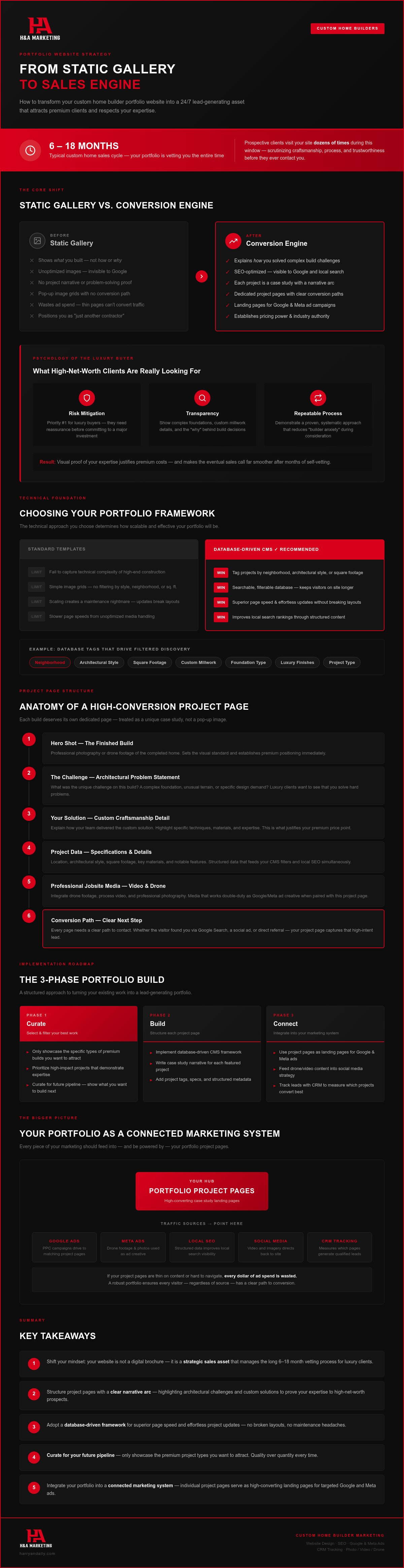
A "Static Gallery" merely shows what you did. A "Conversion Engine" explains how you did it. By integrating professional jobsite media with specific project data, you establish immediate pricing power. You stop being viewed as just another contractor and start being seen as an industry authority. This shift is critical for maintaining a connected marketing system where your website, SEO, and social presence all point toward a single goal: capturing high-intent leads that respect your expertise.
Your portfolio shouldn't exist in a vacuum. It is the ultimate destination for your entire marketing ecosystem. When you run Google Ads or share drone footage on social media, you are directing traffic to these project pages. If those pages are thin on content or hard to navigate, your ad spend is wasted. A robust portfolio ensures that every visitor has a clear path to conversion, whether they are looking for architectural inspiration or technical specifications.
The Psychology of the Luxury Home Buyer
High-net-worth individuals prioritize risk mitigation above almost everything else. They look for transparency and a repeatable process to reduce the inherent "builder anxiety" that comes with a major investment. When your website showcases the "why" behind a complex foundation or a specific custom millwork detail, you provide the visual proof necessary to justify premium costs. This level of detail builds trust during the months-long consideration phase, making the eventual sales call much smoother.
Moving Beyond the Static Image Grid
Standard website templates usually fail to capture the technical complexity of high-end construction. To scale your digital presence without creating a maintenance nightmare, you need database-driven content management systems. These systems allow you to tag projects by neighborhood, architectural style, or square footage. This structured approach keeps visitors on your site longer and improves your local search rankings. Moving beyond a simple image grid is a core pillar of effective custom home builder website design, turning your work into a searchable, filterable database of success that proves you can handle the most demanding projects.
The Anatomy of a High-Conversion Project Page
Static galleries are dead. A single pop-up image might show a beautiful kitchen, but it does nothing to explain your value as a builder. To convert a visitor into a high-ticket lead, every project needs its own dedicated page. This structure is essential for a custom home builder portfolio website because it allows you to showcase the specific problem-solving skills that luxury clients demand. By treating each build as a unique case study, you align your digital presence with custom home design and builder standards that prioritize one-of-a-kind craftsmanship and personalized solutions.
A high-conversion project page follows a narrative arc. It shouldn't just be a "hero" shot of the finished home; it needs to tell the story of the build. This builds trust by showing prospects how you handle the complexities of a custom project. Every page should include:
- The Challenge: Define the client’s goals or the site’s specific constraints.
- The Strategy: Explain your approach to design, materials, and engineering.
- The Execution: Use professional video and photo to document the process and the final result.
- The Outcome: Highlight the specific features that make the home a success.
Visual Storytelling Through Professional Jobsite Media
High-end clients rarely make a decision based on a single photo. They want to see the scale of the site and the neighborhood context. Drone photography is no longer optional; it is a requirement for showcasing how a home sits on its lot. Short-form video is equally powerful for explaining technical challenges, such as structural steel installations or complex waterproofing. When you combine these with professional lighting and staging for the finished shots, you create a visual experience that justifies your premium pricing. If you aren't sure where to start, our video and photo team can help you capture these milestones effectively.
SEO Foundations for Project-Based Content
Individual project pages are your best opportunity to rank for local, high-intent keywords. Instead of generic titles, name your pages based on the location and architectural style, such as "Modern Coastal Estate in [Neighborhood]." This helps your custom home builder portfolio website capture traffic from people searching for specific home types in your area. Ensure every image has descriptive alt-text and utilize schema markup to help Google understand the relationship between your photos and your services. Writing descriptions that balance technical specs with emotive storytelling ensures you satisfy both the search algorithms and the humans reading your site. For a deeper look at how this fits into your overall strategy, explore our approach to custom home builder website design.
Choosing the Right Framework: Static vs. Database-Driven Portfolios
Choosing the right technical foundation is just as important as the architectural plans for a new build. Most builders start with a basic template, but as your business grows, these static systems become a liability. A high-performance custom home builder portfolio website requires a database-driven framework to handle high-resolution media and complex project data without failing. This approach aligns with SBA marketing and sales guidance on building structured systems that turn prospects into qualified leads.
When you evaluate your current site, consider how the 10 features every custom home builder website needs apply to your portfolio. It isn't just about looking good; it's about functionality. Your site must be mobile-first. Most homeowners browse portfolios on tablets or phones while relaxing in the evening. If your gallery takes too long to load or breaks on a small screen, you've lost that lead before they even see your best work. A modern custom home builder website design ensures your work looks impeccable on every device.
The Limits of Standard Website Templates
Many "drag-and-drop" builders struggle with high-resolution construction media. These platforms often lack the server-side optimization needed to serve large image files quickly. Slow load times are more than an annoyance; they are a direct hit to your search rankings and user experience. Generic designs also dilute your brand. If your website looks like every other contractor's site, you can't justify luxury pricing. You need a bespoke system that reflects the uniqueness of your builds and supports your premium positioning.
Why Database-Driven Portfolios Win
Database-driven systems allow you to categorize projects by style, such as Modern, Coastal, or Traditional. This makes it easy for visitors to filter for exactly what they want to see. This technical architecture also automates your local SEO efforts. When you tag a new project with its neighborhood and style, the system automatically updates relevant pages across your site, strengthening your authority in specific geographic niches.
The biggest advantage is the workflow. Your team can upload new photos and project details in minutes. You don't have to worry about breaking the layout or calling a developer for every update. This efficiency allows you to keep your portfolio fresh, showing off your latest jobsites and finished homes with minimal effort. It transforms your website from a digital brochure into a powerful, automated lead generation tool that grows alongside your business.
How to Build Your Lead-Generating Portfolio: A 3-Phase Guide
Building a high-performance portfolio isn't a one-time project. It's a methodical evolution. A custom home builder portfolio website only generates ROI when it's built on a foundation of quality over quantity. To transform your site into a lead-generation machine, you must move beyond simply uploading photos. This process requires a connected marketing system that coordinates your visual assets with your long-term sales goals.
Phase 1: Curating for Premium Positioning
You aren't just a contractor; you're a curator. Your portfolio should only feature the work you want to win more of. Start by identifying three to five "Anchor Projects" that define your brand for 2026. These are the builds that showcase your highest level of craftsmanship and architectural complexity. It's equally important to remove low-margin or off-brand projects that might attract the wrong clientele. This curation ensures your builder branding remains consistent and targets the luxury market effectively.
Phase 2: Capturing High-Impact Assets
High-quality media is the lifeblood of a successful custom home builder portfolio website. We recommend scheduling a dedicated "Media Day" for every completed project. This isn't just about taking a few snapshots. You need a comprehensive checklist to capture the full story of the home:
- Wide Shots: Capture the architectural silhouette and room flow.
- Detail Shots: Highlight custom millwork, hardware, and material transitions.
- Drone Angles: Show the home’s relationship to its environment and neighborhood.
- The Human Element: Include photos of the builder or clients to build a personal connection.
Using professional video and photo services ensures that these assets meet the expectations of high-net-worth prospects who value technical precision.
Phase 3: Mapping the User Journey
Once a visitor is on a project page, you must guide them toward a conversion. Don't leave them at a dead end. Use "Related Projects" sections at the bottom of each page to keep users engaged and browsing your work longer. Strategically place high-intent calls-to-action (CTAs) such as "Download the Floor Plan" or "Inquire About a Similar Build." Finally, implement CRM tracking to see exactly which projects are driving the most inquiries. This data allows you to refine your strategy and double down on the content that produces the highest project-based ROI. For more on how we structure these systems, explore our approach to custom home builder website design.
Discuss your custom builder website strategy with our marketing team today.
Scaling Your Growth with a Connected Marketing System
A high-performing custom home builder portfolio website is the centerpiece of a connected marketing system. It doesn't just sit there; it fuels your Google Ads and social media campaigns. Instead of sending paid traffic to a generic homepage, you can direct high-intent prospects to a specific project page that matches their search query. For example, if someone searches for a luxury modern builder, landing them on a detailed case study of your best contemporary estate is far more effective than a standard contact page. This level of specificity reduces bounce rates and significantly increases the quality of your inquiries.
By treating your project pages as targeted landing pages, you maximize your ad spend. Your portfolio becomes a dynamic sales tool that validates your expertise in real-time. This is why a strategic custom home builder website design is essential. It ensures that every click from a Google search or a Meta ad leads to a high-conversion environment that proves your value as a premium builder.
Integrating Your Portfolio with CRM Automation
When a lead fills out a form on a specific project page, that data should flow immediately into your CRM. This allows you to track a prospect from their first interaction all the way to a signed contract. You can also automate "Thank You" sequences that send additional, relevant projects to the lead based on the architectural style they were just viewing. This keeps your brand top-of-mind during the long consideration phase typical of luxury builds. Using this data helps refine your lead generation strategy by showing you exactly which builds are attracting the most profitable inquiries.
The H&A Advantage: Strategy, Creative, and Traffic
Builders are experts at construction, not digital architecture. You should stop acting as your own marketing manager and focus on the jobsite. We provide a fractional CMO approach that coordinates your strategy, professional media, and traffic capture. We handle the tech so you can handle the builds. Our connected system ensures your portfolio stays updated and optimized for ROI. The first step toward a more efficient pipeline is identifying the gaps in your current presence. Request a marketing audit from our team to see how your custom home builder portfolio website compares to the competition and where you might be losing high-ticket leads.
Transform Your Portfolio into a Strategic Growth Asset
A static image grid is no longer enough to win high-ticket contracts in a competitive market. Moving to a database-driven custom home builder portfolio website allows you to showcase your technical expertise through structured project pages and high-impact media. By curating your best work and mapping a clear user journey, you turn your website into a 24/7 salesperson that qualifies leads before you ever take a call. This shift from a digital brochure to a conversion engine is what separates local contractors from industry authorities.
H&A Marketing acts as your strategic ally. We provide a specialized construction marketing focus that generalist agencies cannot match. Our connected system combines integrated video and drone production with systematized lead generation to ensure your best builds reach the right audience. We manage the technical architecture and CRM integrations so you can stay focused on the jobsite. It's time to stop treating your website as an afterthought and start using it as a high-performance sales tool that drives measurable ROI.
Discuss your custom home builder website strategy with H&A Marketing
Your craftsmanship deserves a digital presence that matches the quality of your luxury homes. Let's build a system that reflects your brand authority and streamlines your lead flow for years to come.
Frequently Asked Questions
How many projects should I have in my custom home builder portfolio?
Aim for 5 to 10 high-quality anchor projects that represent your best work. It's more effective to showcase a few extraordinary builds than to clutter your site with dozens of average renovations. Luxury clients look for consistency and specialized craftsmanship. Each project should act as a deep case study, detailing the architectural challenges you solved and the premium materials used to justify your high-ticket pricing.
Do I really need professional video for my construction website?
Professional video is essential for demonstrating the scale and technical complexity of your builds. While photos capture the finished result, video tells the story of your process and attention to detail. We recommend including:
- Drone sweeps for neighborhood context
- Time-lapse footage of structural milestones
- Interviews explaining architectural challenges
How does a portfolio website help with my local SEO rankings?
A well-structured custom home builder portfolio website improves your rankings by creating dedicated landing pages for specific architectural styles. When you tag projects with descriptive keywords, you signal your authority to search engines. Each case study provides fresh content that Google prioritizes. This approach ensures you capture high-intent traffic from prospects searching for specific types of luxury homes. It turns your past work into a searchable database of success.
Should I include project costs or pricing on my portfolio pages?
You don't need to list exact dollar amounts, but providing price ranges or investment levels can help qualify your leads. Since custom builds are highly variable, focusing on the scope and complexity of the project is often more effective. High-net-worth individuals are usually more concerned with value and risk mitigation than the lowest bid. Use your project descriptions to highlight the specific material choices and structural features that define the project's worth.
How often should I update my builder portfolio with new projects?
Update your portfolio at least once every quarter or immediately following the completion of a major project. Frequent updates signal to both prospects and search engines that your business is active and thriving. You don't always need a finished home to add content; jobsite progress videos and behind the scenes updates can be just as effective. Keeping your portfolio current ensures that your digital presence reflects your most recent capabilities.
What is the best website platform for a custom home builder portfolio?
The best platform for a custom home builder portfolio website is a database-driven content management system that allows for easy project filtering. We prioritize frameworks that support high-resolution media without sacrificing page speed. A custom-built system ensures your site remains mobile-responsive and easy for your team to manage. For a system built specifically for the trade, explore our approach to custom home builder website design.
How do I optimize my project images for faster website loading?
Optimize your images by using modern formats like WebP and implementing server-side compression. High-resolution photos are necessary for luxury portfolios, but they shouldn't destroy your page load times. Use lazy loading to ensure images only load as the user scrolls. These technical adjustments are critical for passing Google's Core Web Vitals, which directly affects how high your portfolio pages rank in search results. Fast loading times prevent prospect frustration.
Can a portfolio website help me attract better subcontractors?
A professional portfolio acts as a recruitment tool by showcasing the quality of the jobsites you manage. Top-tier subcontractors want to work on prestigious projects that will look good in their own portfolios. When your website projects an image of organization and high-end craft, you attract specialized tradespeople who value professionalism. This internal authority helps you maintain a reliable crew, which is essential for delivering projects on time and within budget.
