

Article by
Harry Stanley III
Harry Stanley III is a construction marketing strategist and fractional CMO at H&A Marketing. He has helped construction companies grow through website strategy, SEO, paid advertising, branding, lead generation, CRM systems, and professional content. His past work includes helping Meraki Solar generate an additional $3.7 million in revenue in his first year and supporting American Builders as a fractional CMO. Today, Harry works directly with custom home builders and construction companies to build marketing systems designed to generate qualified leads and measurable growth.
A commercial roofing marketing plan works best when it connects targeting, timing, and follow-up. Use this commercial roofing marketing plan template for 2026 to focus on storm zones and stale estimates, plan seasonal campaigns, assign an owner to every enquiry, and build an email audience with useful content.
Commercial roofing leads often need more than one touchpoint before a restoration or replacement moves forward. A clear plan helps your team respond to new opportunities while keeping older estimates and future inspection needs from slipping out of view.
Use this guide to organize audiences by need and lead source, prepare campaigns for seasonal demand, assign enquiry follow-up, and offer useful content that gives prospects a reason to stay connected. The goal is a manageable system that supports qualified project opportunities, not activity for its own sake.
Key Takeaways
- Match your marketing channel to the commercial roofing projects and markets you want, rather than spreading effort across every channel at once.
- Segment outreach by storm zone, stale estimate, inspection timing, and lead source so each message fits the prospect’s situation.
- Prepare seasonal campaigns ahead of demand, with hail-response ads ready to launch within 12 hours of a major storm.
- Assign one person to own new enquiries and review lead records together weekly to keep follow-up moving.
- Build an email audience with useful roof care content and annual inspection reminders that give prospects a reason to reconnect.
1. Google Local Service Ads and social media ads
Start with the places facility managers use to find commercial roofing contractors. Complete your Google Business Profile with accurate contact details, service information, and project photos. Keep business details consistent across the local directories where your company is listed. Assign someone to update the profile when services, contact information, or operating details change. A current profile helps prospects understand which commercial roofing work you handle.
Google Local Services Ads and Google Ads serve different purposes. Local Services Ads can connect local service searches with your business, while Google Ads lets you target searches for specific services, such as commercial roof replacement or roof coating. Send each ad to a page that explains the work and provides a clear enquiry path. Avoid broad terms that attract residential requests when your goal is commercial projects.
How much should a commercial roofing company budget for marketing in 2026? Set the budget according to target services, market coverage, sales capacity, and the channels your team can support. Review spend against qualified opportunities and signed work, then adjust allocations based on what your pipeline needs.
What are typical commercial roofing lead costs by marketing channel? There is no single useful cost benchmark across markets and campaigns. Compare channels using your own cost per qualified enquiry, project fit, and progression from enquiry to proposal. Do not treat every form submission as equally valuable.
Which commercial roofing marketing KPIs should be tracked, and what are typical benchmarks? Track qualified enquiries, assessment requests, proposal opportunities, signed jobs, and marketing spend by source. Use your own results as the comparison point, and investigate where prospects drop out of the sales process before setting channel targets.
Social media can build awareness and trust while search captures active demand. Share useful commercial project updates, such as restoration progress or an explanation of a roof coating system. Focus content on facility managers, property managers, and building owners, and make sure your social profile points prospects to relevant service information.
For local SEO, align your Google profile, directory details, and service pages. Explain the commercial work you do and the locations you serve, using examples that help property decision-makers understand your process. Performance Max can extend Google advertising across its available placements. Set clear conversion goals and review the enquiries it generates, not just clicks. A connected commercial roofing marketing approach helps keep search, social, and lead measurement working toward the same project goals.
2. Customer segmentation for storm zones and stale estimates
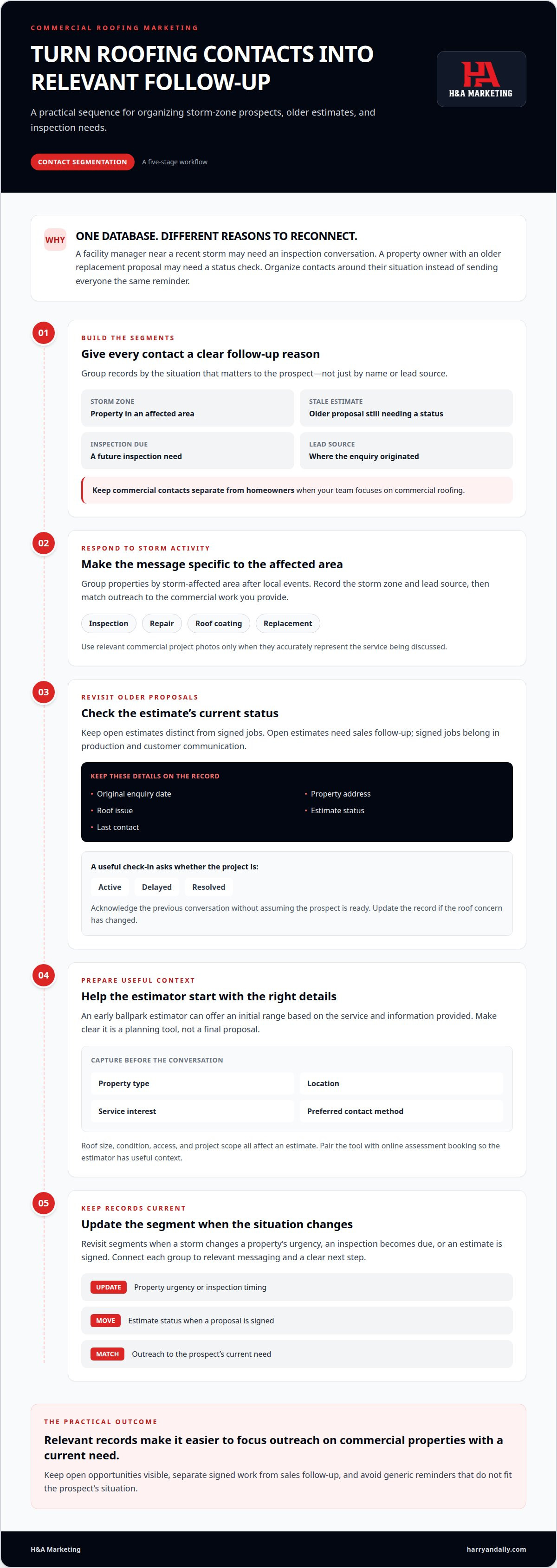
A commercial roofing database is more useful when each contact has a clear reason for follow-up. Segment records by storm zone, stale estimate, inspection due, and lead source. Each group needs different messaging: a facility manager near a recent storm may need an inspection conversation, while a property owner with an older replacement proposal may need a status check. Keep commercial contacts separate from homeowners when your team focuses on commercial work.
How can commercial roofers target facility managers, property managers, and building owners? Organize contacts by property location, role, roof concern, and previous enquiry, then tailor outreach to each group. For example, send facility managers near an affected area a relevant inspection message, while offering property owners with open estimates a clear next step.
For storm-zone campaigns, group properties by affected area after local storm events. Match the message to the work you provide, such as a commercial roof inspection, repair, coating, or replacement. Add the storm zone and lead source to each record. Photos from relevant commercial projects can make outreach more specific, as long as they accurately represent the service being discussed.
Stale estimates need their own follow-up path. Record the original enquiry date, property address, roof issue, estimate status, and last contact. Then separate open estimates from signed jobs. Open estimates need sales follow-up; signed jobs belong in production and customer communication. Keeping these records distinct helps show which campaigns create opportunities and which produce signed work.
Revisit an older estimate with a message that acknowledges the previous conversation without assuming the prospect is ready. Ask whether the project is active, delayed, or resolved. If the roof concern has changed, update the record before suggesting another step. A facility manager who postponed a replacement, for example, may now want to discuss a repair or inspection. Avoid sending every past enquiry the same generic reminder.
A ballpark estimator can give prospects an initial range based on the service and information they provide. Make clear that it is an early planning tool, not a final proposal. Roof size, condition, access, and project scope all affect the estimate. Pair the tool with online assessment booking, and capture property type, location, service interest, and preferred contact method. This gives your estimator useful context before the conversation.
Review segments regularly. Update records when a storm changes a property's urgency, an inspection becomes due, or an estimate is signed. Tie each group to relevant messaging and a clear next step. This helps your team focus outreach on commercial properties with a current need instead of sending broad reminders that do not reflect each prospect’s situation.
3. Meta advertising and seasonal campaigns
Build seasonal advertising around commercial roofing demand and your team’s capacity. Prepare Meta creative, audience settings, and a focused landing page before launch. For storm response, decide in advance which services to promote, which properties to target, and who will handle enquiries. A prepared campaign helps your team act promptly after a significant hail event without rushing the message or lead process.
What marketing claims, licensing rules, and advertising regulations apply to commercial roofers in the United States? Keep advertising claims accurate and supportable, and describe your qualifications truthfully. Licensing and advertising requirements can differ by jurisdiction, so account for the rules that apply where you promote the work.
How should commercial roofing companies build a 90-day marketing calendar and campaign plan? Set a goal, audience, service, creative, and destination page for each campaign. Schedule preparation first, then launch and review enquiries regularly; use the final phase to identify the main conversion obstacle and decide what to continue. Keep the schedule practical for the sales team and current project workload.
Use Facebook and Instagram ads to put commercial project content in front of relevant decision-makers. For example, promote a restoration walkthrough to property managers interested in roof maintenance. Separate audiences by service area or project need, and give each ad one clear action. Paid social supports awareness and consideration; it should not replace search campaigns aimed at people actively looking for roofing work.
Pay-per-click advertising can capture searches for specific services, such as commercial roof replacement or coating. Match the ad’s promise to its destination page, and review clicks alongside qualified enquiries. Programmatic advertising can place display ads across participating websites. Consider it when you have a defined audience, relevant creative, and a clear response-handling plan.
Plan seasonal campaigns around expected demand and operational readiness. Schedule spring repair messaging before the busy period, and prepare storm-response creative ahead of severe weather. Make each offer clear without vague claims or unsupported guarantees. Keep social posts relevant throughout the season with project updates, service explanations, and practical maintenance content.
Review performance by campaign, audience, service, and enquiry quality. If a social campaign earns clicks but few suitable commercial enquiries, examine its targeting and landing page. If a search campaign produces relevant calls, make sure sales follow-up matches the advertised service. Automation can support campaign delivery and reporting, but regular human review keeps messaging accurate and aligned with project capacity.
4. Assigning responsibility for enquiry follow-up
Give every new enquiry one clear owner. Choose one service, one market, and one person to manage incoming enquiries. For example, assign commercial roof replacement enquiries in a defined territory to the sales lead responsible for that market. A shared inbox can receive messages, but it should not replace named accountability. The owner coordinates the next step, records the outcome, and flags any required handoff.
Build one follow-up path across Google Ads, social media, phone calls, and website forms. Each platform should send enquiries into a process the assigned person can see. Record the prospect’s name, company, property location, service interest, source, and requested next step. A facility manager asking about roof coating needs a different response from someone seeking a replacement assessment.
Set a response standard that matches your team’s capacity, and make ownership visible. A simple lead record can show who owns the enquiry, its status, and the next action. Status labels might include new, contacted, assessment requested, proposal in progress, and closed. Use labels consistently so another team member can understand the record without reconstructing the conversation.
- Route commercial restoration enquiries to the person handling restoration opportunities.
- Keep replacement enquiries assigned to the owner responsible for that service.
- Reassign a record when territory, project scope, or workload requires a handoff.
- Log each contact attempt and the prospect’s response in the same record.
Mobile access matters when sales staff visit properties or job sites. Make sure the enquiry owner can review key details and update the next action from a phone. If a prospect calls after seeing a social media post, record that source. If a website form came from Google Ads, preserve the campaign detail. Clear records connect marketing activity to real sales conversations.
Review enquiry records weekly with the people handling them. Discuss new enquiries, unanswered messages, scheduled assessments, and stalled conversations. Use specific records in the meeting: “The property manager requested a coating assessment, and the next step is arranging a site visit.” This keeps the review focused on action rather than vague updates. Record decisions and assign each follow-up task to a named owner.
Compare marketing spend with the opportunities and completed work it produces. Keep the original enquiry date so later estimates and sales can be traced to their source. Use consistent source labels across platforms, and review them alongside enquiry quality. If Google Ads generates calls but few suitable commercial projects, inspect the targeting, service page, and handoff process together.
Social media enquiries also need a defined route. Decide who monitors incoming messages, where each enquiry is recorded, and when sales takes ownership. A practical handoff might move a message about a commercial roof leak from the social media monitor to the assigned sales owner, with the property location and requested service attached. This way, the prospect does not have to repeat basic details.
5. Email subscriber opt-ins and valuable content
Email helps commercial roofers stay useful between an initial enquiry and a future project. Offer a clear reason to subscribe, such as a seasonal roof maintenance checklist or a guide to planning a commercial roof inspection. Place the opt-in beside relevant service content, and explain what subscribers will receive. A facility manager considering restoration has different concerns from a property owner planning replacement.
Keep the form focused. Ask for a name, work email, company, and area of interest when those details help tailor follow-up. A form on a roof coating page can invite readers to receive coating maintenance tips. Avoid asking for information your team will not use. Make the next step clear, whether it is receiving a guide or useful email updates.
Build targeted sequences around real commercial roofing needs. A new subscriber interested in inspections could receive a roof maintenance checklist, a seasonal inspection reminder, and a project example. Someone who downloaded replacement planning content could receive guidance on documenting roof condition and preparing for a proposal. Keep each message focused on one practical topic and one next step.
Automation can maintain contact with cold leads over the next 12 months. Use a planned series of helpful messages rather than repeating a sales pitch. For example, share a roof care article first, then a project walkthrough, followed by an annual inspection reminder. Keep the sequence relevant to the subscriber’s service interest, property role, and previous enquiry.
Useful content can take several forms. Explain how facility teams can prepare for an inspection, what a roof restoration project involves, or how to spot maintenance needs. Short videos can show project stages or explain a commercial roofing term. Pair each video with a concise email summary so readers understand its value before watching.
Plan content production around questions your sales team hears repeatedly. If prospects ask what happens during a roof assessment, create an email and video that walk through the process. Use commercial roofing photography and video to show real project details, then connect each asset to a relevant service page. Useful examples make follow-up more specific than a generic newsletter.
Optimize each email for mobile reading. More than 46% of email opens occur on a mobile device, so use a concise subject line, short paragraphs, and a clear link or action. Review opens, clicks, replies, and resulting sales conversations together. A click matters most when it leads to an inspection request, a qualified enquiry, or renewed discussion about an open project.
Organize the list by source, service interest, and engagement. Remove outdated categories from active campaigns, and use annual inspection reminders to reconnect with past customers. Give each message a practical purpose and help your team see which content supports future commercial roofing opportunities.
H&A Marketing
H&A Marketing helps commercial roofing contractors connect marketing activity with qualified project opportunities. If storm campaigns, search visibility, follow-up, and email content feel disconnected, a coordinated plan can bring them together around restoration and replacement goals.
That work can include website design, branding, SEO, and lead generation, shaped around your target market and sales process. A clear website gives facility managers a useful next step. Search optimization supports visibility for relevant services, while lead generation connects campaigns with the enquiries your team needs to track and follow up.
If you’re ready to turn these ideas into a practical plan for your roofing business, contact H&A Marketing to discuss your marketing strategy.
Put your marketing plan to work
A plan earns its place when it guides decisions after launch. Use the commercial roofing marketing plan template for 2026 as a working document: update priorities when project demand shifts, review which opportunities fit your crews, and refine the next campaign around what your sales pipeline needs.
If your next step is building a clearer presence for commercial restorations and replacements, H&A Marketing can align website design, logo design and branding, and search engine optimization with your growth priorities. This gives prospects a more consistent path from discovering your company to understanding your work and getting in touch.
Choose one priority to move forward now, then build from there. A focused plan helps your team make deliberate marketing decisions and create room for stronger project opportunities.
Review your qualified leads and active proposals regularly, then adjust your marketing priorities to support the projects your crews can take on.
Frequently Asked Questions
What should a commercial roofing marketing plan template include for 2026?
A commercial roofing marketing plan template 2026 should connect business goals with target services, audiences, channels, and sales follow-up. Include restoration and replacement priorities, the property decision-makers you want to reach, campaign timing, content themes, and a process for tracking enquiries through proposals and signed work. Add a review schedule so your team can shift effort when lead quality, project capacity, or demand changes.
What are the best marketing channels for commercial roofing contractors in 2026?
The right channel mix depends on your market, sales capacity, and how prospects find contractors. Search visibility can capture active demand, while paid search supports targeted service campaigns. Social content demonstrates project experience, and email helps you stay relevant with existing contacts. Choose channels your team can support with useful content, clear enquiry handling, and consistent measurement.
What commercial roofing SEO and local search tactics are effective in 2026?
Build useful pages for each core service, such as roof restoration, replacement, and coating. Explain the project process, property types served, and questions a facility manager may ask before requesting an assessment. Keep business details accurate across your profile and directory listings. Add relevant project examples, then review search queries and enquiry quality to identify which services need clearer page content.
What Google Ads and social media strategies work for commercial roofing companies?
Use Google Ads to reach prospects searching for a specific commercial roofing service, and send each ad to a matching page. On Facebook or Instagram, promote useful project content to relevant decision-makers rather than relying on broad engagement. Give every campaign one clear action, such as requesting an assessment. Compare enquiries by service fit and sales progress, not clicks alone.
How do commercial roofing marketing strategies vary by region, climate, and storm season?
Adapt campaign timing and content to roof concerns common in the markets you serve. Areas with frequent hail may call for prepared storm-response messaging, while markets with heavy seasonal rain may value drainage and inspection guidance. Use local weather patterns, project history, and service capacity to shape timing. Treat the commercial roofing marketing plan template 2026 as a framework, then tailor its priorities to your market and operating conditions.
