

Article by
Harry Stanley III
Harry Stanley III is a construction marketing strategist and fractional CMO at H&A Marketing. He has helped construction companies grow through website strategy, SEO, paid advertising, branding, lead generation, CRM systems, and professional content. His past work includes helping Meraki Solar generate an additional $3.7 million in revenue in his first year and supporting American Builders as a fractional CMO. Today, Harry works directly with custom home builders and construction companies to build marketing systems designed to generate qualified leads and measurable growth.
A commercial roofing sales pipeline is stronger when online visibility, targeted outreach, and disciplined follow-up work together. Use your website, search presence, and paid campaigns to reach commercial property owners, then qualify each opportunity and agree on a clear next step. Sales cycles can stretch from months to years, so a consistent process matters more than a burst of leads.
That long timeline is familiar: property owners and managers may need time to assess roof conditions, compare restoration and replacement options, and coordinate decisions. The challenge is keeping suitable prospects engaged without treating every inquiry as a project that is ready to move forward.
This guide covers practical ways to reach commercial decision-makers, qualify leads, build relationships with property managers, and keep opportunities moving. You’ll learn how to organize follow-up, track pipeline performance, and refine your approach so your commercial roofing sales pipeline supports steady growth from qualified projects.
Key Takeaways
- Track lead sources, qualification, stage movement, and close rates to see where prospects stall and where your process needs attention.
- Build property manager relationships through relevant, consistent follow-up that focuses on their properties and roofing priorities.
- Make cold calls more productive by researching the business first, reaching the right decision-maker, and agreeing on a clear next step.
- Keep opportunities moving with follow-up that matches the prospect’s timeline, from initial assessment through proposal and decision.
- Qualify leads by fit, roof need, decision-making access, and timing, then use your online presence to attract and capture better-matched inquiries.
Lead generation KPIs and funnel optimization
Track each prospect from first contact through qualification, assessment, proposal, and decision. There isn’t one typical commercial roofing project cost or profit margin for every U.S. job. Roof area, system, access, scope, labor, materials, and overhead all shape the estimate and margin.
-
Generate and Qualify Leads
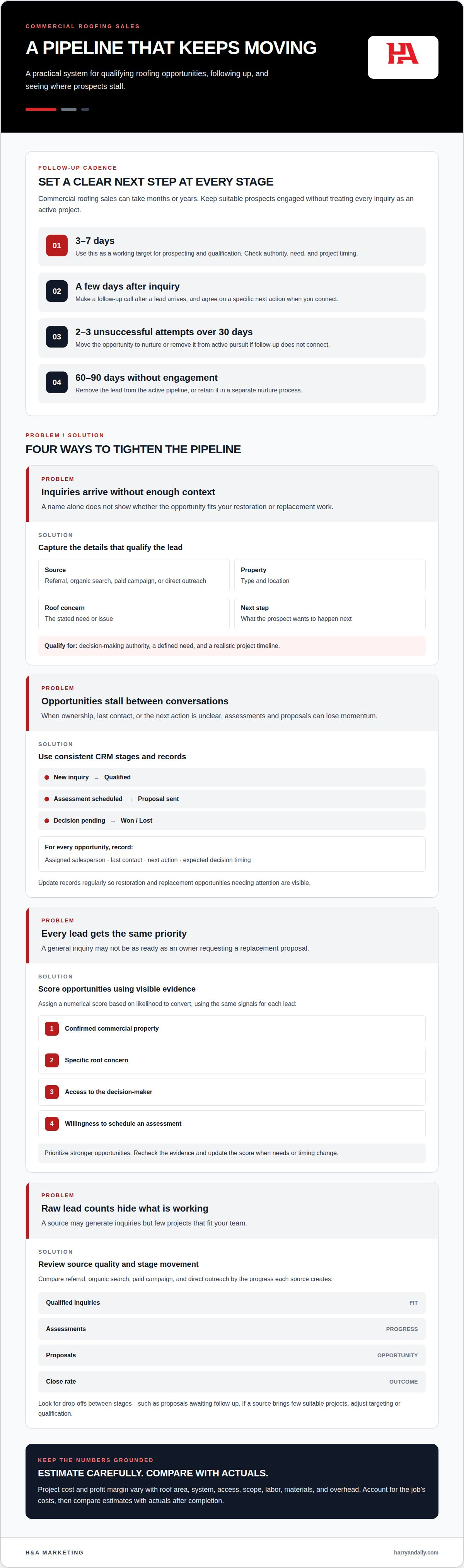
Log each inquiry with its source, property type, roof concern, location, and requested next step. Use 3-7 days as a working target for prospecting and qualification, then check whether the owner or manager has authority, a defined need, and a realistic project timeline. Call a few days after a lead arrives. After 2-3 unsuccessful follow-up attempts over 30 days, move it to nurture or remove it from active pursuit.
-
Track Leads in the CRM
Set up clear stages in your commercial roofing CRM, such as new inquiry, qualified, assessment scheduled, proposal sent, decision pending, won, and lost. For every opportunity, record the assigned salesperson, last contact, next action, and expected decision timing. Managers should update these fields regularly, so owners can see which restorations or replacements need attention. Remove leads after 60-90 days without engagement, or retain them in a separate nurture process.
-
Score and Prioritize Opportunities
Assign each lead a numerical score based on its likelihood of converting, then prioritize the strongest opportunities. Use consistent signals, such as a confirmed commercial property, a specific roof concern, access to the decision-maker, and willingness to schedule an assessment. A property owner requesting a replacement proposal may need a faster response than someone making a general inquiry without project details. Review the evidence behind each score and update it as the prospect’s needs or timing change.
-
Review Lead Sources and Funnel Performance
Record whether opportunities come from referrals, organic search, paid campaigns, or direct outreach. Compare sources by qualified inquiries, assessments, proposals, and close rate, rather than counting raw leads alone. If a source attracts inquiries but few suitable projects, adjust targeting or qualification. Review where prospects drop out between stages to spot delays, such as proposals awaiting follow-up. When estimating margin, account for job scope, labor, materials, access, and overhead, then compare estimated costs with actuals after completion.
Building relationships with property managers
Find property managers through commercial property directories, business networks, and direct outreach to owners’ representatives. A single commercial property manager can represent a significant share of a roofing contractor’s business, so build familiarity before asking for a project commitment.
- Map the property types and portfolios you can serve. List office buildings, warehouses, retail centers, industrial sites, and institutional facilities that fit your restoration or replacement work. Then identify the management firms connected to those properties. A contractor prepared to discuss the needs of a warehouse portfolio can make more relevant contact than one sending the same pitch to every building owner.
- Research each manager before making contact. Review the firm’s website, managed property types, and public project information. Prepare a short, specific reason for reaching out, such as offering to assess an aging roof system or discuss restoration options. Avoid opening with a generic service list. Connect your message to the manager’s portfolio and responsibilities.
- Use the first conversation to learn how decisions are made. Ask who reviews roof assessments, how maintenance concerns reach the owner, and what information supports a capital project request. A property manager may coordinate access and recommendations without approving the final budget. Record each person’s role so your follow-up reaches the right decision-maker.
- Manage relationships across multiple properties with a portfolio record. Track each building separately, including roof type, known concerns, past assessments, contacts, and next action. Then connect those records to the management firm. If a manager oversees several retail sites, this structure helps you discuss each roof accurately without mixing inspection notes or proposal details.
- Build trust between active projects with useful, relevant updates. Share a clear assessment summary, explain restoration and replacement options, and agree on a next step after each meeting. Keep commitments visible in your follow-up notes. A signed project can establish a working relationship, while consistent communication across other properties creates room for future conversations.
- Find government and institutional bid opportunities by monitoring procurement pages and bid notices from municipalities, school districts, universities, and public facility owners. Review each solicitation’s scope, submission instructions, and deadlines, then pursue bids your team can prepare accurately. For relationship-led property outreach, a coordinated commercial roofing marketing approach can help keep your expertise visible to owners and managers.
Cold-calling prospective customers
A useful cold call starts with a relevant reason to speak, not a generic pitch. Research the property, identify the likely contact, and aim for a specific next step, such as discussing an inspection or arranging an assessment.
- Choose a prospect with a clear fit before dialing. Look for commercial properties that match your team’s restoration or replacement work, such as a warehouse, office building, or retail center. Note the property name, location, and any public information that gives your call context. A prepared reason for calling helps you avoid sounding like you’re reading the same script to every owner.
- Open with your name, company, and a direct reason for the call. For example, tell a facility manager you work with commercial roofs and want to learn how they handle roof inspections or planned replacement projects. Then pause and let the contact respond before describing your services. A short opening makes room for a real conversation instead of a one-way pitch.
- Ask focused questions to understand the property’s needs and decision process. Find out whether the manager has an active concern, who reviews roofing recommendations, and what information would help them consider an assessment. If they mention recurring repairs, ask what the issue affects and how they currently track it. Don’t diagnose a roof over the phone or push a proposal before understanding the situation.
- Offer one practical next step based on the answer. If the prospect describes a leak or urgent roof concern, arrange a prompt conversation about assessment; teams can aim to move emergency repair leads to assessment within 24-48 hours. For a planned project, agree on when to reconnect or what property information to share. Keep the commitment specific, so both sides know what happens next.
- Record the call and follow up consistently. Log the contact’s role, stated need, objections, and agreed next action in your lead records. If the contact isn’t ready, note the timing they gave rather than calling without context. Re-engage stalled deals after 14-21 days of inactivity, and refer to the prior conversation. This makes each follow-up useful, not a repeat of your opening pitch.
- Review call outcomes to improve your approach. Compare which property types lead to conversations, inspections, and qualified opportunities. If calls to retail managers often reach site staff rather than decision-makers, refine your contact research. Respectfully close when someone declines. A consistent process helps your team learn which messages earn a next step and which need revision.
Commercial roofing sales cycle
Commercial roofing contracts can take months to close, and some sales cycles can take years. Bids commonly lose ground when scopes are unclear, proposals miss the buyer’s priorities, follow-up stalls, or decision timing shifts.
- Map the stages from first conversation to signed agreement. Separate qualification, site assessment, proposal preparation, review, and decision into visible steps. Assign an owner to each opportunity and record its next action. For a planned replacement, track assessment and proposal progress separately from a project awaiting budget approval. This keeps a long-running opportunity active without treating every prospect as ready to buy.
- Set a working target of 7-14 days for assessment and quote preparation. Use that window to schedule access, document roof conditions, clarify restoration or replacement scope, and prepare a proposal the buyer can evaluate. If building access or decision-maker input delays the work, update the expected date and explain the outstanding item. A clear status helps the prospect understand what happens next.
- Adjust the process to the project type. Emergency roofing repairs may move through the sales process in 1-3 days, while roofing sales involving insurance claims can extend to 30-60 days. For an urgent leak, prioritize assessment and communicate the next action. For an insurance-related project, record required discussions and pending decisions, then set follow-up around those milestones.
- Guide qualified proposals toward a decision without assuming the buyer’s timeline. Use 7-21 days as a working target to close a deal, while recognizing that commercial approvals can extend much longer. Confirm who reviews the proposal, what questions remain, and when the group expects to decide. If a deal stalls, re-engage after 14-21 days of inactivity with a useful update, such as a scope clarification or answer to an open question.
- Review cycle performance by stage and season. Deal velocity and conversion rates may be faster during peak season, from late spring through fall. Compare how long assessments, proposal reviews, and decisions take during those periods. If prospects repeatedly pause at proposal review, adjust the presentation to make the scope, options, and next steps easier to evaluate. A successful roofing business learns from lost bids, records the reason, and applies that insight to the next opportunity.
How do commercial roofing companies generate and qualify leads?
Build lead flow through referrals, search visibility, outreach, and follow-up, then qualify each inquiry by project fit, need, and timing. A source that generates inquiries matters only when those prospects can become suitable commercial roofing projects.
- Ask satisfied contacts for introductions to commercial property owners and managers. Word of mouth remains a useful channel: 71% of roofers rely on referrals. Make the request specific, such as an introduction to a warehouse manager planning a roof replacement. Record who referred the prospect and the property involved, so your follow-up connects to the actual opportunity rather than a generic thank-you.
- Make your online presence answer the questions owners ask before contacting a contractor. Show clear information about commercial restorations, replacements, roof coatings, assessment requests, and the properties you serve. Since 97% of people research local companies online, use useful project explanations and straightforward contact options to help prospects understand your work. Treat your website as a sales representative that can present your capabilities beyond business hours.
- Use search and social content to attract prospects with a relevant roofing need. A page explaining restoration versus replacement can help an owner identify the right next conversation. A post featuring a completed commercial project can show the type of work your team handles. Pair each campaign with a clear inquiry route, then review whether the resulting leads involve commercial properties and viable project scopes.
- Qualify the opportunity through a brief discovery conversation. Confirm the property address, building use, known roof concern, desired project type, decision-makers, and expected timing. For example, a facility manager describing recurring leaks and requesting a replacement assessment shows clearer intent than someone asking only for general information. Ask which outcome matters most, then document the answer before deciding whether to schedule an assessment or continue nurturing the lead.
- Keep qualified prospects engaged with relevant follow-up. Roofing companies can use automated emails triggered by a set time or a prospect’s action, such as requesting an assessment. Make each message useful: share next steps, explain what information supports a roof review, or answer a question raised earlier. Email follow-up can also support repeat work; 25.5% of roofers who follow up by email land repeat work.
Discuss commercial roofing lead generation
A commercial roofing business's digital strategy can act as a 24/7 sales representative, but timely personal follow-up can help move an inquiry forward. Call leads a few days after they become leads and use the conversation to reconnect their stated concern with the next step. Keep the discussion focused on the property’s roofing need and whether the prospect is ready to proceed, rather than treating every inquiry as equally qualified.
Improve the sales cycle by targeting prospects whose needs match the work your company handles. Address their concerns in follow-up and look for pipeline roadblocks that may be slowing a decision or obscuring the next step. Automate routine sales tasks where useful, while keeping messages relevant to each lead’s inquiry. Focused targeting, responsive calls, and a clear pipeline support qualification from first contact through continued follow-up.
H&A Marketing: Website Design
H&A Marketing helps commercial roofing contractors connect their online presence with a clearer path from discovery to inquiry. Turn to the team when your website doesn’t explain restoration and replacement work clearly or makes it difficult for property owners to take the next step.
Website design can organize service pages, project details, and inquiry options around commercial buyers’ questions. Search Engine Optimization helps the right owners find those pages, while Lead Generation supports a more intentional path from site visit to qualified inquiry. Logo Design & Branding can also create a consistent identity across your digital presence.
These pieces work best when they reflect the same target properties, project types, and follow-up process you use to manage opportunities. Explore commercial roofing marketing with H&A Marketing, or contact the team to discuss your website and lead strategy.
Build the next stage of growth
Make your next step a focused review of the opportunities you want your team to pursue. Choose the commercial project profile that best fits your capacity, then align your priorities around it. A clear direction gives your commercial roofing sales pipeline a purpose beyond simply adding more names.
H&A Marketing can help you assess how your marketing supports that direction and identify gaps. Use the conversation to set a practical priority for your next stage of growth.
Build deliberately, learn from each opportunity, and keep moving toward the commercial work your business is ready to win.
Frequently Asked Questions
What are the most effective online strategies for reaching commercial property owners?
Match each online campaign to a specific commercial buyer and roofing need. Separate commercial searches from residential traffic, then direct visitors to a relevant page for restoration, replacement, or coatings. Use inquiry forms that capture the property type, location, and requested service so sales staff can assess fit before calling. Review search terms and form submissions together. Clicks alone won’t show whether a campaign attracts viable commercial projects.
What are the stages of a commercial roofing sales pipeline?
A useful pipeline moves from prospecting to qualification, assessment, proposal development, buyer review, and a recorded outcome. Define the evidence required to move between stages. For example, advance a prospect to assessment only after access and a site contact are established. Mark a proposal as under review only after the buyer receives it. These rules keep early interest separate from an active project and make handoffs clearer across the sales team.
What is the average commercial roofing sales cycle length?
There’s no single average that describes every commercial roofing sale. Timing depends on roof condition, access, budget planning, procurement steps, and the number of stakeholders who must approve the work. A private owner may decide differently from a school district or multi-site company. For forecasting, note the prospect’s approval calendar and project dependencies, then estimate the next decision point instead of assuming every opportunity will close on the same schedule.
Which CRM and sales pipeline tools are best for commercial roofing contractors?
Choose a CRM that fits how your salespeople work in the field and office. Useful selection criteria include mobile access, straightforward contact and property records, task reminders, reporting, and the ability to export data. Test a sample workflow using a real roofing inquiry, from first call through proposal review. If staff can update the system without duplicate entry or confusing workarounds, they’re more likely to use it consistently.
How should commercial roofing sales teams follow up with property owners and facility managers?
Make follow-up easy for the property contact to share internally. After a conversation, send a brief recap of the concern discussed, relevant project documents, and the specific decision or information needed next. Ask whether the owner, asset manager, or facilities team should be included. This keeps stakeholders aligned when the person coordinating roof work isn’t the final approver and reduces confusion as a proposal moves between departments.
What metrics should roofing companies track in a commercial sales pipeline?
Measure conversion between stages, not just total inquiries. Calculate the lead-to-qualified rate by dividing qualified leads by incoming leads, then compare proposal win rates by project type or source. Also review gross margin on completed work alongside sales outcomes, so a high close rate doesn’t conceal low-quality jobs. Segmenting these measures helps owners see whether the team needs better targeting, stronger estimating discipline, or a different mix of commercial projects.
