


Article by
Harry Stanley III
Harry Stanley III is a construction marketing strategist and fractional CMO at H&A Marketing. He has helped construction companies grow through website strategy, SEO, paid advertising, branding, lead generation, CRM systems, and professional content. His past work includes helping Meraki Solar generate an additional $3.7 million in revenue in his first year and supporting American Builders as a fractional CMO. Today, Harry works directly with custom home builders and construction companies to build marketing systems designed to generate qualified leads and measurable growth.
LinkedIn marketing for commercial roofing contractors works best when it targets commercial buyers, such as facility-management professionals, within a 50-mile radius of your office, rather than pursuing residential roofing leads.
That focus matters: clicks only help when they reach people who can influence a restoration or replacement project. A polished company page and relevant project examples give prospects a reason to take your business seriously, while clear details about your work and its value make your message memorable.
This guide explains what can affect LinkedIn ad costs, how to improve your company page for B2B searches, and how to present roofing projects and potential savings in a credible way. You’ll also see how to align your targeting and content with the commercial opportunities you want to pursue, so LinkedIn supports a more focused sales pipeline rather than simply generating activity.
Key Takeaways
- Shape your LinkedIn ad strategy around commercial buyers and the projects your company wants to win.
- Make your company page clearly describe your roofing services, markets, and expertise so relevant business prospects can find and assess you.
- Use project visuals and specific, supportable details to show the scope of your work and explain potential cost savings.
- Share practical content that helps facility managers and property owners understand roofing decisions and your approach.
- Choose a posting rhythm you can sustain, then focus on useful updates rather than publishing just to stay active.
1. LinkedIn advertising costs
That range offers a starting point for budgeting, not a guaranteed price for every campaign. With pay-per-click advertising, you’re charged when someone clicks an ad, so impressions alone don’t show whether your spend is producing useful prospects.
For example, a click from a facility manager researching a roof replacement may be more valuable than several clicks from people looking for residential repairs. Track the path from click to inquiry, then qualify each inquiry by property type, project scope, location, and timing. A campaign with fewer clicks can still be more useful if it attracts commercial restoration or replacement opportunities.
Target LinkedIn ads by the industries you serve, relevant job titles, and a location filter that matches your service footprint. For nationwide commercial roofing contractors, prioritize facility-management professionals and related property decision-makers across your targeted U.S. regions. Build the audience around commercial prospects rather than residential roofing leads, and review whether the people engaging match your intended buyers.
Start with one audience and one offer, such as a roof assessment or project consultation. Write ad copy that names a commercial problem, such as recurring leaks or an aging roof, and direct prospects to a relevant landing page. Once the campaign has gathered clicks, compare audience quality and inquiry details before changing the budget or expanding the targeting.
For U.S. lead generation, make each LinkedIn form clear about what information you collect and how you’ll use it. Request only the details needed to respond, such as a business email, company name, property location, and roofing concern. Explain what follow-up to expect and provide a clear way to opt out of future marketing messages.
Base budget decisions on the sales process, not just the ad platform. A click is more useful when the landing page describes commercial roofing work, the inquiry reaches the right team member, and follow-up records the building’s needs. Review qualified inquiries and sales conversations, rather than treating click volume as the final measure.
- Audience fit: Compare job titles, industries, and locations against the commercial buyers you want to reach.
- Landing page: Match the page to the ad, such as a page focused on roof restoration.
- Lead quality: Record whether each inquiry concerns a commercial property and a realistic project.
- Follow-up: Track the next step for every inquiry so paid clicks don’t disappear into an unmonitored inbox.
A coordinated commercial roofing marketing approach connects LinkedIn ads with landing pages and lead tracking. That connection helps you see whether paid traffic is reaching the right buyers and advancing real project conversations.
3. Optimizing company pages for B2B search
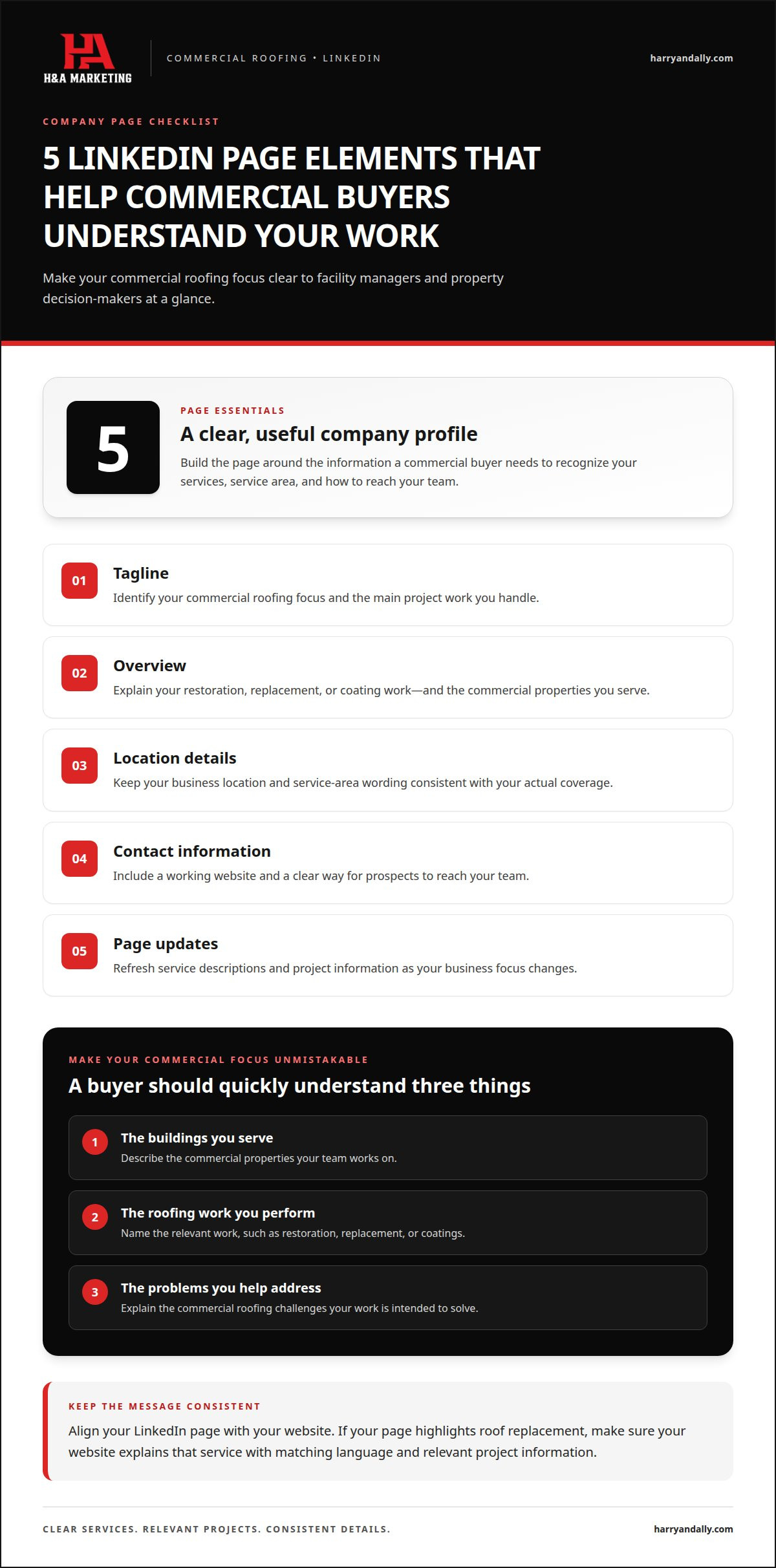
Your LinkedIn company page should make your commercial roofing focus clear to potential buyers. Use your company name consistently and describe services such as roof restoration, replacement, and coatings. A facility manager should quickly understand the property types you serve and how to learn more about your work.
Start with the core page fields: add a recognizable logo, a concise tagline, and a useful overview. Include phrases buyers understand, such as “commercial roof replacement” and “roof restoration for commercial properties.” Write for people first. Repeating keywords unnaturally can make the description harder to read.
LinkedIn marketing for commercial roofing contractors can support B2B discovery by making your specialties visible to relevant professionals. Search LinkedIn for facility managers and commercial property owners using job titles, company information, and location filters. Review profiles to understand each person’s responsibilities, then send a brief connection note tied to a relevant business concern, such as planning a roof replacement.
Make the overview specific enough to distinguish commercial work from residential services. Describe the buildings you serve, the roofing work you perform, and the problems you help owners address. For example, explain that your team handles restoration projects for commercial facilities with aging roofs. Keep all service and performance claims accurate and supportable.
- Tagline: Identify commercial roofing and your main project focus.
- Overview: Explain your restoration, replacement, or coating work and the properties you serve.
- Location details: Keep your business location and service-area wording consistent with your actual coverage.
- Contact information: Include a working website and a clear way to reach your team.
- Page updates: Refresh service descriptions and project information as your business focus changes.
Use posts to reinforce the expertise described on your page. An update about a commercial restoration can explain the building’s challenge, the work completed, and what the project involved. A practical note about how an assessment informs repair or replacement planning gives facility managers useful context.
Keep your LinkedIn page and website aligned. If the page highlights roof replacement, make sure your website explains that service with matching language and relevant project information. Prospects often review both before contacting a contractor, so consistent descriptions help them understand your commercial capabilities.
A focused LinkedIn marketing for commercial roofing contractors approach connects page information, professional outreach, and useful project updates. For help aligning your positioning with commercial buyer outreach, explore commercial roofing marketing strategies designed around clear messaging and qualified inquiries.
4. Showcasing commercial roofing projects and cost savings
A LinkedIn project post should help a facility manager understand the roof, the problem, and the work performed. Start with a clear project type, such as commercial roof restoration or replacement. Then explain the property owner’s challenge, the assessment process, and the solution selected.
Use jobsite photos that show meaningful details, not just a finished roof. Before-and-after photos can illustrate a visible change, while close-ups can show drainage improvements or repaired areas. Add captions that identify what viewers are seeing. Don’t reveal customer names, addresses, or sensitive building details without permission.
For example, describe a warehouse roof with recurring leaks, then explain how your team assessed its condition and recommended restoration or replacement. Keep the story factual: outline the building’s issue, the work completed, and the documented outcome. If project records don’t support a savings figure, explain the decision factors instead of inventing a dollar amount.
Cost-savings claims are more credible when readers can see the comparison behind them. If you have project documentation, describe the options considered and the assumptions used. Compare restoration with replacement only when the roof’s condition and project records support it. Explain what the work included, such as repairs, coating, or other defined tasks.
- Project context: Identify the property type and the roofing challenge.
- Decision process: Explain why restoration, coating, or replacement fit the documented conditions.
- Evidence: Use approved photos, inspection details, and records that support each claim.
- Business relevance: Connect the work to concerns like disruption, recurring leaks, or planning capital improvements.
Make each post easy to scan. Lead with a specific headline, such as “Commercial roof restoration for a warehouse,” then use short paragraphs and descriptive photo captions. End with a useful prompt, such as inviting facility managers to discuss how roof condition affects their project options. Keep the focus on informed conversations, not exaggerated promises.
LinkedIn project content can also answer common buyer questions. A post might explain what an inspection revealed, which factors shaped the recommendation, and how the owner evaluated the alternatives. Separate confirmed project facts from general guidance, and get permission before sharing customer details. Consistent, evidence-based examples help prospects assess your work and understand your approach to commercial roofing decisions.
5. What LinkedIn content works best for commercial roofing contractors?
Useful content gives commercial buyers a reason to pay attention before a roofing project becomes urgent. For LinkedIn marketing for commercial roofing contractors, focus on the questions facility managers and property owners face when planning roof maintenance, restoration, or replacement. A clear post about evaluating a proposal can help readers identify which details deserve attention.
Turn recurring conversations into practical explainers. If owners often ask how restoration differs from replacement, outline the decision factors without trying to diagnose a roof remotely. If facility managers ask how to prepare for an inspection, describe the records or access details that help your team assess the property. Keep each post focused on one concern.
Share insights from your team’s commercial work, not generic company announcements. An estimator could explain why roof condition influences project scope. A project manager could describe how crews coordinate work around an active facility. These details help buyers understand your approach without unsupported claims about results or savings.
- Decision guides: Explain factors that shape restoration, coating, or replacement planning.
- Proposal insights: Clarify what a commercial roofing scope describes and how owners can compare options.
- Facility operations: Share practical planning considerations for a warehouse, office, or retail property.
- Team perspectives: Let estimators and project leads explain their roles in a roofing project.
Choose a format that makes each idea easy to absorb. A short text post can answer one buyer question, while a document post can organize a proposal review checklist. A jobsite photo can illustrate a project lesson, provided the customer approves its use and the caption explains what readers should notice.
Make every post specific to a commercial audience. Instead of saying, “We’re ready for your next project,” explain how a facility manager might prepare for a roof assessment or organize information about recurring leaks. Practical detail makes a post useful even before the reader is ready to contact a contractor.
Use LinkedIn content to start informed conversations with commercial buyers. Close with a focused prompt, such as asking how property teams plan roof assessments. Then respond to comments with useful detail and move project-specific discussions into a direct conversation when appropriate.
Before publishing, check that the post makes one clear point, speaks to a commercial buyer, and accurately represents your work. Rotate educational posts, team perspectives, project lessons, and buyer planning tips. This mix adds useful depth without turning every update into a sales pitch.
5. How often should a commercial roofing contractor post on LinkedIn?
Post on a schedule your team can maintain without sacrificing useful detail. LinkedIn works best as a steady practice, not a burst of updates followed by silence. If your team can regularly publish a clear project lesson, choose that pace and protect time for it. If jobsite demands interrupt production, prepare posts in advance.
Start with a simple content calendar tied to real roofing work. Mark project milestones, seasonal planning discussions, and common questions from facility managers. A commercial roof assessment, restoration proposal, or replacement project can each prompt a useful update. Publish when you have a specific point to share, rather than just to fill a calendar slot.
Gather content ideas from work already underway. After a site visit, note a question the property owner raised. During project planning, record what shaped the recommendation. Once work is complete, capture an approved photo and a factual description. These notes give your team material for future posts without asking estimators or project managers to create content from scratch each time.
- Project moments: Share an approved update when a restoration or replacement reaches a meaningful stage.
- Buyer questions: Turn recurring questions about leaks, roof condition, or proposal scope into short explanations.
- Team knowledge: Ask an estimator to explain one factor that affects a commercial roofing recommendation.
- Industry context: Comment when a facility-management concern connects directly to roofing decisions.
Review your LinkedIn page after each publishing cycle. Look for comments from relevant professionals, profile visits, direct messages, and inquiries that mention a post. These signals help show whether your topics reach the intended audience. A post with modest engagement may still prompt a useful conversation with a property owner, so consider lead relevance alongside visible reactions.
Adjust the schedule if the process becomes difficult to sustain or the content starts feeling repetitive. If every update promotes the same service, shift toward practical explanations, project lessons, and team perspectives. If posts attract residential questions, make the commercial focus clearer with examples involving warehouses, offices, or other commercial facilities.
A consistent posting rhythm also depends on follow-up. Assign someone to review comments and messages, then record relevant commercial inquiries for the sales team. If a facility manager asks about recurring leaks, respond with a useful next step instead of leaving the question unanswered. This makes publishing part of business development, not a disconnected marketing task.
Build a LinkedIn publishing plan around the projects and buyer questions your team already handles.
Discuss a commercial roofing content strategy
H&A Marketing: Website Design
H&A Marketing helps commercial roofing contractors connect LinkedIn activity with a website that explains their services and captures relevant inquiries. If prospects reach your page but can’t quickly understand your restoration or replacement expertise, strengthen that experience.
Website design, search engine optimization, branding, and lead generation can work together: clear service pages support discovery, consistent branding builds recognition, and focused inquiry paths help qualified prospects take action. This coordinated approach is useful when LinkedIn visibility isn’t turning into meaningful conversations with facility managers and property owners.
Explore commercial roofing marketing and contact H&A Marketing to discuss your next step.
Turn LinkedIn attention into a stronger sales pipeline
Make your next step connecting LinkedIn activity to the way your team handles commercial opportunities. Decide how you’ll recognize a qualified inquiry, who will respond, and how you’ll record its progress. That process helps your team identify conversations worth following up and keeps promising prospects from getting lost between marketing and sales.
LinkedIn marketing for commercial roofing contractors is most useful when it creates a clear path from first impression to a meaningful discussion about a property’s roofing needs. H&A Marketing offers website design, logo design and branding, and search engine optimization to help create a consistent presence along that path.
Start with one practical improvement, such as clarifying your commercial roofing message or setting up a process to track LinkedIn inquiries. Then build on what your team learns.
A focused, steady approach can help your company show up confidently for the commercial buyers you want to reach.
H&A Marketing for LinkedIn Marketing
H&A Marketing provides services to support your commercial roofing company’s LinkedIn marketing, including Social Media Management, Lead Generation, and Search Engine Optimization.
Turn to H&A Marketing when you’re ready to connect LinkedIn activity with a broader marketing approach. Website Design, Logo Design & Branding, and Video & Photo services can also help shape how your business appears across its marketing materials.
Frequently Asked Questions
How can commercial roofing contractors optimize a LinkedIn company page?
Give the page an active role in your business development process. Assign a team member to review comments and messages, route project inquiries to the right estimator, and record conversations that may develop into future work. For example, if a property manager asks about a facility’s roof condition, note the discussion and follow up with relevant information. This makes the page a useful touchpoint, not just a company directory listing.
What LinkedIn advertising options and costs are available for commercial roofing companies?
LinkedIn advertising can promote posts in the feed, direct prospects to a website, or collect inquiry details through an on-platform lead form. Choose a format based on the next action you want a facility manager to take. Campaign costs depend on audience selection, competition, bidding, and the campaign objective. Compare options by the quality and relevance of inquiries, not just clicks or form submissions.
