
Construction Brand Guidelines: A Builder’s Guide


Article by
Harry Stanley III
Harry Stanley III is a construction marketing strategist and fractional CMO at H&A Marketing. He has helped construction companies grow through website strategy, SEO, paid advertising, branding, lead generation, CRM systems, and professional content. His past work includes helping Meraki Solar generate an additional $3.7 million in revenue in his first year and supporting American Builders as a fractional CMO. Today, Harry works directly with custom home builders and construction companies to build marketing systems designed to generate qualified leads and measurable growth.
A polished proposal can’t carry a construction brand if the jobsite sign, website, and follow-up email tell three different stories. Practical brand guidelines construction teams can use keep those touchpoints aligned, from the first project photo a prospect sees to the sales conversation.
Quality work matters most, but inconsistent materials can make it harder for prospects to recognize the care you bring to a build. Clear rules for your logo, colors, photography, and messaging help your team communicate what makes the company credible and distinct.
This guide explains what to include in brand guidelines construction companies can put to work, not just file away. You’ll learn how to set useful standards for proposals, jobsite signs, project photography, social media, and your website, then make them easy for employees and marketing partners to follow. You’ll also see how consistent branding supports the way homeowners assess a custom builder and commercial clients evaluate a construction partner, helping prospects understand whether your company fits their project.
Key Takeaways
- Separate your brand strategy, visual identity, and day-to-day usage rules so each has a clear purpose.
- Build brand guidelines construction around the projects you want, the audiences you serve, and proof your team can show.
- Set practical standards for logo files, colors, typography, photography, layouts, and claims your company can support.
- Roll out the guide by assigning an owner, reviewing current materials, and updating the touchpoints prospects use to assess your company.
- Keep the guide concise and useful, then connect it to the marketing work that attracts prospects and captures inquiries.
What Construction Brand Guidelines Do, and Why Builders Need Them
Construction brand guidelines document how your company presents itself across marketing, sales, and customer communications. They turn decisions about who you serve and what you stand for into direction employees and marketing partners can use when creating customer-facing materials.
Three related ideas have different jobs. Brand strategy sets the direction: your best-fit projects, audiences, strengths, and market position. Visual identity is how that direction looks, including your logo, colors, typography, and photography. Brand guidelines explain how to apply both in real materials. The broader idea of corporate identity covers how a business presents itself to the public; guidelines help make that presentation coherent.
Guidelines support your company’s positioning, but they can’t replace a sound business strategy or make an unclear promise compelling. Once your direction is clear, shared standards help proposals, project photos, the website, and sales conversations reinforce the same impression. That matters when a homeowner is weighing custom builders or a commercial client is evaluating a construction partner for a high-stakes project.
What belongs in construction brand guidelines?
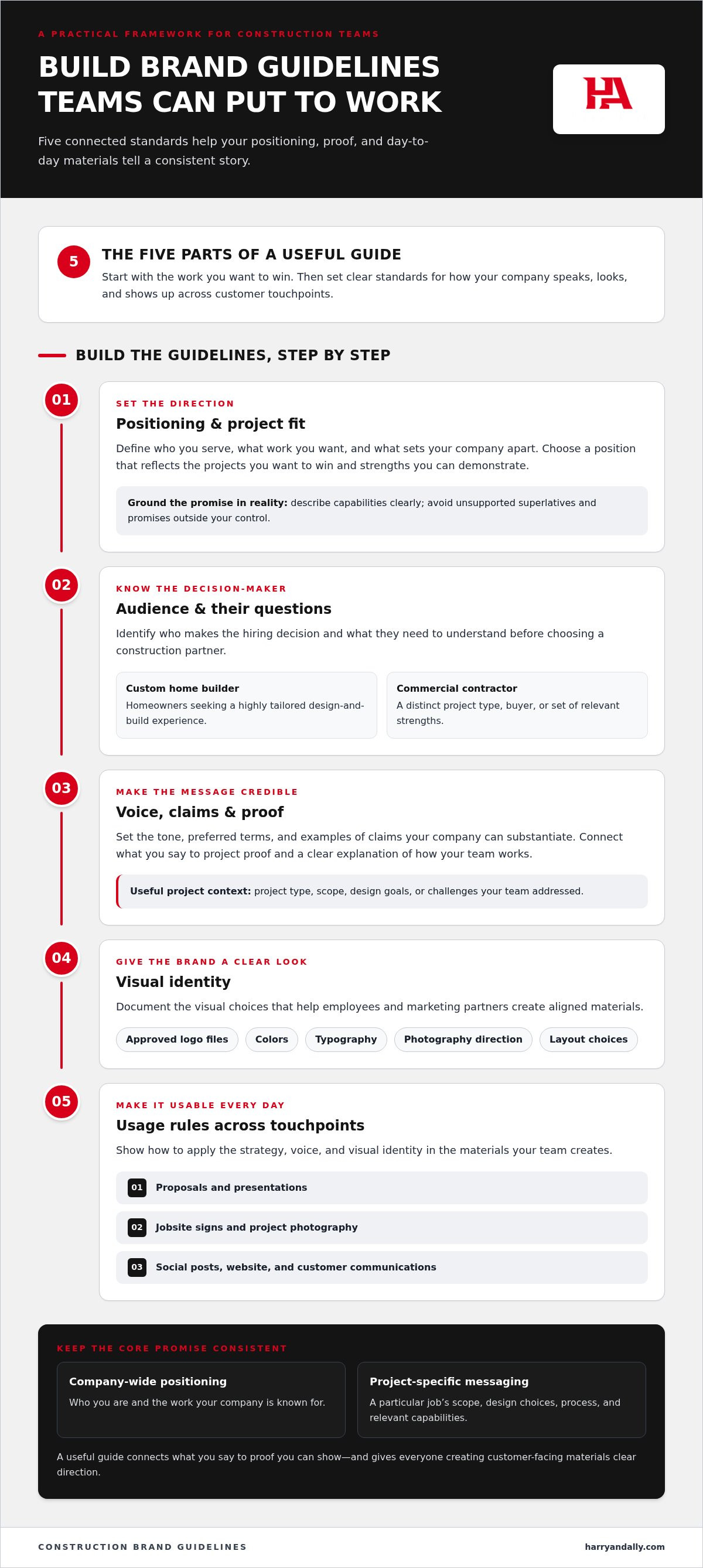
A useful guide gives your team clear answers in five areas:
- Positioning: Who you serve, what work you want, and what sets your company apart.
- Audience: The needs and questions of homeowners, developers, or commercial decision-makers.
- Voice: The tone to use, preferred terms, and examples of claims your company can substantiate.
- Visual identity: Approved logo files, colors, typography, photography direction, and layout choices.
- Usage rules: How to apply those elements across proposals, signs, social posts, and digital materials.
Definition: Construction brand guidelines are the practical standards that help a building company present its positioning, voice, and visual identity consistently across customer touchpoints. They reduce guesswork, so a project manager preparing a presentation and a marketing partner updating the website can make aligned choices.
Why construction brands need more than a logo sheet
A logo sheet can show which mark to use. It won’t explain how to describe your process, choose project photos, or connect a proposal’s promises to completed work. Prospects may first see a jobsite sign, then review your portfolio, compare websites, request a proposal, and speak with your team. Each interaction contributes to how they judge fit and credibility.
If a polished proposal is paired with unrelated project photography, or the website makes claims your sales team can’t support, the overall presentation loses cohesion. Useful standards connect what you say to proof you can show. Make the guide easy to find and apply, and share it with everyone who creates customer-facing materials. A decorative document that sits unread won’t guide a single decision.
Build Construction Brand Guidelines Around Your Positioning and Proof
Choose your position before choosing colors, fonts, or a logo style. Your identity should reflect the work you want to win and the strengths you can demonstrate, not simply a visual trend or a broad claim like “quality construction.” Effective brand guidelines for construction companies start with a clear picture of best-fit clients and projects.
Define the audience, project fit, and brand promise
Start by answering a few direct questions: Which projects fit your capabilities and business goals? Who makes the hiring decision? What do those clients need to understand before they choose a construction partner? A custom home builder may want to attract homeowners seeking a highly tailored design-and-build experience. A commercial contractor may focus on a different project type, buyer, or set of strengths. Premium positioning makes sense when it reflects the work and experience the company actually delivers, not as a default for every builder.
Translate real strengths into specific language. If coordination across project stages is a strength, explain how your team approaches coordination. If your portfolio demonstrates experience with a particular type of build, name that capability clearly. Avoid unsupported superlatives such as “the best” and promises that depend on factors outside your control.
Keep company-wide positioning distinct from project-specific messaging. Your core brand describes who you are and the work you’re known for. A project page or proposal can then focus on that job’s scope, design choices, process, and relevant capabilities without changing the company’s underlying promise.
Turn construction experience into credible brand proof
Credible brand promises connect directly to visible project proof and a clear explanation of how your team works. Use completed-project photography to show details that matter to your audience, and pair it with concise context such as project type, scope, design goals, or challenges your team addressed. Explain your process in plain language so prospects can understand what working with you involves.
For custom home builders, a portfolio should help homeowners picture the quality, style, and care behind the finished home. For commercial construction companies, project examples can clarify relevant capabilities and show how the company approaches complex work. In both cases, choose proof that supports the message instead of relying on generic stock images or claims without evidence. This gives prospects useful material as they compare options and decide whether to start a conversation.
Procore’s Marketing for construction companies offers additional construction-focused context for connecting marketing with the work you do. Strong construction branding aligns your visual identity with your positioning, so project proof and brand presentation support the same story.
Set Practical Visual and Voice Rules for Every Construction Touchpoint
A brand guide only helps if people can apply it while building a proposal, updating a project page, or preparing a jobsite sign. Make visual and voice rules specific enough to guide those tasks, without turning every piece of communication into a template.
Make visual identity rules easy to apply
Show the approved primary and alternate logo files, explain when each version fits, and specify how much clear space to leave around it. Set a minimum size and list changes to avoid, such as stretching the mark or adding unapproved effects. Document color values and typography for print and digital use. Give direction for project photography, too: finished work, active sites, team members, and construction details should each serve a clear purpose.
Give the construction brand a consistent voice
Define how the company should sound in proposals, web copy, email, and social posts. Specify the audience, tone, preferred terms, and claims the team can support with actual project experience. Keep the voice direct and useful: explain craftsmanship through materials, details, or process rather than unsupported superlatives. These practical brand guidelines construction teams can use should help employees and collaborators make sound choices, not force every sentence into identical wording.
A simple comparison makes the rules easier to apply:
| Touchpoint | Consistent use | Common misapplication |
|---|---|---|
| Proposal | Approved logo, readable type, clear description of scope and process | Stretched logo, mixed fonts, broad promises without supporting detail |
| Project portfolio | Relevant photos with concise context about the work shown | Unrelated imagery or photos presented without explaining the project |
| Social post | Direct language that describes a visible project detail or team process | Generic claims such as “the best quality” without evidence |
Rules should account for the format without changing the identity. A proposal may need more detail than a social post, but both should use approved visual assets and describe the company in a credible voice. Apply the same standards to your website, where visitors review services, project work, and next steps. Thoughtful construction web design carries the identity online while making information easy for prospects to navigate.
Put Brand Guidelines to Work Across the Builder’s Customer Journey
A guide creates value only when the team uses it. Build it into everyday workflows so the brand stays consistent from a prospect’s first impression through project research, proposal review, and follow-up. Make the brand guidelines construction teams rely on easy to find, simple to apply, and relevant to the materials they actually produce.
Roll out the guide without disrupting daily work
Use a straightforward rollout that fits around current responsibilities:
- Assign an owner. Give one person responsibility for keeping approved files current, answering usage questions, and coordinating updates.
- Inventory existing materials. Gather proposal templates, website pages, portfolio assets, social profiles, email signatures, and jobsite materials. Mark outdated or conflicting versions.
- Update priority touchpoints. Start with materials prospects use to assess fit: the website, project portfolio, proposal, and follow-up messages. Replace old templates as new materials are approved.
- Brief employees and collaborators. Share the guide and walk through practical examples. Show office staff how to use proposal assets and project teams how to capture work in line with the company’s photography direction.
Keep approved files in a shared, accessible location and label current templates clearly. Retire old versions so team members don’t accidentally use an outdated logo or proposal. Brief examples make standards concrete, especially for people who don’t work in marketing every day.
Connect brand touchpoints to the homeowner decision journey
Map the materials a prospect encounters in sequence. An initial sign or referral may prompt a search; the website and portfolio help a homeowner assess style and project fit; a proposal clarifies the company’s approach; and follow-up conversations continue that impression. The goal isn’t to make every touchpoint identical. It’s to make each one feel like it comes from the same capable, clearly positioned company.
Use project imagery with purpose. A finished-home photo can help a homeowner assess design and craftsmanship, while images of a team at work can add context about the building process. Keep image selection, captions, and presentation aligned with the guide. Consistent construction photo and video can help tell that story across a portfolio, website, and social content.
A considered custom home builder marketing approach connects brand experience with the company’s broader growth strategy rather than treating each material as a separate task. Review the guide periodically, and revisit it when your positioning, services, or approved assets change. Timely updates help ensure the standards still reflect the business.
Explore how H&A Marketing supports construction companies with coordinated marketing services.
Make Construction Brand Guidelines a Living Part of Your Marketing System
A brand guide doesn’t need to be a lengthy manual to be useful. A concise set of clear standards that people can find and apply is more practical than an elaborate document nobody opens. The goal of brand guidelines construction teams can use is to help people make consistent decisions as the business and its marketing evolve.
Keep the guide useful as the business evolves
Review the guide when your project mix, target audience, services, or positioning changes. Check whether the language still describes the work you want and whether the examples reflect what the company does now. Update approved templates, photos, and logo files together, then remove outdated versions from shared folders. Ask the people who use the guide, from office staff to project teams, where the rules are unclear or hard to follow. Their feedback can show where an example or instruction needs to be clearer.
Connect brand standards to coordinated construction marketing
Brand guidelines work best as a shared reference across the marketing system, not as a design file on its own. Branding sets the direction; website design, SEO, social media, and lead generation put that direction in front of potential clients and help capture inquiries. Professional photo and video provide real project material for those channels. When each part follows the same standards, prospects can recognize the company and understand its strengths across different touchpoints.
Marketing tasks affect one another. A website may use project photos in a portfolio, social posts may bring attention to that work, and an inquiry form may capture interest. The guide helps those pieces share a consistent voice and visual identity without forcing every channel to use identical content. It also gives employees and marketing partners a common reference when creating new materials.
Keep the guide accessible, assign someone to maintain it, and revisit it when the business changes. A connected marketing system coordinates strategy, creative, traffic, and lead capture, while practical brand standards help the work feel cohesive. If you’re ready to align your brand and marketing around your construction company’s priorities, start a conversation with H&A Marketing.
Give Your Construction Brand a Clear, Consistent Direction
Practical brand guidelines construction teams can use do more than standardize a logo. They connect your positioning to the project proof, visuals, and language prospects encounter as they consider your company. Start with the clients and projects you want to attract, set clear rules for how your brand appears, then make the guide easy for employees and marketing partners to use.
Keep those standards current as your services, project mix, or business priorities change. When branding, website design, SEO, social media, lead generation, and professional photo and video follow shared direction, each channel can reinforce the same credible story. H&A Marketing specializes in digital marketing for construction companies and brings these services together as a connected marketing system, rather than treating brand guidelines as an isolated design file.
If you’re ready to align your brand and marketing around your construction company’s priorities, request a free quote from H&A Marketing.
A clear brand gives your team a stronger foundation for showing the quality of your work and helping the right prospects understand why your company fits their project.
Frequently Asked Questions
What should construction brand guidelines include?
A practical guide should define your positioning, target audiences, brand voice, visual identity, and rules for applying them. For a construction company, include examples for project photography, proposals, the website, and other sales materials, not just abstract design notes. Keep approved logos and templates easy to find, and name the person responsible for maintaining current files. Clear examples help employees and marketing partners apply standards consistently.
Why do construction companies need brand guidelines?
Brand guidelines help construction companies present a consistent identity wherever prospective clients encounter them. They clarify how to describe services, display project proof, and use visual assets across proposals, websites, and other materials. That consistency can make the customer experience clearer, but it can’t replace strong service or credible project evidence. Prospects evaluating a significant construction project still need to understand your capabilities and see relevant proof of your work.
How do you create brand guidelines for a construction company?
A practical approach to brand guidelines construction starts with your audience, best-fit projects, positioning, and promises you can support. Document your logo, colors, typography, imagery, and voice rules, then apply them to priority materials such as your website and proposals. Assign someone to maintain approved assets and brief the people using them. Review the guide as your services, project mix, or business priorities change.
Are brand guidelines just rules for using a logo?
No. Logo use is only one part of brand guidelines. A useful guide also covers positioning, audiences, voice, colors, typography, imagery, and how those elements work in real materials. For builders, that means showing how the standards apply to project portfolios, proposals, websites, and marketing content. A logo sheet can identify approved versions, but it won’t explain what your company stands for or how to communicate that consistently.
Can a small construction company create brand guidelines without a large marketing team?
Yes. Start with a concise guide that records your audience, positioning, voice, logo files, colors, typography, and photography direction. Focus first on the materials your team uses most, such as proposals, project photos, and the website. Store approved assets where employees can find them easily. Add examples and guidance over time; the guide doesn’t need to be a large manual to be useful.
How often should construction brand guidelines be updated?
Review your guidelines when your positioning, target projects, services, visual identity, or core marketing materials change. A regular check can also catch outdated logos, conflicting templates, or examples that no longer represent the business. Update related files and guidance together, then remove obsolete versions from shared folders. Keeping one current, accessible guide helps employees and marketing partners follow the same standards across the company.
