
Construction Landing Pages: High-Ticket Lead Strategy


Article by
Harry Stanley III
Harry Stanley III is a construction marketing strategist and fractional CMO at H&A Marketing. He has helped construction companies grow through website strategy, SEO, paid advertising, branding, lead generation, CRM systems, and professional content. His past work includes helping Meraki Solar generate an additional $3.7 million in revenue in his first year and supporting American Builders as a fractional CMO. Today, Harry works directly with custom home builders and construction companies to build marketing systems designed to generate qualified leads and measurable growth.
Why are you paying upwards of $8.33 per click just to end up on the phone with "tire-kickers" who don't have the budget for your craftsmanship? It's a common frustration for builders who invest in landing pages for construction companies only to receive inquiries that fail to match the quality of their physical builds. You need a pipeline filled with high-ticket opportunities, not a cluttered inbox of low-value leads that waste your estimating team's time.
High-performing digital assets must function as a strategic filter, not just a wide net. We agree that in the high-stakes world of custom builds and commercial contracting, a single qualified lead is worth more than fifty generic inquiries. This article teaches you how to build a digital presence that prioritizes project quality and lead ROI over raw volume. We'll examine how a connected marketing system integrates custom home builder website design with professional media and targeted traffic to create a predictable lead engine that finally matches your level of craftsmanship.
Key Takeaways
- Effective landing pages for construction companies act as a strategic filter to eliminate low-budget "tire-kickers" before they ever reach your estimating team.
- Learn why leading with a unique value proposition and verified trust signals is more effective than using generic templates that look dated compared to your physical builds.
- Discover how to optimize lead capture forms to prioritize project budget and timeline, ensuring your sales pipeline stays filled with high-ticket opportunities.
- Understand the critical role of jobsite media and professional drone photography in establishing authority and providing visual proof of your craftsmanship.
- See how a connected marketing system coordinates strategy, creative, and traffic to turn expensive ad clicks into measurable project ROI.
Why Standard Landing Pages Fail High-Ticket Builders
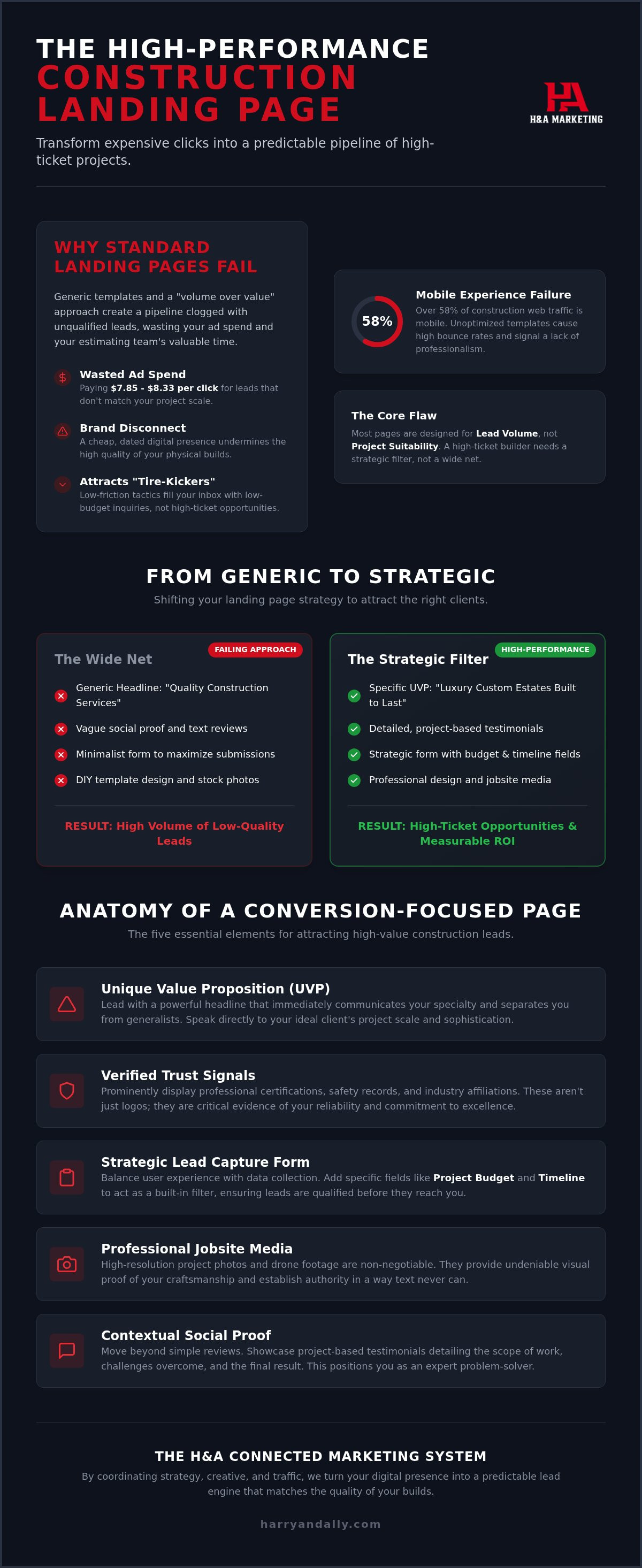
Most landing pages for construction companies are designed with a fundamental flaw: they prioritize inquiry volume over project suitability. When you're paying between $7.85 and $8.33 per click in the home improvement category, every unqualified lead represents a direct hit to your profit margins. Generic templates often use low-friction tactics to drive up conversion rates, which might look good on a report but results in a pipeline clogged with "tire-kickers" and small-scale repair requests. For a firm that specializes in high-six-figure custom builds or commercial projects, this high-volume approach creates more work for your estimating team without increasing your bottom line.
There is a jarring disconnect when a builder who prides themselves on precision and craftsmanship uses a digital presence that feels cheap or dated. High-ticket clients are looking for a partner they can trust with a massive financial and emotional investment. If your landing page looks like a $50 DIY project, they'll assume your jobsite management follows the same lack of standards. True ROI comes from a digital asset that acts as a strategic filter, using professional positioning to attract serious developers and luxury homeowners while quietly discouraging those who aren't a fit for your specific expertise.
The Psychology of the Construction Lead
The decision journey for a high-ticket project isn't impulsive. It's a calculated process of risk mitigation. Before a prospect provides their contact information, they're looking for authority and proof of competence. It helps to understand what a landing page is in a professional context; it's a standalone destination designed to fulfill a singular business goal. For you, that goal isn't just a phone call. It's a qualified conversation. These leads need to see that you understand the complexities of their specific trade or market challenges before they'll trust you with their vision.
The Pitfalls of DIY Templates
One-size-fits-all designs dilute your brand and often suffer from technical debt that kills conversions. With 58.4% of construction web traffic now coming from mobile devices, a template that isn't perfectly optimized for mobile UX will cause your bounce rate to skyrocket. Slow load times and clunky interfaces signal a lack of professionalism. Investing in professional construction web design ensures your digital storefront matches the quality of your physical builds. A custom-built system allows you to integrate the specific trust signals and visual storytelling necessary to move the needle for sophisticated clients who have seen it all before.
The Anatomy of a High-Performance Construction Landing Page
A high-performance landing page isn't just a digital brochure. It's a focused environment designed to convert a specific type of visitor into a high-value lead. For your header strategy, you must lead with a Unique Value Proposition (UVP) that immediately separates your firm from the competition. Don't settle for generic statements like "Quality Construction Services." Instead, speak directly to the scale and sophistication of your work, such as "Precision-Engineered Commercial Developments" or "Luxury Custom Estates Built to Last Generations." This clarity ensures that when prospects land on your site, they know they've found a specialist who understands their specific needs.
Trust signals are the foundation of high-ticket conversions. You need to integrate professional certifications, safety records, and industry affiliations directly into the layout. These aren't just logos; they're evidence of your reliability and commitment to excellence. Your lead capture mechanism must also find the perfect balance between user experience and data collection. While a short form might increase volume, adding specific fields for project budget and timeline acts as a strategic filter. For a deeper look at balancing these factors, you can consult Online Lead Generation: The Ultimate Guide, which outlines how to structure forms for maximum effectiveness.
Strategic social proof moves beyond simple text reviews. For landing pages for construction companies, this means showcasing project-based testimonials that include the scope of work, the challenges overcome, and the final result. This approach provides context that a generic "they did a great job" review simply cannot match. It positions your firm as a problem-solver capable of handling complex, high-stakes builds.
Essential Elements for High-Ticket Conversion
Your visual assets must command attention. High-resolution project hero images are non-negotiable because they serve as the primary proof of your craftsmanship. These visuals should be supported by clear, action-oriented calls to action (CTAs) that guide the user toward the next step, whether that's requesting a project audit or scheduling a consultation. Since over half of your traffic likely comes from mobile devices, a responsive design is mandatory. Your page must look as professional on a dusty jobsite tablet as it does on a high-end office monitor.
Building Trust Through Transparency
Homeowner and developer anxiety is often rooted in the unknown. You can reduce this friction by clearly showcasing your process and highlighting your team's expertise. Using professional video and photo content allows you to pull back the curtain on your operations and prove the quality of your work in real-time. This transparency builds the confidence necessary for a client to commit to a long sales cycle. If you're ready to refine your approach, consider how a connected lead generation strategy can transform your digital presence into a predictable growth engine.
Lead Quality vs. Lead Volume: Designing for ROI
Generating a high volume of inquiries feels productive, but for high-ticket builders, raw numbers are often a vanity metric. If your team spends forty hours a week chasing 100 leads that only want small-scale repairs, your marketing isn't working; it's just creating noise. Success in this industry requires shifting your focus toward lead quality. Ten qualified leads with the right budget and project scope are infinitely more valuable than 100 unqualified inquiries that will never move past the initial phone call. Effective landing pages for construction companies must act as a sophisticated gatekeeper for your business.
You can achieve this by introducing intentional friction into your lead capture forms. While standard marketing advice suggests keeping forms as short as possible, high-ticket construction requires the opposite. By requiring prospects to select a budget range and a projected start date, you filter out those who aren't a fit before they ever enter your pipeline. This approach aligns with broader construction marketing strategies that prioritize the long-term health of your sales funnel over short-term click counts. It ensures your estimators only spend time on projects that meet your firm's minimum revenue requirements.
Connecting your landing page to a CRM is the final step in proving ROI. This integration allows you to track a lead from the first click through the entire multi-month sales cycle to the final contract signature. You stop guessing which ad campaigns work and start seeing exactly which traffic sources drive your most profitable projects. This data-driven approach transforms your digital presence from an expense into a measurable growth engine.
The Connected Marketing System Approach
A landing page doesn't exist in a vacuum. It's the destination for a broader lead generation strategy that coordinates SEO, paid ads, and professional media. When your Google Ads or organic search efforts point to a page specifically designed for high-ticket conversion, the entire system becomes more efficient. To understand how these pieces fit together, read our guide on Lead Generation for Construction Companies. This connected marketing system ensures that every dollar spent on traffic is directed toward a page optimized for your specific niche.
Measuring What Matters
Stop obsessing over cost-per-lead (CPL) and start measuring cost-per-acquisition (CPA). A lead that costs $130 might seem expensive, but if that lead converts into a $2 million commercial build, the ROI is undeniable. You must also consider how your branding influences lead retention. High-quality visuals and clear authority signals keep your firm top-of-mind during the long decision-making periods typical of luxury residential or commercial construction. Tracking the entire lifecycle of the lead is the only way to truly understand your marketing performance.
Leveraging Jobsite Media and Visual Storytelling
Stock photography is a conversion killer. When a potential client visits landing pages for construction companies, they aren't looking for a generic image of a smiling man in a pristine hard hat. They want to see your crew, your equipment, and your actual results. Using authentic jobsite media provides the "proof-of-work" that high-ticket clients demand before they'll consider a multi-million dollar contract. If your digital presence relies on the same stock assets as a low-cost handyman, you've already lost the trust of a sophisticated developer or luxury homeowner.
Professional drone photography is particularly effective for establishing project scale and site context. It allows you to showcase the complexity of a commercial build or the expansive footprint of a custom estate in a way that ground-level photos cannot match. High-quality drone photography provides a sense of authority and permanence. Beyond static images, incorporating project walkthrough videos helps build familiarity with your team and your standards of craftsmanship before the first meeting even takes place. These assets prove you have the capacity to handle large-scale projects without missing the fine details.
Transformation sequences, such as "Before and After" galleries, demonstrate your ability to solve problems and deliver visible value. These aren't just for residential remodels; they work equally well for commercial site preparation and structural completions. They tell a story of progress and precision that words alone cannot convey. They show that you don't just finish projects; you transform environments.
The Power of Professional Assets
High-end media directly supports premium pricing. If you want to charge more than the competition, you must look like you're worth more. Using professional jobsite progress photos shows potential clients that your sites are organized, safe, and managed with strict attention to detail. This level of visual transparency reduces the perceived risk of the investment. To see how these assets fit into your broader strategy, read our guide on Visual Storytelling: Photo and Video for Home Builders.
Authenticity as a Differentiator
Humanizing your brand is a powerful way to stand out in a crowded market. Showing the faces behind the firm builds a personal connection that generic corporate sites lack. While high-level shots show scale, macro shots of finishes show quality. Capturing the tight miter joints or the flawless pour of a foundation proves your commitment to craftsmanship. Integrating professional video and photo services into your marketing ensures every detail is captured with the same care you put into your physical builds.
Capture your craftsmanship with professional jobsite media.
Implementing Your High-Conversion System
Implementing a high-conversion system is a methodical process that moves your digital presence from a passive brochure to an active sales asset. It requires a clear roadmap to ensure your investment translates into signed contracts rather than just empty traffic. This isn't a "set it and forget it" task; it's a cycle of refinement that aligns your digital storefront with your physical craftsmanship.
First, you must define your primary project goal. A page designed for high-end luxury remodels will look and sound significantly different than one targeting multi-unit commercial developments. Second, audit your current visual assets. If you don't have high-resolution proof of your recent work, schedule professional media production immediately. Third, build the page with a singular focus on your unique value proposition and the trust signals that mitigate client risk. Fourth, integrate the page with your CRM. Speed-to-lead is critical in high-ticket construction; your team should be notified the moment a qualified prospect submits their details. Finally, launch and optimize. You must track lead quality, not just click rates, to understand the true performance of your landing pages for construction companies.
Scaling Your Lead Flow
Once your baseline is established, you can begin to scale your results. Use A/B testing to refine your messaging and discover which headlines resonate most with your target demographic. You might find that commercial developers respond better to "on-time structural delivery" while homeowners prefer "award-winning architectural detail." Expanding your reach involves a coordinated effort between SEO and paid traffic. While ads provide immediate visibility, organic search builds long-term authority and reduces your average cost-per-acquisition over time. This transition from one-off pages to a full digital strategy ensures your pipeline remains full regardless of seasonal shifts.
Partnering for Growth
Specialized agencies outperform generalist marketing firms because they understand the nuances of the construction lifecycle. They know that a lead might take six months to convert and that visual proof is a non-negotiable requirement for high-ticket builds. H&A Marketing coordinates strategy, creative, and lead capture as a connected marketing system, acting as an essential extension of your business. We handle the technical complexities of tracking and optimization so you can stay focused on the jobsite. If your current website doesn't reflect the quality of your physical builds, it's time for a change. Request a marketing audit from H&A Marketing to see where your system is leaking potential revenue.
Build a Digital Presence That Matches Your Craftsmanship
High-ticket projects aren't won with generic templates or high-volume inquiry numbers. They are won through strategic trust-building and clear visual proof. By shifting your focus from raw lead counts to project ROI, you ensure your estimating team spends time on the luxury remodels and commercial builds that drive your business growth. Specialized marketing isn't just about visibility; it's about authority.
Optimizing landing pages for construction companies requires a connected approach that integrates professional jobsite media with a data-driven lead capture system. When your digital authority finally matches the quality of your physical work, you stop chasing "tire-kickers" and start attracting serious developers and homeowners who value your expertise. It's the difference between a website that just exists and a system that actually produces.
Request a free marketing audit and strategy session
Your next high-tier project is already looking for a partner they can trust. We're ready to help you build the marketing engine that proves you're the only logical choice for their vision.
Frequently Asked Questions
What is a good conversion rate for construction landing pages?
A healthy conversion rate for construction landing pages typically ranges from 1.9% to 3.65%. While the industry average sits around 2.8%, you should focus on the quality of those conversions rather than just the raw percentage. For high-ticket builders, a lower conversion rate consisting of multi-million dollar project inquiries is far more profitable than a high rate of low-budget inquiries that waste your estimating team's time.
Should I use my main website or a dedicated landing page for Google Ads?
You should use a dedicated landing page for Google Ads rather than your main website. Main websites often have multiple navigation links that distract visitors from your primary goal. A dedicated page removes these exits and focuses entirely on a single call to action. This is a core part of a connected marketing system, ensuring that expensive ad traffic is funneled into a high-conversion environment designed for ROI.
Can I use stock photos if I don’t have professional project photography yet?
Stock photos are a liability for high-ticket builders. Potential clients in the luxury or commercial space can spot generic imagery instantly, which signals a lack of real-world experience. It is better to use authentic jobsite photos while you wait for professional production. H&A Marketing provides professional on-site photography and drone services to ensure your digital presence finally matches the quality of your physical craftsmanship and builds immediate trust.
How long should a construction landing page be?
Your landing page should be long enough to mitigate the high-ticket buyer's risk. While simple lead magnets can be short, construction services require more proof to convert. Include sections for your specific process, project highlights, and trust signals like safety records or industry certifications. The goal is to provide enough information to qualify the lead and establish authority without overwhelming them with unnecessary technical jargon or fluff.
What information should I ask for in my lead capture form?
Ask for basics like name and email, but include qualifying fields for project budget and timeline. These additional questions act as a strategic filter to ensure your team only follows up with high-value opportunities. Asking for a brief project description also helps you prepare for the initial consultation. Balancing ease of use with detailed data collection is essential for maintaining a healthy pipeline of qualified, high-ticket leads.
Do landing pages help with my construction company SEO?
Yes, landing pages for construction companies significantly improve your SEO when they target specific, high-intent keywords. By creating dedicated pages for different services or project types, you provide search engines with highly relevant content that answers a user's specific query. This specialized approach builds domain authority. If you specialize in residential work, integrating these pages with your custom home builder website design helps you rank for luxury terms your competitors overlook.
How often should I update the content on my landing page?
You should audit your content at least once a quarter to ensure your portfolio reflects your latest and best work. Freshness is a trust signal for both users and search engines. Update your page whenever you complete a major project or receive a high-impact testimonial. Keeping your visual assets current proves that your firm is active, successful, and consistently delivering high-quality results across your entire service area.
