
Lead Nurturing for Home Builders: Converting High-Ticket Prospects in 2026

Article by
Harry Stanley III
Harry Stanley III is a construction marketing strategist and fractional CMO at H&A Marketing. He has helped construction companies grow through website strategy, SEO, paid advertising, branding, lead generation, CRM systems, and professional content. His past work includes helping Meraki Solar generate an additional $3.7 million in revenue in his first year and supporting American Builders as a fractional CMO. Today, Harry works directly with custom home builders and construction companies to build marketing systems designed to generate qualified leads and measurable growth.
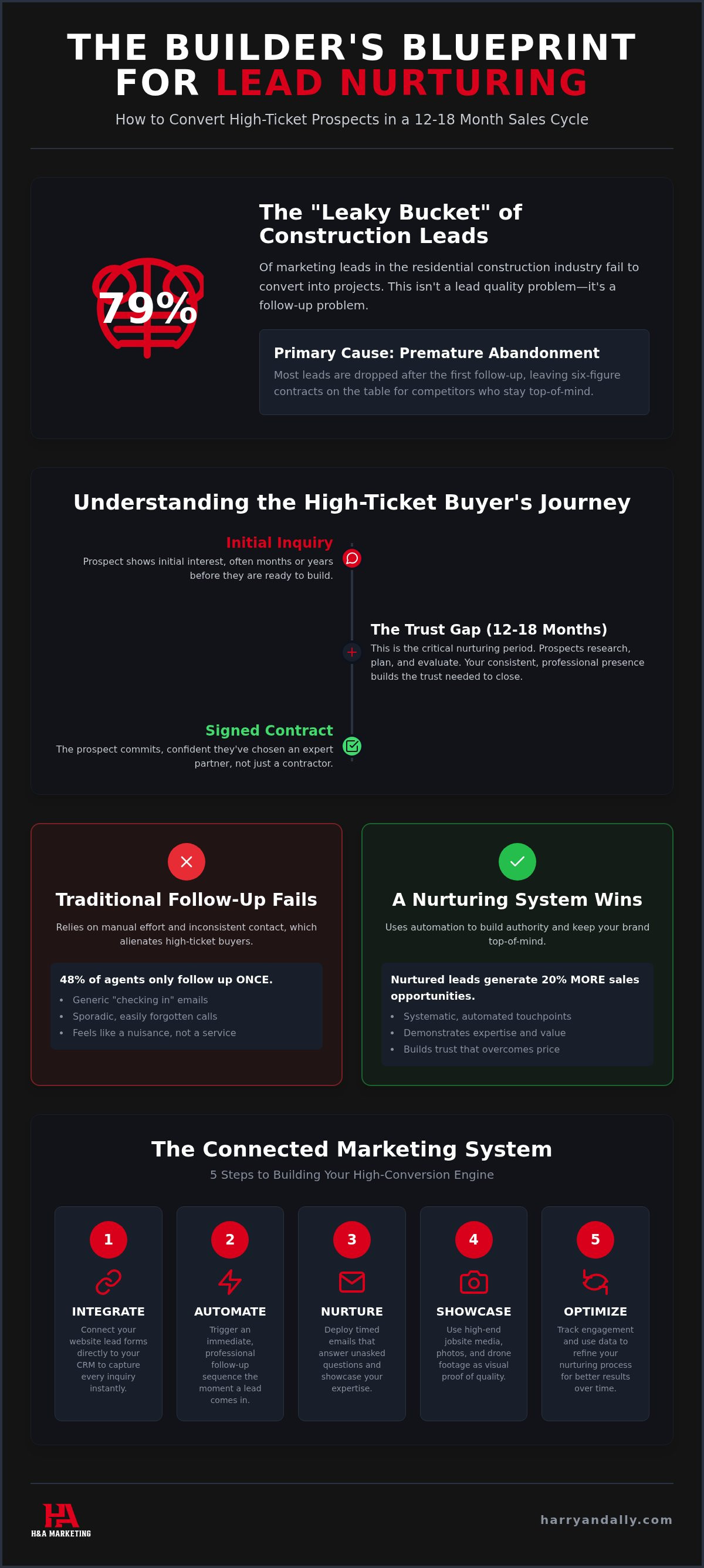
79% of marketing leads in the residential construction industry fail to convert, primarily because they are abandoned after the first follow-up. When you’re dealing with a sales cycle that often lasts 12 to 18 months, one phone call won't cut it. You’ve likely experienced the frustration of providing a detailed quote only to have the prospect ghost you for months. It’s a common pain point for builders who find themselves stuck in a cycle of manual follow-ups that never move the needle. Effective lead nurturing for home builders isn't just about staying in touch; it’s about building a connected system that maintains your authority while the prospect does their due diligence.
We understand that your time is better spent on the jobsite than chasing cold inquiries. In this article, you’ll learn how to transform stagnant leads into signed construction contracts using a strategic system designed for 2026. We will break down how to create a repeatable follow-up process that feels personal and keeps your brand top-of-mind. From leveraging professional visual assets to utilizing CRM workflows, we’re previewing the exact steps needed to increase your conversion rates and ensure no high-value opportunity is left to go cold.
Key Takeaways
- Stop treating follow-up as a manual chore and start viewing it as a strategic demonstration of authority that prevents six-figure projects from slipping away.
- Bridge the trust gap with high-ticket prospects by maintaining a consistent, professional presence throughout their 18-month decision journey.
- Implement automated lead nurturing for home builders to keep your brand top-of-mind without spending hours on repetitive manual emails or phone calls.
- Use high-end jobsite media and drone footage to provide transparency and visual proof of your construction quality during the long sales cycle.
- Learn the five steps to building a connected marketing system that integrates your website, CRM, and visual assets into a high-conversion engine.
The Reality of Lead Nurturing for Home Builders
Lead nurturing for home builders is the strategic process of maintaining engagement with a prospect from the moment they first inquire until they sign a construction contract. It’s a marathon, not a sprint. While many builders invest heavily in lead generation for construction companies, they often ignore what happens after the initial contact. This creates a "leaky bucket" where six-figure projects slip through the cracks. If 79% of leads fail to convert due to poor follow-up, you aren't just losing names; you're losing massive revenue opportunities that your marketing budget already paid to acquire.
To better understand how this process works in a modern business environment, watch this helpful video:
A successful lead management process requires a connected marketing system that coordinates your website, CRM, and visual assets. Lead generation is simply about getting the click; lead nurturing is about closing the contract. Without a bridge between the two, you’re essentially paying for traffic that your competitors will eventually close because they stayed top-of-mind. Systematizing this journey ensures that your brand remains the only logical choice when the prospect is finally ready to build.
Why Traditional Follow-Up Fails in Construction
High-net-worth prospects don't want another "just checking in" email. These generic touchpoints feel like a nuisance rather than a professional service. Since the decision window for a custom build typically spans 12 to 18 months, your strategy must match that timeline. Most builders stop their follow-up efforts far too early. Statistics show 48% of agents only follow up with a new lead once before giving up. When a client is spending a year planning their dream home, a single phone call is nowhere near enough to secure the contract.
The ROI of a Structured Nurturing System
Investing in a repeatable system directly impacts your bottom line and the quality of projects you land. Nurtured leads generate 20% more sales opportunities compared to those left to go cold. This structured approach reduces price-shopping behavior because it shifts the conversation from cost to quality. When you consistently demonstrate your expertise through automated touchpoints, you build a level of trust that a lower-priced competitor can't match. Lead nurturing is an authority-building engine that systematically demonstrates your expertise until the prospect is ready to break ground.
Psychology of the High-Ticket Construction Buyer
High-ticket construction is an emotional minefield. Homeowners aren't just looking for a floor plan; they're looking for a partner they can trust with their life savings. This creates a "Trust Gap" that only narrows through consistent, professional presence. An effective lead nurturing strategy addresses this by providing proof of reliability before a single brick is laid. Luxury buyers prioritize certainty and specialized growth over the lowest bid. They want to know you're the expert who won't disappear when challenges arise.
Effective lead nurturing for home builders recognizes that the prospect is moving through a funnel from curiosity to commitment. Early on, they need reassurance. Later, they need technical validation. If you treat a lead who is 12 months out the same as one who is ready to break ground next week, you'll lose both. Tailoring your communication to their specific emotional state is what separates the top-tier builders from the rest of the pack. You're not just selling a service; you're selling the confidence that the project will be completed to their exact standards.
Establishing Authority During the Wait
Prospects often spend months in an informational search phase. They're asking questions about zoning, materials, and financing. You shouldn't wait for them to ask you directly. By answering these unasked questions through your nurturing emails, you position your firm as a consultant rather than just a contractor. This shift is critical for effective lead generation for construction companies because it builds a foundation of authority that competitors lack. If you aren't sure where your current strategy stands, you might consider a marketing audit to identify gaps in your authority building.
Managing the Long-Term Decision Journey
The path from a website visit to a signed contract is rarely linear. It involves multiple touchpoints, including site visits, design meetings, and portfolio reviews. Social proof plays a massive role here. Seeing your recent projects or hearing from past clients validates their decision to move forward. Custom home builders must maintain premium positioning in every communication. Every email, brochure, and drone video must reflect the high-ticket nature of the work you do. Reliability is the currency of the luxury market.
Understanding this psychology allows you to build a system that speaks to the buyer's needs at every stage. You aren't just "following up"; you're guiding them through a complex emotional journey. This consistent engagement ensures that when they finally decide to move from planning to building, your firm is the only one they trust to execute the vision.
Systems Over Sweat: Automating the Follow-Up
Manual follow-up is a guaranteed way to burn out and lose high-ticket projects. When you're managing a jobsite, you don't have time to manually email every prospect who downloaded a floor plan six months ago. Modern sales automation allows you to maintain a professional presence without being tethered to your inbox. A CRM for custom home builders doesn't just store contact information; it tracks lead behavior and engagement in real time. This intelligence tells you exactly when a prospect revisits your pricing page or spends ten minutes viewing a specific luxury project in your portfolio.
Effective lead nurturing for home builders relies on setting up "triggers" based on these actions. If a lead views your gallery three times in one week, the system can automatically send a personalized text or email that feels like a manual reach-out. This balance between automated efficiency and the human touch ensures you're always engaging at the moment of peak interest. Automation isn't a replacement for your expertise; it's the infrastructure that makes high-level service possible at scale.
The Essential Tech Stack for Builders
Tools like GoHighLevel or LeadConnector are the backbone of a modern builder's office. These platforms coordinate every piece of the puzzle, from initial traffic to final contract. When a lead fills out a form on your custom home builder website design, they should immediately enter a pre-defined sequence. This isn't just a "thank you" note. It's the start of a multi-month journey that provides value, answers common build questions, and showcases your authority before you even pick up the phone.
Email vs. SMS Nurturing for Contractors
Email is your authority builder, while SMS is your speed-to-lead tool. Research shows that responding to a new lead within 60 seconds can increase conversion rates by as much as 391%. Use quick SMS alerts for project updates or meeting reminders to stay top-of-mind. Long-form email updates are better suited for deep dives into your construction process or sharing professional video and photo assets of finished homes. A connected marketing system ensures these channels work together to keep your brand relevant without being intrusive. We recommend a frequency that mirrors the build cycle: more frequent early on, then settling into a consistent monthly rhythm that maintains your professional presence.
Visual Nurturing: Closing Deals with Jobsite Media
Visual storytelling isn't just about pretty pictures; it's about reducing the perceived risk of a multi-million dollar investment. High-ticket prospects are often visual learners who need to see your process in action before they feel comfortable committing. By incorporating jobsite media into your lead nurturing for home builders, you provide a window into your daily operations. This transparency proves that you maintain a clean site, follow safety protocols, and execute with precision. It bridges the gap between a digital inquiry and the physical reality of a luxury home.
Drone photography is particularly effective for showing the scale of a project and how it integrates with the local landscape. It projects a level of professionalism that amateur smartphone photos simply can't match. Meanwhile, "behind-the-scenes" video content humanizes your construction team. It transforms your company from a faceless entity into a group of dedicated craftsmen. When a homeowner can see the faces of the people who will be in their home every day, the "Trust Gap" mentioned earlier begins to close rapidly.
Using Professional Photo and Video Assets
Your existing portfolio is a goldmine for nurturing content. Repurposing these assets into automated email sequences allows you to showcase your best work consistently. High-end video and photo services ensure that every detail, from the grain of the custom cabinetry to the sweep of a grand staircase, is captured in high definition. This level of quality is essential for building trust with luxury buyers who expect excellence at every touchpoint. You can read more about photo and video for home builders to see how these assets drive engagement during the long sales cycle.
Case Studies and Progress Updates
A "Project Spotlight" sequence is one of the most effective ways to nurture a long-term lead. By showing a home's evolution from foundation to finish, you demonstrate your ability to manage complex timelines and deliver results. Video testimonials from satisfied clients can also be integrated to handle common objections before they are even raised. Linking these visual assets to high-performing construction landing pages creates a seamless path for the prospect to move from observer to active participant in the design process. This coordinated approach ensures that your marketing remains as high-quality as the homes you build.
Schedule a professional jobsite shoot to fuel your nurturing engine
Implementing Your Connected Marketing System
Building a successful engine for lead nurturing for home builders requires a transition from fragmented tactics to a unified strategy. You can't rely on luck or a single spreadsheet to manage a multi-million dollar pipeline. A connected marketing system ensures that your website, SEO, and visual assets work together to move prospects through the funnel. This shift from traditional, word-of-mouth methods to modern digital dominance is what allows a firm to remain competitive in 2026. To build this engine from scratch, follow these five essential steps:
- Audit existing traffic: Identify exactly where prospects are falling out of your sales process.
- Sync your website with a CRM: Ensure every form submission triggers an immediate, professional response.
- Deploy high-ticket visual assets: Use your professional portfolio to build authority before the first meeting.
- Automate behavioral triggers: Set up sequences that respond to specific prospect actions, such as viewing a pricing page.
- Measure ROI: Focus on the total value of signed contracts rather than the number of clicks or leads.
Builders belong on the jobsite, not behind a marketing dashboard. A growth partner acts as a strategic ally and an extension of your business, managing the technical execution while you focus on construction. This partnership provides the professional relief that comes from delegating specialized tasks to experts who understand the unique challenges of the custom home market. Every piece of your online presence must work together to project the same level of quality you put into your builds.
Auditing Your Current Lead Flow
Most builders lose prospects because they don't know where the leak is. Is it the initial response time? Is it the lack of follow-up after the first quote? Identifying these drop-off points is the first step toward optimization. You must also check for inconsistency in your brand voice. If you sound like a luxury expert on the phone but your automated emails look like generic templates, you create a trust gap. Preparing for a professional marketing audit will highlight these gaps and provide a clear roadmap for improvement.
Building for Long-Term ROI
In 2026, the industry is prioritizing lead quality and conversion efficiency over raw lead volume. While overall lead volume has slightly decreased across the sector, conversion efficiency has improved by nearly 11% for builders using integrated systems. Your marketing efforts must connect directly to pipeline growth and project quality. This ensures that the leads you nurture aren't just names in a database, but qualified prospects ready to invest in a high-ticket build. By focusing on the long-term decision journey, you turn a high-cost lead into a high-ROI contract.
Discuss your strategy with H&A Marketing
Building a High-Ticket Pipeline for the Future
The decision to build a custom home is the largest investment most people will ever make. Success in 2026 requires more than just generating a lead; it demands a connected marketing system that maintains authority over an 18-month journey. By implementing automated lead nurturing for home builders, you ensure that your brand remains the only logical choice when the prospect is finally ready to break ground.
High-end visual assets and professional jobsite media serve as the foundation of this trust. They provide the transparency that luxury buyers crave and prove that your quality matches your promises. When you combine these assets with a structured CRM workflow, you transition from chasing cold leads to managing a predictable, high-ROI pipeline. H&A Marketing acts as your specialized growth partner, handling the end-to-end strategy and professional production while you focus on the build.
Discuss your connected marketing system with H&A Marketing
Your next six-figure project is waiting for a system that doesn't let it go cold. We're ready to help you turn those stagnant inquiries into signed construction contracts.
Frequently Asked Questions
What is lead nurturing for home builders?
Lead nurturing for home builders is the strategic process of maintaining professional engagement with a prospect from their first inquiry until they sign a construction contract. It isn't just about sending reminders; it's about demonstrating jobsite authority and reliability over a long sales cycle. By providing consistent value through educational content and visual updates, you ensure your firm remains the top choice when the homeowner is finally ready to move from planning to breaking ground.
How long should a construction lead nurturing sequence last?
A construction lead nurturing sequence should typically last between 12 and 18 months to match the average decision-making window for custom homes. Research indicates that high-ticket real estate leads often take over a year to convert. Your system needs to stay active throughout this entire duration, providing periodic touchpoints that keep your brand visible. Stopping follow-up after just a few weeks means you'll likely lose the project to a competitor who stayed engaged.
Can lead nurturing be automated without sounding like a robot?
You can certainly automate your follow-up without losing the personal touch by using behavioral triggers and plain language. Instead of generic templates, use your CRM to send messages based on specific actions, like a lead revisiting your portfolio page. This makes the communication feel timely and relevant. When your automated emails include professional photo and video assets from your recent jobsites, they project a level of personalized expertise that generic, robotic messages can't replicate.
What is the best content to send to a custom home prospect?
The most effective content for custom home prospects includes high-end visual assets, educational guides, and social proof. Send "Project Spotlights" that show a build from foundation to finish, or share drone footage that demonstrates the scale of your work. Answering unasked questions about zoning or material selection positions you as a consultant rather than a salesperson. This variety of content addresses the emotional and technical needs of the buyer throughout their long-term decision journey.
Do I need a CRM to manage my construction leads?
A CRM is essential for any builder looking to scale their business and manage high-ticket projects efficiently. In 2026, over 70% of residential builders utilize a CRM or construction management system to track lead behavior. These tools allow you to see exactly when a prospect engages with your content, enabling you to time your reach-outs perfectly. Without a central system, leads inevitably fall through the cracks, resulting in lost revenue from abandoned inquiries.
How often should I follow up with a potential construction client?
You should follow up immediately after an initial inquiry and then settle into a consistent, non-intrusive rhythm. Responding within 60 seconds can increase conversion rates by as much as 391%, so speed is critical at the start. After the initial contact, a bi-weekly or monthly cadence of educational emails is usually sufficient. The goal is to remain top-of-mind without becoming a nuisance, ensuring you're there when they are ready to sign.
What is the difference between lead generation and lead nurturing?
Lead generation is the process of attracting interest and capturing contact information, while lead nurturing for home builders is the long-term strategy used to turn that contact into a client. Generation gets them in the door, but nurturing closes the contract. Since 79% of leads fail to convert due to poor follow-up, the nurturing phase is where the actual ROI is realized. You need both to build a sustainable and profitable construction pipeline.
How do I re-engage a lead that has gone cold?
To re-engage a cold lead, avoid the "just checking in" approach and offer something of genuine value instead. Send a new case study, a professional video of a completed project, or an update on local building regulations. This provides a professional reason to reach out and reminds them of your expertise without sounding desperate. Using a connected marketing system allows you to track their re-engagement, telling you when they are active again.
