
Custom Home Builder Branding: Win High-End Clients

Article by
Harry Stanley III
Harry Stanley III is a construction marketing strategist and fractional CMO at H&A Marketing. He has helped construction companies grow through website strategy, SEO, paid advertising, branding, lead generation, CRM systems, and professional content. His past work includes helping Meraki Solar generate an additional $3.7 million in revenue in his first year and supporting American Builders as a fractional CMO. Today, Harry works directly with custom home builders and construction companies to build marketing systems designed to generate qualified leads and measurable growth.
A custom home builder’s brand is only as convincing as the proof behind it. A refined logo can set the tone, but it won’t explain what makes your craftsmanship, process, or homeowner experience different. Strong custom home builder branding connects those details so the right clients see more than another polished portfolio.
If your company looks interchangeable with other builders, or your marketing doesn’t reflect the quality of homes you want to build, an immediate rebrand may not be the answer. Start by clarifying who you serve and what sets your approach apart. Then carry that position through your visual identity, project photography, website, search presence, and client experience. This article explains how to decide whether to refine your existing brand or rebuild it, and how to use consistent, credible proof when homeowners evaluate their options. The goal isn’t simply to look high-end. It’s to help qualified homeowners understand why your team may be the right partner for the home they’re planning.
Key Takeaways
- Define the projects and homeowner experience your business wants to be known for before changing brand visuals.
- Build custom home builder branding around a clear position, then support it with relevant project proof.
- Separate brand strategy, visual identity, and portfolio evidence so each part has a clear job.
- Keep your message and visuals consistent as homeowners discover, research, compare, and contact your company.
- Review inquiry quality and fit to see whether your brand is attracting the homeowners and projects you want.
Why custom home builder branding matters when homeowners compare builders
Homeowners don’t evaluate a custom builder from a logo alone. They form an impression from the projects shown, the words used to describe the work, the way the company explains its process, and the consistency of each interaction. Branding is the set of cues that helps homeowners recognize and evaluate a builder. For a major decision like building a home, those cues should make the company’s strengths and fit easy to understand.
A campaign is a specific effort to get attention. A referral is one way a homeowner hears about you. Lead generation attracts and captures inquiries. Branding is the underlying identity and reputation those activities draw on. It shapes what people understand about your business before, during, and after a campaign. For a foundational overview of the term, see What is a Brand?
That distinction matters. More promotion can bring people to your website, but it can’t fix unclear positioning or make unrelated project examples feel like proof of a consistent specialty. A focused construction branding strategy gives your company a clear point of view to carry into its marketing. It helps homeowners understand what you build and how your approach may fit their priorities. Branding can support better-fit conversations, but it cannot guarantee a particular number of inquiries or a specific business outcome.
What does custom home builder branding include?
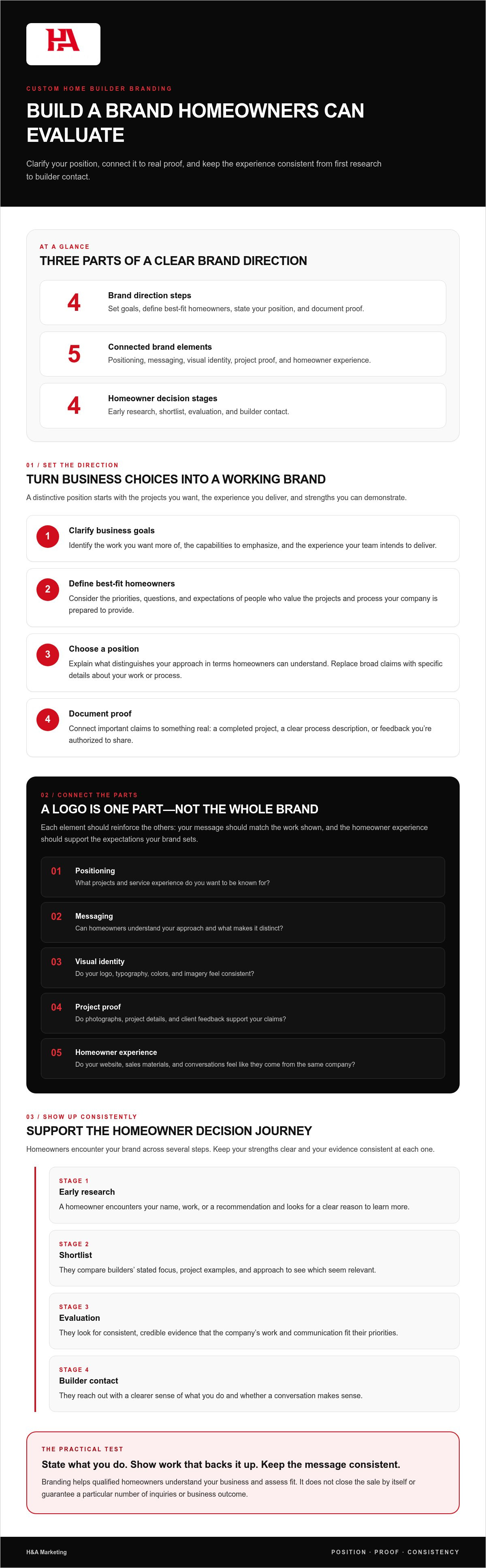
Custom home builder branding brings together the position you claim, the messages you use, the visual identity you present, the project proof you share, and the experience homeowners have at each touchpoint. A logo is one part of visual identity, not the whole brand. Each part should reinforce the others: your message should match the work shown, and the homeowner experience should support the expectations your brand sets.
- Positioning: What kinds of projects and service experience do you want to be known for?
- Messaging: Can homeowners understand your approach and what makes it distinct?
- Visual identity: Do your logo, typography, colors, and imagery feel consistent?
- Project proof: Do photographs, project details, and client feedback support your claims?
- Experience: Do your website, sales materials, and conversations feel like they come from the same company?
Why brand clarity matters in a long homeowner decision
A homeowner’s decision unfolds through several steps, not one ad or conversation. Your brand should help them make sense of your company at each stage:
- Early research: The homeowner encounters your name, work, or a recommendation and looks for a clear reason to learn more.
- Shortlist: They compare builders’ stated focus, project examples, and approach to see which seem relevant.
- Evaluation: They look for consistent, credible evidence that the company’s work and communication fit their priorities.
- Builder contact: They reach out with a clearer sense of what you do and whether a conversation makes sense.
Clear positioning helps people assess fit without guessing. If you want to be considered for a particular kind of project or recognized for a specific service experience, state it plainly and support it with relevant examples. Avoid broad claims that could describe any builder. Explain what you do, show work that backs it up, and keep the message consistent wherever homeowners encounter your company.
That consistency gives prospects a sound basis for comparison and gives your team a more focused starting point for a conversation. Branding doesn’t close the sale by itself. It helps qualified homeowners understand your business before deciding whether to contact you.
Build a custom home builder brand around a clear position and homeowner
A distinctive position starts with business choices, not a clever tagline. Decide what kinds of projects you want to pursue, how you want the building process to feel for clients, and which strengths you can demonstrate. Then make those choices clear enough that homeowners can recognize whether your approach suits their priorities.
Use this sequence to turn those choices into a working brand direction:
- Clarify business goals. Identify the work you want more of, the capabilities you want to emphasize, and the experience you want your team to deliver.
- Define best-fit homeowners. Consider the priorities, questions, and expectations of people who value the projects and process your company is prepared to provide.
- Choose a position. State what distinguishes your approach in terms a homeowner can understand. Avoid broad claims such as “quality” or “excellence” unless you explain what they mean in practice.
- Document proof. Match each important claim with something real, such as a completed project, a clear description of your process, or feedback you’re authorized to share.
How should a custom builder define a distinctive position?
Look at your projects, process, and client experience together. Ask which project characteristics you want to be known for, how your team guides homeowners through decisions, and what clients consistently appreciate about working with you. A meaningful distinction is specific and supportable. “We build exceptional homes” is hard to assess. Explaining how your team approaches design coordination or communicates during construction gives a homeowner something concrete to evaluate, if it accurately describes your process.
This exercise can also help focus conversations. A homeowner who understands your focus can compare it with their own needs before reaching out. That doesn’t mean turning away every project outside a narrow description. It means setting expectations honestly, so the first discussion can focus on fit rather than decoding what your company stands for. Procore’s overview of Branding in the Construction Industry also frames branding as more than appearance, connecting it to how a construction business presents itself.
Turn the builder’s story into homeowner-focused messaging
Your story matters when it answers a homeowner’s practical questions. Instead of listing internal credentials or describing your company as “passionate,” explain what your approach means for the client. For example, if you guide homeowners through key project decisions, describe what that guidance looks like and support the statement with a real example. Keep the language plain, specific, and true to how your team works.
Separate what you’ve done from what you hope to do. A completed project can demonstrate current experience; a future goal should be presented as an aspiration, not a proven specialty. This discipline makes custom home builder branding more credible and gives your website, portfolio, and sales materials a consistent foundation. For broader channel planning, connect this positioning work with Marketing for Custom Home Builders: Scaling Luxury Growth.
For examples of how a construction brand can be defined and expressed, see construction branding services.
Custom home builder branding is more than a logo: align identity with proof
A new logo can make a builder look different. It can’t explain why the company is the right fit for a homeowner or prove that its work supports its promises. Custom home builder branding is strongest when strategy, visual identity, and project evidence tell the same story.
Think of these as three connected parts:
- Brand strategy sets direction. It defines the position, audience, and ideas the company wants homeowners to associate with it. For example, a builder may emphasize a hands-on process, then explain what that means in practice.
- Visual identity makes that direction recognizable. A logo, typography, color, and layout create a consistent look across the website, social profiles, and sales materials.
- Project proof makes the message credible. Photography, project descriptions, and customer-facing language show what the company has actually delivered and how it works.
If your brand promises careful communication but the inquiry experience feels confusing, the gap can weaken trust. If the visuals suggest a certain kind of work but the portfolio doesn’t support that impression, homeowners have little reason to believe the positioning. Real project imagery and accurate descriptions help close that gap. For practical guidance on documenting finished work, see professional photo and video for builders, including the ideas covered in “Visual Storytelling: Photo and Video for Home Builders.”
When does a builder need a brand refresh or a full rebrand?
A refresh usually makes sense when the business direction still fits but the assets feel inconsistent, dated, or difficult to use. A full rebrand may be worth considering when the company’s position, project mix, or intended homeowner has changed enough that the existing identity no longer represents the business. Neither choice is automatically necessary or a guarantee of stronger performance.
Before deciding, review whether homeowners recognize the brand, whether it speaks to the people you want to serve, whether the portfolio reflects the projects you want, and whether the message stays consistent across customer touchpoints. If the strategy still fits, targeted updates may be more appropriate than replacing everything.
Make visual identity match the work you want to win
Choose visual elements to support the brand character you’ve established. Typography, color, image treatment, and page layouts should feel coherent rather than selected as isolated trends. Then check whether those choices suit the actual projects and the homeowner experience you want to communicate.
Use real project photography as evidence, not decoration. Pair it with specific descriptions of the work shown and the decisions or process the builder can accurately discuss. Don’t imply that a project demonstrates a capability the company hasn’t delivered. Apply the same standard to captions, portfolio pages, and sales materials. When the look, language, and proof align, the identity becomes more than a polished surface: it gives homeowners a consistent way to understand the business.
Apply custom home builder branding consistently across the homeowner journey
Homeowners meet your brand in pieces. They may see a search listing, browse a project gallery, check a social profile, then review a proposal or sales presentation. Each touchpoint should reinforce the same position, even when the format and level of detail change. Consistency doesn’t mean repeating identical copy everywhere. It means giving homeowners a coherent picture of what your company does and what working with you may involve.
Map your brand to the decisions a homeowner is making at each stage:
- Discovery: Search descriptions and social profiles should quickly communicate the builder’s focus and give homeowners a relevant reason to learn more.
- Research: Website content and project stories should help homeowners understand the work, process, and experience behind the brand.
- Comparison: Portfolio details and sales materials should make it easier to assess whether the builder’s approach fits their priorities.
- Inquiry: Contact prompts and follow-up materials should continue the same clear, professional tone rather than introduce a different promise.
This is where custom home builder branding becomes practical: the position guides what each channel says and shows, while the channel answers the homeowner’s next question.
What should a builder’s brand communicate on its website?
Your website should express the brand, not just display it. The homepage needs to make the company’s focus understandable. Project examples should illustrate the kind of work you do, while process information can address questions about how you guide clients through a build. Inquiry language should make the next step clear and feel consistent with the experience described elsewhere. A considered construction website design connects those messages in one place, instead of leaving homeowners to assemble the story themselves.
Keep brand presentation coherent across discovery channels
Review your business descriptions, imagery, and core messages across search listings, social profiles, website pages, and sales materials. Check that each uses a consistent description of your focus and doesn’t imply a project type or service experience that differs from the others. A consistent search presence helps homeowners connect the listing they find with the company they encounter next.
Useful project content makes your approach more tangible. A project description that explains the homeowner’s priorities and the work completed gives more context than a photo or broad claim alone. For more on search visibility as part of construction marketing, see Local SEO for Construction: 2026 High-Ticket Lead Strategy.
Run a quick brand consistency audit
Choose a few touchpoints, such as a search listing, your homepage, a social profile, and a sales document. Review them side by side and ask:
- Does each clearly reflect the same position and tone?
- Does the project evidence support the claims being made?
- Would a homeowner understand what the company does and what to expect next?
Note mismatches, then prioritize the touchpoints that create the most confusion. If you want help turning those findings into a coordinated plan, review H&A Marketing’s website.
Turn custom home builder branding into a practical growth system
A brand becomes useful when your team can apply it consistently and learn from the conversations it attracts. Treat custom home builder branding as an operating guide, not a one-time design project. Write down the position, connect it to the assets homeowners see, and review whether incoming inquiries reflect the work and experience you want to provide.
Create a manageable brand implementation plan
Start with the core message and proof, then update the touchpoints homeowners rely on most. You don’t need to replace every asset at once. A focused rollout can help your team keep the work clear and consistent:
- Document the position. Record the projects you want to pursue, the homeowners you aim to serve, how your process works, and the proof that supports your claims.
- Align brand assets. Bring the logo, visual standards, core messages, project descriptions, and photography into line with that position.
- Update priority touchpoints. Begin with the website, key search and social profiles, and the sales materials used in homeowner conversations.
- Review inquiries. Look at whether prospects understand your focus and whether their needs appear to fit your projects and process.
Give someone on your team responsibility for maintaining the core messages, visuals, and project evidence. That ownership matters as new projects are added and materials are revised. Revisit the position when your project focus, intended homeowners, or business priorities materially change, rather than changing the brand just to make it feel new.
After the first updates, discuss whether the message and proof are helping homeowners understand your business, then identify which touchpoint needs attention next.
Connect brand strategy to coordinated marketing
Branding does not work in isolation from the rest of your marketing. A connected marketing system links strategy, creative, traffic, and lead capture: strategy sets direction; creative carries it through identity and project content; search engine optimization helps homeowners find relevant information; and lead capture gives interested prospects a clear next step.
For a custom builder, that means aligning the website’s message with the project portfolio, keeping search content consistent with the brand position, and making sure inquiry prompts match the homeowner experience you describe. Professional photo and video can strengthen the creative by showing actual work and explaining the details behind a project. Each part has a distinct role, but homeowners should encounter one coherent business.
Review marketing activity alongside inquiry quality. Track which channels are producing inquiries, then note whether prospects mention the projects, process, or strengths you want to be known for. Record recurring questions, mismatches in expectations, and examples of strong fit. These observations can guide useful adjustments, though they don’t prove that one brand change caused a particular inquiry or outcome.
H&A Marketing brings construction branding, website design, SEO, lead generation, and photo and video together as a connected marketing system for construction companies. When the brand, website, search presence, and lead capture work together, homeowners get a clearer view of your business and your team has a consistent way to communicate its value.
Make your brand a lasting business asset
Keep custom home builder branding connected to the decisions your company makes next. As project priorities shift, use your brand position as a filter: does this opportunity fit the work you want to be known for, and can your team deliver the experience your messaging sets out? That discipline keeps marketing grounded in the business you’re building, not just the image you present.
Give your team a simple way to maintain that alignment. Keep core messaging and approved project proof easy to reference, and revisit them when your focus changes. A clear process for reviewing those materials helps your brand stay useful as the business evolves.
To align your brand with how homeowners find and evaluate your company, request a free quote from H&A Marketing.
A clear, credible brand gives your next stage of growth a stronger foundation.
Frequently Asked Questions
Is custom home builder branding different from general construction branding?
Yes, the emphasis often differs because a custom home builder needs to communicate how it partners with homeowners through a personal, complex project. A broader construction brand may need to speak to several types of clients or work. For a custom builder, useful details include how design decisions are handled, what the homeowner can expect from collaboration, and which completed projects reflect the company’s capabilities.
Can a custom home builder build a strong brand without changing its logo?
Yes. Keep the logo if it’s recognizable and still suits the company, then improve how it’s used and what surrounds it. For example, create consistent rules for logo placement, colors, and type, and make sure sales documents and online profiles follow them. A familiar mark can remain while the company clarifies its message, updates project materials, and gives its team a shared way to describe the business.
When should a custom home builder consider a rebrand?
Consider a rebrand if homeowners regularly misunderstand what your company builds, your current identity no longer fits the business, or your materials present conflicting versions of the company. Look for patterns in sales conversations and staff feedback, not one isolated comment. If the issue is limited to a few outdated templates or inconsistent profile descriptions, targeted updates may address it without replacing an identity that still serves the business.
What should a custom home builder include in a brand brief?
A useful brand brief gives the people working on your identity enough context to make sound decisions. Include business goals, the projects you want to pursue, homeowner priorities, your actual process, and evidence supporting your claims. Add examples of language that sounds like your company, visual references you respond to, and anything the brand should avoid. Note where the identity will appear, such as proposals, signage, or online profiles.
How can a builder make branding feel premium without using generic luxury language?
Describe real choices and capabilities instead of relying on labels like “exclusive” or “world-class.” If accurate, explain how your team approaches a particular design detail, coordinates decisions, or communicates during a project. Use imagery that shows the finished work clearly, with captions that identify what the viewer is seeing. Specific evidence feels more credible than grand claims and helps homeowners judge whether your approach suits their expectations.
Should a custom home builder use the same brand message on every marketing channel?
Keep the central idea consistent, but adapt its expression to the channel. A short social profile may need a concise description, while a proposal can explain how your process works in greater detail. A project post can focus on one completed home. The key is that these formats don’t contradict one another or suggest different capabilities. Give staff a short set of approved talking points, then let them tailor the detail to the conversation.
How can a builder tell whether its branding is attracting the right inquiries?
Look beyond inquiry volume. In your lead notes, record what kind of project the person has in mind, what they value, and what prompted them to reach out. Mark whether the inquiry fits your current priorities and note any mismatch, such as expectations your materials may have set incorrectly. Reviewing those notes alongside the channel or content that generated the inquiry can help guide improvements without assuming one touchpoint caused the decision.
