


Article by
Harry Stanley III
Harry Stanley III is a construction marketing strategist and fractional CMO at H&A Marketing. He has helped construction companies grow through website strategy, SEO, paid advertising, branding, lead generation, CRM systems, and professional content. His past work includes helping Meraki Solar generate an additional $3.7 million in revenue in his first year and supporting American Builders as a fractional CMO. Today, Harry works directly with custom home builders and construction companies to build marketing systems designed to generate qualified leads and measurable growth.
More clicks won’t fix a campaign built to attract the wrong roofing work. Google Ads for commercial roofing put your restoration and replacement services in front of people searching online, but campaign performance depends on more than showing up. The targeting, message, landing page, and lead tracking all need to support the projects you want to win.
That matters when a commercial inquiry may involve a facility manager, property owner, or larger project pipeline. A campaign can generate activity without producing qualified opportunities if it targets overly broad keywords or sends prospects to a page with no clear next step.
This guide compares Local Services Ads, Search Ads, and Maps Ads, then explains how keyword choices, landing pages, call and form tracking, and bidding shape a commercial roofing campaign. You’ll learn what each ad type is suited to and what to align before launch, so your budget can focus on relevant prospects and meaningful lead measurement.
Key Takeaways
- Choose between Local Services, Search, and Maps Ads based on how commercial prospects find roofing contractors and what kind of lead you want to attract.
- Build landing pages around specific services, such as roof restoration or replacement, and make it easy for facility managers to take the next step.
- Focus keyword targeting on commercial roofing intent, then use exclusions to reduce clicks from searches unrelated to your services.
- Track calls and form submissions as meaningful conversions so bidding decisions reflect real opportunities, not just ad activity.
- Align campaign settings and ad content with Google’s policies while keeping licensing claims accurate for the areas you serve.
Landing pages, call tracking, and campaign management
Commercial roofing campaigns need a clear path from ad to sales conversation. Service-specific pages, call records, and regular account reviews help connect campaign activity to the inquiries your sales team handles.
Campaigns Segmented by Roofing Service
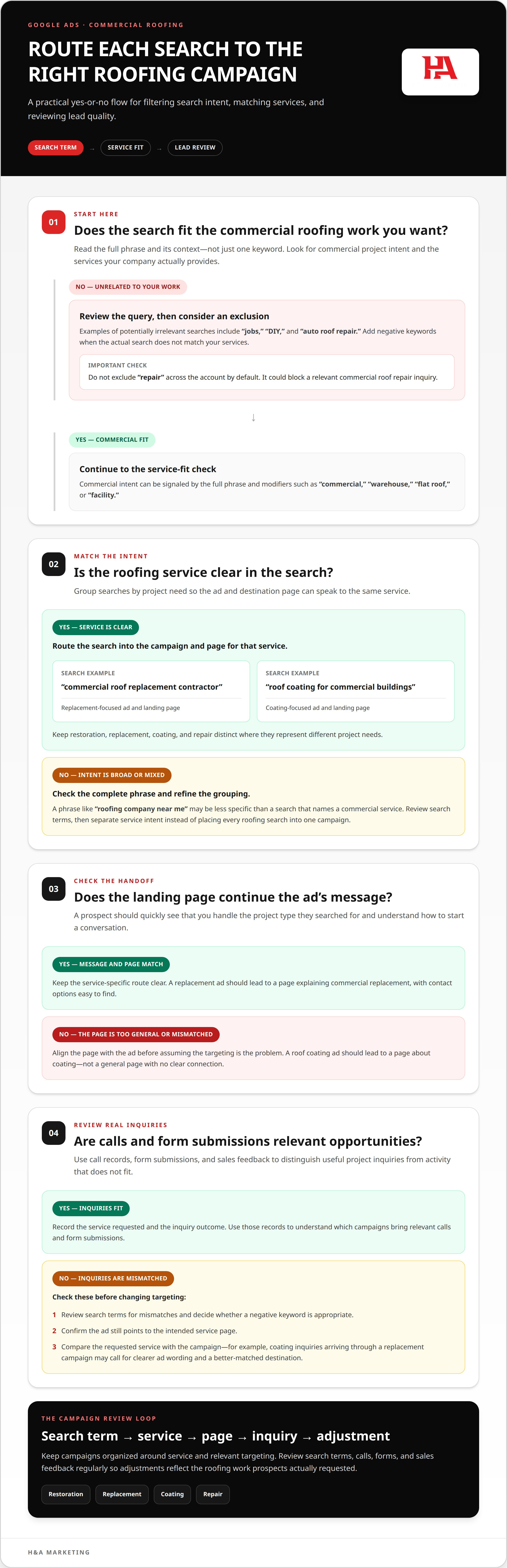
Separate campaigns for restoration, replacement, coating, and repair so each speaks to a distinct need. A property manager researching roof restoration should see an ad and page focused on restoration, not an emergency repair message. Separating services also makes it easier to see which offerings generate relevant inquiries and which need adjustment.
Each landing page should continue the conversation started by its ad. For a replacement campaign, explain the commercial replacement service, make the next step clear, and keep contact options easy to find. A facility manager who clicks should quickly understand whether you handle that project type and how to start a conversation.
Keep the page aligned with the campaign’s purpose. If an ad promotes roof coating, send prospects to a page that explains that service, not a general page with no clear connection. Matching the ad and landing page reduces confusion and gives the sales team context when an inquiry arrives.
Commercial Roofing Campaign Structure
Organize your Google Ads account by service and relevant targeting, rather than putting every roofing search into one campaign. A restoration campaign can have its own ads and destination page, while a replacement campaign uses messaging tailored to that project. This structure makes performance easier to review and lets you adjust one service without disrupting unrelated campaigns.
Give each campaign a defined purpose and a clear route to inquiry. For example, a commercial repair campaign can direct prospects to a page describing the work and the information needed to begin an assessment. Name campaigns so the service and targeting are easy to understand during routine reviews.
Campaign Performance and Lead Costs
Review calls, form submissions, and the service each prospect requested. A call about commercial restoration differs from an unrelated residential inquiry, even if both came through the same account. Recording the outcome helps you assess whether the ad reached the right audience and set clear expectations.
Campaign managers can use those records to guide ongoing adjustments. Review search terms for mismatches, confirm that ads still point to the intended service pages, and compare inquiry quality across campaigns. For instance, if a replacement campaign receives calls about coating instead, revisit the ad wording and destination before changing its targeting. Use sales feedback to distinguish genuine project opportunities from activity that doesn’t fit the contractor’s work.
High-intent roofing keyword targeting
Strong keyword targeting separates commercial project searches from residential, employment, and do-it-yourself queries. Common budget-wasting mistakes include using broad keywords, overlooking negative keywords, and failing to review search terms.
Keyword Research
Start with the projects and buyers your roofing company wants to reach. Group searches for commercial restoration, roof replacement, flat roofing, and roof coating by service intent. Phrases such as “commercial roof replacement contractor” signal a clearer project need than “roofing company near me.” Keyword research should also account for the areas you serve and the terms facility managers use.
Then review search terms and campaign data to refine targeting. “Roof replacement contractor” may suit a replacement campaign, while “roof coating for commercial buildings” points to a different service page. Mixing these searches can blur ad relevance and make it harder to identify which service attracts qualified inquiries.
Negative Keyword Lists
Negative keywords exclude searches that don’t match the company’s work. A professional can review search-term reports and add irrelevant terms, such as “jobs,” “DIY,” or “auto roof repair,” when they appear.
Build negative keyword lists around the contractor’s actual services, not assumptions about every search. Excluding “repair” across an account, for example, could block a relevant commercial roof repair inquiry. Check the query’s context and campaign before adding a negative keyword. Regular reviews keep exclusions useful as new searches appear.
Commercial intent comes from the full search phrase, not just one word. “Roofing estimate near me” may refer to residential work, while “industrial roofing contractor” can indicate a commercial project. Consider modifiers such as “commercial,” “warehouse,” “flat roof,” and “facility” alongside the service term. This helps focus ad spend on searches aligned with restoration and replacement work.
Match each keyword group to a relevant ad and destination page. A search about commercial roof coating should lead to copy and a page about coating, not a general roofing message. This helps prospects understand the offer before calling or submitting a form. It also makes results easier to assess by service and search intent.
Keyword targeting supports broader visibility but doesn’t replace it. Search engine optimization for roofing companies can help address relevant organic searches alongside paid campaigns. In Google Ads, keep reviewing search terms, negative keywords, and lead quality, then adjust the account when traffic doesn’t fit your commercial project goals.
How do Google Ads work?
Google offers different ad formats for different stages of a commercial roofing buyer’s search. Local Services Ads, Search Ads, and Maps placements vary in how prospects encounter them and how campaigns are managed. Plan your budget around the format, target services, market, and sales capacity rather than a universal benchmark.
Local Services Ads connect searchers with service providers through lead-focused listings. They can suit prospects looking for a contractor and generate direct inquiries, such as calls. Search Ads are text ads shown in response to relevant searches, giving campaign managers more control over keyword themes, ad messaging, and the destination page.
Maps placements appear in location-based searches and business discovery. They can help nearby prospects find a roofing company while viewing map results. Unlike a dedicated Search campaign, these placements put the map context at the center of how the business appears. Consider whether local discovery supports your commercial sales strategy and service coverage.
These formats serve different needs. A property manager searching for a specific commercial roof replacement may respond to a targeted Search Ad. Someone comparing nearby roofing businesses may encounter a Maps placement, while Local Services Ads offer another way for prospects to contact providers. The right mix depends on buyer intent, service area, campaign control, and how your team handles inquiries.
Start budget planning with the work you want to sell. Review target services, areas served, keyword demand, and likely auction competition. Account for the landing pages and lead-handling process behind each format, too. If you want restoration projects, direct investment toward that priority rather than spreading it evenly across unrelated services.
Seasonality can influence planning, but adjust campaigns in response to business conditions. You may change emphasis when demand shifts, crews have capacity, or inquiries focus on a priority service. After a weather event, consider whether your team can respond and whether emergency work is relevant. Increasing spend without capacity or a clear objective can create avoidable pressure.
Evaluate formats by the opportunities they produce, not traffic alone. Compare prospect type, requested service, and progress into a sales conversation. That evidence can help you decide whether to refine Search targeting, adjust local visibility, or shift investment between formats. Because revenue may take time to connect to an ad interaction, include lead records and sales feedback in budget reviews.
Conversion tracking and bidding strategies
For commercial roofing campaigns, a conversion should represent a useful sales action, not just an ad interaction. Connect tracking to your sales process, then choose bidding signals that reflect the intent and quality of incoming inquiries.
Track meaningful actions, not just activity
First define the actions that matter, such as calls, completed inquiry forms, inspection requests, or proposal discussions. Set a consistent definition for each action in Google Ads. A click on a phone number indicates interest, but a conversation about commercial roof replacement gives more context about a prospect’s needs.
Next, check that tracking records the intended action accurately. A submitted form and a call from the same prospect may represent one opportunity, not two qualified leads. Set up the campaign so these distinctions are clear. Then review inquiries by source, requested service, and status instead of treating every recorded conversion as equal.
Connect ad activity with later sales progress, too. A lead may be qualified, disqualified, awaiting a site review, or moving toward a proposal. Recording these stages provides more context than a form submission alone. For example, a roof restoration inquiry that progresses to a site assessment offers a clearer signal than a visit to a service page.
Choose bidding around intent and outcomes
Choose a bidding strategy that matches the campaign objective and the quality of its conversion data. If page visits are the main measure of success, bidding may favor activity that doesn’t represent a serious project inquiry. Prioritize defined lead actions, then use sales feedback to assess whether they’re relevant.
Search intent helps explain why conversion quality varies. A search for commercial roof replacement differs from a general roofing query, even if both produce clicks. Evaluate the search, ad, and recorded outcome together. Competitors may affect auction conditions, but changing bids alone won’t fix an unclear conversion definition or a mismatch between the ad and the prospect’s need.
For a restoration campaign, you might give more weight to a qualified inspection request than to general page engagement. Use contractor feedback to define what makes that request qualified, such as property type and project scope. Clear criteria keep bidding signals tied to business priorities rather than convenient but less meaningful interactions.
Finally, review tracking and bidding together. Look for duplicate events, low-quality inquiries, and differences between campaign records and sales outcomes. If a campaign reports conversions but the leads rarely fit your commercial work, revisit which actions count and whether bidding supports the right objective. This feedback loop keeps decisions grounded in the opportunities you want to pursue.
What Google Ads policies and licensing rules apply to roofing contractors?
Keep two reviews separate: whether an ad meets Google Ads requirements, and whether the contractor’s claims reflect its operating credentials. Review ad text, destination pages, and business details for consistency. Licensing obligations depend on where roofing work is performed, so campaign copy should never imply broader authority than the contractor can substantiate.
Start with the claims prospects will see. If an ad says “licensed commercial roofing contractor,” the business should be able to substantiate that statement for the advertised work and location. Apply the same care to claims about insurance, warranties, certifications, years in business, and project results. Avoid unsupported superlatives such as “best” or “number one,” and don’t invent customer endorsements.
Next, compare each ad with its landing page. An ad promoting commercial roof restoration should lead to a page about restoration, not a residential repair offer. Review the business name, phone number, service descriptions, and calls to action. A mismatch can confuse prospects, even when the ad itself is clear. Keep the destination focused on the work being promoted.
Licensing and registration requirements can differ between states and local jurisdictions. A campaign serving several areas may therefore need careful review of geographic claims. For example, an ad targeting one state shouldn’t suggest the contractor is authorized to work everywhere. Keep location targeting aligned with the areas the business actually serves, and don’t present a license or credential as universal.
A provider can build a pre-launch review around practical checks:
- Compare every service claim with the contractor’s actual commercial roofing work.
- Review licensing and credential language against the relevant work locations.
- Match each ad’s promise with the landing page’s service details and contact information.
- Remove guarantees, discounts, or project claims that the business can’t support.
- Revisit ads and destination pages when services, credentials, or targeted locations change.
For example, an ad for roof coating shouldn’t promise a specific outcome unless the contractor can substantiate it. A replacement campaign shouldn’t imply emergency availability if the team doesn’t provide it. Clear, measured wording helps facility managers understand the offer without confusing marketing claims with licensing status.
Finally, record who reviewed the campaign and what changed. A short approval log can identify the ad, service, location, and landing page reviewed. This gives the contractor and campaign manager a shared reference when updating claims or expanding targeting. Google Ads approval alone doesn’t establish that licensing language is appropriate in every jurisdiction, so keep the reviews distinct.
H&A Marketing
H&A Marketing helps commercial roofing contractors connect campaign strategy with the website and lead journey behind each inquiry. If clicks aren’t turning into qualified restoration or replacement opportunities, the gap may involve keyword intent, landing-page clarity, or how leads are captured. Website design, search engine optimization, branding, and lead generation can work together to create a more connected path from prospect search to sales conversation.
For a contractor planning its next marketing step, the priority is attracting suitable commercial projects and making inquiries easier to assess. Contact H&A Marketing to discuss your commercial roofing marketing needs.
Build a Campaign Around the Projects You Want
Make your advertising plan reflect the commercial work your team wants to pursue. A strategy for Google Ads for commercial roofing should connect campaigns to a clear business priority, whether that’s generating more restoration inquiries, building a replacement pipeline, or reaching facility managers in selected markets.
H&A Marketing can align your advertising direction with the wider marketing presence behind it. Website Design, Logo Design & Branding, and Search Engine Optimization can support a consistent message as prospects move from an ad to your business information and service pages. The focus is on presenting your commercial roofing work clearly and helping qualified prospects take the next step.
Bring your campaign goals and the project types you want to attract to a strategy conversation. A clear starting point makes it easier to coordinate your message, online presence, and lead-generation priorities.
Your next qualified commercial roofing opportunity can begin with a more focused plan.
Frequently Asked Questions
What Are Roofing Google Ads?
Roofing Google Ads are paid placements that connect roofing businesses with people searching for relevant services. A commercial contractor might promote roof restoration, replacement, coating, or repair. The campaign directs prospects to call or submit an inquiry. Its value depends on matching the search, ad message, and destination to the commercial work the company wants to pursue.
Can you improve campaigns that are already running?
Yes. A professional can review an active account before making changes, looking for issues such as unrelated search terms, overlapping campaigns, or ads that send prospects to an unsuitable page. If a replacement campaign attracts mostly repair inquiries, for example, the review can trace where search intent and messaging diverge. That diagnosis helps prioritize changes instead of resetting campaigns without understanding their history.
How do you track leads from Google Ads?
Track each inquiry from its first ad interaction through the contractor’s sales process. A lead record can capture the campaign, requested service, contact method, and later status, such as inspection scheduled or proposal sent. Comparing records helps distinguish a call about residential work from a commercial property inquiry. Clear lead definitions also prevent teams from treating every form submission as equally valuable.
How quickly will I see leads?
Paid campaigns can begin bringing traffic after launch, but lead timing depends on campaign approval, search activity, targeting, and whether prospects respond to the offer. A campaign serving a narrow commercial service area may see a different inquiry pattern from one covering several markets. The landing page and the contractor’s follow-up process also affect whether a click becomes a conversation.
What tools do Google Ads professionals use to run roofing campaigns?
Use the Google Ads account to manage campaigns, keywords, budgets, and ad performance. Conversion tracking records actions such as calls or submitted forms, while call tracking can help connect phone inquiries with campaign activity. A CRM or lead record helps connect those inquiries to sales stages. The right setup gives the contractor a clear view of lead source and outcome.
What results should I realistically expect?
Expect measurable campaign activity, such as impressions, clicks, calls, and inquiries, not a promised number of contracts. Commercial projects can involve qualification, site review, and proposal discussions before a decision. Evaluate whether inquiries fit the company’s services and progress into sales conversations. Judge results by project quality and pipeline progress, not clicks alone.
How do Google Ads work for commercial roofing companies?
Google Ads lets commercial roofing companies bid to show ads for relevant service searches in selected locations. A facility manager searching for commercial roof restoration may see a relevant ad and follow it to a service page or call. Campaign setup determines which searches and areas can trigger ads. Make the intended commercial service clear in the contractor’s message.
What is the average cost per click for commercial roofing Google Ads in the United States?
There isn’t one dependable cost per click for every U.S. commercial roofing campaign. Costs vary with the search term, location, competition, bidding settings, and ad relevance. A phrase about commercial roof replacement may face different auction conditions from a broader repair query. Start with the actual services and markets you want to target, then compare expected click costs with lead quality.
