
Google Ads for Luxury Home Builders: High-Ticket Lead Guide

Article by
Harry Stanley III
Harry Stanley III is a construction marketing strategist and fractional CMO at H&A Marketing. He has helped construction companies grow through website strategy, SEO, paid advertising, branding, lead generation, CRM systems, and professional content. His past work includes helping Meraki Solar generate an additional $3.7 million in revenue in his first year and supporting American Builders as a fractional CMO. Today, Harry works directly with custom home builders and construction companies to build marketing systems designed to generate qualified leads and measurable growth.
Chasing raw click volume is the fastest way to burn through your marketing budget when you build seven-figure estates. Running profitable Google Ads for luxury home builders isn't about casting a wide net; it's about ruthless pre-qualification. You've likely experienced the frustration of watching expensive clicks pile up from users searching for minor repairs or budget remodels, with zero signed architectural contracts to show for it. When housing advertising policies block direct income targeting, treating custom residential builds like standard emergency home services guarantees wasted capital.
You need a predictable acquisition system that reaches serious, high-net-worth clients without relying entirely on your personal referral network. In this guide, you'll discover how to structure, target, and convert search campaigns engineered specifically for custom seven-figure builds and long sales cycles. We'll walk through compliant affluence signals, high-intent keyword frameworks, and the connected digital foundation required to turn search traffic into signed architectural agreements.
Key Takeaways
- Why running Google Ads for luxury home builders requires abandoning volume-based contractor tactics in favor of ruthless lead qualification.
- How to reach high-net-worth buyers using compliant intent signals and architectural search behavior rather than prohibited demographic filters.
- The negative keyword framework essential for filtering out repair requests, DIY searchers, and low-budget remodels before they drain your budget.
- Key landing page standards, from high-resolution portfolio media to clear project minimums, that establish instant credibility with discerning homeowners.
- How integrating paid search into a connected marketing system with CRM tracking and multi-channel retargeting sustains pipeline momentum across long sales cycles.
Why Standard Contractor PPC Fails Luxury Custom Home Builders
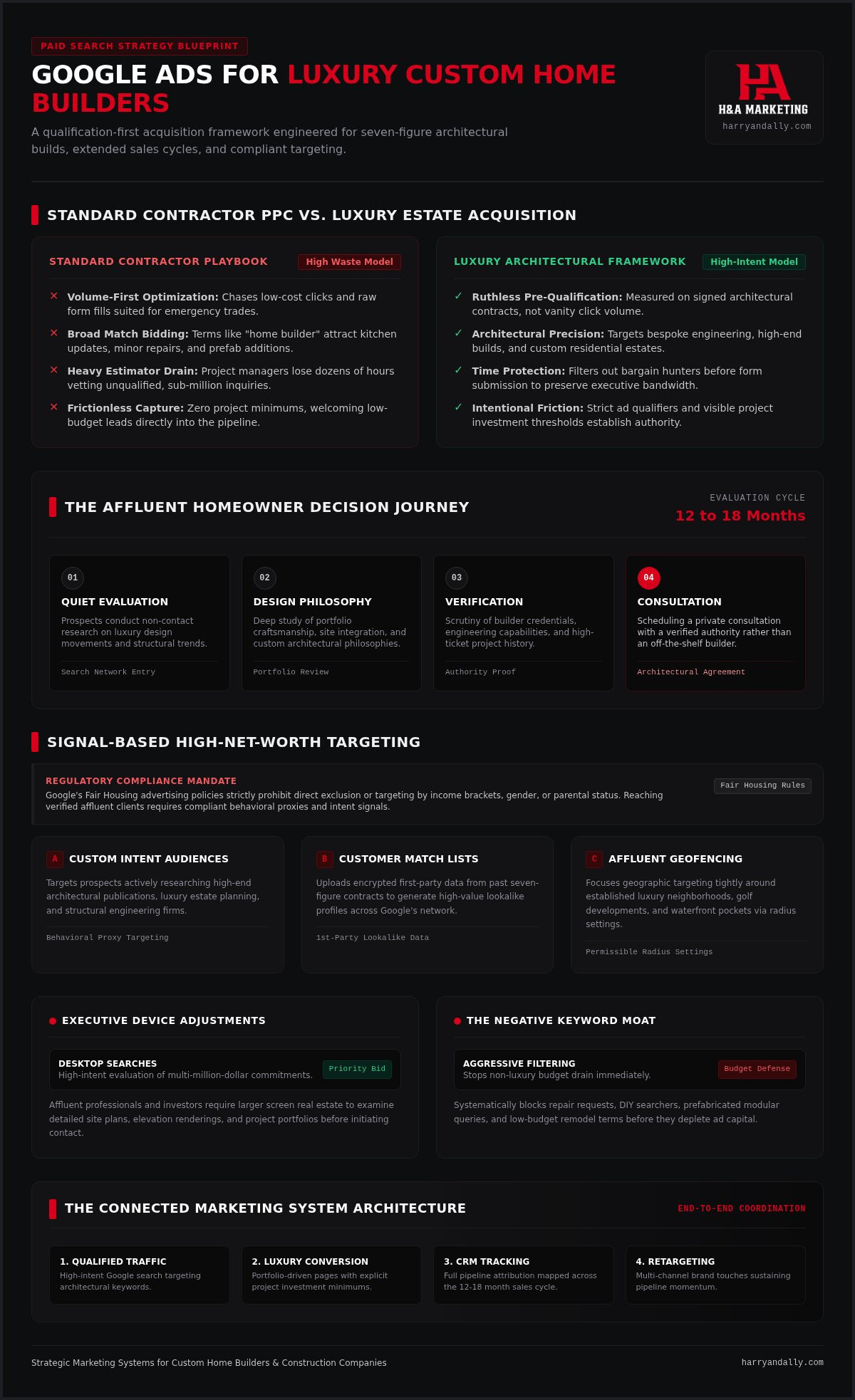
Most marketing agencies manage custom estate campaigns like standard trade services. They apply the same volume-based pay-per-click playbook used for emergency roofers or plumbers, optimizing for maximum clicks and low-cost form fills. When configuring Google Ads for luxury home builders, applying standard contractor formulas guarantees wasted spend. Production home builders rely on standardized floor plans and rapid turnarounds, whereas custom architectural estates involve bespoke engineering, multi-year timelines, and discerning clients. Treating both search intents as identical leads to broad match chaos, attracting homeowners searching for minor kitchen updates or prefabricated additions instead of multi-million-dollar builds.
The True Cost of Unfiltered Click Volume
Bidding on broad terms like "home builder" or "local contractor" invites high traffic with zero qualification. The primary financial drain isn't just the ad spend; it's the administrative toll. Your project managers and estimators lose dozens of hours every month fielding unqualified, sub-million-dollar inquiries. Effective lead generation for construction companies targeting the high-end market requires evaluating campaigns on signed architectural contracts rather than raw lead volume. Inserting intentional friction into the campaign structure, such as strict ad copy qualifiers and explicit project investment thresholds, filters out bargain hunters before they ever submit a form.
Understanding the Affluent Homeowner Decision Journey
A persistent misconception in the industry is that ultra-wealthy clients never search online. They do, but their evaluation patterns don't mirror standard consumer behavior across modern online advertising channels. The decision journey for a bespoke residential build typically spans 12 to 18 months. Affluent buyers quietly evaluate design philosophies, study portfolio craftsmanship, and verify credentials long before reaching out to schedule a private consultation. Winning with Google Ads for luxury home builders means meeting these prospects during their research phase with precise architectural messaging, positioning your firm as a verified authority rather than an off-the-shelf contractor.
Targeting High-Net-Worth Buyers on the Google Search Network
Precision targeting makes or breaks Google Ads for luxury home builders. Unlike standard consumer campaigns, luxury residential construction operates under Google's Fair Housing advertising policies. These regulations prohibit targeting or excluding searchers based on demographic categories like gender, parental status, or direct household income tiers. You cannot simply check a box to eliminate the bottom 50 percent of earners. Reaching verified affluent clients requires smarter, signal-based targeting built around behavioral proxies, intent signals, and platform settings.
Demographic and Household Income Layering
Because direct income exclusion is restricted under housing rules, strategic builders use intent-driven audience layers. Focus on in-market and custom affinity audiences tailored to custom residential architecture, luxury interior finishes, and real estate development. Research from Think with Google on attracting high-value customers highlights that affluent prospects prioritize detailed relevance and authority over generic volume. To isolate high-intent prospects, apply these compliant methods:
- Custom Intent Audiences: Target users researching high-end architectural publications, luxury estate planning, and structural engineering firms.
- Customer Match Lists: Upload encrypted first-party data from past seven-figure clients to create lookalike models across Google's network.
- Affluent Radius Geofencing: Focus geographic targeting tightly around established luxury neighborhoods, golf developments, and waterfront pockets using permissible radius settings.
Device and Schedule Adjustments for Executive Audiences
Device performance reveals sharp differences between casual browsers and serious investors. While mobile traffic drives high click numbers, affluent professionals and business owners typically evaluate multi-million-dollar commitments on desktop computers. Desktop searches offer the screen real estate required to examine site plans, elevation renderings, and project portfolios. Increasing desktop bid adjustments by 15% to 30% prioritizes users engaging in deep research over impulse mobile scrollers.
Dayparting schedules should align with executive working routines. Run your primary budgets Monday through Friday between 7:00 AM and 7:00 PM, capturing decision-makers at their desks. Suppress late-night hours where casual browsing spikes and qualified inquiries plummet. If you want to refine your paid strategy, reviewing your setup with a partner focused on lead generation for construction companies will pinpoint exactly where misconfigured settings are leaking your ad budget.
High-Intent Keyword Architecture vs. The Negative Keyword Moat
Most failed paid campaigns suffer from loose match types and weak exclusions. When managing Google Ads for luxury home builders, bid management is secondary to your search term hygiene. Bidding on broad terms like "home builders near me" allows Google's algorithms to match your ads with bargain remodels, prefabricated structures, and repair searches. Building a profitable campaign requires a disciplined keyword architecture balanced by an aggressive negative keyword moat that intercepts wasteful spend before a click occurs.
Selecting High-Value Architectural Keywords
Filter your traffic by targeting queries that only serious custom estate buyers use. Stick strictly to phrase match and exact match phrasing while your account establishes reliable baseline data. Broad match terms waste ad capital unless backed by extensive conversion history. Focus your ad groups around distinct search intents:
- Estate-Level Phrases:
[luxury custom home builder],"bespoke modern estate builder","high-end residential general contractor" - Architect-Led Intent:
"custom architectural home builder","architectural design build firms",[contemporary luxury home contractors] - Site-Specific Development:
"waterfront custom home builders","private estate construction firm"
Building an Impenetrable Negative Keyword List
Your negative keyword list protects your ad budget. Without one, you'll pay premium cost-per-click rates for searches with zero intent to build an estate. Load a master negative list at the account level before launching a single ad, containing terms such as:
- Budget and Low-Cost: cheap, affordable, low cost, modular, prefab, mobile, kit home, tiny house, cost per square foot
- Repairs and Trades: handyman, repair, drywall patch, roof leak, small remodel, kitchen refacing
- Employment and Education: jobs, careers, salary, apprenticeship, licensing exam, blueprints free, floor plans pdf, software
Prequalifying Through Ad Copy Messaging
High-converting ad copy should actively turn away unqualified searchers. State your minimum project budget directly in headline two or three, using phrases like "Builds Starting at $1.5M" or "Architectural Estates From $2M." Highlight bespoke craftsmanship, white-glove site management, and limited annual client intakes. Pair these statements with structured callout extensions that reinforce your company's pedigree. Integrating cohesive construction branding across your ad extensions signals verified authority, ensuring every click on your Google Ads for luxury home builders comes from a qualified prospect.
Engineering Luxury Landing Pages That Convert Affluent Searchers
Driving qualified clicks solves only half the equation. When executing Google Ads for luxury home builders, directing high-intent prospects to a generic website homepage destroys campaign returns. Affluent clients immediately notice friction, poor layout balance, or cheap design elements. A successful landing page functions as an editorial showcase, guiding high-net-worth visitors through a structured narrative of craftsmanship, exclusivity, and structural capability.
Every dedicated landing page must establish an intentional visual hierarchy:
- Hero Portfolio Asset: Lead with full-width, cinema-grade imagery or an architectural video loop of a completed estate.
- Defined Construction Scope: State clearly that your firm focuses exclusively on custom residential builds from specified budget baselines upward.
- Detailed Case Studies: Highlight architectural collaborations, structural complexities solved, and bespoke craftsmanship details.
- Third-Party Validation: Display regional builder awards, architectural journal features, and respected trade guild memberships.
- Private Consultation Intake: Position the contact mechanism as a confidential discovery session rather than a generic price estimate.
Visual Proof and Architectural Imagery Standards
Discerning clients judge your building standards by your digital presentation. Using standard stock photography or compressed cell phone snapshots destroys trust instantly. Your digital presence demands specialized commercial video and photo assets that capture natural stone textures, custom millwork, and refined structural proportions. Pair high-resolution galleries with immersive video tours that present the spatial flow of your completed builds. To keep bounce rates low, optimize retina-ready assets with modern compression formats so luxury pages load smoothly without degrading visual fidelity.
Designing the Prequalification Intake Form
Standard lead generation forms ask for simple contact details to maximize submissions. Luxury home campaigns require the opposite approach. You need an intake system that filters out casual tire-kickers while demonstrating respect for serious buyers' time. Replace the generic "Free Estimate" button with "Request a Private Architectural Consultation." Require prospective clients to specify their land acquisition status, preferred architectural style, target build timeline, and anticipated investment range starting at your project minimum.
These specialized landing environments perform best when anchored to custom architectural infrastructure. Building dedicated campaign assets through specialized custom home builder website design ensures your paid acquisition connects directly with a polished, high-ticket brand narrative.
Explore high-converting custom home builder website design
Integrating Paid Search into a Connected Marketing System
Paid search doesn't exist in a vacuum. Treating paid campaigns as isolated tactics is why many builders believe online advertising fails for seven-figure custom residences. When an affluent buyer clicks your ad, their decision journey is only starting. A standalone ad cannot maintain engagement across a year-long deliberation process without supporting assets. Running profitable Google Ads for luxury home builders requires an integrated system where paid traffic coordinates directly with CRM tracking, multi-channel retargeting, and sustained portfolio authority.
Tracking High-Ticket Pipeline Metrics Instead of Raw Clicks
Evaluating paid search on cost-per-click or raw form submissions misses the mark. In custom residential construction, the true benchmark is cost per signed architectural contract. Reaching that level of precision requires offline conversion tracking configured inside your CRM. Map these critical project milestones back to the search platform:
- Discovery Call Completed: Confirms the prospect owns land and meets your budget baseline.
- Architectural Agreement Signed: Validates high intent and advances the build into planning.
- Groundbreaking Contract Finalized: Delivers the ultimate attribution data back to your campaigns.
Feeding closed-loop milestones back into the ad platform allows smart bidding models to seek users who behave like verified estate buyers. This transforms paid clicks into a disciplined driver within your broader lead generation for construction companies framework.
Multi-Touch Retargeting and Long-Cycle Brand Nurturing
Because estate design and permitting cycles stretch over months, initial search traffic must be nurtured across multiple touchpoints. A prospect who visits your portfolio today might not finalize land acquisition for another six months. Deploy cross-channel retargeting across Meta and Google's visual networks to serve continuous proof of your craftsmanship, from jobsite walk-throughs to completed interior tours.
Pairing paid search with systematic SEO ensures your company claims primary visibility across both organic rankings and sponsored listings. When high-net-worth prospects research luxury construction techniques, your firm appears as the consensus choice across every channel. Managing Google Ads for luxury home builders within an integrated marketing structure keeps your business top of mind until the client is ready to break ground.
Turn Luxury Search Intent into Signed Architectural Contracts
Scaling a multi-million-dollar construction firm requires abandoning volume-obsessed contractor tactics. Mastering Google Ads for luxury home builders comes down to three operational disciplines: constructing an impenetrable negative keyword moat, targeting compliant intent signals rather than blunt demographics, and directing qualified searchers to portfolio-grade digital environments. When you anchor paid acquisition to real pipeline milestones rather than surface-level click metrics, your business breaks free from seasonal word-of-mouth cycles.
As a boutique partner focused exclusively on construction companies and custom builders, H&A Marketing unifies creative production, paid media, and CRM pipeline tracking into a single connected marketing system. You focus on exceptional craftsmanship and client relationships while we build the infrastructure that brings vetted seven-figure projects straight to your door.
Frequently Asked Questions
Do affluent clients actually search on Google for luxury custom home builders?
Yes, affluent buyers actively use search engines to vet custom builders, explore architectural styles, and verify credentials before initiating contact. While they often rely on architect introductions or private peer referrals, high-net-worth clients conduct discreet due diligence online. They inspect project galleries, review craftsmanship standards, and verify reputations. Running Google Ads for luxury home builders positions your brand during this critical research phase, ensuring you make the shortlist before private consultations begin.
How much should a custom home builder spend monthly on Google Ads campaigns?
Monthly ad spend depends on your geographic market competition and target project volume, but budgets should support meaningful search impression share. High-end residential keywords carry higher click costs due to commercial competition. Rather than spreading a modest budget thin across dozens of generic terms, successful builders allocate sufficient capital to dominate three to five high-intent keyword clusters. This focused approach ensures consistent visibility among serious estate planners without exhausting daily caps prematurely.
What is the best keyword match type for high-end residential construction?
Phrase match and exact match are the most reliable options for high-end residential builders. Broad match gives Google's algorithm excessive leeway, often pulling in searchers looking for mobile home installations, drywall repair, or DIY construction blueprints. Utilizing exact match for terms like [bespoke estate builder] and phrase match for phrases like "custom architectural home builder" gives you complete control over your ad spend while blocking irrelevant search intent.
How do we prevent low-budget remodeling leads from clicking our paid search ads?
You filter out unqualified searchers by combining strict negative keyword lists with transparent project minimums in your ad headlines. Add terms like "cheap," "small repair," "addition," and "remodel" to an account-level negative list. In your ad copy, state your project parameters plainly, such as "Custom Estates From $2M." Displaying real financial thresholds turns away budget-conscious searchers before they click, protecting your budget for qualified inquiries.
How long does it take for a luxury builder Google Ads campaign to generate signed contracts?
Expect a timeline of six to eighteen months from the initial click to an executed construction agreement. While well-targeted campaigns often generate discovery calls within the first 30 to 60 days, bespoke architectural builds require extensive feasibility studies, architectural drafting, and site engineering. Managing Google Ads for luxury home builders requires treating paid traffic as the starting point of an extended pipeline rather than an overnight transaction.
Should luxury home builders bid on their competitors' brand names in paid search?
Bidding on competitor brand names is generally inefficient for boutique luxury builders. When affluent clients search for a specific builder by name, they are usually looking for a direct referral or an ongoing project update. Intercepting these searches leads to inflated click costs, lower Quality Scores, and high bounce rates. Direct your capital toward non-branded architectural intent and estate-level keywords where searchers are actively comparing options.
What conversion rate should a custom home builder expect on a dedicated landing page?
Dedicated landing pages for high-ticket custom builders typically achieve conversion rates between 3% and 8%. Because these pages feature intentional qualification friction, like required budget baselines and land ownership questions, conversion percentages will be lower than standard contractor sites. However, every completed inquiry represents a vetted, high-value prospect rather than a casual estimate shopper, yielding a substantially higher return on your marketing investment.
