
Hire a Construction Marketing Consultant to Scale Leads

Article by
Harry Stanley III
Harry Stanley III is a construction marketing strategist and fractional CMO at H&A Marketing. He has helped construction companies grow through website strategy, SEO, paid advertising, branding, lead generation, CRM systems, and professional content. His past work includes helping Meraki Solar generate an additional $3.7 million in revenue in his first year and supporting American Builders as a fractional CMO. Today, Harry works directly with custom home builders and construction companies to build marketing systems designed to generate qualified leads and measurable growth.
What if more marketing activity isn’t the answer to a thin project pipeline? If your website, social media, and lead generation aren’t connected to sales priorities or the work your team can take on, adding another tactic may create more noise. A construction marketing consultant should link those efforts to the projects you want, the buyers you need to reach, and the long decisions that shape construction sales.
Marketing should do more than report clicks or inquiry counts. A more useful measure is whether the right prospects enter the pipeline and progress toward a real opportunity. This guide explains what a consultant should do, how consulting differs from coaching and managed execution, and how to choose a working model that fits your team. You’ll also learn how to align strategy, creative, traffic, and lead capture, then connect measurement to lead quality, project priorities, and capacity. The goal is a coordinated approach to growth, not activity for its own sake.
Key Takeaways
- A construction marketing consultant should tie marketing decisions to the projects your business wants and can take on.
- Compare consulting, coaching, in-house ownership, and managed execution to see which model fits your team’s needs.
- Connect your website, SEO, traffic, creative, and lead capture around shared business priorities.
- Use a flexible first phase to review current activity, set priorities, launch focused work, and learn from meaningful signals.
- Coordinated marketing capabilities can support construction companies and custom home builders through a longer buying journey.
Why a Construction Marketing Consultant Must Understand Your Pipeline
A construction marketing consultant should connect marketing choices to business goals, project fit, and the work your team has capacity to deliver. Start with the pipeline: which projects you want, where qualified opportunities come from, and what happens after an inquiry arrives. Those details help reveal whether the issue is visibility, lead quality, follow-up, or capacity.
A busy inbox can look like progress, but form submissions alone don’t show whether prospects match your services, budget expectations, schedule, or preferred project type. A custom home builder seeking premium projects has different priorities from a commercial contractor pursuing a specific type of work. Marketing should help the right prospects recognize that fit, then make it easier for your team to understand their needs and respond.
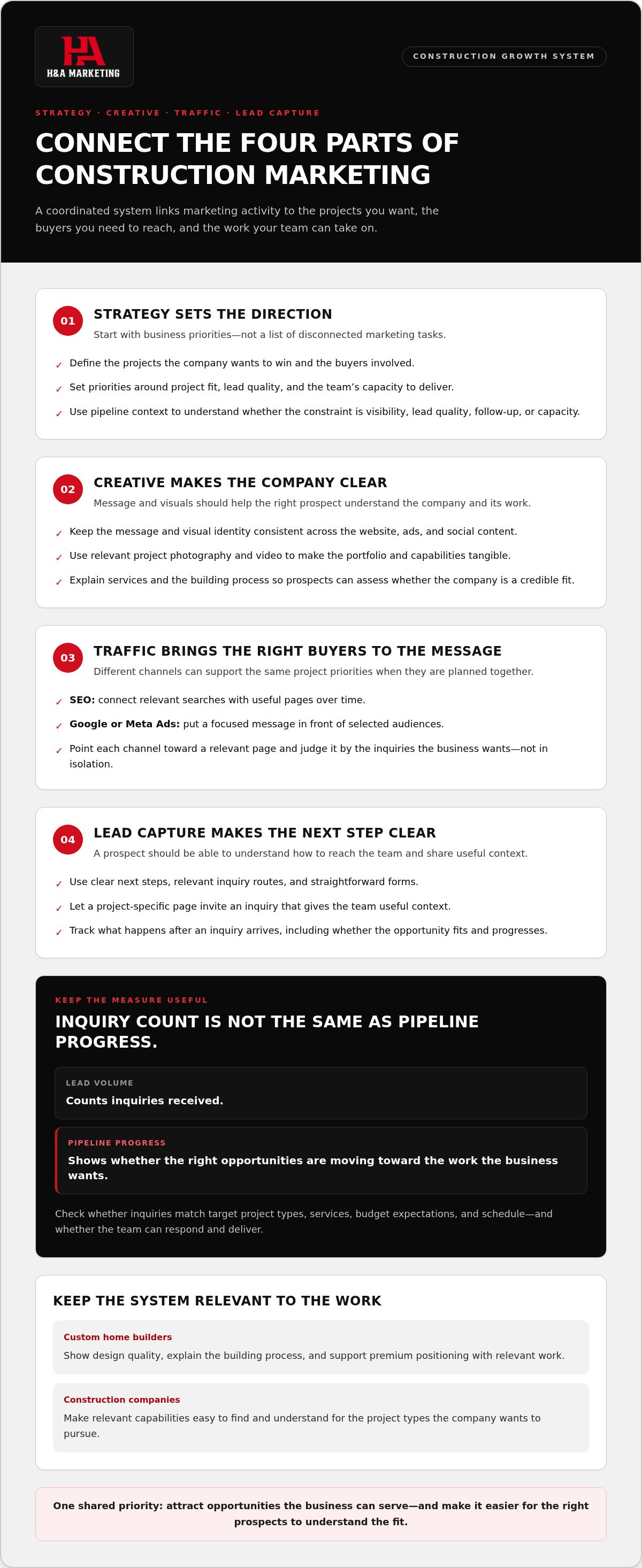
Lead volume counts inquiries; pipeline progress shows whether the right opportunities are moving toward the work your business wants.
Construction decisions often involve substantial planning, multiple stakeholders, and extended consideration. Buyers may review your work, compare providers, and return with questions before they’re ready to talk. A steady, trustworthy presence matters throughout that journey. Clear service information, relevant project examples, and dependable follow-up help prospects build confidence and understand what working with you involves. For a broader look at the industry’s planning and procurement context, see this Construction industry overview.
What makes construction marketing different from generic marketing?
Effective messaging reflects the project type, buyer priorities, and work the company wants to win. Homeowners may focus on design preferences, communication, and confidence in the building process. Commercial buyers may have different decision paths, with more people involved and distinct project requirements. A portfolio that highlights relevant work, explains the process, and clearly describes services helps each audience assess whether your company is a credible fit. A well-planned construction lead generation approach can support those messages by attracting inquiries aligned with your priorities.
When does a construction company need outside marketing guidance?
Outside guidance may help when inquiries are inconsistent, your positioning feels unclear, or website, social, and lead-generation work pull in different directions. First, separate a marketing communication problem from a capacity or sales-process issue. If qualified prospects aren’t finding or understanding your offer, messaging and visibility may need attention. If opportunities are arriving but response time or project capacity is the constraint, more lead volume may not help. Set goals around fit, project quality, and operational capacity, not just the number of forms submitted.
That distinction gives marketing a practical job: attract opportunities the business can serve and make the next step clear. It also gives owners and sales teams a useful way to evaluate activity. Check whether inquiries match target projects and progress through the company’s decision process. This creates a stronger basis for choosing what to improve, rather than adding tactics simply to appear busier.
What a Construction Marketing Consultant Should Connect
A construction marketing consultant should connect four parts of the growth system: strategy, creative, traffic, and lead capture. Strategy sets the direction. Creative gives the company a consistent message and visual identity. Traffic helps the right buyers discover it. Lead capture creates a clear next step and a way to understand what happens after someone reaches out. Plan these parts together so each channel supports the same business priorities instead of operating as a separate task.
How strategy, creative, and traffic work as one system
Start with the work the company wants to win, the buyers involved, and its growth priorities. A custom home builder focused on premium positioning may need to showcase design quality and explain its process. A construction company pursuing a specific project type may need to make relevant capabilities easy to find and understand. Those choices shape the message, visual direction, and pages or campaigns built to attract attention.
Branding, photography, and video should reinforce that message wherever a prospect encounters the business. Project imagery can make a portfolio feel tangible, while visual content can also support social posts, website pages, and campaign creative. Keep the presentation consistent: a buyer who sees an ad, visits the website, and then reviews social content should get a coherent picture of the company and its work.
Traffic channels have different roles, but they can share a goal. SEO helps connect relevant searches with useful pages over time. Google or Meta Ads can put a focused message in front of selected audiences. Judge neither channel in isolation from the landing page and the type of inquiries the business wants. A construction marketing consultant can coordinate these choices so investment in creative and traffic points toward the same opportunity.
Why lead capture and measurement belong in the plan
Even strong visibility can lose momentum if a prospect can’t tell what to do next. Clear calls to action, relevant inquiry routes, and straightforward forms make the next step easier to understand. For example, a page about a particular type of project can invite an inquiry that gives the team useful context, rather than sending every visitor to a generic contact route. H&A’s construction lead generation work connects lead capture with the broader marketing system.
Measurement should follow the inquiry beyond the initial form. Record where it came from, whether it fits the company’s priorities, and whether it progresses through the sales process. This helps distinguish a channel that brings attention from one that contributes to relevant opportunities. It also gives the sales team and marketing partners a shared view of what’s working, where prospects lose momentum, and what may need adjustment.
Aligned channels create a clearer path from discovery to inquiry, with each interaction helping the right prospect take the next step. That path is easier to improve when strategy, message, creative, traffic, and follow-up are treated as connected parts of one plan.
Consultant, Coach, or Agency: Which Construction Marketing Model Fits?
The right marketing model depends on what your company needs and what your team can take on. A construction marketing consultant may set direction, but advice alone won’t create campaign assets or manage channels unless those tasks are part of the engagement. Coaching, in-house ownership, and managed execution place different responsibilities on your business. Define those responsibilities early so the plan doesn’t stall between recommendations and action.
How advice, coaching, and managed marketing differ
Consulting provides strategic direction. Coaching builds your team’s ability to make and carry out marketing decisions. In-house ownership puts planning and delivery with your employees. Managed execution assigns agreed marketing work to an external partner. Some engagements combine these approaches, so clarify who owns each task rather than relying on the model’s label.
| Working model | Direction and assets | Channels and inquiry tracking |
|---|---|---|
| Advice-only consulting | The consultant recommends priorities; your team or another partner creates assets. | Your team manages channels and tracks inquiries unless those tasks are separately assigned. |
| Coaching | The coach develops your team’s skills; your team creates and approves the work. | Your team manages channels and inquiry tracking, applying what it learns. |
| In-house ownership | An employee or internal team sets direction and creates or coordinates assets. | Your team operates channels and maintains inquiry records. |
| Managed execution | An agency and your team align on direction; the agency handles agreed creative work. | The agency manages agreed channels, while inquiry tracking and sales follow-up are assigned explicitly. |
This distinction addresses a common concern: consulting can end with a list of recommendations and no one responsible for carrying them out. Advice-only consulting can still be effective when your company has the time and people to implement the plan. If your team lacks that capacity, coaching or managed execution may fit better, or the engagement can combine strategic guidance with hands-on delivery.
What to assess before committing to a working model
Start with the actual gap. Do you need clearer market positioning, more capacity to create and publish marketing, or ongoing coordination across several activities? Then map the work: who supplies project details and photos, who approves creative, who manages channels, and who responds when an inquiry arrives? Long sales cycles make that last responsibility especially important. Marketing can attract interest, but internal follow-up helps determine whether a prospect is a good fit and moves forward.
Choose a model your team can support, not one that looks comprehensive on paper. Agree on the activities each party owns and the indicators you’ll review, such as inquiry sources, fit with target projects, or movement through the sales process. Treat these as ways to assess the work and adjust priorities, not promises of a particular lead or revenue outcome. The best arrangement connects a clear plan to accountable execution while respecting your company’s capacity and the projects it wants to pursue.
How to Build a Practical First Phase With a Construction Marketing Consultant
A productive first phase doesn’t need a rigid calendar or a promise of instant results. It needs a clear sequence, shared responsibilities, and room to adjust as the team learns. A construction marketing consultant can turn business priorities into practical steps, then review early signals before expanding the plan.
Use this sequence as a starting point, not a fixed formula:
- Assess current marketing. Review your website, brand presentation, search visibility, active campaigns, and how inquiries are handled.
- Set priorities. Agree on the project types and client fit the business wants, along with what its current capacity can support.
- Align assets. Connect the message, creative, website pages, and inquiry routes to those priorities.
- Launch focused work. Begin with a manageable set of activities rather than trying to change every channel at once.
- Review signals. Consider inquiry quality, source information, and follow-up progression, then adjust the next steps.
Start with business goals, offer, and current marketing
Begin with the business, not a channel checklist. Clarify which projects are a strong fit, which services should be more visible, and how much work the company can take on. Then identify the main constraint. If buyers can’t understand the offer, positioning or website content may need attention. If relevant prospects aren’t finding the company, search visibility could be a priority. H&A’s construction SEO work can support that part of the review.
Also map the inquiry path. Check what information a prospect sees, where they submit an inquiry, who receives it, and how the team follows up. This can reveal whether the biggest issue is marketing communication, lead handling, or limited project capacity. Separate urgent barriers from useful improvements that can wait. That keeps the first phase focused and avoids spreading effort across tasks that don’t address the main constraint.
Set priorities and review progress without false promises
Choose a small set of workstreams tied to the agreed business goals. For example, a company may prioritize making its core project offer clearer online and improving the path from a relevant search to an inquiry. Agree on who supplies project details, who approves materials, and who follows up with prospects. These practical decisions help keep work moving without assuming every company has the same resources or sequence.
Review leading indicators alongside sales follow-up. Track where inquiries originate, whether they fit the target work, and whether the team makes contact and advances the conversation. Channel signals can help explain what prospects respond to, but they don’t guarantee a project win. Use the review to ask useful questions: Are inquiries relevant? Are they reaching the right person? Is follow-up happening consistently? Adjust the plan based on what the answers reveal.
A first phase should create clarity and momentum, not a false deadline. Discuss your construction marketing priorities with H&A Marketing.
How H&A Marketing Acts as a Construction Growth Partner
Construction companies need more than a collection of disconnected marketing tasks. H&A Marketing works with builders and construction businesses as a growth partner, coordinating strategy with hands-on marketing capabilities. The focus is a connected system: clarify what the business wants to be known for, build the creative and digital assets to support that position, attract relevant attention, and make it easier for prospective clients to inquire.
That coordination can support different goals. A custom home builder may want a more polished, premium presentation that helps prospective clients understand the quality and character of its work. A construction company pursuing pipeline growth may need stronger visibility for priority services and a clearer way to capture relevant inquiries. In both cases, marketing should reflect the projects the team wants and can deliver, not simply chase more activity.
A connected marketing system for builders and construction companies
H&A brings together website design, logo design and branding, SEO, lead generation, social media management, and professional photo and video production. Each capability has a role, but the value comes from how they work together. Brand messaging guides the website and campaign creative. SEO and social media help bring that message to potential buyers. Lead generation connects their interest to an inquiry path the business can manage.
The website often anchors that experience. It gives prospects a place to understand services, review relevant work, and decide what to do next. H&A’s construction website design connects brand presentation with clear project information and lead capture. Professional photos and video can show finished work and reinforce the company’s presentation across its portfolio and marketing channels.
As a construction marketing consultant and growth partner, H&A helps keep these activities aligned with the company’s priorities. Look beyond whether a channel is active. Ask whether the message, creative, traffic, and inquiry process support the same business direction. Coordinated lead generation can then be considered in the context of project fit and pipeline clarity, rather than as a standalone count of submissions.
Take the next step with a clear business conversation
A useful starting conversation doesn’t require a polished marketing brief. Bring a clear picture of the projects you want to pursue, the types of clients who are a strong fit, and the constraints affecting growth. It also helps to identify what’s already working, where marketing feels fragmented, and who on your team handles inquiries and follow-up.
From there, H&A can shape an approach around your priorities instead of forcing your business into a one-size-fits-all package. The work may call for stronger positioning, updated website assets, improved search visibility, lead generation, social media support, or visual content. The right mix depends on your goals and capacity. A clear plan creates a practical basis for coordinated work without promising a specific number of leads or a particular business outcome.
Request a free quote from H&A Marketing to discuss your construction marketing priorities and a tailored approach.
Make Your Next Marketing Move Count
The next step isn’t to add more activity. Choose a direction your team can stand behind and build from there. Decide what kind of work you want to be known for, what your business can take on, and what support will help you move forward. Those answers give a construction marketing consultant a practical foundation for shaping work around your business, not a generic growth formula.
Progress comes from deliberate choices, followed by learning from the conversations and opportunities they create. Keep the focus on projects that make sense for your company and the trust you want to build with prospective clients. With the right partner, marketing can become a more considered part of how your business moves forward.
Request a free quote from H&A Marketing to start a clear conversation about your goals and next steps.
Frequently Asked Questions
What does a construction marketing consultant do?
A construction marketing consultant helps a builder connect marketing decisions to business goals. They may review how the company presents its work, which buyers it wants to reach, and where prospects lose clarity before making an inquiry. The role can involve advice, coaching, or hands-on support, depending on the agreement. For example, a consultant might recommend revising a project page so it speaks to a target client and gives visitors a useful next step.
How is a construction marketing consultant different from a marketing agency?
A consultant often focuses on guidance, while an agency can also carry out marketing work. The distinction depends on agreed responsibilities, not just the title. H&A Marketing pairs construction-focused direction with website design, branding, SEO, lead generation, social media management, and visual production. A company with internal capacity may need strategic input; one without it may benefit from coordinated hands-on support for its marketing activities.
Can a construction marketing consultant help generate qualified leads?
Yes. A consultant can help shape marketing to attract inquiries that better match the company’s target work, though no approach can guarantee a particular lead or project outcome. For example, if a builder wants more inquiries about custom homes, its website content and campaigns can make that focus clearer. Lead quality also depends on how the business defines a good-fit project and what happens after an inquiry arrives.
How do I know if my construction company needs a marketing consultant?
Consider outside guidance if you can’t explain which marketing efforts support your business goals, or if your team is unsure which projects its message should attract. A practical sign is repeated disagreement about whether to update the website, invest in search visibility, or improve inquiry handling. Before adding marketing work, identify whether the main challenge is unclear communication, limited delivery capacity, or a sales process that needs attention.
What should a construction marketing plan measure besides lead volume?
Track whether inquiries match your preferred project type, service, and client profile. Also note the source of each inquiry, whether your team made contact, and what stage it reached in the sales conversation. These details help reveal whether marketing is attracting relevant prospects or simply increasing activity. A short, consistent record shared by marketing and sales can make patterns easier to spot and decisions easier to explain.
How long does it take for construction marketing to show progress?
There isn’t one reliable timeline for every construction company. Results depend on the work being done, the channels involved, the starting point, and how long buyers take to make decisions. A paid campaign may provide early signs of audience response, while search visibility and trust-building content can take longer to develop. Agree on what signals to review and when, then use those findings to refine the plan without assuming a fixed outcome.
Should custom home builders hire a specialist construction marketing consultant?
A specialist can be useful if a custom home builder needs its marketing to reflect the quality, design approach, and client experience it wants to be known for. Buyers may compare portfolios and consider how a builder communicates before starting a conversation. A consultant familiar with construction can help make those details clearer across the builder’s online presence. The right fit depends on the builder’s goals and the support its team needs.
