
Hire the Best Marketing Agency for Custom Home Builders

Article by
Harry Stanley III
Harry Stanley III is a construction marketing strategist and fractional CMO at H&A Marketing. He has helped construction companies grow through website strategy, SEO, paid advertising, branding, lead generation, CRM systems, and professional content. His past work includes helping Meraki Solar generate an additional $3.7 million in revenue in his first year and supporting American Builders as a fractional CMO. Today, Harry works directly with custom home builders and construction companies to build marketing systems designed to generate qualified leads and measurable growth.
More leads don’t automatically mean better projects. A marketing agency for custom home builders should understand the difference between an inquiry and a qualified homeowner whose goals, budget, and project fit your work. If your marketing brings in activity but doesn’t show which efforts are creating real opportunities, the pieces may not be working together.
An agency should do more than deliver a list of services. Your portfolio, website, search visibility, and follow-up should work together to communicate the quality and individuality of your homes, while helping you understand which inquiries may turn into projects.
This guide explains how to compare an agency’s construction experience, creative approach, lead-generation strategy, and measurement practices. You’ll learn what to look for in premium positioning, local SEO, website design, and photo and video content, as well as how to assess whether marketing activity connects to qualified leads and pipeline. Use it to find a partner that supports your business strategy, not just another set of disconnected tactics.
Key Takeaways
- Choose a marketing agency for custom home builders based on how well it connects your positioning, lead generation, and measurement.
- Make craftsmanship, building process, and project fit clear so prospective homeowners can judge whether your work suits their goals.
- Look for a coordinated approach where your website, search visibility, creative, and lead capture support the same strategy.
- Compare agencies by their construction experience, strategic fit, communication, and evidence of how they measure marketing activity.
- Prepare for a productive partnership by defining ideal projects, gathering useful assets, aligning stakeholders, and setting a review rhythm.
Why a Marketing Agency for Custom Home Builders Must Sell Trust Before It Sells a Lead
A custom home is a high-consideration decision, not an impulse purchase. Prospective clients need to understand what you build, how you work, and whether your approach fits their goals before they’re ready to talk. Marketing that asks for an inquiry before answering those questions may generate activity without building confidence.
Premium positioning takes more than polished language. It should make your craftsmanship visible, explain your process in plain terms, and help homeowners recognize which projects are a good fit. An advertising agency can coordinate different marketing functions, but for custom builders, those functions need to reflect the realities of the work and the decisions homeowners are making.
How homeowners evaluate a custom home builder
Homeowners often move from gathering ideas and exploring styles to comparing builders, reviewing past work, and deciding whom to contact. Your website and portfolio should help them make those comparisons. Organize project photos and descriptions so visitors can see the range of your work, understand the details that distinguish it, and identify which types of projects align with your expertise.
Consistency matters throughout that journey. Search results, website copy, and visual content should tell a coherent story about your standards and process. If a search listing promises one kind of experience but the portfolio or website suggests another, prospects have to work harder to understand your offer. Clear, consistent information gives them a stronger basis for deciding whether to reach out.
Why generic lead volume is a weak success measure
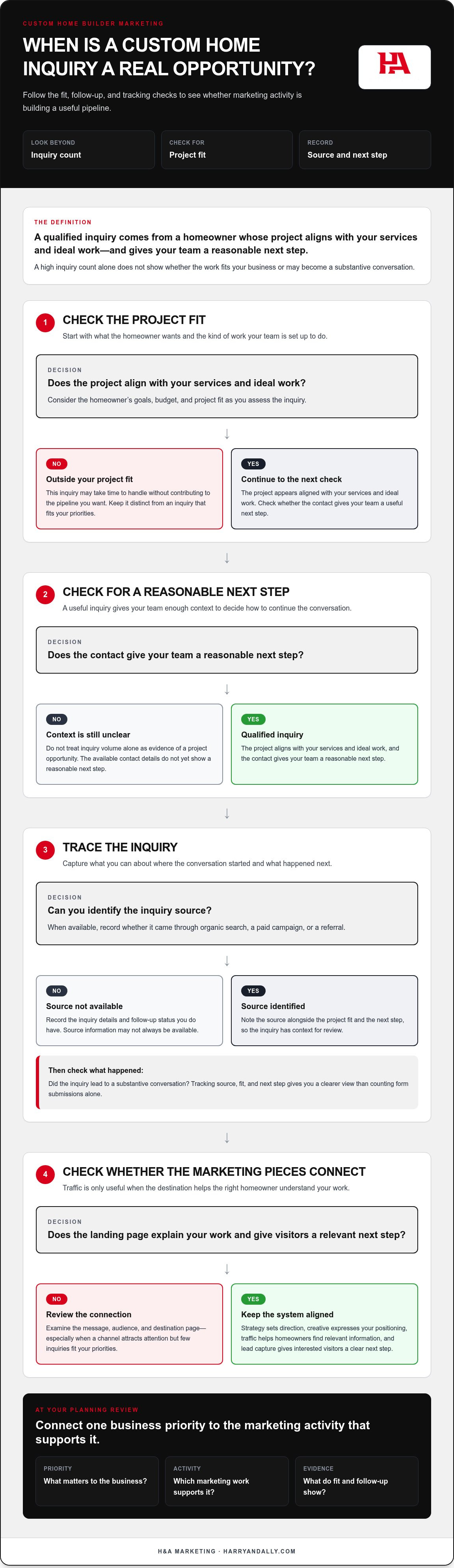
A high inquiry count can look encouraging, but it doesn’t tell you whether those people want the kind of home you build or are ready for a useful conversation. An inquiry outside your services or project focus may take time to handle without contributing to the pipeline you want.
A qualified custom-home marketing inquiry comes from a homeowner whose project aligns with your services and ideal work, and whose contact gives your team a reasonable next step.
Make reporting more useful by tracking each inquiry’s source, fit with your project criteria, and next step. For example, note whether someone came through organic search, a paid campaign, or a referral, then record whether the inquiry led to a substantive conversation. This won’t answer every attribution question, but it gives you a clearer view than counting form submissions alone. The same focus on lead quality and pipeline applies to lead generation for construction companies.
When comparing a marketing agency for custom home builders, look for a plan that connects trust-building content with a clear path to inquiry. The goal isn’t simply to attract more attention. It’s to help the right homeowners recognize your value and make an informed first move.
What a Connected Marketing System Does for Custom Home Builders
A connected marketing system coordinates strategy, creative, traffic, and lead capture around your business priorities. Strategy sets direction. Creative expresses your positioning. Traffic helps homeowners find relevant information. Lead capture gives interested visitors a clear next step. Each part has a role, and each should reinforce the others instead of leaving you to connect separate marketing tasks.
A connected system links each marketing activity to the next, while a list of services leaves the connections up to you. For example, increased site traffic has limited value if the landing pages don’t explain your work or help visitors take a relevant next step. The system should make the purpose of each activity clear.
How strategy, creative, and traffic work together
Positioning guides the message across your website, SEO topics, social content, and campaigns. If you want to be considered for a particular type of custom project, focus content on the expertise and services relevant to that work. Professional photo and video can support the message by showing completed projects and giving context to your building process.
Your website organizes these materials and makes them useful to visitors. Thoughtful custom home builder website design can give portfolio work, service details, and inquiry options a clear structure. Local SEO matters too. Keep your Google Business Profile accurate, and make sure relevant location pages reflect the areas you serve. This helps nearby homeowners find information that matches your business.
How lead capture and tracking support a long sales cycle
Make the inquiry path easy to find, then record where each conversation began when that information is available. A CRM or another tracking system can help your team keep inquiry details, source information, and follow-up status organized. For a long sales cycle, include practical details such as the project type, fit with your services, and the agreed next step, so the conversation doesn’t lose context between follow-ups.
Review that information alongside marketing activity. If a channel attracts attention but few inquiries that fit your priorities, examine the message, audience, and destination page. Search visibility is one part of the system, and SEO for construction businesses can support discovery when it’s aligned with useful content and clear next steps.
At your next planning review, connect one business priority to the marketing activities that support it. Then decide what information you’ll use to assess progress, such as inquiry source, project fit, or the next step in your sales process.
How to Compare Marketing Agencies for Custom Home Builders
A proposal can look impressive and still miss what your business needs. Compare agencies by how well they understand custom-home projects, connect marketing activities, and report on progress, not by how many services appear on a page. The right marketing agency for custom home builders should explain how its plan reflects your work, ideal projects, and the way homeowners make decisions.
Use the same criteria for each agency. This keeps the comparison focused on fit and evidence rather than presentation alone.
| What to compare | What strong evidence looks like |
|---|---|
| Construction experience | Relevant work for builders or construction businesses, with a clear explanation of the marketing challenge and the agency’s role. |
| Strategic fit | A plan tied to your project types, ideal clients, brand position, and business priorities, rather than a generic channel checklist. |
| Service coordination | A clear connection between website content, search visibility, creative, traffic, and inquiry paths. |
| Measurement | Reporting that distinguishes activity from inquiries and tracks lead quality or pipeline progression when the available data allows. |
| Communication | Defined points for updates, decisions, and discussion of priorities, with responsibilities understood on both sides. |
Questions that reveal industry and project-fit understanding
Look for a specific explanation of how the agency’s strategy would reflect your work. Can the team describe how it would present your portfolio, communicate your process, and shape content around the projects you want? Relevant construction experience is more useful than a broad claim of serving every industry, especially if the agency can explain how its approach changes for custom builders rather than treating every contractor the same.
Evidence should be concrete and properly framed. A documented example can explain the client’s starting point, the work completed, and what was observed, without implying that the same outcome is guaranteed for you. A promise of more leads, stronger visibility, or better performance isn’t proof by itself. Look for clear scope and context.
What useful reporting and accountability should clarify
Good reporting helps you see what happened and what the team recommends next. It may connect campaign or search activity to inquiries, identify their sources, and include notes on fit and progression when those details are available. Rankings, clicks, and inquiry totals can be useful signals, but none alone confirms that marketing is contributing to the opportunities your business values.
Communication matters as much as the report. The partnership should make clear how progress is shared, how decisions are explained, and how priorities are revisited when the evidence points to a change. That gives you a practical basis for judging agency fit before committing to a plan.
How to Prepare for an Agency Partnership Without Wasting the First Month
A productive agency partnership starts with useful context, not a perfect marketing plan. You don’t need every asset organized or every goal settled before the first strategy conversation. Clear priorities do help an agency understand what your business needs, what’s already working, and where marketing support could make a difference.
Whether you’re building your marketing from the ground up or improving existing work, prepare a shared starting point:
- Clarify business goals. Identify the priorities marketing should support, such as attracting projects that fit your capabilities or improving the quality of inquiries.
- Describe ideal projects. Note the kinds of homes, services, and client relationships that match your team’s strengths and current priorities.
- Gather useful materials. Collect brand guidelines, project photos and videos, website information, and any available marketing reports.
- Align the people involved. Decide who will share project knowledge, review creative, approve decisions, and provide feedback.
- Agree on a review rhythm. Set regular points to discuss activity, inquiry quality, and whether business priorities have changed.
This preparation isn’t an onboarding formula. It gives an agency enough context to make recommendations that reflect your projects instead of defaulting to generic tactics. If you’re starting fresh, focus on goals, project fit, and the materials you already have. If marketing is underway, include what’s been tried, what the team has learned, and which questions your reporting hasn’t answered.
What builders should bring into the first strategy conversation
Bring a concise picture of your business: project types, priority services, client-fit considerations, and current goals. Add existing brand materials, project photography, website information, and available marketing data. If your team tracks inquiry sources or follow-up steps, explain how. Gaps are useful context too. Knowing what isn’t measured helps the agency recommend a practical way to improve visibility.
How to keep collaboration practical and accountable
Choose a primary point of contact and clarify who has input or approval responsibilities. Agree on how feedback will be collected so creative and strategy decisions don’t stall across separate conversations. Then use a regular review rhythm to discuss what’s been done, the quality of inquiries, and what should come next. Your team brings project expertise; the agency coordinates marketing execution.
Keep the working relationship focused on shared decisions. For example, if a campaign attracts inquiries that don’t match your project priorities, bring that feedback into the next review. The agency can use it to revisit messaging or the inquiry path, while your team explains what makes a project a good fit. That exchange keeps marketing grounded in your business reality.
How H&A Marketing Supports Custom Home Builders With a Connected System
For a custom builder, marketing needs to do more than make a portfolio look polished. It should help homeowners understand the quality of your work, see how your approach fits their goals, and find a clear path to start a conversation. H&A Marketing brings construction-focused services together as a connected marketing system, coordinating strategy, creative, traffic, and lead capture around your business priorities.
The work can include website design, branding, search engine optimization, lead generation, social media management, and professional photo and video. These services have distinct jobs, but their value comes from supporting the same story. Your brand sets the tone. Your website presents your work and process. Search and social content help homeowners find and explore your business. Lead capture creates a route from interest to inquiry.
What working with a construction-focused marketing partner can support
Aligned marketing helps keep your brand presentation consistent wherever a prospective homeowner encounters your business. A project portfolio can show more than finished rooms. Paired with useful descriptions and process-focused content, it can help visitors understand your design sensibility, craftsmanship, and the types of work you take on.
A polished website gives those materials structure. Social content and photo or video can extend the story, while search visibility helps connect relevant information with homeowners researching builders. For a longer decision journey, this gives prospects more opportunities to review your work and learn about your approach before reaching out. The aim is to support trust and better-informed inquiries, not guarantee a particular lead count or sales result.
Coordination also makes the work easier to assess. Rather than treating branding, content, search visibility, and lead generation as separate deliverables, the system connects them to shared priorities. Reporting and conversations can then consider not only activity, but also where inquiries began and whether they appear relevant to the projects you want to pursue, when that information is available.
A practical next step for builders considering H&A
Before starting a conversation, choose the marketing priority that matters most right now. You might need a stronger portfolio presentation, clearer brand messaging, more useful search visibility, or better insight into inquiry quality. You don’t need to arrive with a complete plan. A clear starting priority gives the discussion direction, while your knowledge of your projects and clients helps shape recommendations.
H&A Marketing serves construction businesses with a coordinated approach designed to support builders while they focus on construction. If you’re comparing a marketing agency for custom home builders, consider whether its services connect to your business needs and whether the partnership can adapt as priorities change. Learn more about H&A Marketing’s construction-focused marketing services.
Make Your Next Marketing Decision With Confidence
Choose your next marketing move based on the business priority you want it to support. A focused conversation can turn that priority into a practical direction for your custom home building business.
When you’re ready, choose a marketing agency for custom home builders that can connect its recommendations to your goals and project priorities.
Frequently Asked Questions
Is a marketing agency for custom home builders different from a general marketing agency?
It can be, especially if the agency understands builder portfolios, project complexity, and the long path from early research to a serious inquiry. That context helps shape useful content, such as explaining how your design-build process works or showing the details behind a completed home. A general agency may also have relevant experience, so focus on whether the team can apply its strategy to your project types and homeowner expectations.
What should custom home builders measure besides the number of leads?
Measure whether inquiries fit your services, where they came from, and what happens after first contact. For example, distinguish someone asking about a project that matches your capabilities from someone seeking work outside your scope. If your team records consultations or next steps, use that information to understand progression. The most useful measures depend on your goals and the data you can reliably collect, not a universal reporting template.
Can a marketing agency help a custom home builder attract higher-quality inquiries?
It can support better project fit by making your strengths and services clear before a homeowner reaches out. Positioning, relevant portfolio content, and straightforward project information help prospective clients understand what you build and whether their goals align. Campaign messaging can reinforce that clarity rather than draw broad interest without context. These efforts can support more relevant conversations, but they can’t promise a particular inquiry volume or business result.
How long does SEO take to support a custom home building business?
SEO develops over time, and there’s no reliable fixed timeline for every builder. Progress can vary with local competition, the condition and content of your website, and the consistency of the work. A useful plan identifies the pages and search topics that matter to your business, then reviews visibility and relevant inquiry activity over time. Treat rankings as one signal, not a guaranteed outcome or a complete measure of value.
Should a custom home builder use one agency for every marketing service?
One partner can make coordination easier by connecting brand messaging, website updates, search work, creative, and lead capture. That can reduce the burden of aligning separate activities internally. Still, the right scope depends on your priorities, current resources, and what you already have in place. A builder with a strong in-house team may need a different arrangement from one looking for broader marketing coordination.
What should a custom home builder prepare before speaking with a marketing agency?
Bring a clear picture of your goals, project priorities, and the kinds of clients or projects that are a good fit. Existing brand materials, available project photos, website information, and any marketing reports can make the discussion more specific. You can also note what your team knows about inquiry sources and follow-up. This preparation helps frame a useful conversation, but you don’t need a finished marketing plan to begin one.
