
Proven Construction Marketing Strategy for Growth

Article by
Harry Stanley III
Harry Stanley III is a construction marketing strategist and fractional CMO at H&A Marketing. He has helped construction companies grow through website strategy, SEO, paid advertising, branding, lead generation, CRM systems, and professional content. His past work includes helping Meraki Solar generate an additional $3.7 million in revenue in his first year and supporting American Builders as a fractional CMO. Today, Harry works directly with custom home builders and construction companies to build marketing systems designed to generate qualified leads and measurable growth.
More leads won’t fix a marketing plan that attracts the wrong projects. A strong construction marketing strategy connects what your company is known for with the channels that reach the right buyers, then gives those prospects a clear path to get in touch.
If your website, search visibility, ads, social content, and follow-up feel like separate efforts, it’s hard to know what deserves your time. And when construction sales take months, a spike in inquiries doesn’t tell you whether marketing is creating real opportunities. The better measure is whether you’re attracting projects that fit your services, goals, and capacity.
This guide shows you how to build a coordinated plan around the work you want to win. You’ll learn how to clarify your positioning, choose channels that support it, connect visibility to lead capture and follow-up, and track progress beyond raw lead volume. From website content and SEO to paid traffic, jobsite photos and video, and CRM tracking, each part should support the same qualified-lead journey.
Key Takeaways
- Build your construction marketing strategy around the projects you want, your company’s capacity, and where current work comes from.
- Connect your positioning, marketing channels, lead capture, and follow-up so each step supports the same business goals.
- Choose channels based on how your buyers research and what each channel can contribute, not because every competitor uses them.
- Track attention separately from qualified opportunities and pipeline progress to make better decisions over a long sales cycle.
- Use a regular review rhythm to refine strategy, creative, traffic, and lead capture as your priorities change.
Why a Construction Marketing Strategy Needs More Than Disconnected Tactics
A construction marketing strategy is a set of coordinated decisions about who you want to reach, what work you want to win, how you’ll reach prospective clients, and how you’ll judge progress. It connects positioning, audience, channels, lead capture, and evaluation. That’s different from posting when there’s time or running an ad because the schedule has an opening.
Each channel can serve a different moment in the buyer’s decision. A referral may introduce your company with a measure of trust already in place. Search helps a prospect find and compare builders while researching a project. Social content can show active work and your team’s approach. Paid campaigns can put a specific service in front of people looking for it. A connected plan gives each channel a clear job and directs interested prospects toward useful information and a next step.
This is the practical value of a marketing strategy: decisions about the offer, audience, and methods work together rather than compete for attention. For a construction company, that could mean matching project photography and service pages to the work you want, then giving prospects a clear way to inquire. A well-organized construction company website can help carry that message from first visit to inquiry.
What should a construction marketing strategy accomplish?
Start with business fit. Identify the project types that make sense for your skills, margins, schedule, and available crews. Marketing should support a pipeline of suitable opportunities, not simply fill an inbox. Set goals that account for the work you can take on and the kind of growth you want.
Keep the stages clear: visibility means a buyer encounters your company; an inquiry is a response; a qualified opportunity fits your services and capacity; signed work is a business outcome. These are related, but they aren’t interchangeable. Since high-value construction decisions can take time, follow-up content should answer useful questions and reinforce your experience without pressuring prospects to decide before they’re ready.
How do construction buyers move from discovery to inquiry?
Buyers look for evidence that your company understands their project and can deliver the kind of work they need. A custom-home client may focus on design sensibility, finished details, and whether your portfolio reflects the home they hope to build. A commercial prospect may look for relevant project experience, service scope, and a straightforward way to discuss requirements.
Strong project photography, specific service information, and clear next steps reduce guesswork. Show the work, explain what your company does, and make it easy to start a conversation or share project details. When those elements appear consistently across search results, social content, ads, and your website, each interaction helps a prospect build a more complete picture of your company.
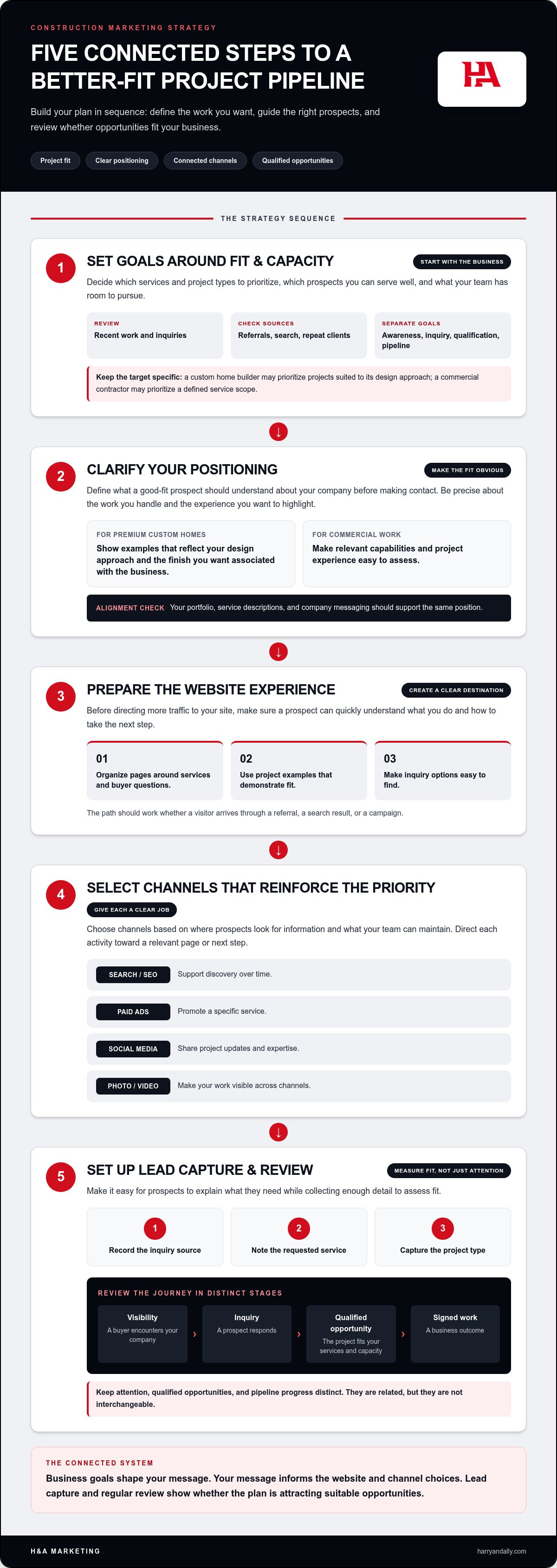
How to Build a Construction Marketing Strategy in Five Connected Steps
Build the plan in sequence. Each decision should make the next one easier: define what the business needs, shape a message for the right prospects, prepare a useful destination, select channels, then check whether the process is producing suitable opportunities.
- Set goals around project fit and capacity. List the services and project types you want to prioritize, the prospects you can serve well, and the work your team has room to pursue. Review recent work and inquiries to see which sources have contributed, including referrals, search, or repeat clients. Separate awareness goals from inquiry, qualification, and pipeline goals. A custom home builder may focus on projects that suit its design approach; a commercial contractor may prioritize a specific service scope. Keep those goals distinct so each can guide its own marketing choices.
- Clarify your positioning. Write down what a good-fit prospect should understand about your company before making contact. Be specific about the work you handle and the experience you want to highlight. Then check whether your portfolio, service descriptions, and company messaging support that position. For premium custom homes, select examples that reflect the design quality and finish you want associated with the business. For commercial work, make relevant capabilities and project experience easy to assess.
- Prepare the website experience. Before sending more traffic to your website, make sure a prospect can quickly understand what you do and how to take the next step. Organize pages around services and buyer questions, use project examples that demonstrate fit, and make inquiry options easy to find. Thoughtful construction web design can connect those elements into a clear path, whether a visitor arrives through a referral, search result, or campaign.
- Select channels that reinforce the priority. Choose channels based on where your prospects look for information and what your team can maintain. Search engine optimization can support discovery over time. Paid ads can promote a specific service, while social media can share project updates and expertise. Photography and video provide material that helps make your work visible across those channels. Give each activity a role, and direct it toward a relevant page or next step rather than treating every channel as a separate campaign.
- Set up lead capture and review. Make it easy for prospects to explain what they need, while collecting enough detail to assess fit. Record the inquiry source, requested service, project type, and next action in your CRM or chosen tracking process. Review the information alongside channel activity. Note where prospects drop off, which inquiries match your priorities, and whether follow-up is happening consistently. Use those observations to make one focused adjustment at a time. If you need support connecting these pieces, discuss how a coordinated marketing system could fit your goals.
Which Construction Marketing Channels Fit Your Company and Buyers?
No channel deserves priority just because it’s popular. Your construction marketing strategy should reflect who you need to reach, the economics of the projects you want, your team’s capacity to respond, and the visibility you already have. A commercial contractor with strong referral work but limited search presence may need a different mix from a custom builder whose portfolio is central to homeowner decisions.
Use this comparison to clarify each channel’s job before you invest time or budget:
| Channel | Best use | Useful signal |
|---|---|---|
| Owned website content | Explain services, project fit, and what a prospect can expect next. | Relevant service-page visits and inquiries that match your work. |
| SEO | Help prospects find useful service and project information as they research. | Qualified organic visits and inquiries tied to relevant searches. |
| Google Ads | Promote a specific service to people actively searching for it. | Tracked inquiries and the share that fit your project criteria. |
| Meta Ads | Put project or service content in front of a selected audience. | Engaged prospects who visit relevant pages or inquire. |
| Social media | Maintain visibility, share progress, and demonstrate how your team works. | Meaningful engagement and visits from prospective buyers. |
| Project media | Show finished work and explain details that are hard to convey in text alone. | Use of project galleries and media in buyer conversations or inquiries. |
When should builders prioritize search, paid ads, or social media?
Search is a strong fit when prospects are actively researching a service and you have useful pages that answer their questions. SEO supports discovery over time; Google Ads can promote a specific offer or project type to searchers now. Paid campaigns need a clear destination, an easy next step, and lead tracking so you can assess whether inquiries fit. For premium residential projects, the message and landing page should reflect the homeowner’s decision process, not just push for a quick form fill.
Social media serves a different role. Use it to keep project progress, team expertise, and finished work visible between active searches. It can help prospects get familiar with your company, but activity alone doesn’t show whether it’s contributing to suitable opportunities. Give each channel a purpose, then review its signals alongside inquiry quality.
How do project photos and video support trust?
Portfolio images provide proof of completed work: the design, finish, scale, or type of project. Jobsite media can show progress and give context to the work behind the finished result. Buyer-focused content has another job. It answers questions about your process, services, or project considerations. Pairing both helps a prospect see your capabilities and understand what working with your company may involve. Professional construction photography and video can supply media for your website and marketing channels.
Choose channels as a connected mix, not a checklist. If one attracts attention, make sure another helps buyers assess fit, and that your inquiry process captures enough detail to evaluate the opportunity.
How to Measure Construction Marketing Without Chasing Vanity Metrics
Marketing reports can show plenty of activity without answering the business question: are you attracting projects worth pursuing? For a construction company, useful measurement follows the path from first attention to a qualified opportunity and, over time, movement through the sales pipeline. It helps you make better decisions, but it doesn’t prove that one channel alone caused a signed project.
Use a consistent set of notes or a CRM to track each inquiry. Record where it came from, what service or project type it concerns, whether it fits your company’s work and capacity, and what happens next. Keep the categories simple enough that your team will use them consistently.
- Attention: visits, search visibility, ad engagement, or social interactions show whether people are encountering your marketing.
- Inquiries: calls and form submissions show that someone took a step to contact you.
- Qualified opportunities: inquiries that match your services, project criteria, and capacity are more useful for judging lead quality.
- Pipeline progression: track whether conversations advance, pause, or close, and record the outcome when it’s known.
Which signals show whether marketing is attracting suitable projects?
Don’t stop at counting form submissions. Compare the source and requested service with project fit, then note whether the conversation progresses. For example, a campaign may bring fewer inquiries than another channel but attract prospects asking about work that matches your company’s priorities. That context matters more than a raw lead count.
Construction decisions often take time, so review new inquiries alongside opportunities already in discussion. A monthly check can help surface early patterns, while a broader review over a longer period gives prospects time to move through the pipeline. Choose a rhythm your team can maintain, and use the same definitions each time. A practical lead generation approach for construction companies should make it possible to connect campaign activity with inquiry and qualification details.
How should builders use marketing data to adjust the plan?
Look at channel activity, website engagement, inquiry quality, and follow-up together. If an ad attracts attention but the related page describes a different service, the message may be creating friction. If the page is clear but inquiries stall, review whether the next step is easy to find and whether your team has a consistent follow-up process.
Change one priority at a time. Write down what you changed, why you changed it, and what signal you’ll review next. That gives you a clearer read than changing several campaigns and pages at once. Measurement won’t remove every uncertainty from a long sales cycle, but it can help your construction marketing strategy focus on qualified opportunities and informed adjustments, not activity for its own sake.
Ready to refine your approach? Contact H&A Marketing today to discuss a construction lead generation strategy designed for sustainable growth.
Turn Your Construction Marketing Strategy Into a Coordinated Growth System
A plan only works when someone carries it through. For a construction company, that means connecting strategic direction to the creative, traffic, inquiry handling, and review that keep marketing moving. A coordinated system won’t guarantee a certain number of projects. It can make responsibilities clearer, reduce duplicate or disconnected work, and help your team see where prospects are entering the pipeline.
What does a connected marketing system coordinate?
Each part should support the same business priority. Positioning sets the message. Branding gives that message a consistent look and feel. Website design turns it into useful service and project information. SEO and advertising help bring the right audiences to those pages. Professional photo and video provide project proof and material for campaigns. CRM tracking helps connect inquiries to their source and keeps their status visible.
Coordination also means agreeing on who does what. Marketing activity needs an owner to plan campaigns and check performance. Inquiry capture needs a clear route into the company’s workflow. The people handling prospects need enough information to see what came in, where it came from, and what follow-up is due. That visibility helps prevent leads from sitting in an inbox with no clear next step.
For example, a campaign promoting a particular service should lead to a page that explains that service, shows relevant work, and offers a practical way to inquire. A consistent construction branding approach can help keep that message recognizable across the website, social content, and advertising. H&A Marketing brings construction-focused strategy and execution together across these connected elements, so builders can stay focused on running projects while marketing work follows a clear direction.
What should a builder do next?
Start with a simple review of your current setup. Write down your active channels, the sources of recent inquiries, the project types those inquiries represent, and how your team responds. Note where information is missing or work stalls. You don’t need a complex report to spot a practical gap.
- If your message is unclear: refine your positioning and make sure your website and creative reflect the projects you want.
- If buyers aren’t finding you: review whether search content or paid traffic supports your priority services.
- If inquiries are hard to assess: improve the questions on your contact form and record source and project fit.
- If follow-up is inconsistent: clarify who owns the next step and where its status is tracked.
Choose the next priority based on the clearest gap, not on the newest marketing trend. Record why you chose it, who will carry it out, and what signal you’ll review. Then use what you learn to guide the next adjustment. That steady operating rhythm turns your construction marketing strategy into a working system, not a pile of unrelated tasks.
Make Your Next Marketing Move Deliberate
Your construction marketing strategy doesn’t need to change all at once. Pick the gap that matters most to the work you want next, whether that’s unclear project positioning, weak visibility, or limited insight into inquiry quality. Set a clear owner for the next action and decide what you’ll review to learn whether it’s helping.
That first focused improvement gives your team a practical starting point. As you learn more about which prospects fit and how opportunities progress, you can adjust the plan with greater confidence. A steady, connected approach helps keep marketing aligned with the business you’re building.
Choose a next step that fits your capacity, then build from there. Growth starts with a plan your team can put into motion.
Frequently Asked Questions
What should a construction marketing strategy include?
Keep a construction marketing strategy in a working brief that names target work, audiences, channel roles, inquiry destination, and review measures. Add two operational details that are easy to overlook: who approves project claims and who owns updates when services or capacity change. Note what the company won’t promote right now, too. Those boundaries help keep marketing aligned with what the business can actually deliver.
How do construction companies get more qualified leads?
Look for patterns in inquiries that didn’t turn into suitable opportunities. Were prospects asking for a service you don’t provide, a project outside your scope, or work you couldn’t schedule? Use those patterns to refine campaign wording, page details, and audience exclusions. This gives your team a practical way to improve lead quality over time without assuming that simply increasing traffic will bring better projects.
Which marketing channels work best for construction companies?
The right channels depend on your buyers, services, available capacity, and the point at which prospects need information. Start with the channel your team can support well, then add another when its destination and measurement are ready. For example, prepare a relevant service page before directing paid traffic to it. This order helps prevent promotion from getting ahead of the information and follow-through prospects need.
How much should a construction company spend on marketing?
Set a budget by separating planned work into priorities, such as maintaining core marketing materials and testing a new campaign. Consider the staff time needed to supply project details, approve content, and handle new inquiries as part of the plan. Then decide what you can sustain without disrupting construction operations. Review spending against the purpose of each activity, and adjust only when you understand what the change is meant to address.
How long does construction marketing take to work?
There isn’t one reliable timeline for every construction company. Results can vary with channel, competition, execution, and the length of the buying process. Set expectations by identifying early signs to watch, such as whether the right people are engaging with a new page, and later signs, such as whether conversations advance. This staged view helps you avoid judging longer-term work only by immediate inquiries or signed projects.
How can a construction company measure marketing results?
Capture why opportunities stall or close, not just whether they came in. A brief note such as “scope changed,” “project postponed,” or “selected another approach” can help show whether the issue sits in marketing, timing, or the sales process. Keep these notes consistent across the team. Over time, they can reveal which concerns your content should address and where the handoff from marketing to estimating needs attention.
Can a small construction company create a marketing strategy without a full-time marketer?
Yes. A small company can keep marketing manageable by assigning one person to set priorities and approve business details, while specialists handle defined execution tasks. Build content capture into work already happening, such as noting project milestones or collecting team input during a job. A short, repeatable process is easier to maintain than a large calendar of ideas, especially when construction schedules shift.
