
Home Builder Website Not Generating Leads? The 2026 UX Audit Checklist

Article by
Harry Stanley III
Harry Stanley III is a construction marketing strategist and fractional CMO at H&A Marketing. He has helped construction companies grow through website strategy, SEO, paid advertising, branding, lead generation, CRM systems, and professional content. His past work includes helping Meraki Solar generate an additional $3.7 million in revenue in his first year and supporting American Builders as a fractional CMO. Today, Harry works directly with custom home builders and construction companies to build marketing systems designed to generate qualified leads and measurable growth.
Your high-end portfolio isn't failing because the projects are mediocre; it's failing because your website architecture is working against your sales team. Most builders invest heavily in professional photography only to bury it behind a clunky interface that frustrates potential clients before they ever reach the contact page. It's a common disconnect that makes a premium firm look like a budget contractor.
It is frustrating to spend thousands on targeted ads only to watch visitors bounce within seconds of landing on your site. You know your work stands up against any competitor in the market, but if your online presence feels dated or difficult to navigate, luxury homeowners will assume your building process is just as disorganized. Improving your home builder website user experience is the most effective way to close this gap and start capturing qualified inquiries.
This 2026 UX audit checklist identifies the specific friction points killing your conversion rates. You will learn how to transform your site into a high-performance lead engine that reflects your project quality. We will cover the essential fixes for custom home builder website design, from mobile navigation to the seamless integration of your CRM, ensuring your digital hub works as hard as your crew on the jobsite.
Key Takeaways
- Identify the "Ghost Town" effect where high website traffic fails to convert because of a mismatch between luxury project quality and low-end web templates.
- Audit your project galleries to improve the home builder website user experience by eliminating "dead-end" portfolios that fail to guide visitors toward a contact page.
- Simplify lead capture by applying the "Less is More" rule to contact forms, ensuring you capture high-ticket inquiries without creating unnecessary friction.
- Prioritize technical performance by optimizing image load speeds and adopting a mobile-first design approach that caters to how modern homeowners actually browse.
- Transform your website from a static brochure into a connected marketing system that coordinates strategy, high-end media, and CRM tracking for measurable ROI.
Diagnosing Why Your Home Builder Website Is Not Generating Leads
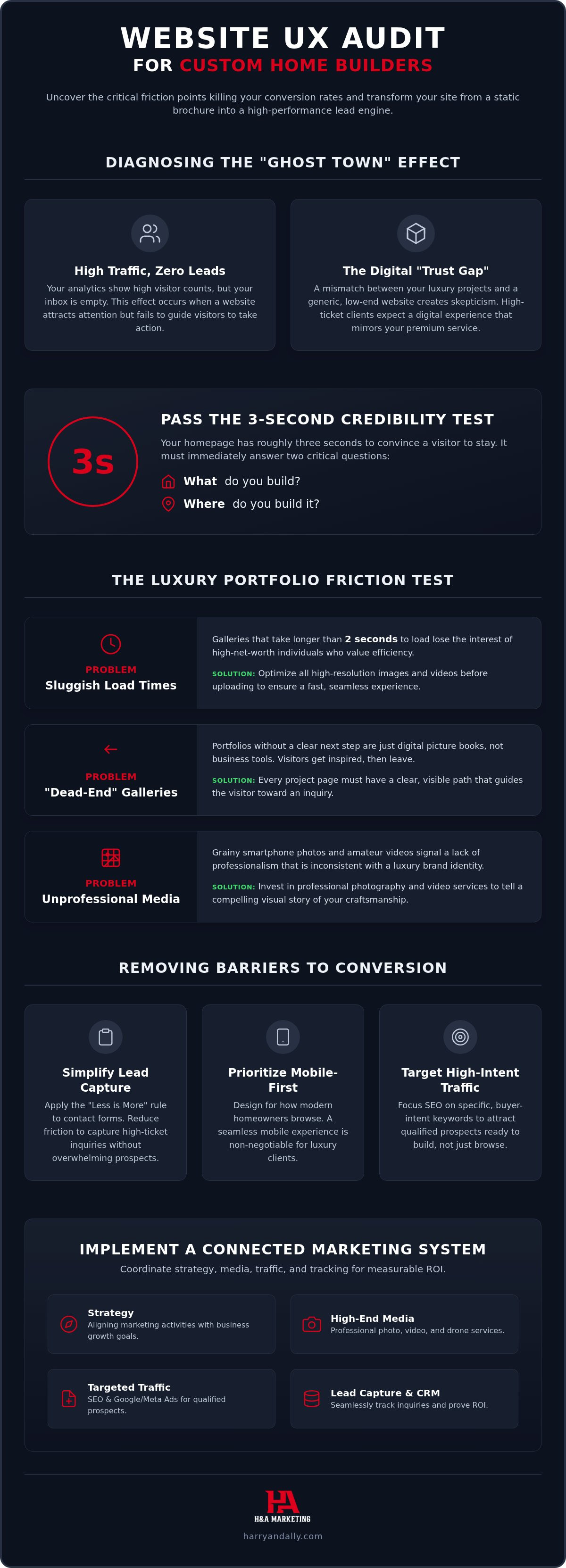
Many builders mistake high traffic for success. If your analytics show hundreds of visitors but your inbox remains empty, you are experiencing the "Ghost Town" effect. This happens when your digital presence attracts attention but fails to facilitate action. In the 2026 home buyer journey, potential clients are more tech-savvy and less patient. They expect your website to function as a seamless conversion engine, not a static digital brochure that sits idle. When your site fails to convert, it is rarely a lack of interest; it is a failure of the home builder website user experience.
A significant "Trust Gap" often exists between the physical quality of your homes and the digital quality of your website. You likely spend months perfecting the finishes on a luxury build, yet many builders settle for low-end, generic web templates that look "cheap" by comparison. This visual mismatch creates immediate skepticism. If a visitor sees a dated site with poor navigation, they subconsciously project that lack of detail onto your construction projects. High-ticket clients require a digital experience that mirrors the premium service you provide on-site.
Solving the Intent Mismatch in Home Builder Website User Experience
Attracting the wrong traffic is just as damaging as attracting no traffic at all. Many construction firms target generic keywords like "home design ideas" which bring in hobbyists and DIYers rather than serious prospects. There is a massive difference in search intent between someone looking for kitchen inspiration and someone searching for a "custom home builder" to start a multi-million dollar project. When your SEO strategy lacks specificity, your site becomes a gallery for browsers instead of a portal for buyers. UX friction eventually forces these high-intent buyers to leave your site and find a competitor who makes the next step obvious.
The 3-Second Credibility Test
Your homepage has roughly three seconds to convince a visitor to stay. This relies on a clear visual hierarchy and the foundational principles of user experience (UX) to ensure the most important information is seen first. If your homepage is cluttered with outdated logos or grainy, low-resolution jobsite photos, you lose credibility instantly. To pass this test, your site must answer two questions immediately: "What do you build?" and "Where do you build it?" Failing to provide these answers above the fold leads to high bounce rates. Professional custom home builder website design prioritizes these answers while showcasing your luxury portfolio with high-impact media. A refined home builder website user experience ensures that every scroll reinforces your authority and guides the prospect toward a consultation.
Checklist: The Luxury Portfolio Friction Test
A stunning portfolio is the heart of any builder's digital presence, but technical friction can easily turn a visual asset into a lead-killing liability. High-resolution images are necessary to showcase craftsmanship, yet they often lead to sluggish load times that drive away impatient prospects. You should follow digital best practices by optimizing every file before it goes live. If your gallery doesn't load within two seconds, you're losing the interest of high-net-worth individuals who value efficiency as much as aesthetics.
The most common mistake is the "Dead End" portfolio. This occurs when a visitor scrolls through a beautiful project gallery but finds no clear instruction on what to do next. Every project page must serve as a mini-landing page with a visible call-to-action (CTA). Don't force your prospects to hunt for a "Contact" button after they've just been inspired by your work. If your portfolio doesn't guide them toward an inquiry, it's just a digital picture book, not a business tool.
Visual Storytelling and High-End Media
Luxury homeowners aren't just buying a house; they're buying a process and a partnership. Relying on grainy smartphone snaps from the jobsite suggests a lack of professionalism that doesn't align with a seven-figure price tag. Utilizing professional video and photo services is essential for establishing immediate trust. High-performance video walkthroughs are particularly effective for out-of-state buyers who need to feel the flow of a home before they fly in for a meeting.
For estate-scale projects, drone photography provides the necessary perspective to show how a home sits within its environment. To keep the home builder website user experience fast, replace outdated carousels and sliders with lazy-loaded grids. This ensures your high-end media doesn't compromise the site's performance on mobile devices, where most of your initial "discovery" traffic happens.
Portfolio Navigation for High Net Worth Individuals
Luxury clients want to find relevant examples quickly. If you handle multiple project types, your home builder website user experience must include intuitive filtering. Allow users to sort by project type, such as custom estates, luxury remodels, or waterfront builds. This level of organization respects the user's time and demonstrates that you understand their specific needs.
Integrating social proof directly into the portfolio view is another powerful way to bridge the trust gap. Instead of a separate testimonials page, place client quotes and industry awards alongside the specific projects they reference. This context makes the praise more believable and impactful. If your current site architecture makes it difficult to showcase your work this way, you might need to refresh your website design to better support your sales process. If you aren't sure where the friction lies in your current gallery, you can request a marketing audit to identify specific conversion killers.
Removing the Barriers to Lead Capture and Conversion
Many builders make the mistake of treating their contact page like a gatekeeper rather than a welcome mat. If your form requires ten fields including lot address and exact budget before a prospect has even spoken to you, you are killing your conversion rate. High-ticket leads value their time. By simplifying your entry points and refining your custom home builder website design, you improve the home builder website user experience and reduce the psychological friction of reaching out.
Your "Call to Action" (CTA) buttons must be omnipresent. A prospect might decide to contact you halfway through a project gallery or while reading about your building process. If they have to scroll back to the top of the page to find a button, you've already lost momentum. Effective lead generation strategies involve placing clear, high-contrast buttons on every scroll depth so the path to inquiry is always visible.
The "Contact Us" Page Pitfall
The "Contact Us" page is often where 70% of potential leads drop off. This usually happens because the page feels cold or impersonal. You can fix this by adding "Expectation Management" to your form. Tell the user exactly when they will hear from you. A simple "We typically respond to new inquiries within four business hours" builds more trust than a generic "Thank you" message. Including map data and physical office hours also reinforces your regional legitimacy, proving you are a local expert with a physical presence rather than a faceless entity.
Lead Nurturing and CRM Integration
A website is only as good as the system behind it. Your site must feed directly into a lead management system to ensure no inquiry falls through the cracks. Follow-up automation plays a vital role here; an immediate auto-response can provide a floor plan guide or a "Building Process" PDF while the lead is still on your site. This keeps the conversation moving without requiring manual effort from your sales team during the initial discovery phase.
To qualify leads without overwhelming them, consider using a multi-step form. These forms ask one or two simple questions at a time, such as "What is your project type?" before asking for contact details. This approach feels less like an interrogation and more like a consultation, significantly enhancing the home builder website user experience. Finally, test your path to inquiry yourself. If it takes more than two clicks to find a way to talk to a human, your site is a barrier to your business growth.
Technical UX: Speed, Mobile, and Search Authority
Technical performance is the invisible architecture that determines whether your sales team ever gets a chance to speak with a prospect. While builders often focus on the visual "wow" factor, the home builder website user experience relies heavily on Core Web Vitals. Largest Contentful Paint (LCP) is the most critical metric for construction sites because of their heavy reliance on high-resolution imagery. If your main hero image takes more than 2.5 seconds to load, your bounce rate will climb as impatient luxury buyers move to the next search result. Security is equally vital; failing to maintain an active HTTPS certificate triggers "Not Secure" browser warnings that destroy brand trust before a visitor even sees your portfolio.
The Cost of a Slow Website
In the luxury sector, a one-second delay in page load time can lead to a significant drop in conversion rates. High-net-worth individuals value their time and expect a digital experience that matches the efficiency of your building process. To maintain speed without sacrificing quality, you should use WebP image formats and a Content Delivery Network (CDN) to serve assets from the server closest to the user. Technical UX is the foundation of lead generation because no amount of high-end photography can save a site that refuses to load. When your technical foundation is solid, your SEO efforts for high-intent construction terms become far more effective, as search engines reward sites that prioritize the visitor's time.
Mobile UX for the Busy Homeowner
A common disconnect exists between how builders and buyers view a website. You likely review your site on a large office monitor, but your prospects are browsing on their phones between meetings or while visiting jobsites. Your home builder website user experience must be mobile-first, not just mobile-responsive. This means implementing thumb-friendly navigation where the "Call" and "Inquiry" buttons are easily reachable with one hand. You should also eliminate intrusive pop-ups that block the view of your portfolio on smaller screens.
Specific construction assets like floor plans and site maps require special attention on mobile devices. These documents are often detail-heavy, so they must be pinch-to-zoom friendly or available as high-quality downloads. If a user can't read the dimensions of a master suite on their phone, they'll likely abandon the session. A refined custom home builder website design ensures that every technical detail, from mobile zoom to load speed, works in favor of the buyer's journey.
Request a technical UX audit for your website
Implementing a Connected Marketing System for Builders
A website without a strategy is just an expensive digital brochure. To generate consistent results, your site must act as the central hub of a connected marketing system. This means your custom home builder website design must work in perfect sync with your traffic sources and brand identity. When your home builder website user experience is aligned with your construction branding, you create a unified presence that commands authority in the luxury market. High-end media isn't just for the gallery; it's the fuel for your SEO and social media channels, creating a consistent visual narrative that builds trust before the first phone call.
Traffic Meets Conversion
Even the best UX will fail if it's fed the wrong traffic. Many builders find that Google Ads and Meta Ads fail to convert because the landing pages don't mirror the promise of the ad. A connected system uses website data to create a feedback loop. By analyzing which pages hold attention and where users drop off, you can refine your ad targeting to reach homeowners who are actually ready to build. Working with a growth partner who understands this synergy is more effective than hiring a one-time designer who leaves you to figure out the traffic yourself.
The ROI of a High-Performance Site
In custom home building, success isn't measured by lead volume but by lead quality. A refined home builder website user experience filters out budget-shoppers and attracts clients who understand the value of your craftsmanship. By providing clear information and removing technical friction, you can significantly shorten a sales cycle that typically lasts 6 to 18 months. A high-performance site handles the heavy lifting of education and trust-building, allowing your sales team to focus on closing qualified contracts rather than chasing dead ends.
The transition from a traditional builder to a dominant digital force requires a tactical shift. If you suspect your current site is leaking leads, the next step is to identify exactly where the friction is happening. Requesting a professional marketing audit provides a clear roadmap for these fixes, turning your website into a measurable marketing system that drives long-term ROI.
Transforming Your Website Into a Lead-Generating Asset
Your website should be your most productive salesperson. By auditing your portfolio for friction and simplifying your lead capture forms, you move closer to a system that converts browsers into high-ticket contracts. A refined home builder website user experience bridges the gap between your on-site craftsmanship and your digital authority. When you prioritize technical speed and mobile-first navigation, you respect the time of your most valuable prospects.
H&A Marketing acts as a specialized construction marketing system for firms ready to scale. As luxury portfolio optimization experts, we ensure your high-end media fuels an integrated lead tracking and CRM support structure. Your reputation for quality is your greatest asset. It's time your online presence reflected that same standard of excellence.
Discuss your custom home builder website design with H&A Marketing
Taking these steps today ensures your pipeline remains full as the market continues to evolve. You've done the hard work of building a premium brand; now let your website prove it to every visitor.
Frequently Asked Questions
Why is my home builder website getting traffic but no leads?
Your website likely suffers from an intent mismatch or high-friction user experience. While searchers might find your blog posts or galleries, they often encounter "dead ends" where no clear call-to-action exists. If your site looks dated compared to your luxury builds, visitors will bounce. Fixing the home builder website user experience by simplifying forms and adding clear conversion triggers is the fastest way to turn browsers into qualified inquiries.
How much should a custom home builder spend on a website redesign in 2026?
Investment levels for a professional redesign vary based on the complexity of your luxury portfolio and the depth of integrated systems required. A high-performance site is a project-based investment rather than a generic expense. You should prioritize a partner who understands the construction sales cycle and offers a connected marketing system. This ensures your website serves as a long-term lead generation engine rather than just a static digital brochure.
Does my construction website really need professional video to convert?
Professional video walkthroughs and drone footage are essential for building trust with high-net-worth clients. These visual assets allow out-of-state buyers to experience the flow of a home and the quality of your craftsmanship before meeting in person. Static photos are a baseline, but video captures the scale and detail that sets your firm apart. Integrating these assets into your site significantly strengthens your authority and shortens the decision-making process.
What is the best website platform for home builders in 2026?
The best platform is one that allows for complete control over technical SEO, mobile responsiveness, and high-resolution image optimization. It must integrate seamlessly with lead management systems and CRM tracking. While many builders start with generic templates, a custom-built solution is often necessary to handle estate-scale portfolios without sacrificing load speeds. Your platform should support your growth goals and allow for easy updates as your project list expands.
How long does it take for a new builder website to start generating leads?
A well-optimized website can begin capturing leads immediately if it is launched with a coordinated traffic strategy. While organic SEO growth typically takes several months to gain significant momentum, paid ad campaigns can drive high-intent visitors to your new site on day one. The key is ensuring your home builder website user experience is frictionless from the moment the site goes live so that you don't waste initial traffic or advertising spend.
What are the most important SEO keywords for custom home builders?
You should prioritize high-intent keywords that signal a readiness to build rather than just a desire for inspiration. Terms like "custom home builder," "luxury home construction," and specific project types like "modern estate builder" are more valuable than generic design terms. Targeting these specific phrases ensures your traffic consists of serious prospects. Combining these keywords with a robust search strategy helps you dominate the results for your target market.
Can I fix my website UX without doing a full redesign?
You can often make significant improvements by identifying and fixing specific friction points. Start by auditing your mobile navigation, simplifying your contact forms, and ensuring every project gallery leads to a clear call-to-action. Optimizing image file sizes and updating your branding can also bridge the trust gap without requiring a ground-up build. However, if your underlying platform is outdated or slow, a comprehensive redesign might be the most cost-effective long-term solution.
How does CRM integration improve my website lead conversion?
CRM integration ensures that every inquiry is captured and tracked immediately, preventing lead leakage. When your website feeds directly into a lead management system, you can automate initial follow-ups with floor plan guides or process documents. This immediate response keeps your firm top-of-mind during the homeowner's decision journey. It also allows your sales team to prioritize high-quality leads based on real-time data and interaction history from your site.
