
Local SEO for Construction: 2026 High-Ticket Lead Strategy


Article by
Harry Stanley III
Harry Stanley III is a construction marketing strategist and fractional CMO at H&A Marketing. He has helped construction companies grow through website strategy, SEO, paid advertising, branding, lead generation, CRM systems, and professional content. His past work includes helping Meraki Solar generate an additional $3.7 million in revenue in his first year and supporting American Builders as a fractional CMO. Today, Harry works directly with custom home builders and construction companies to build marketing systems designed to generate qualified leads and measurable growth.
Your portfolio of high-end builds means nothing to a search engine if your digital footprint is fragmented. It's a common frustration for custom home builders to see competitors with inferior craftsmanship dominating the local map pack. When local SEO for construction companies is handled like a generic commodity, you end up with a phone that rings for small repairs instead of multi-million dollar renovations. You know your work is the best in the region, but your online presence isn't telling that story to the homeowners who are ready to sign a contract.
It's time to stop chasing vanity metrics and start building a predictable pipeline. This guide breaks down a high-ticket strategy designed specifically for the 2026 search environment. You'll learn how to transform your business into a connected authority system that captures high-intent searches. We'll cover how to integrate jobsite media, navigate AI-driven search changes, and ensure your custom home builder website design works in tandem with your search strategy. By the end, you'll understand how to position your brand as the only logical choice for luxury projects in your market through a connected marketing system that reflects the quality of your physical craftsmanship.
Key Takeaways
- Learn how local search has evolved from simple keyword matching to a system of entity-based authority that favors established builders.
- Discover how to treat your Google Business Profile as a living digital jobsite by using geo-tagged media to dominate the local map pack.
- Understand how to use Schema markup to ensure AI search engines can accurately interpret and summarize your high-ticket project data.
- Find out how to build localized project pages that act as mini-portfolios to capture leads with high intent in specific service areas.
- See why a connected marketing system is the only way to ensure local SEO for construction companies translates into measurable project ROI.
The Evolution of Local Search for Construction in 2026
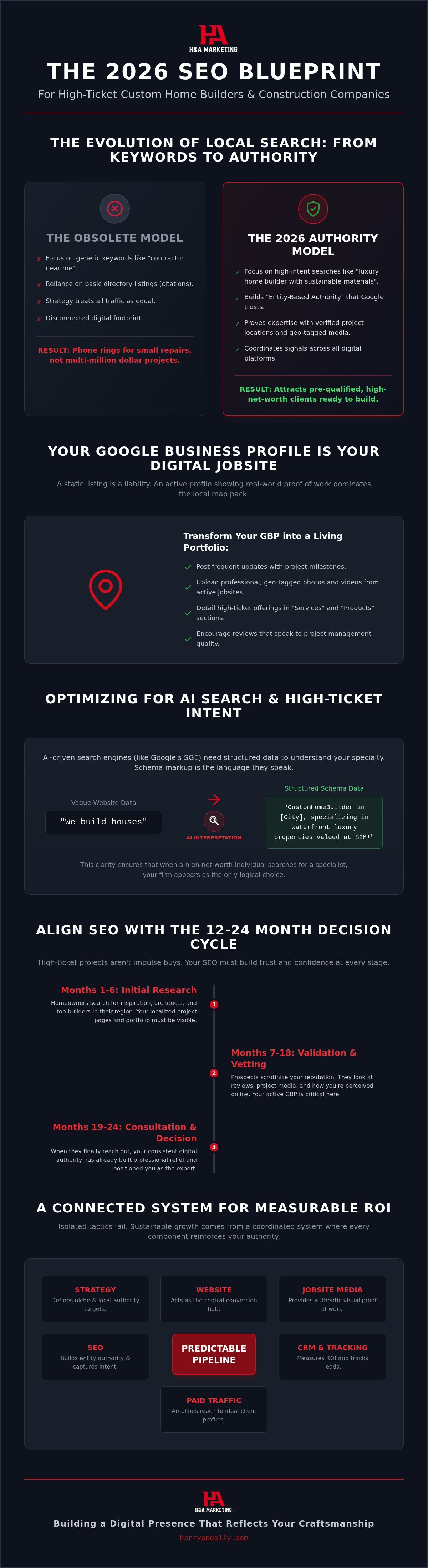
Local SEO has fundamentally shifted from a game of proximity to a game of authority. For construction firms, this means search engines no longer just look at your address; they look at your "entity." In 2026, local SEO for construction companies requires a strategy that proves you're a specialist through a connected marketing system. Traditional citation building, like listing your name in a dozen directories, is now just the baseline. It isn't enough to win in competitive markets where every builder is vying for the same high-net-worth clients. You need to demonstrate that your business is a trusted local fixture with a verified track record of success.
Entity-based authority means Google treats your business as a unique object with specific attributes, such as "luxury," "modern," or "commercial." It connects your website content to your Google Business Profile, your social media, and your mentions in local news. This creates a web of proof that is much harder for competitors to fake. This shift forces a move away from isolated tactics toward a strategy that coordinates every digital signal your business sends out.
Why High-Ticket Builders Need a Different SEO Approach
High-ticket construction projects aren't impulse buys. They involve 12 to 24-month decision cycles. A generic approach to SEO that prioritizes raw traffic volume often backfires by flooding your office with low-quality leads. You need a system that builds professional relief and confidence long before a homeowner reaches out for a consultation. Effective search strategy acts as a digital extension of your sales team, validating your craftsmanship through every stage of the homeowner's research journey. By focusing on the quality of the lead rather than the quantity of the clicks, you ensure every interaction moves a prospect closer to a signed contract.
The Death of Generic Keywords and the Rise of Intent
The era of "contractor near me" is fading. Today's high-intent leads use specific, descriptive queries that reflect their exact needs. We see a clear move toward long-tail searches like "luxury custom home builder with sustainable materials" or "architectural renovation specialist." Google's algorithms now prioritize builders who provide deep context through jobsite data and high-end portfolios. Local Authority is defined as the intersection of proximity, relevance, and proven project history. This transition ensures that when someone searches for a specialist, your firm appears as the only logical choice. To achieve this, your digital presence must include:
- Verified project locations and geo-tagged media from your actual jobsites.
- Consistent brand signals that reinforce your specific niche expertise.
- Deep topical relevance that answers complex homeowner questions.
- Integration of real-world reviews that speak to project management quality.
By moving away from generic keywords, you align your marketing with the actual intent of your most valuable prospects. This ensures your digital presence reflects the actual quality of your physical craftsmanship.
The Google Business Profile as Your Digital Jobsite
Your Google Business Profile (GBP) is no longer just a digital business card. It's your most important digital jobsite. For high-ticket local SEO for construction companies, a static listing is a liability. Google's algorithm now prioritizes profiles that show active, real-world proof of work through frequent updates and high-quality media. Treating your GBP as a living portfolio means posting updates as often as you'd post to social media. These posts should highlight project milestones, new equipment, or specific design trends you're seeing on-site. This consistent activity signals to Google that your business is operational and highly relevant to local searchers.
Don't leave the "Services" or "Products" sections of your GBP blank. These fields should mirror your high-end offerings exactly. If you build custom waterfront homes, list it as a specific product with a detailed description and a professional photo. This helps Google's AI-driven search summarize your business more accurately for complex queries. When your digital presence reflects the specific scale of your physical work, you attract leads that are pre-qualified for your price point.
Optimizing Visual Proof for Local Rankings
High-end builders can't rely on stock photos. Using professional video and photo assets is a direct ranking signal. Every time you upload a photo from a jobsite, Google reads the metadata. Geo-tagged images prove you are actually working in the neighborhoods you claim to serve. Drone photography is particularly effective here. It doesn't just show a finished house; it shows the scale of the project and the prestige of the neighborhood. This level of detail builds immediate trust with high-intent leads who want to see evidence of your craftsmanship in their local area. If you want to ensure your media is working as hard as your crew, you should consider a professional media strategy that captures your best work as it happens.
The Review Management System
Reviews are strategic assets, not just social proof. A simple "great job" doesn't help your SEO as much as a descriptive, keyword-rich review. You want clients to mention specific services like "custom luxury kitchen" or "commercial site prep." These details help Google categorize your business as an authority for those specific high-ticket searches. Responding to every review is mandatory. It shows professional reliability and lets your brand voice shine through. A well-managed review system turns satisfied homeowners into a permanent part of your local SEO for construction companies, creating a loop of trust that drives new contracts. Use your responses to reiterate the specific value you provided, further reinforcing your expertise to both Google and potential clients.
Beyond Keywords: Optimizing for AI Search and SGE
AI search is fundamentally changing the rules of engagement for builders. Google's Search Generative Experience (SGE) no longer just provides a list of links; it synthesizes information to provide a direct answer to complex user queries. For a custom home builder, this means the AI might summarize your expertise, project history, and client satisfaction before the user even clicks to your website. This shift toward zero-click searches makes your brand's digital presence more critical than ever. You aren't just competing for a spot in the blue links; you're competing to be the recommended solution in an AI-generated summary.
Winning in this environment requires moving beyond basic keyword optimization. You must build topical authority by creating specialized content that addresses the nuances of high-ticket construction. When you provide deep insights into luxury materials or complex zoning laws, you signal to AI agents that you possess the specialized knowledge required for high-stakes projects. This is a core component of modern local SEO for construction companies that want to stay ahead of the curve. By becoming the definitive source of information for your niche, you ensure your firm is the one AI recommends when homeowners ask high-intent questions.
Structuring Data for Search Engines
AI agents don't browse your site like a human; they crawl code to extract specific data points. This is where Schema Markup becomes your most powerful technical tool. By implementing project type, location, and service schema, you help Google's AI "read" your portfolio. It connects your physical jobsites to your digital service areas, creating a verified map of your local authority. This technical precision starts with a custom home builder website design that is built for crawlability. If your site structure is messy, AI agents will fail to index your most valuable project data, leaving you invisible in modern search summaries.
Becoming the "Recommended" Builder in AI Summaries
Google prioritizes E-E-A-T (Experience, Expertise, Authoritativeness, and Trustworthiness) more than ever in the construction niche. To win an AI citation, your content must cite real-world project outcomes and specific local expertise. AI looks for proof of your claims in your portfolio, reviews, and external mentions. Don't just say you're an expert; prove it with detailed case studies that outline the challenges and solutions of specific builds. For builders looking to expand their reach, understanding the nuances of Marketing for Custom Home Builders is essential for scaling authority in a competitive market. By providing the data AI needs to verify your expertise, you position your firm as the trusted choice for high-intent local searches.
High-Performance Content Strategies for Local Dominance
Traditional blogging often fails construction firms because it focuses on information rather than intent. High-performance local SEO for construction companies relies on localized project pages that act as mini-portfolios. These pages don't just show a finished house; they document the story of a build in a specific service area. This approach creates a "Hub and Spoke" system where your main service pages link to granular, location-specific project data. It tells search engines and potential clients that you aren't just a builder; you're the local expert for their specific neighborhood and project type. You need to balance this educational content with high-conversion landing pages that guide the reader from research to contact. This structure ensures your site remains crawlable for AI agents while providing the depth that human visitors demand.
The Anatomy of a High-Converting Local Project Page
A project gallery shouldn't be a dead end. Every project page must integrate lead generation elements to capture interest while it's at its peak. Use specific project descriptions to target long-tail searches like "custom coastal kitchen remodel" or "modern luxury estate construction." Including client testimonials directly on the relevant project page bridges the gap between seeing the work and trusting the builder. This creates a high-conversion environment that turns casual browsing into a project inquiry. Don't just list the city; describe the architectural style, the specific materials used, and the unique challenges your team solved. This level of specificity is what wins high-ticket contracts in competitive markets.
Leveraging Jobsite Media Across the Connected System
Efficiency is the key to scaling your digital presence. A single professional media shoot can fuel your SEO, GBP, and social media efforts for weeks. High-quality video and photo assets provide the raw material for "Behind the Scenes" content that builds deep trust with high-net-worth individuals. They want to see the process, the cleanliness of the site, and the precision of the crew. Jobsite videography serves as the ultimate proof of quality and safety. Utilizing drone photography adds a layer of neighborhood context that ground-level shots simply can't match. This connected approach ensures that your jobsite media works as a unified system to build authority across every digital channel.
Build your jobsite media system today
Building a Connected Marketing System for Sustainable Growth
Isolated SEO efforts fail in competitive construction markets because they treat search visibility as a standalone task. If your search strategy isn't talking to your website design, and your website isn't capturing data for your CRM, you're losing high-value leads in the gaps. Effective local SEO for construction companies requires a connected marketing system that coordinates strategy, creative, and lead capture into a single high-performance engine. At H&A Marketing, we act as an essential extension of your business, handling the digital heavy lifting so you can focus on the jobsite. We align your professional video and photo assets with technical search requirements to ensure your digital presence reflects the true quality of your craftsmanship.
A growth partner doesn't just "do SEO"; they manage the entire digital landscape to protect your brand authority. This involves integrating your search efforts with CRM tracking to measure the actual ROI of every project lead. When you can trace a high-ticket contract back to a specific local search query, you move from guessing to strategic expansion. This transition from traditional methods to modern digital dominance is what separates industry leaders from those who simply own a website. We coordinate every signal, from Google Ads to organic search, to ensure your pipeline remains full and predictable.
Measuring What Matters: Leads vs. Traffic
Raw traffic volume is a vanity metric that doesn't pay the bills. You need to measure what matters: qualified leads and signed contracts. Setting up robust conversion tracking for phone calls and contact forms allows you to identify which local keywords drive the highest-value opportunities. This data-driven approach ensures your marketing budget is focused on the services that offer the best return. A high-performing construction web design is the foundation of this process, acting as the primary tool for lead capture and authority building. Without a site designed for conversion, even the best search rankings will fail to generate a predictable pipeline.
Next Steps: Your Local Dominance Roadmap
The path to local dominance begins with a comprehensive local SEO audit of your construction firm. This audit identifies where your current system is leaking leads and where your competitors are gaining an edge. Transitioning from a "website owner" to an "industry authority" requires a commitment to consistent, high-quality digital signals across your entire presence. If you're ready to stop wasting money on generic SEO and start building a connected system that delivers results, it's time to discuss a custom strategy. We'll help you map out a roadmap that turns local searchers into your next high-ticket clients.
Take Control of Your Local Market Presence
Building a dominant local presence requires moving beyond the basics. In 2026, winning high-ticket contracts depends on your ability to prove your craftsmanship through a connected authority system. You've learned how to treat your Google Business Profile as a digital jobsite and how to structure your data for the new era of AI search. By prioritizing jobsite media and localized project pages, you ensure that every search result validates your expertise.
Successful local SEO for construction companies isn't a one-time project; it's a continuous coordination of strategy, creative, and lead capture. H&A Marketing specializes in this integrated approach, acting as a growth partner for builders who prioritize ROI over raw traffic volume. We handle the technical heavy lifting so your digital presence finally reflects the quality of your physical work. It's time to stop letting inferior competitors outrank you and start building a predictable pipeline of high-intent leads.
You have the craftsmanship. We have the system to show the world. Let's start building your digital dominance together.
Frequently Asked Questions
How long does it take to see results from local SEO for a construction company?
Most builders see initial traction within three to six months of starting a campaign. Local SEO for construction companies is a long-term investment that builds compound interest over time. While technical fixes provide quick wins, establishing the topical authority needed for high-ticket contracts takes consistent effort. You're building a digital asset that continues to generate leads long after the initial setup is complete.
Does my construction company really need a blog for local SEO?
You don't need a traditional blog, but you do need intent-based content. Static pages aren't enough to satisfy 2026 search requirements. Instead of generic articles, focus on localized project stories that highlight your specific expertise. This approach builds the topical authority search engines require to recommend you for complex, high-ticket builds. Content should answer the specific questions your prospects ask during their decision journey.
What is the most important factor for ranking in the Google Local Pack?
Google prioritizes a combination of relevance, distance, and prominence. Prominence is where you have the most control through consistent activity on your Google Business Profile. Regularly uploading jobsite media and securing detailed client reviews signals to Google that your business is an active local authority. When these signals are coordinated with a high-performance website, your chances of appearing in the top three results increase significantly.
How does professional photography affect my local SEO rankings?
Professional photography acts as a direct ranking signal by increasing user engagement and dwell time. High-quality images from your actual jobsites contain geo-metadata that proves your physical presence in specific service areas. Google's AI agents also scan these images to verify your business category and project quality. Using professional assets ensures your digital presence matches the premium nature of your physical craftsmanship.
Can I manage my own local SEO, or do I need an agency?
You can handle the basics, but managing a connected marketing system is a full-time job. Builders who attempt to DIY their SEO often find themselves distracted from their primary work on the jobsite. A specialized agency like H&A Marketing acts as an extension of your team, handling technical execution and strategy. This allows you to focus on construction while experts manage your lead pipeline and brand authority.
What is the difference between local SEO and national SEO for builders?
Local SEO focuses on capturing leads within a specific service area, while national SEO targets broad industry authority. For builders, the goal is to dominate the local map pack and appear for location-specific queries. National SEO can support this by building overall brand trust, but local strategies are what drive signed contracts in your market. Most construction firms thrive by owning their local region before worrying about national visibility.
How much should a construction company budget for local SEO in 2026?
Budgeting should focus on the ROI of a single high-ticket project rather than just the monthly cost. Most successful construction firms allocate a percentage of their annual revenue to marketing retainers and project-based fees. This covers ongoing search engine optimization management, professional media production, and website maintenance. Investing in a connected system ensures that your marketing spend isn't just a cost, but a tool for generating predictable project growth.
How do I handle negative reviews on my Google Business Profile?
Respond to every review professionally, regardless of its sentiment. Addressing a negative review publicly demonstrates your commitment to reliability and customer service. It's an opportunity to show potential clients how you handle challenges on the jobsite. Focus on resolving the issue offline while maintaining a calm brand voice online. A balanced profile with authentic responses often builds more trust than a perfect five-star rating with no interaction.
