

Article by
Harry Stanley III
Harry Stanley III is a construction marketing strategist and fractional CMO at H&A Marketing. He has helped construction companies grow through website strategy, SEO, paid advertising, branding, lead generation, CRM systems, and professional content. His past work includes helping Meraki Solar generate an additional $3.7 million in revenue in his first year and supporting American Builders as a fractional CMO. Today, Harry works directly with custom home builders and construction companies to build marketing systems designed to generate qualified leads and measurable growth.
More commercial roof restoration leads don’t automatically create a stronger sales pipeline. The goal is to attract property owners and facility managers whose buildings, roof needs, and project timing align with your work. Focused targeting, useful service pages, and thoughtful follow-up help keep longer sales cycles moving.
It’s reasonable to want a clear monthly price before investing in lead generation. But the cost of building a commercial roofing pipeline depends on the market, the buildings you target, and the work needed to reach decision-makers. A useful plan starts with those factors, not a one-size-fits-all figure.
This guide explains how to attract restoration and coating prospects, reach facility directors and property managers, and assess lead quality beyond form submissions. It also covers what influences lead-generation costs, how website content and campaigns work together, and what to look for in a marketing partner. The aim is a dependable flow of qualified conversations and bid opportunities, not inquiries that don’t fit your crew, service area, or project capabilities.
Key Takeaways
- Focus campaigns on the building types, roof systems, and service areas that match your commercial roofing capabilities.
- Shape outreach around restoration, coatings, replacement, and maintenance needs, since prospects may be planning rather than ready to buy immediately.
- Speak to property managers and facility directors about practical concerns such as budgets, tenant impact, and project documentation.
- Measure lead quality through project fit, useful conversations, and bid opportunities, not just inquiry volume.
- Assess lead-generation costs based on your market, target buildings, and the effort needed to reach decision-makers.
How a Lead-Generation Provider Targets by Building Type, Roof System, Roof Area, and Service Radius
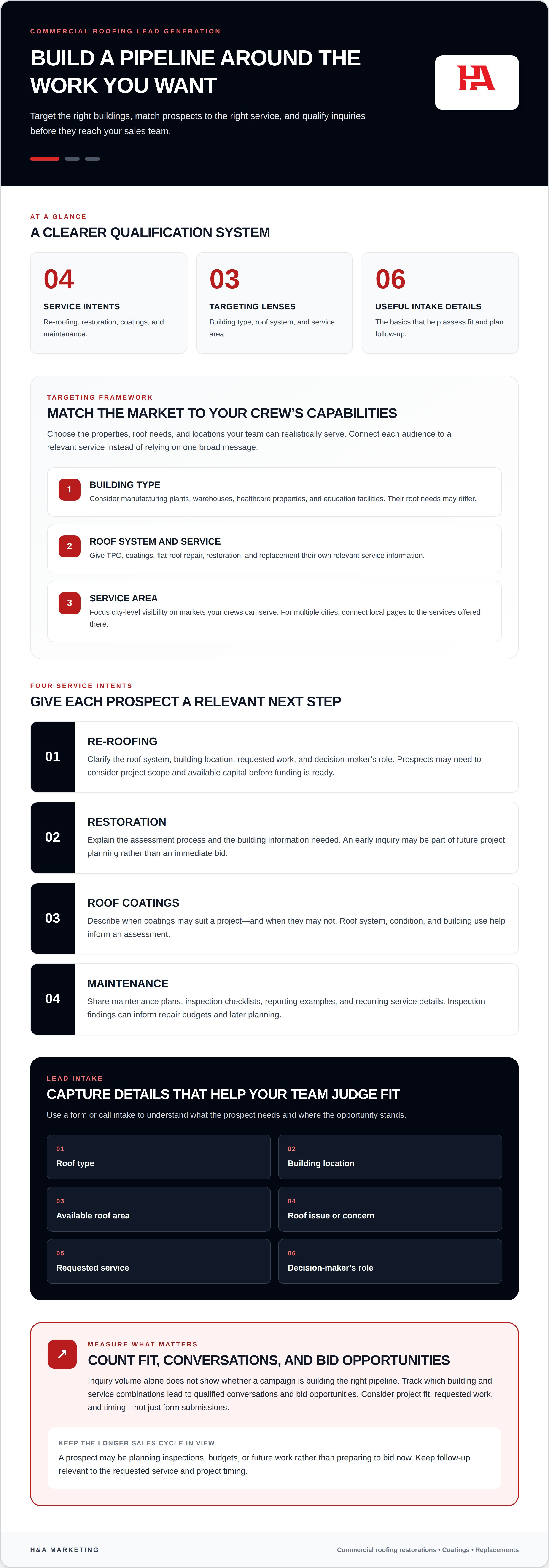
Start by targeting the buildings your crews can serve and the work they perform. Manufacturing plants, warehouses, healthcare properties, and education facilities can have different roof needs. Connect each property type to relevant restoration, coating, or replacement services so commercial roof restoration leads better match your project capabilities.
The roof system matters as much as the building category. A page about TPO roofing should clearly describe the commercial service you’re promoting. Separate pages can cover roof coatings, flat roof repair, restoration, or replacement. This helps property owners connect a roof concern with the service you want to provide.
Roof area can help qualify a request before it enters your sales pipeline. A form or call intake can capture available square footage, known roof type, building location, and requested service. For example, distinguish a warehouse manager seeking a coating assessment from an owner requesting a replacement bid. These details help your team assess project fit and plan a useful follow-up.
Target service areas where your crews can realistically work. City-level searches can focus visibility on the markets you serve instead of attracting inquiries from beyond your reach. If you work across several cities, create relevant pages for each market and connect local searches with the roof systems and services you offer there. Geographic focus also makes lead reports easier to interpret.
REIT asset managers and facility directors need information relevant to portfolios and building operations. Campaigns can address manufacturing, warehouse, healthcare, and education properties with pages tailored to specific services. Explain how restoration, coatings, or replacement may relate to a building’s roof needs. A facility director planning a budget may need a different next step from a manager reporting an active leak.
SEO supports this approach by matching useful pages to specific searches. Instead of relying on one broad commercial roofing page, organize content by service, roof system, building type, and city. Each page should offer practical guidance and connect the property’s needs with your work. For example, a warehouse page can discuss relevant restoration options and point readers to the appropriate service page.
- Match each building category to a relevant roofing service.
- Use city pages for markets your crews can serve.
- Capture roof type, location, area, issue, and requested work.
- Track which building and service combinations produce qualified conversations.
Turn those details into a practical targeting plan: choose the property types, roof systems, and markets that fit your work, then build pages and intake questions around them. Clear qualification helps distinguish a promising restoration inquiry from a request outside your service area or project focus.
Commercial re-roof, restoration, coatings, and maintenance prospects
Commercial roofing inquiries may begin with a leak, inspection, budget request, or bid discussion. Match each concern to the right service and next step.
Re-Roof Prospects
Re-roof prospects often need to consider the building’s condition, project scope, and available capital. An owner may request a replacement bid before funding is ready. Relevant pages can present project experience and building-type information, alongside a qualification form that clarifies the roof system, location, requested work, and decision-maker’s role.
Restoration Prospects
Restoration prospects may be weighing an alternative to full replacement. Campaigns can reach owners exploring cost-effective options before replacement is necessary. Useful content explains the restoration process, the building information needed for an assessment, and the prospect’s concerns. A warehouse manager requesting a roof assessment, for example, may not be ready to discuss a replacement bid. Relevant follow-up can keep the inquiry connected to future project planning.
Coating Prospects
Coating campaigns should address suitability rather than imply every roof is a candidate. A dedicated page can explain when coatings may suit a project and when they may not, and outline the information needed to assess the roof, such as its system, condition, and building use. A facility director comparing coating and replacement options needs a clear way to discuss both, without being told coatings always work.
Maintenance Prospects
Maintenance prospects may be planning recurring roof care rather than a one-time repair. Campaigns can feature maintenance plans, inspection checklists, reporting examples, and details about recurring service. These resources help property managers understand ongoing care and how findings can inform repair budgets. A facility director seeking inspection information may later ask about restoration or replacement planning. Make it easy to start that next conversation.
Capital planning also affects when prospects respond. Project funding timelines vary. That makes early inquiries valuable, even when a project isn’t ready for bidding. Campaigns can provide relevant information about inspections, budget requests, and future planning, while capturing the requested service and project timing.
Track inquiries by service intent, such as re-roofing, restoration, coatings, or maintenance. Record whether the contact requested an inspection, assessment, budget discussion, or bid. These distinctions show which campaign topics lead to useful conversations and booked site visits. They also help sales teams follow up with relevant information instead of treating every inquiry as an immediate replacement opportunity.
Educational content can cover maintenance, coatings, roof systems, inspections, and replacement planning. Campaigns can also address searches for roof inspections, flat roof repair, TPO roofing, roof coatings, maintenance plans, emergency leak response, and contractor credentials. Paid search can target urgent leak, inspection, flat roof repair, and replacement searches. Maintenance campaigns can share maintenance plans, inspection checklists, reporting examples, and recurring service information to address roof-life extension and repair budgeting. Restoration and coating campaigns can reach buyers exploring cost-effective alternatives before full replacement is necessary.
How a Lead-Generation Provider Reaches Property Managers, Facility Directors, and Building Owners
Commercial roofing buyers include property managers, facility directors, REIT asset managers, and building owners. Each role has different responsibilities, so connect the roof need to the person coordinating the next step.
A property manager may oversee a retail portfolio and need repair, restoration, or replacement options for several buildings. A manufacturing facility director may focus on roof access, operational impact, and documenting the work. Address these concerns directly instead of relying mainly on curb appeal.
For REIT asset managers, portfolio-level messaging can make a service relevant to multiple properties. A campaign might address planning roof assessments across industrial buildings, then invite readers to discuss restoration or replacement. For an owner managing one warehouse, a more relevant message may focus on a specific roof concern and the information needed to discuss it.
Trust signals should answer practical questions before a prospect submits a request. Commercial roofing pages can present project experience, safety documentation, insurance information, maintenance options, emergency response processes, photo documentation, reporting, and manufacturer certifications. These details help buyers understand the contractor’s capabilities and how project information is handled.
Create different paths for different actions. An owner seeking a replacement bid needs a way to share project scope and building details. A facility director requesting an inspection needs a clear way to describe the concern and location. A property manager considering a commercial roof restoration needs relevant project experience and information about the restoration process.
Forms and calls should capture details that help qualify an inquiry: building type, known roof type, location, issue, urgency, available square footage, decision-maker role, and requested service. For example, distinguish a property manager reporting a leak from a REIT asset manager exploring a future restoration. That gives follow-up a useful starting point.
Campaigns can combine city-level search visibility with pages built for commercial services, roof systems, or building types. A warehouse restoration page can speak to that property category, while a separate page addresses a facility director seeking maintenance. Commercial roofing marketing should connect these messages with relevant landing pages, calls, and forms, rather than sending every buyer to one generic destination.
Track inquiry type, building category, source, market, booked site visits, bid opportunities, and reasons for disqualification. If a campaign attracts owners but few qualified bid conversations, these records can show where targeting or messaging needs work. Measure useful conversations and project fit, not form submissions alone.
Commercial lead volume and project value
A busy inbox doesn’t automatically mean a healthy commercial roofing pipeline. A leak inquiry for a small facility and a restoration opportunity across a property portfolio involve different sales conversations. Track both inquiry volume and project fit, then assess campaigns by useful conversations, booked site visits, and bid opportunities.
Lead volume shows whether campaigns are generating responses. Assess project value through qualification details, not a guessed dollar figure. Record the requested service, building category, available square footage, roof type, location, and decision-maker role. A warehouse owner requesting a restoration assessment, for example, signals a different scope from a facility director reporting an urgent leak.
Separate inquiries by intent. Inspection requests, maintenance discussions, budget requests, restoration assessments, and replacement bids can all enter the pipeline, but they aren’t equally ready to purchase. A property manager seeking an inspection may need the findings before considering a larger project. A general contractor requesting a roofing bid may already have defined project requirements.
Use consistent stages to see where opportunities progress or stall. A simple tracking process can record:
- Inquiry source, market, building category, and requested service.
- Whether the conversation led to a booked site visit.
- Whether the opportunity advanced to a bid discussion.
- Why an inquiry was disqualified, such as location or service mismatch.
These records help explain why a campaign’s lead count might rise while qualified opportunities remain flat. If inquiries come from outside your service area, refine geographic targeting. If owners submit forms but don’t book site visits, review the landing page, intake questions, and follow-up. If a building category produces relevant bid conversations, examine which message and service page attracted those prospects.
Commercial roofing projects often follow capital budgets and longer sales cycles. A prospect may request information now, then move toward restoration or replacement as planning develops. Measure progress across the pipeline rather than judging every inquiry by immediate sales. A maintenance conversation, for example, may reveal future repair needs without becoming a current replacement bid.
Set reporting around business decisions. Compare inquiry types by source and market, then connect them to site visits, bids, and disqualification reasons. Review whether campaigns attract projects suited to your crews, service area, and commercial capabilities. This provides a clearer basis for adjusting investment than raw form totals alone.
A strong lead-generation plan balances volume with fit. It creates enough relevant conversations to build a pipeline while identifying which prospects are ready for a site visit, a bid, or continued follow-up. That helps commercial roofing contractors focus sales time on opportunities with a clear service match and practical next step.
Useful conversations and project fit are better measures of campaign success than maximizing form submissions. Replacement and bid pages can present project experience, credentials, and building-type information alongside qualification forms. This context helps prospects assess questions about capability, safety, manufacturer systems, scheduling, and documentation, and decide whether a project is a fit.
Commercial roofing lead-generation pricing and monthly retainers
A commercial roofing lead-generation partner should understand restoration, coatings, replacement, and commercial buyers. Look for a provider that connects campaign targeting, landing pages, inquiry qualification, and pipeline reporting. A warehouse restoration campaign, for example, needs a different message and intake path from an urgent leak campaign.
Lead-generation costs depend on the market, the buildings targeted, and the work required to reach decision-makers. The price depends on the case and is given after a quote request, with scope shaped by those factors. A focused city campaign for restoration prospects may require different work than outreach across several markets and building categories.
A monthly retainer should define the scope, not just promise a lead count. Clarify which audiences and services campaigns target, what pages or forms support them, and how inquiries are tracked. One plan might focus on warehouse restoration inquiries; another could include replacement bids and maintenance requests across several property types.
Ask how reporting connects campaign activity to sales opportunities. A useful report separates inquiry source, market, building category, booked site visits, bid opportunities, and disqualification reasons. Inquiries from outside your service area should be distinct from qualified restoration requests. The aim is to identify where effort produces relevant conversations, not simply count form submissions.
Define what counts as a qualified lead before campaigns begin. A commercial roofing contractor may prioritize a decision-maker, a serviceable location, a known building type, and a clear restoration need. Another may want more inspection requests to build future opportunities. Agreeing on criteria helps evaluate lead quality against your project goals.
Which lead-generation companies specialize in commercial roof restoration? Look for providers focused on commercial roofing who understand restoration, roof coatings, replacement planning, and facility-manager decision paths. Their strategy should connect these services with relevant property types, markets, lead qualification, and reporting.
Before choosing a retainer, map the campaign to your current sales capacity. If estimators can handle restoration assessments but not a surge of low-fit repair inquiries, reflect that in targeting and intake. Review the scope, reporting definitions, and adjustment process together, then assess performance through qualified conversations and bid opportunities. This keeps the monthly investment tied to pipeline needs rather than a stand-alone lead tally.
A practical proposal should clarify the work included, the markets and services it supports, and how outcomes are assessed. Compare the proposed scope with your priorities, such as restoration assessments or replacement bids, rather than comparing monthly totals alone.
Discuss commercial roofing lead-generation strategy
Prioritize providers that distinguish restoration prospects from urgent leak inquiries and report qualified opportunities by market and building category.
H&A Marketing: Lead Generation
H&A Marketing helps commercial roofing contractors create a clearer path from search to qualified restoration inquiries. Its lead generation can align campaign targeting with the services, building types, and markets you want to pursue.
When prospects land on a page that doesn’t explain your commercial work, construction website design can make the next step clearer. Search engine optimization can support relevant pages for commercial roofing services and local searches. Logo design and branding can help present a consistent, professional identity across those campaigns.
Consider this approach when inquiries don’t match your restoration focus, your website doesn’t guide commercial buyers toward a useful conversation, or you need a more coordinated way to attract qualified projects. Start with a strategy shaped around your services, target buildings, and market.
Contact H&A Marketing to discuss your commercial roofing marketing.
Build a Pipeline That Fits Your Next Phase
Commercial roof restoration leads are most useful when they fit the projects your business wants to pursue. Use your next planning conversation to identify the markets, building types, and service opportunities that deserve attention. This gives future campaigns a clearer direction without chasing activity for its own sake.
H&A Marketing can connect lead generation with website design, logo design and branding, and search engine optimization. Together, these services can give commercial roofing prospects a consistent path from finding your business to understanding your services and starting a conversation.
You don’t need to solve every marketing challenge at once. Start with the gap that most limits qualified inquiries, then build from there with a strategy shaped around your commercial roofing goals.
Frequently Asked Questions
What are commercial roof restoration leads?
Commercial roof restoration leads are inquiries from businesses or property decision-makers considering restoration work on a commercial building. They might come from a facility manager seeking an assessment, a property owner exploring restoration before replacement, or an asset manager planning roof work across a portfolio. Useful leads give contractors enough context to understand the building, requested service, and prospect’s next step.
