
Luxury Custom Home Builder Marketing: 2026 Playbook for High-Ticket Leads

Article by
Harry Stanley III
Harry Stanley III is a construction marketing strategist and fractional CMO at H&A Marketing. He has helped construction companies grow through website strategy, SEO, paid advertising, branding, lead generation, CRM systems, and professional content. His past work includes helping Meraki Solar generate an additional $3.7 million in revenue in his first year and supporting American Builders as a fractional CMO. Today, Harry works directly with custom home builders and construction companies to build marketing systems designed to generate qualified leads and measurable growth.
More inquiries won’t strengthen a luxury building business if they don’t fit the projects you want to build. Effective luxury custom home builder marketing makes your craftsmanship, service, and point of view clear, then helps the right homeowners take the next step.
A polished portfolio can still leave prospects unsure what sets your work apart. Marketing can also attract homeowners whose goals don’t match your scope. When your website, search visibility, social content, and sales follow-up operate separately, promising conversations can lose momentum.
This playbook shows how to position your brand for the clients and projects you want, coordinate marketing channels, and assess inquiries by fit rather than volume alone. You’ll learn how portfolio content can demonstrate the experience behind a finished home, how search and paid campaigns can support different stages of homeowner research, and how to connect marketing activity to useful pipeline measures. The goal is a connected system that turns distinctive proof into qualified conversations, without treating every inquiry as a good lead.
Key Takeaways
- Define the project types, homeowner goals, and service experience your business is best equipped to deliver.
- Use luxury custom home builder marketing to make your value clear through specific portfolio details, not luxury language alone.
- Give each channel a distinct job, from helping homeowners discover your firm to supporting their evaluation and inquiry.
- Track inquiry source, project fit, follow-up status, and pipeline progress to judge marketing by lead quality, not volume alone.
- When evaluating a marketing partner, ask how they coordinate strategy, creative, traffic, and lead capture for construction businesses.
Luxury custom home builder marketing starts with premium-fit positioning
Luxury custom home builder marketing explains which projects a builder is suited to deliver, what makes the experience distinct, and what evidence supports that promise. The goal isn’t to attract everyone who uses the word “luxury.” It’s to help suitable prospects recognize a fit before they inquire.
Premium positioning depends on clarity, not dramatic photography or phrases like “the finest homes.” Strong visuals can draw attention, but they can’t explain whether you take on ground-up builds, major renovations, or projects with a particular level of design complexity. They also don’t show how decisions are made, who guides the process, or what homeowners can expect when working with your team.
Luxury means different things to different clients. One homeowner may prioritize architectural detail; another may value a collaborative design process or a home shaped around daily routines. Budget alone won’t tell you what matters. Make your actual project scope, process, design approach, and homeowner experience clear enough for prospects to judge whether they align with their priorities.
What luxury homeowners need to understand before they inquire
Before contacting a builder, a prospect may want to know whether the firm handles their project type, how design and construction decisions are coordinated, and what level of involvement is expected from the homeowner. They may also look for credibility signals: completed work relevant to their goals, a clear explanation of the process, and specific information about the builder’s role.
Answer those questions with useful detail. A portfolio entry can explain a project’s scope and design challenges. Process content can outline key decision points without implying that every build follows the same path. This helps homeowners assess alignment and gives your team a more informed starting point for a conversation.
Turn the builder’s real strengths into a clear position
Start with strengths you can demonstrate, such as an approach to architectural collaboration, experience with a defined project scope, considered material selection, or a documented communication process. Use only claims that reflect your actual work, and connect each one to proof: project descriptions, detailed photography, or an explanation of how your team works.
Replace broad superlatives with specifics. Instead of calling your work “unmatched,” describe the design decisions or construction details visible in a completed project. For more guidance on defining and expressing those differentiators, explore construction branding for custom builders. A credible position gives suitable homeowners a reason to keep evaluating your firm, while helping others recognize when the fit may not be right.
Build luxury custom home builder marketing as a connected system
A homeowner may discover your firm through search, return later to review completed projects, and submit an inquiry after comparing your process with another builder’s. Luxury custom home builder marketing needs to support that full journey, not just the first click. Each touchpoint should reinforce the same project fit and brand promise, while giving prospects a clear next step.
Consistency doesn’t mean every channel repeats the same message. It means the claims, visuals, and information work together. If an ad highlights a particular type of custom build, its landing page should show relevant projects and explain how to inquire. A clear path can build confidence, but it doesn’t guarantee a sale.
Give each marketing channel a clear job
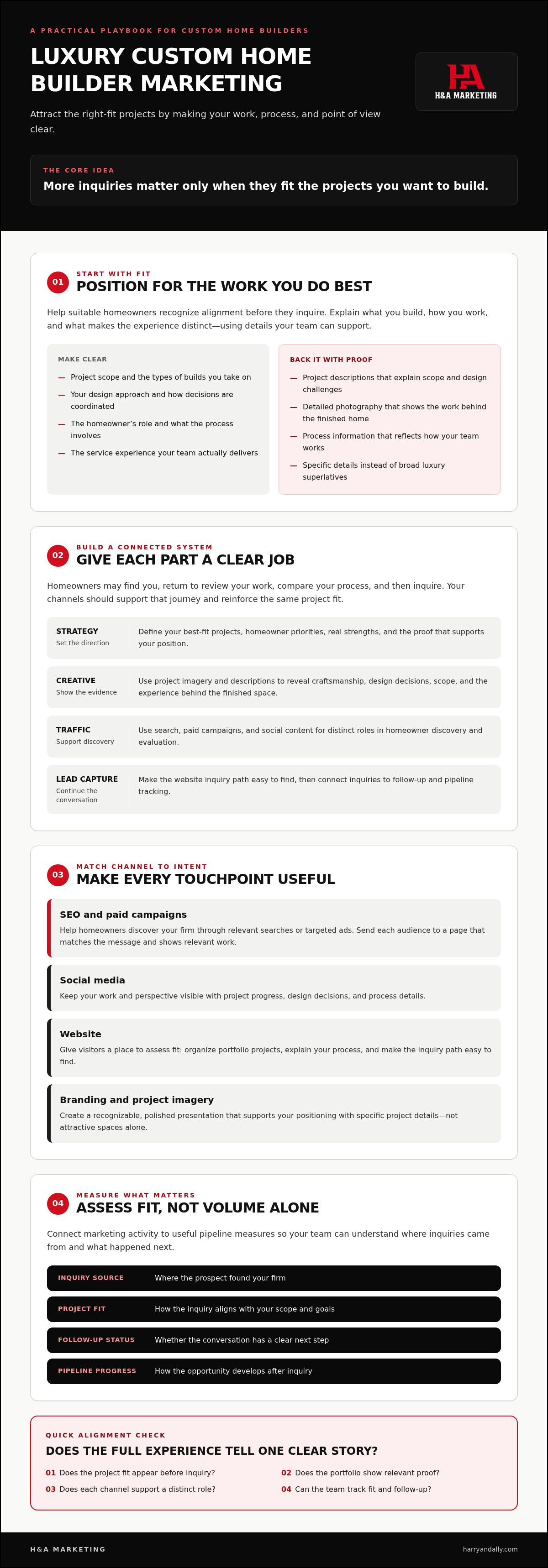
- Branding and project imagery: Establish a recognizable, polished presentation. Use photography and project descriptions that show the details behind your positioning, not just attractive finished spaces.
- SEO and paid campaigns: Help homeowners find your firm through relevant searches or targeted ads. SEO can support discovery while prospects research; paid campaigns can direct a defined audience to a relevant page.
- Social media: Keep your work and perspective visible between visits. Share project progress, design decisions, or process details that help people understand how your team approaches a build.
- Website: Give visitors a useful place to assess fit. Organize portfolio projects, explain your process, and make the inquiry path easy to find. For broader housing and builder context, the National Association of Home Builders offers industry resources.
Help channels hand off smoothly. Someone who sees a project on social media should be able to find related work on your website. A search visitor should land on a page that answers the question behind the search, rather than a generic page that leaves them guessing.
Connect traffic, inquiry capture, and follow-up
Every campaign needs a relevant destination and a practical way to respond. A project-focused page, for example, can connect an ad or search result to portfolio evidence, process information, and an inquiry form. Ask for details that help your team assess alignment, such as project type and goals, without making the first step feel like a lengthy application.
Then record what happens next. A CRM, or another consistent lead-tracking method, can help your team note where an inquiry came from, whether it fits your scope, who is following up, and what stage the conversation has reached. This connects marketing activity to sales follow-through without treating every inquiry as a qualified opportunity.
If your website isn’t supporting that handoff, explore construction web design as part of a coordinated approach to brand, traffic, and lead capture.
Choose marketing channels by homeowner intent, not by trend
A channel is useful when it reaches a homeowner at a relevant stage and gives them a clear next step. For luxury custom home builder marketing, choose based on the projects you want, how prospects are likely to research, and whether your team can follow up when inquiries arrive. A channel that works for another builder may not suit your audience or capacity.
Search, social, and referrals play different roles. A homeowner actively looking for a custom builder may use search to compare firms and review project details. Local SEO can help your firm appear for relevant searches tied to the areas you serve. Keep service-area information accurate, and add location context to completed projects where appropriate. Social content can keep your work visible, while referrals may introduce your firm through trusted connections.
Match channels to the homeowner decision journey
| Channel | Role it can play | What to check |
|---|---|---|
| Local SEO | Help homeowners in your service areas find relevant builder and project information. | Are your service-area details accurate, and do your pages explain the projects you take on? |
| Paid campaigns | Bring targeted traffic to a specific project or service page. | Does the destination match the ad, and can your team respond to inquiries? |
| Social media | Maintain visibility and share project progress, design choices, or team perspective. | Can you publish consistently without pulling focus from essential business work? |
| Referrals | Introduce your firm through professional or personal connections. | Can referred prospects find clear proof of fit when they review your firm? |
| Professional photo and video | Make completed work and documented process easier to evaluate. | Does each asset have accurate project context and a useful place to appear? |
Use the 2026 construction industry outlook as one reference for broader conditions, then make channel decisions around your audience, project scope, and follow-up readiness. If your team can’t manage inquiry volume or keep project information current, expand carefully instead of adding channels for their own sake.
Use portfolio proof to support premium trust
Strong visuals attract attention, but context helps homeowners judge whether a project resembles their goals. Pair professional photography with an accurate description of the scope, design choices, and details your team can document. Avoid implying that every build follows the same process or that one project guarantees a particular experience.
Give each project a clear role in your portfolio. Explain what the work shows about your approach, then use those assets across relevant website pages and social posts. See professional photo and video for builders for ways visual content can support that presentation.
Turn luxury builder marketing into a practical qualification and measurement plan
Luxury custom home builder marketing should be judged by whether it starts the right conversations and helps your team move them forward, not simply by how many forms come in. Set up a basic tracking process before changing campaigns. You can use a CRM, a spreadsheet, or another consistent record system already available to your team. H&A Marketing’s role is to coordinate its marketing services to align with this operational clarity.
A qualified inquiry is a homeowner conversation that appears aligned with your project scope and business priorities based on the information available so far. It’s an early assessment, not a prediction that the project will proceed. Project fit can become clearer as you learn more.
Define what a qualified custom home inquiry means
Agree on a few useful conversation prompts that reflect your business. These aren’t universal rules, and no single form field can tell you whether a project will move forward.
- Project scope: What kind of build or work is the homeowner considering, and does it match the projects your team takes on?
- Timing: What stage of planning are they in, and what timing have they shared?
- Location fit: Is the project in an area your business serves?
- Decision context: Who is involved in the decision, and what goals or questions are shaping it?
Keep the first inquiry path approachable. Use follow-up conversations to fill in missing details instead of treating an unanswered field as proof that someone is a poor fit.
Measure progress across a long sales cycle
Use this sequence to connect marketing activity to meaningful pipeline information:
- Clarify fit. Document the project types, homeowner goals, and location parameters that match your business.
- Select channels. Choose channels that suit those goals and your team’s ability to manage inquiries.
- Capture inquiries. Record the source, date, project details shared, and any relevant campaign or page information.
- Follow up. Note who responded, when, what the next step is, and whether the conversation is waiting on information.
- Review outcomes. Track progression through stages such as inquiry, consultation, proposal, and later sales outcome where available.
Look for patterns in your records. Which sources lead to conversations that match your scope? Which portfolio pages or content pieces help prospects ask informed questions? Where do follow-ups stall? These observations can guide practical adjustments without relying on unsupported benchmarks or treating every form submission as a sales opportunity.
Make a connected marketing partner the next step for your luxury build business
Strong luxury custom home builder marketing connects five decisions: how you position the business, what proof supports that position, where homeowners find you, how inquiries are captured, and how your team evaluates progress. A marketing partner should explain how those pieces fit together, not just present a list of separate tactics.
Before choosing a partner, look for an approach that respects the realities of custom building: projects vary, homeowners need time to assess fit, and follow-up matters after the first inquiry. Ask how the work will be planned, coordinated, and reviewed.
What to ask before hiring a marketing partner
- How will strategy, creative, traffic, and lead capture connect? Ask how brand messaging and project content will carry from search or social posts to relevant website pages and inquiry paths.
- How will we define project fit? Discuss the scope, goals, and other details that help your team assess alignment. Clarify how inquiry quality will be reviewed without treating one form response as a guarantee of a sale.
- What will we track and review? Agree on useful measures, such as inquiry source, response status, project alignment, and progression through your sales process.
- Who owns each responsibility? Confirm what the partner will handle, what your team will provide, and how reporting and communication will work before the engagement begins.
Ask for examples of how the partner works with construction businesses and how they’ll learn your project scope and actual differentiators. Look for a practical plan you can assess, not broad promises or a channel list detached from your business.
Discuss a connected approach with H&A Marketing
H&A Marketing provides website design, logo design and branding, SEO, lead generation, social media management, and professional photo and video production for construction companies. These services can support a connected marketing system, with strategy and creative supporting visibility while your website and inquiry process give homeowners a next step.
Marketing and sales records can help your team understand which sources bring inquiries that appear aligned, how follow-up is progressing, and where conversations stand. H&A’s role is to coordinate its marketing services; your team can define project fit and maintain the sales-stage information needed to assess outcomes.
For a broader view of planning growth around your business goals, read Marketing for Custom Home Builders: Scaling Luxury Growth. To discuss how positioning, channels, and lead capture could work together for your firm, contact H&A Marketing or request a quote.
Build a marketing system around the projects you want
Luxury custom home builder marketing works best when each part supports the next: clear positioning helps suitable homeowners recognize a fit, portfolio proof backs up your claims, and coordinated channels guide prospects toward a useful conversation.
Choose channels based on homeowner intent and your team’s ability to follow up. Then track more than form submissions. Inquiry source, project alignment, response status, and sales progression can help you see which activity contributes to meaningful opportunities.
H&A Marketing focuses on digital marketing for construction companies. Its services include website design, branding, SEO, lead generation, social media management, and photo and video production, which can be coordinated as a connected marketing system.
With a clear plan and consistent follow-through, you can focus your marketing on homeowners whose goals fit the work your team does best.
Frequently Asked Questions
What is luxury custom home builder marketing?
Luxury custom home builder marketing presents a builder’s project fit, distinct strengths, and credible proof to homeowners considering a high-end custom build. It can include branding, portfolio content, website design, SEO, paid campaigns, social media, and inquiry follow-up. The aim isn’t to attract the most inquiries. It’s to help suitable homeowners understand what the builder does and decide whether to start a conversation.
How do custom home builders attract luxury homeowners?
Show the kind of work you want to build, explain your process, and make it easy for homeowners to assess fit. Use project pages with accurate descriptions of scope and design choices, supported by professional photography. Answer practical questions about your approach and next steps. Consistent messaging across your website, search presence, social content, and referrals helps prospects evaluate your firm before they reach out.
Which marketing channels work best for luxury home builders?
The right mix depends on your project goals, homeowner behavior, and capacity to manage inquiries. SEO can help homeowners researching builders find relevant information; paid campaigns can direct targeted traffic to a specific page; social media can keep your work visible; referrals can introduce your firm through trusted connections. A strong website and clear project visuals support evaluation across these channels. Choose channels for their role, not because they’re trending.
How can a custom home builder qualify marketing leads?
Define a qualified inquiry around your actual project scope and business priorities. In early conversations, ask what the homeowner wants to build, where the project is located, what stage of planning they’re in, and who is involved in decisions. Treat these as prompts, not universal pass-or-fail rules. A form response alone can’t predict whether a project will proceed, so record what you learn as the conversation develops.
Does SEO help luxury custom home builders find clients?
SEO can help homeowners discover a builder while they research custom home projects and compare firms. Useful pages can address the builder’s process, project types, design approach, and completed work. SEO takes time to build visibility and shouldn’t be treated as a guaranteed source of inquiries. Connect search content to clear portfolio evidence and a useful next step, then review whether the resulting conversations match your project scope.
How should a luxury builder measure marketing performance?
Track more than website visits and form submissions. Record where each inquiry came from, whether the project appears aligned with your scope, how quickly your team responds, and whether the conversation progresses. Use a CRM, spreadsheet, or another consistent record system. Review which channels and content contribute to useful conversations and later sales outcomes where available. This gives you a more practical view of marketing’s role in a long sales cycle.
Should custom home builders hire a specialized marketing agency?
A specialized agency may be useful if your team needs support coordinating marketing while staying focused on construction. Ask how the agency will learn your project scope, connect strategy and creative with traffic and inquiry capture, and report on progress. H&A Marketing focuses on digital marketing for construction companies, with services including website design, branding, SEO, lead generation, social media management, and photo and video production. Compare the proposed approach with your needs before deciding.
