
Meta Ads for Builders: How to Generate Qualified Construction Leads


Article by
Harry Stanley III
Harry Stanley III is a construction marketing strategist and fractional CMO at H&A Marketing. He has helped construction companies grow through website strategy, SEO, paid advertising, branding, lead generation, CRM systems, and professional content. His past work includes helping Meraki Solar generate an additional $3.7 million in revenue in his first year and supporting American Builders as a fractional CMO. Today, Harry works directly with custom home builders and construction companies to build marketing systems designed to generate qualified leads and measurable growth.
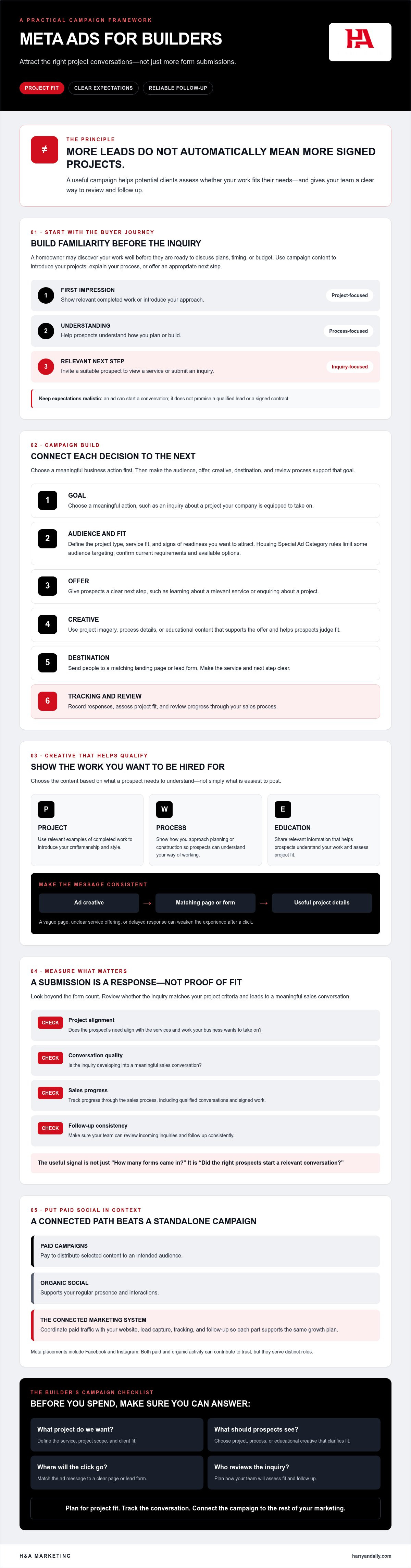
More leads don’t automatically mean more signed projects. Meta ads for builders work best when campaigns attract people who fit your work, set clear expectations, and give your team a reliable way to follow up.
If you’re unsure which projects to promote, how to reach relevant prospects, or whether ad clicks are becoming real opportunities, you’re not alone. Meta’s Housing Special Ad Category limits some audience targeting, so builders need to use project details and creative to help prospects assess fit.
This guide explains how to plan, launch, and improve meta ads for builders around project fit, not just form submissions. You’ll learn how to structure campaigns, use photos and video to show the work you want, and ask useful qualification questions without making it harder for prospects to enquire.
You’ll also see how to connect ad responses with follow-up and business outcomes, including qualified conversations and signed work. The goal is a practical system that supports a longer buying journey, with Meta ads working alongside your website, lead capture, and ongoing marketing.
Key Takeaways
- Use Meta ads for builders to introduce your work before prospects are ready to enquire, and plan for a longer decision journey.
- Build each campaign around a relevant business action, then align the offer, creative, landing page, and tracking with that goal.
- Choose project, process, or educational creative based on what prospects need to understand about your work and project fit.
- Look beyond form submissions: check whether inquiries match your project criteria and lead to meaningful sales conversations.
- Coordinate paid traffic with your website, lead capture, and follow-up so each part supports the same growth plan.
Why Meta Ads for Builders Need to Support a Long Decision Journey
A homeowner may see a builder’s project long before they’re ready to discuss plans, timing, or budget. That makes meta ads for builders useful for more than collecting immediate inquiries. Paid placements across Meta platforms, including Facebook and Instagram, can introduce a builder’s work to potential clients during early research and offer an appropriate next step when they’re ready.
A custom home or construction project involves substantial decisions. Prospects may need time to compare approaches, understand the process, and decide whether a builder’s work suits their goals. A campaign can build familiarity with examples of completed projects, process details, and relevant information. It creates an opportunity to start a conversation, not a promise of qualified leads or signed contracts. Lead generation is the process of attracting and developing prospective customers. For a builder, its value depends on whether those prospects fit the work the business wants to take on.
What Meta Ads can do for a construction business
Paid campaigns can support different stages of the decision journey. A project-focused ad may introduce your craftsmanship to someone who hasn’t encountered your business. A process-focused ad can help a prospect understand how you approach planning or construction. An inquiry-focused ad can invite people with a relevant project to get in touch. These are campaign roles, not guaranteed outcomes.
Paid ads differ from organic social publishing. An ad campaign pays to distribute selected content to an intended audience, while organic posts and community management help maintain your regular presence and interactions. Both can contribute to trust, but they serve distinct roles. For more on coordinating campaigns with lead capture, see construction lead generation.
Which builders are best positioned to test paid social
Before spending on ads, define the projects you want and the clients they suit. Be ready to describe the services being promoted, show credible work, and offer a clear next step, such as viewing a relevant portfolio or submitting an inquiry with useful project details.
Strong creative can help prospects judge fit, but the experience after the click matters too. If the landing page is vague, the service offering is unclear, or inquiries sit without a timely response, relevant interest can fade. Check that your team can review incoming inquiries, identify project fit, and follow up consistently. Paid traffic works best as part of a connected path from ad creative to lead capture and conversation, not as a standalone fix for unclear positioning or weak follow-up.
How to Build a Meta Ads Campaign for Builders
Effective meta ads for builders start with a business goal, not a setting in Ads Manager. Choose an action that matters, such as an inquiry about a project your company is equipped to take on. Then map a clear path from the prospect’s first impression to that action, and decide how you’ll assess the inquiries afterward.
Use this sequence to plan the campaign:
- Goal: Choose a meaningful business action, such as a relevant project inquiry.
- Audience: Define the project type, service fit, and signs of readiness you want to attract. For housing-related advertising, confirm current Special Ad Category requirements and available targeting options.
- Offer: Give prospects a clear next step, such as learning about a relevant service or enquiring about a project.
- Creative: Select project imagery, process details, or educational content that supports the offer.
- Destination: Send people to a matching landing page or lead form.
- Tracking and review: Record responses, assess project fit, and review progress through your sales process.
Set the campaign goal and define the right prospect
Be specific about the opportunity you want to create. A custom-home inquiry and a commercial construction opportunity may call for different messages, proof, and follow-up. Define the service, project scope, and client fit before choosing an audience. Decide which details your team needs to know before determining whether a prospect is ready for a sales conversation.
Agree on what counts as a meaningful inquiry. A form submission is a response, not proof of fit. Your sales process should distinguish prospects whose projects align with your services from those whose needs don’t. Keep each campaign focused on one audience need and one offer. Combining unrelated services or project types makes it harder to tell which message attracts relevant prospects.
Connect the ad, destination, and tracking
The destination should deliver what the ad promises. If an ad features a type of project, the landing page should explain the related service and make the next step clear. Consistent imagery, language, and project details help prospects recognize they’ve reached the right place. Keep claims accurate and consult the Federal Trade Commission’s truth-in-advertising standards when developing ad copy.
Before launch, confirm the available campaign objectives, interface labels, and tracking setup in Meta Ads Manager. Record the campaign source and inquiry details in your existing tracking or CRM process. Where possible, connect each inquiry to qualification and sales progress. Check that your setup captures the information your team needs, then review the records before making campaign changes.
Choose Builder Ad Creative That Shows Proof and Filters for Fit
Creative should help a prospect answer two questions: “Is this the kind of work I want?” and “Does this builder seem right for my project?” For meta ads for builders, strong visuals attract attention, while specific language gives people a clearer reason to enquire or recognize that the service isn’t a fit.
Match the creative to its job:
- Project-led: Show completed work to communicate the builder’s style, craftsmanship, and project types. Add context about the scope or service so viewers understand what they’re seeing.
- Process-led: Use a short video or walkthrough to explain an aspect of how the company works. This can help prospects understand the experience behind the finished result.
- Educational: Offer a useful explanation or planning resource that addresses a prospect’s questions before they’re ready to discuss a project.
These approaches serve different purposes, and none guarantees qualified inquiries. The goal is to make the work and expectations clear enough for prospects to assess their fit.
Which creative formats can builders test
Choose formats that suit the story and assets you have. A still photograph can highlight a defining detail, while a short video or project walkthrough can show how spaces connect or how work progressed. Jobsite content can add context, but use footage that accurately represents your business and the work you perform. Don’t present another company’s project or an unrepresentative finish as your own.
Consistent, professional media can make it easier to show the quality and character of your work. Explore construction photo and video services for support creating visual assets.
How to make the offer and call to action more specific
Replace broad claims like “We do construction” with a clear description of the service and intended prospect. For example, identify whether the ad is for custom-home projects or a particular construction service, then invite people with a relevant project to enquire. State what happens next, such as a conversation to understand the project and assess fit. Don’t imply a timeline, price, or commitment your business can’t confirm.
Test one meaningful change at a time, such as the project shown or the wording of the offer. Track not only responses but also whether inquiries match your project criteria. Clear ads set better expectations, and a consistent follow-up process helps your team respond to interest. Harvard Business Review’s discussion of how quickly online leads go cold is a useful reminder to plan who handles inquiries and what happens after someone responds.
Measure Meta Ads by Lead Quality, Not Just Form Submissions
A higher inquiry count doesn’t automatically mean a stronger pipeline. For meta ads for builders, measure what happens after someone responds: does the project fit your services, does the prospect move into a useful sales conversation, and is there a clear next step? A campaign can generate activity without attracting the opportunities your business needs.
Separate platform indicators from sales outcomes. Delivery and engagement measures, such as reach, clicks, and form submissions, show whether people are seeing and responding to an ad. They don’t show whether an inquiry is a good fit. Track sales measures such as:
- Whether the project matches the services you promote
- Whether the prospect is ready for a conversation about the work
- Whether your team made contact and agreed on a next step
- Whether the inquiry progressed to a sales opportunity
Use your own consistent records as the comparison point. Don’t treat an outside benchmark as a target without considering your project types, sales process, and definition of a qualified inquiry.
Track the path from ad response to sales conversation
Record the campaign source alongside each inquiry, then capture the project details your team needs to assess fit. Keep records useful and consistent: service or project type, fit status, follow-up action, and current sales stage. A CRM or another reliable tracking process can connect the initial response with later qualification and follow-up. Confirm the setup works before relying on the data.
This gives marketing and sales a shared view of what an inquiry became, rather than leaving campaign reports disconnected from conversations. The record is only useful if the people handling inquiries update it consistently.
Use results to improve the next campaign decision
Review campaign data with the people handling inquiries. If engagement is strong but project fit is weak, the offer or creative may be too broad. If inquiries appear relevant but don’t progress, check the landing page, qualification questions, and response handling before changing audience settings. The issue may be somewhere after the click.
Change one meaningful element at a time and document what changed, what the inquiries looked like, and what sales feedback revealed. Over successive reviews, you’ll build a practical record to help decide which messages deserve more attention and which need refinement.
Use these findings to shape your next construction lead generation campaign.
Make Meta Ads Part of a Connected Marketing System for Builders
Meta ads work best when every step supports the same business goal. Strategy defines the projects and prospects you want to attract. Creative shows why your work is relevant. Paid traffic puts that message in front of people, while your website and lead capture process give interested prospects a clear next step. If one part is unclear, a campaign can attract attention without helping your sales pipeline.
Connect Meta campaigns with the builder website and sales process
Before sending traffic to a page, check that it answers the prospect’s immediate questions: What services do you provide? What type of project is a fit? What should someone do next? The page should continue the promise made in the ad, with matching language and relevant project details. A general homepage may not give a prospect enough context to enquire confidently.
Review construction web design if your website needs to communicate services, project fit, or inquiry steps more clearly. Ongoing social media management can also help keep your organic presence active alongside paid campaigns, but paid ads and organic publishing have distinct roles. Connect both to the same positioning and project priorities.
Decide what to handle internally and where to get help
Your team brings project knowledge an outside partner can’t assume. Keep these responsibilities close to the business:
- Define which projects and clients are a strong fit.
- Share sales feedback about inquiry quality and common prospect questions.
- Assign responsibility for responding to inquiries and recording the next sales action.
Specialist support may help when your team lacks time or capability to plan campaigns, produce suitable creative, manage paid traffic, or connect campaign activity with lead capture and tracking. Clarify responsibilities before launch: who approves project claims, who reviews inquiries, and how does sales feedback reach the people improving the campaign?
H&A Marketing offers services for construction companies including website design, lead generation, social media management, and professional photo and video production. The right support depends on where your process needs attention. Keep your business involved in project fit and sales feedback, and get help with gaps your team can’t reasonably cover.
Build a Clearer Path from Ad Click to Project Opportunity
Meta ads for builders are most useful when they support the full decision journey, not just the first response. Choose a clear project goal, use authentic creative that shows the work and sets expectations, then track whether inquiries become relevant sales conversations.
Keep the campaign connected to the rest of your marketing. The ad, website, lead capture, and follow-up should make the same promise and help prospects understand what happens next. Review lead quality with your sales team before deciding what to change. More submissions alone don’t show whether a campaign is building the right pipeline.
H&A Marketing works with construction companies on lead generation and social media management, alongside website design and professional photo and video production. Request a free quote to discuss how these services could support your marketing priorities.
With a clear plan and consistent follow-up, your next campaign can give suitable prospects a stronger reason to take the next step.
Frequently Asked Questions
Are Meta Ads effective for builders?
Meta Ads can help builders introduce their work, build familiarity, and invite relevant prospects to enquire, but results depend on the campaign and what happens after a response. Use clear project details and creative that reflects your actual work. Then assess whether inquiries fit your services and progress into sales conversations. Ads create opportunities; they don’t guarantee qualified leads or contracts.
How do builders get qualified leads from Meta Ads?
Start by defining the project types and clients your business can serve well. Build an ad around one relevant service or offer, and send prospects to a matching page or form that explains the next step. Ask only for information that helps assess project fit. Track each response through follow-up, and use sales feedback to refine the message and qualification process.
What should a builder advertise on Facebook and Instagram?
Promote work and services that reflect the projects you want to take on. A builder might feature a completed project, explain part of the building process, or offer useful planning information for prospective clients. State who the service is for and what happens after an enquiry. Use authentic photos or video, and avoid broad claims that could attract people seeking work you don’t provide.
How much should a construction company spend on Meta Ads?
There isn’t one budget that suits every construction company. Set a test budget based on what your business can commit while evaluating the campaign, your capacity to respond to inquiries, and the value of a suitable project. Define what you’ll measure before launch, including project fit and sales progress. Review your own consistent records before deciding whether to adjust spending, creative, or the offer.
Do builders need a landing page for Meta Ads?
A dedicated landing page isn’t required for every campaign, but the destination should match the ad and make the next step clear. A relevant service page or lead form can work if it explains what you offer, who the service suits, and how to enquire. Check the experience on mobile, remove confusing detours, and make sure submitted inquiries reach the person responsible for follow-up.
Can Meta Ads help custom home builders find suitable clients?
Yes, Meta Ads can help custom home builders present their projects to potential clients, but no ad format can guarantee a suitable match. Show work that represents your design approach and describe the types of projects you’re seeking. Use the landing page and inquiry questions to clarify project fit. Then have your team assess each prospect through a conversation about their goals and needs.
How should builders measure whether Meta Ads are working?
Measure both campaign activity and business outcomes. Reach, clicks, and form submissions show whether people saw or responded to an ad, but they don’t establish lead quality. Record the campaign source, project details, fit, follow-up, and sales stage for each inquiry. Review those records with your sales team and compare campaigns using your own consistent definitions, rather than relying on submission volume alone.
