
Marketing for Design-Build Firms: Proven Growth Plan

Article by
Harry Stanley III
Harry Stanley III is a construction marketing strategist and fractional CMO at H&A Marketing. He has helped construction companies grow through website strategy, SEO, paid advertising, branding, lead generation, CRM systems, and professional content. His past work includes helping Meraki Solar generate an additional $3.7 million in revenue in his first year and supporting American Builders as a fractional CMO. Today, Harry works directly with custom home builders and construction companies to build marketing systems designed to generate qualified leads and measurable growth.
A design-build project can give clients a more coordinated experience, but that advantage gets lost when your website, portfolio, campaigns, and sales follow-up tell different stories. Effective marketing for design-build firms connects each touchpoint to the same promise: one team guiding a project from concept through construction.
If your marketing looks busy but still brings in low-fit inquiries, look at how the pieces work together. Design-build clients often compare firms, review project proof, and consider who they trust with a major investment. The goal isn’t simply to generate more leads. It’s to make your approach clear and credible, so the right prospects can decide whether to take the next step.
This guide lays out a practical growth plan, from positioning and project storytelling to website design, SEO, paid traffic, visual content, and lead capture. You’ll see how to coordinate these efforts, connect inquiries to sales follow-up, and track pipeline progress without expecting every marketing touchpoint to produce an immediate sale.
Key Takeaways
- Explain your design-build process so prospects understand how design judgment and construction expertise work together.
- Build marketing for design-build firms around the buyer journey, with each channel helping prospects move from discovery to inquiry and follow-up.
- Give each marketing channel a specific job, then track whether it attracts the project opportunities you want.
- Set project-fit goals before choosing campaigns. Audit your assets and prioritize gaps that could weaken your pipeline.
- Coordinate strategy, creative, traffic, and lead capture so your website, SEO, ads, CRM tracking, and project media support one another.
Why Marketing for Design-Build Firms Must Sell the Whole Project Experience
Design-build marketing needs to explain more than a finished home or building. It should connect a first impression to a useful next step: how the firm approaches a project, what its team handles, what the work looks like, and how a prospective client can start a conversation. Buyers are assessing both the design and the people responsible for delivering it, so those details need to reinforce one another.
Design-build is a project delivery system in which design and construction services are contracted by a single entity. For marketing, the firm’s value lies in showing how these capabilities work together, rather than presenting them as unrelated services. A custom home client may be drawn to a distinctive design, then look for evidence that the builder can carry it through construction. A commercial prospect may want to understand the firm’s relevant experience and working approach before making an inquiry.
Design-build marketing connects consistent project proof to inquiries from clients whose needs fit the firm’s work. A higher lead count alone doesn’t show whether marketing is attracting the right projects. A more promising inquiry has a project type, expectations, and timing that appear aligned with the firm’s capabilities. Marketing can set that context before the first sales conversation. Follow-up helps determine whether the fit is real.
What makes marketing a design-build firm different?
Design and construction form one client proposition, so marketing should show how decisions in one phase inform the next. A portfolio of attractive spaces that says nothing about the firm’s role leaves questions about its process. Construction details without design context may also make it difficult for a homeowner to understand the finished experience.
Show the judgment behind the work as well as the result: the client’s priorities, the design choices, and how the team carried the project forward. This gives prospects a clearer basis for evaluating both creative decisions and delivery capability.
What should a prospective client understand first?
Make the basics easy to find: the project types the firm takes on, the clients it serves best, and what distinguishes its working approach. Portfolio pages can make those points tangible by pairing strong project visuals with a concise explanation of the brief, the firm’s contribution, and the completed work. For construction website design, that clarity helps visitors connect project proof to services and the inquiry path.
Then state the next step plainly. Tell prospects what information to share, such as project type and broad goals, and what happens after they submit an inquiry. Keep the request focused. A clear path makes it easier for a well-matched prospect to start a conversation without implying that every inquiry is a suitable project.
How a Connected Design-Build Marketing System Moves Buyers Forward
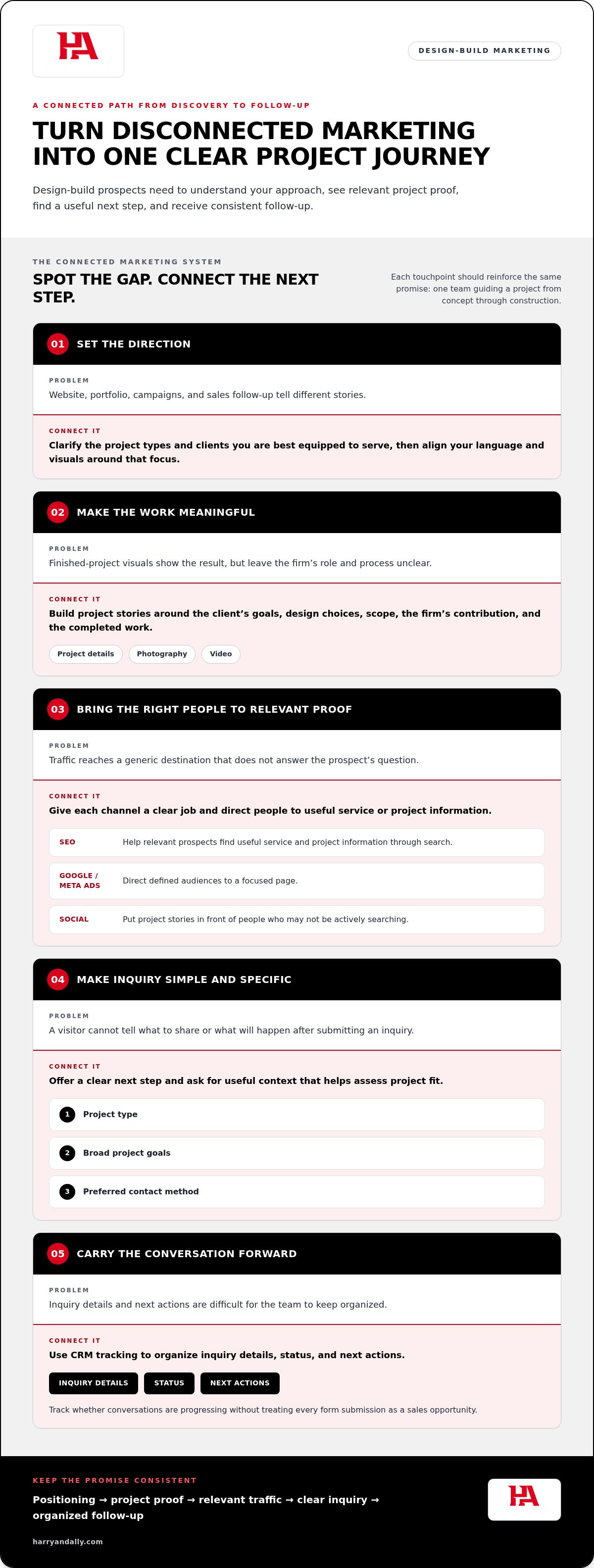
Marketing for design-build firms works best as a connected path, not a stack of channels. Each step should help a prospective client understand the firm, see relevant proof, find a useful next step, and receive consistent follow-up. A homeowner planning a custom home might discover a firm through search, review a project page, and submit an inquiry. The website, content, and sales process should carry a consistent message through each step.
- Clarify positioning. Define the project types and clients the firm is best equipped to serve. Use that focus to guide the language and visuals across your marketing.
- Create proof. Build project stories from details the firm can substantiate, such as the client’s goals, design choices, scope, and the firm’s role. Professional photography and video can show the completed work and communicate its character.
- Attract attention. SEO helps relevant prospects find useful service and project information through search. Google or Meta Ads can direct defined audiences to a focused page. Social distribution can put project stories in front of people who may not be actively searching.
- Capture inquiries. Give each visitor a clear next step, such as sharing a project type, goals, and preferred contact method. A well-structured construction website connects that invitation to relevant project information.
- Track follow-up. Use CRM tracking to organize inquiry details, status, and next actions. This helps the team see which conversations need a response and whether inquiries are progressing, without treating every form submission as a sales opportunity.
Connect project storytelling to the right audience
A project narrative should help a prospect decide whether the firm’s experience fits their needs. A custom home project page, for instance, could explain the homeowners’ priorities, the design decisions that addressed them, and how the firm coordinated the work. Keep claims tied to project records and approved details. Photos and video provide useful proof when they clearly show the design, materials, and finished spaces, rather than serving as decoration alone.
Make discovery lead to a useful next step
Search visibility and paid traffic matter when they lead to information that answers the visitor’s question. Someone researching a design-build firm should land on a page that explains relevant work and offers a clear inquiry path, not a generic homepage with no direction. The U.S. Census Bureau’s construction spending data can provide broader market context as firms assess business priorities.
Keep inquiry forms focused on details that support a useful first conversation. Then record the source, project type, and follow-up status in your CRM process. That gives the team a clearer view of which channels prompt relevant conversations and where prospects may be dropping out. If the destination or follow-up process is unclear, address that gap before expanding campaign activity.
When discovery leads to a clear next step and consistent follow-up, each channel has a defined role in supporting the firm’s pipeline.
Which Marketing Priorities Fit Your Design-Build Firm?
There’s no useful channel mix without a clear business goal. A custom home builder seeking premium residential projects may need stronger portfolio pages and search visibility. A firm pursuing commercial opportunities may need relevant project proof and a consistent way to manage follow-up. Prioritize based on project type, audience, sales capacity, and the assets you already have, not on what’s trending.
Use this comparison to identify what each channel needs before you invest more time or budget:
Website and SEO
Objective: Help prospects researching design-build services find relevant information.
Channel role: Explain services, project fit, process, and experience.
Readiness needed: Useful service pages, accurate project details, and a clear inquiry path.
Signal to track: Relevant search visits and inquiries tied to target projects.
Paid traffic
Objective: Put a focused offer or project page in front of a defined audience.
Channel role: Bring targeted visitors to a relevant destination.
Readiness needed: A clear audience, landing page, inquiry process, and follow-up owner.
Signal to track: Inquiry fit and progress after first contact, not clicks alone.
Social distribution
Objective: Keep project work visible and reinforce the firm’s approach.
Channel role: Share project stories and direct interested people to deeper information.
Readiness needed: A supply of accurate, useful content and a consistent publishing owner.
Signal to track: Engagement that leads to visits, project-page views, or meaningful conversations.
Photo and video
Objective: Make the firm’s work and process easier to understand.
Channel role: Provide visual proof for the website, search content, ads, and social posts.
Readiness needed: Clear project goals for each shoot and permission to use the material.
Signal to track: Whether the content supports useful project conversations and channel activity.
Choose channels by project fit, not trend
Start with buyer intent. Search-focused content can answer questions from people actively researching a design-build firm. Social platforms help distribute relevant project stories and maintain visibility between active searches. Paid campaigns make more sense when you can define an audience, send visitors to a relevant page, and handle resulting inquiries. If the destination or follow-up is unclear, address that first.
Measure progress beyond inquiry volume
Track whether inquiries match your preferred project types, whether prospects move into substantive conversations, and where follow-up stalls. Keep early awareness signals, such as reach or page visits, separate from sales signals, such as a qualified conversation or an opportunity under discussion. Review patterns to refine messaging, channel focus, or lead handling. For broader pipeline planning, use this construction lead generation guide to connect marketing activity with sales follow-up.
Choose your next priority by identifying the weakest link: visibility, project proof, inquiry capture, or follow-up. Strengthening that point gives each channel a clearer job and helps the team judge progress by project fit, not raw activity.
Build a Practical Marketing Plan for a Design-Build Firm
A useful plan gives every marketing task a purpose and an owner. It separates foundational work, such as clear positioning, project pages, and inquiry tracking, from campaign activity like paid ads or social promotion. Build the foundation first so campaigns have a relevant destination and someone ready to handle the response.
Use this sequence to shape a plan around the projects your firm can deliver well:
- Set project-fit goals. Describe the work you want, the clients it suits, and the signals that make an inquiry promising. Include your team’s capacity to respond and take on new projects. Aim for more relevant conversations, not simply more form submissions.
- Audit your assets. Review your website, service information, portfolio, photography, search visibility, campaign pages, and inquiry process. Note what’s current, what’s missing, and whether each asset supports the project types you want to attract.
- Prioritize the gaps. Fix issues that could weaken the path from discovery to follow-up before adding campaign activity. If paid traffic needs a focused destination, make sure the page matches the campaign message and gives visitors a clear next step.
- Assign ownership. Name who is responsible for strategy, creative production, traffic, inquiry capture, and sales follow-up. One person may cover several roles, but every task needs a clear owner and handoff.
- Review signals. Use your own tracking to establish a baseline before setting improvement goals. Review inquiry quality, response handling, and movement through sales stages, then document what you learn.
Set goals around the projects you want to win
Make the goal specific enough to guide decisions. For example, a firm focused on custom homes might define the design preferences, project scope, and client expectations that fit its work. A commercial builder might prioritize a particular type of opportunity or relationship. These are planning examples, not performance promises. Use what your team can deliver, and compare inquiries against those criteria.
Record current patterns before changing channels or setting targets. Track where inquiries came from, whether they fit, how quickly the team handled them, and what stage they reached. Your baseline gives future reviews context. It also helps distinguish a shift in opportunity quality from a temporary rise in website visits or social engagement.
Turn the plan into an operating rhythm
Put a recurring review on the team calendar. Look at what prospects asked, which sources prompted qualified conversations, where follow-up slowed, and whether active opportunities moved forward. Keep awareness measures, such as reach and visits, separate from sales-stage signals. They answer different questions.
Adjust one priority at a time, then record the reason and what the team will watch next. If the firm changes a landing page, campaign audience, and follow-up step all at once, it becomes harder to tell which change mattered. A steady review rhythm keeps the plan practical without relying on arbitrary targets.
Discuss a connected marketing plan
How H&A Marketing Connects Design-Build Strategy to Lead Capture
Marketing for design-build firms needs coordination across four jobs: strategy, creative, traffic, and lead capture. If each is handled in isolation, a polished campaign can lead to a page that doesn’t answer the prospect’s questions, or strong project content can go unseen by the right audience. H&A Marketing brings these parts together as a connected marketing system, with each activity supporting a clear business priority.
The right mix depends on the firm’s goals and current marketing gaps. Website design gives visitors a place to understand the firm’s approach and explore its work. SEO helps prospects discover relevant services. Social media management keeps project stories in circulation, and lead generation supports the path from interest to inquiry. Professional photo and video help show the work. Each activity has a distinct role, and the handoffs matter as much as the individual channel.
What connected support looks like in practice
Start with a shared message about the projects the firm wants and the way it works. Carry that message into the website, project content, and campaigns so prospects see a consistent story. Professional visuals should reinforce that story with real, approved project details. For example, a campaign for custom homes could lead to a page with relevant portfolio work and a straightforward inquiry path, rather than a general page with no clear next step.
Then connect the destination to follow-up. Record inquiries with enough context for the team to understand what the prospect is looking for and where the conversation stands. This is the practical link between lead generation and sales follow-up: a campaign starts the path, and the team can see what happened after the inquiry arrived. H&A’s construction lead generation support can align that capture path with the firm’s broader pipeline priorities.
Choose a clear next step for your firm
A useful starting conversation identifies where the current system is breaking down. Is the firm’s positioning unclear? Are project visuals hard to find? Do campaigns lack focused destinations, or are inquiries difficult to track through follow-up? The answer helps determine which work should come first. H&A works with construction businesses to coordinate strategy and execution around their needs, rather than treating every channel as a separate task.
Bring your priority project types, current marketing concerns, and sales follow-up process to the discussion. That gives the team a practical basis for considering how website design, SEO, social media, visual content, and lead capture should fit together. The goal is a clear, credible marketing path that supports better-informed inquiries and makes pipeline progress easier to review.
Ready to connect your marketing activity to the projects you want? Discuss your design-build marketing strategy with H&A Marketing.
Make Your Next Marketing Move Count
The next step doesn’t have to be a complete overhaul. Choose one point where your marketing loses momentum: prospects aren’t finding the right project information, your message doesn’t reflect the work you want, or inquiries aren’t receiving consistent follow-up. Focus there first, and give the team a clear way to judge whether the change is helping attract better-fit conversations.
That’s a practical starting point for marketing for design-build firms: connect each improvement to the projects you want to pursue and the experience you want prospective clients to have. A considered plan can make marketing easier to manage and give your sales team clearer context as conversations develop.
Ready to identify your priorities? Request a free quote from H&A Marketing to discuss a connected marketing plan.
Frequently Asked Questions
How do design-build firms explain the difference between their approach and hiring separate professionals?
Explain how your team coordinates design and construction decisions under one project approach, rather than criticizing other ways of working. Describe who guides the client through key choices, how design intent informs construction planning, and how communication is handled across the work. A simple process diagram or short walkthrough can make the distinction clear. Keep the comparison factual and focused on what clients can expect from your firm.
What content helps a design-build firm attract qualified projects?
Publish practical material that helps a prospect decide whether your firm fits their project. For example, create a guide to early decisions involved in planning a custom home, a comparison of material options your team works with, or answers to common questions about your process. Add clear context about the projects you take on. Useful content helps prospects arrive with better questions, not just more information.
Should a design-build firm use social media if most projects come through referrals?
Yes. Social media can support referrals by giving past clients, partners, and prospects something current to share or review. A referral may check your profiles before reaching out, so keep information consistent with your website and feature work that reflects the projects you want. Focus on useful posts rather than constant promotion, such as a design detail, a completed space, or a short explanation of a project decision.
How can design-build firms tell whether marketing is producing the right leads?
Define a good-fit inquiry using criteria your team can apply consistently, such as project type, scope, client expectations, and fit with current capacity. Then record those details alongside the source and outcome of each inquiry. Review patterns across meaningful sales conversations, not just form submissions. This gives marketing and sales a shared way to assess quality and spot mismatches in the message, audience, or qualification process.
How much should a design-build firm spend on marketing?
There isn’t one budget that fits every firm. Set spending based on your growth priorities, available sales capacity, and the work required to maintain useful marketing assets. Separate ongoing needs, such as SEO or social media management, from project costs like website development or visual content. Then decide what you can fund consistently and review whether that investment supports the project types you want to pursue.
How long does design-build marketing take to generate qualified inquiries?
There’s no reliable timeline that applies to every firm. Results depend on factors such as existing visibility, project demand, the quality of your website and content, campaign activity, and how quickly inquiries receive follow-up. Paid campaigns may generate visits after launch, while organic visibility generally needs sustained work. Assess progress over time, including inquiry fit and sales-stage movement, rather than expecting a fixed date for qualified opportunities.
