
Contractor Websites: A Practical Guide to Earning Better-Fit Project Inquiries


Article by
Harry Stanley III
Harry Stanley III is a construction marketing strategist and fractional CMO at H&A Marketing. He has helped construction companies grow through website strategy, SEO, paid advertising, branding, lead generation, CRM systems, and professional content. His past work includes helping Meraki Solar generate an additional $3.7 million in revenue in his first year and supporting American Builders as a fractional CMO. Today, Harry works directly with custom home builders and construction companies to build marketing systems designed to generate qualified leads and measurable growth.
A contractor website should do more than display finished projects. It should help the right homeowner, developer, or project owner recognize that your company handles the work they need, understands how to deliver it, and offers a clear next step. If contractor websites bring visitors but few suitable inquiries, the gap may not be the quality of your portfolio. Prospects may simply lack enough information to judge fit.
Project photos matter, but they can’t explain your process, project types, service area, or what happens after someone reaches out. Builders and construction companies need a site that answers those questions while building confidence with specific service information and relevant proof.
This guide shows how to make your website communicate who you work with, what projects you take on, and how to start a conversation. We’ll cover the content that helps visitors assess fit, the trust details worth prioritizing, and how to connect your site with search, advertising, visuals, and lead tracking. The goal isn’t more inquiries at any cost. It’s a clearer path from early research to a better-fit project inquiry.
Key Takeaways
- Use your website to qualify projects by making your services, project types, and ideal client fit easy to understand.
- Guide visitors from initial research to relevant project examples, then make the next step clear.
- Give project photos useful context with accurate descriptions that show the scope and work involved.
- Audit contractor websites in order: improve clarity and credibility first, then address navigation, design, SEO, and tracking.
- Connect website content with search, advertising, project media, and lead tracking so each part supports a consistent message.
Why Contractor Websites Need to Qualify Projects, Not Just Look Professional
A polished portfolio can catch a visitor’s eye, but it can’t answer every question behind a serious project decision. A homeowner planning a custom build and a commercial buyer evaluating construction partners need to understand more than what your finished work looks like. They need to see whether your company handles the kind of project they have in mind, how you approach the work, and what to do next.
A contractor website is a business tool that explains a company’s services and project fit, establishes credibility, and helps prospective clients take a clear next step. A website can take different forms, as outlined in this overview of what a website is, but its value to a construction company depends on how well it communicates to the people considering its services.
That’s the difference between visual polish and business usefulness. Strong design supports the message; it doesn’t replace clear service information, relevant project context, or an understandable inquiry path. For a closer look at construction-specific website design, see construction web design.
What should a contractor website help a prospective client understand?
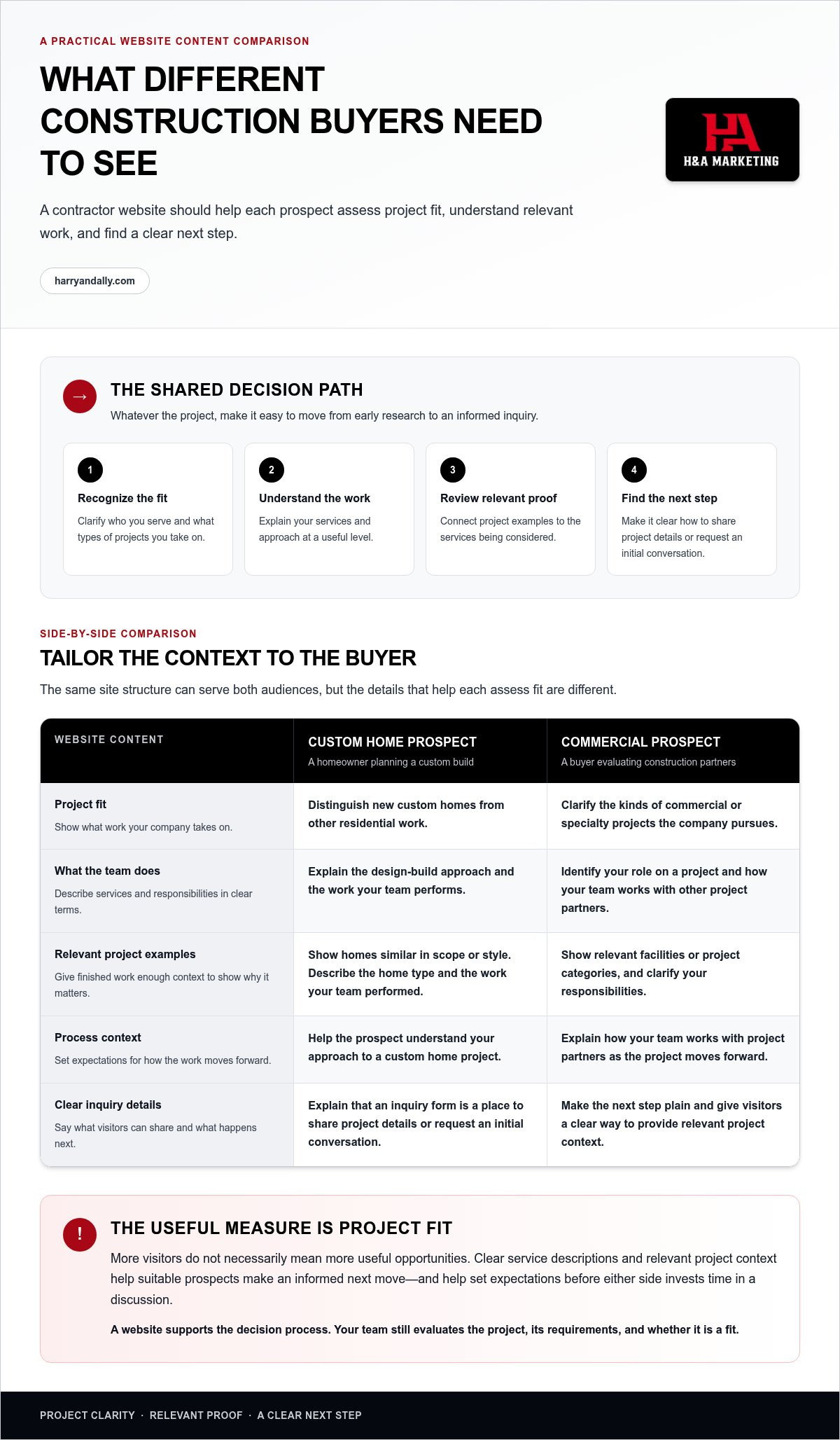
Within a short visit, someone should be able to tell who you serve, what types of projects you take on, and what work your company performs. A custom home builder might distinguish new custom homes from other residential work. A construction company might clarify the kinds of commercial or specialty projects it pursues. Specific language helps visitors compare their needs with your actual scope.
Then make it easier to assess fit before starting a conversation. Explain your process at a useful level, show relevant examples, and describe the next step plainly. For instance, tell visitors whether the inquiry form is where they can share project details or request an initial conversation. Avoid suggesting that submitting a form means the project is automatically a match.
Why project fit matters more than website traffic alone
More visitors don’t necessarily mean more useful opportunities. If the site leaves project scope or company fit unclear, it may attract inquiries that don’t align with the work you want to pursue. Clear descriptions help set expectations before either side invests time in a discussion.
For contractor websites, the practical goal is to help suitable prospects make an informed next move, not to promise a contract from every visit. The site supports the decision process; your team still evaluates the project, its requirements, and whether it’s a fit.
How Contractor Website Structure Guides Visitors from Research to Inquiry
A useful site takes prospects through a straightforward sequence: help them recognize that they’re in the right place, answer their key questions, show relevant work, then make the next step easy to find. Each page should move that decision forward. A visitor shouldn’t have to piece together your services from scattered portfolio captions or hunt for a way to get in touch.
Homeowners and commercial prospects may need different context. Someone planning a custom home may want to understand your design-build approach and see homes similar in scope or style. A commercial buyer may look for the types of facilities or projects you handle, your role on a project, and how your team works with other project partners. Organize the site so each audience can find the information that matters to them.
Organize contractor website pages around real buyer questions
Give core pages distinct jobs. A service page explains the work you take on and who it serves. A process page sets out what a prospective client can expect as a project moves forward. An about page gives useful background on the company and team. These pages can reinforce one another without repeating the same overview word for word.
Keep contact options visible, but don’t turn every section into a pitch. A clear “Discuss a project” link can lead to a form that asks for relevant context, such as project type, location, and a brief description. Visitors should know what information to share and what the inquiry is for, without being led to assume every submission is automatically a fit.
Connect project evidence to the services being considered
A project example is more useful when visitors can connect it to the service they’re researching. Explain the project’s general scope, the company’s role, and details that help a prospect understand why it’s relevant. For a custom home, that might mean describing the home type and the work your team performed. For a commercial project, clarify the project category and your responsibilities.
Then make it easy to continue exploring. Link from a service page to related work, from a project example back to the relevant service, and from both to inquiry details. Clear labels such as “View custom home projects” or “Discuss a commercial project” tell visitors what to expect before they click. Avoid vague links that leave people guessing.
The aim is a connected path, not a maze of pages. Review your navigation from the perspective of a homeowner and a commercial prospect: can each find relevant services, evidence, and a next step without starting over? If not, clarify the page roles and navigation before adding more pages or features.
What Makes Contractor Website Content Credible to Homeowners and Commercial Buyers?
Strong design can make a company look polished, but design alone doesn’t establish credibility or show whether a project is a fit. Prospective clients need evidence they can interpret. A gallery of attractive builds may catch attention, yet without context, visitors can’t tell what work the company performed, what kind of project they’re viewing, or whether it resembles their own needs.
Useful proof connects project examples to your services and the questions clients are weighing. A custom home buyer may want to understand the home’s scope and your team’s role. A commercial prospect may need clarity about the project category and the work your company handled. Accurate descriptions give each audience something concrete to assess. Claims like “the best quality” or “industry-leading results” don’t provide that context unless they’re backed by specific, supportable evidence.
Present construction projects with useful context
For each project, share the details you can stand behind: project type, general scope, relevant constraints, and your company’s contribution. A concise caption can explain what a photo shows and which service it illustrates. Don’t add client names, outcomes, testimonials, or performance figures unless they’re accurate and approved for use.
Professional project photography and video can make this evidence easier to understand. Pair visuals with brief descriptions rather than expecting images to explain themselves. Explore construction photo and video services for ways to present project work with visual context.
Build trust with clear, consistent business information
Keep service descriptions, process details, and inquiry expectations consistent across the site. If one page describes your company as a custom home builder while another suggests a broader or different scope, visitors may be unsure what work you actually take on. Use direct language to explain the projects you pursue and what information is useful when someone reaches out.
Use genuine team and project imagery where available, and let specific details do the work instead of relying on generic claims of excellence. A clear project description can show care and experience without making promises about future results. That same discipline helps set the stage for a more relevant inquiry. For additional guidance on attracting suitable prospects, see H&A Marketing’s construction lead generation guide.
How to Prioritize Contractor Website Improvements Before a Redesign
A full redesign isn’t always the first move. Start by tracing the path a prospective client takes, from landing on a page to deciding whether to inquire. Look at the questions people ask during sales conversations and compare them with what the site actually answers. That review can reveal simple content or navigation fixes before you invest in larger design work.
Start with the questions prospects ask before contacting you
Review recent conversations with homeowners and commercial prospects. Note recurring questions about project types, services, process, timing expectations, and what information to provide when reaching out. Then check whether the answers are easy to find on your site, accurate, and consistent across relevant pages.
Use this sequence to prioritize improvements:
- Clarity: Make your services, project scope, and ideal fit easy to understand.
- Credibility: Add accurate project details or team information where visitors need evidence.
- Navigation: Make important pages and contact options straightforward to find.
- Inquiry handling: Review forms and contact details, and make the next step clear.
Fix missing or confusing answers first. Updating a service description or clarifying a project example may be more useful than adding a new design feature. Consider a larger redesign when the site’s structure, visual presentation, or functionality prevents people from finding and using essential information.
Measure useful progress without inventing benchmarks
Once the basic path is clear, review how inquiries reach your team. If reliable analytics are available, track inquiry sources and the pages visitors use before contacting you. A CRM can help connect website inquiries with follow-up and the project qualification process, so you can assess whether the site is attracting conversations relevant to the work you pursue.
Use these records to learn, not to chase an unsupported conversion target. If inquiries often lack key project details, consider whether the site explains what information to share. If a source brings inquiries that rarely fit, review whether the messaging and landing page set accurate expectations. Contractor websites improve through informed decisions, not redesigns based on appearance alone.
For a focused review of your construction website priorities, discuss your website strategy.
Build Contractor Websites as Part of a Connected Marketing System
A website works best when the marketing around it points to clear, relevant information and the inquiries it captures are handled consistently. SEO, paid campaigns, project media, and follow-up shouldn’t operate as separate tasks with different messages. They should support the same positioning: what your company does, which projects it pursues, and what a suitable prospect can do next.
Connect the website to traffic, visuals, and lead capture
SEO can help prospects find service and project pages while they’re researching a construction partner. Google and Meta Ads can direct specific audiences to relevant information, such as a commercial service page or a custom home portfolio. The landing page should continue the message from the search result or ad, rather than sending every visitor to a generic homepage.
Professional photo, video, and drone content can help tell the story behind the work. Use project media alongside descriptions that explain the scope and your company’s role, so visuals support useful information instead of standing alone.
Then connect inquiries to a clear follow-up process. CRM tracking can help organize where inquiries came from, what project details they shared, and how conversations progress. That context is valuable for construction businesses with longer sales cycles, where an initial inquiry may be only the start of a considered decision. Tracking also helps the team learn which marketing activity is bringing inquiries that align with its project goals.
This is the connected marketing system: strategy shapes the message, creative makes it clear, traffic brings it to the right audience, and lead capture supports the next conversation. H&A Marketing coordinates these pieces for construction companies and custom home builders, including website design, SEO, Google and Meta Ads, CRM tracking, and professional visual content.
Choose the next step for your contractor website
Start with the most important gap. If visitors can’t tell which projects you take on, clarify the content. If your site is difficult to navigate or doesn’t support the inquiry path, consider a broader redesign. Custom home builders can explore custom home builder website design as a starting point for aligning site structure with business goals.
Contractor websites don’t need every marketing channel added at once. They need a clear priority and coordinated next steps. A connected plan can help align the site, traffic, project storytelling, and inquiry follow-up around the work you want to pursue.
Make Your Website the Start of a Better-Fit Project Conversation
For custom home builders and construction companies, contractor websites should do more than showcase completed work. They should make your services and project fit clear, provide useful context around your work, and guide prospective clients toward a straightforward next step.
Start with the gaps that matter most: unclear service information, project examples without context, or an inquiry path that’s hard to follow. Then consider how the website can work alongside the rest of your marketing. H&A Marketing provides website design tailored to construction companies and can coordinate it with SEO, paid ads, CRM tracking, and professional visual content. The goal is a connected system that supports prospects from research through inquiry, not a collection of disconnected marketing tasks.
You don’t have to tackle every improvement at once. Choose the next step that makes your company’s work clearer and helps the right prospects move forward with confidence.
Frequently Asked Questions
What should a contractor website include?
A contractor website should clearly explain the company’s services, project types, process, and next steps. Make relevant work easy to explore, with accurate descriptions that help visitors understand the project and your team’s role. Include straightforward contact options, such as a form or phone number. The right pages depend on your audience and services, so prioritize useful answers and credible project context over features that don’t address buyer questions.
How can a contractor website get more qualified leads?
Make project fit clear before trying to increase traffic. Explain the work you take on, the clients you serve, and what happens after someone makes an inquiry. Support that information with relevant project examples and easy-to-find contact options. Connect your site with suitable traffic sources and follow-up processes, then review which inquiries align with your project goals. More visitors alone don’t guarantee more suitable opportunities.
Do contractors need a separate page for every service?
No, separate pages aren’t necessary for every service. Give each important service enough space to explain its scope, intended client, and relevant project evidence. Separate pages can help when services address different buyer questions or require distinct examples. Combining services can also work if visitors can still understand what you offer and find the right information. Organize pages around prospect needs, not page count.
What should a contractor show in an online project portfolio?
Choose projects that reflect the work and clients you want to attract. Add accurate context where available, such as project type, scope, and your company’s role. Use captions to explain what the images show and how the work relates to your services. Don’t invent client names, outcomes, testimonials, or performance claims to make a portfolio seem more impressive. Clear, factual details give visitors useful evidence to consider.
How often should a contractor update their website?
Update your website when your services, project focus, process, or business information changes. Revisit pages when prospects repeatedly ask questions the site could answer more clearly. Treat updates as ongoing maintenance rather than following an arbitrary schedule. Check that project examples are accurate, contact details are current, and inquiry paths work as intended. Regular reviews help keep the information useful as your construction business evolves.
Is a contractor website enough to generate inquiries?
A website can explain your business and give prospective clients a way to inquire, but it’s only one part of marketing. Relevant traffic, credible project information, and consistent follow-up also play a role. Contractor websites can work alongside SEO or advertising and inquiry tracking to support the path from research to conversation. A website can’t guarantee leads or contracts, so review inquiry quality and adjust your approach based on what you learn.
How can a custom home builder website appeal to higher-end clients?
Present a consistent, polished brand and make your project approach easy to understand. Feature relevant portfolio examples with accurate context, professional photography, and clear service information. Explain how prospective clients can take the next step, and avoid unsupported luxury claims. A considered website experience can help homeowners assess whether your work aligns with their expectations. Explore custom home builder website design for a focused approach.
