


Article by
Harry Stanley III
Harry Stanley III is a construction marketing strategist and fractional CMO at H&A Marketing. He has helped construction companies grow through website strategy, SEO, paid advertising, branding, lead generation, CRM systems, and professional content. His past work includes helping Meraki Solar generate an additional $3.7 million in revenue in his first year and supporting American Builders as a fractional CMO. Today, Harry works directly with custom home builders and construction companies to build marketing systems designed to generate qualified leads and measurable growth.
Commercial roofing leads are won through proof, fit, and follow-through, not just a fast quote. Digital marketing for commercial roofers must speak to property owners, facility managers, and other decision-makers considering roof restorations, replacements, and ongoing maintenance. Unlike residential marketing, it needs to show that your company can handle commercial properties and support a longer, more considered sales process.
You already know a commercial project isn’t an impulse purchase. Buyers need clear information, confidence in your work, and a reason to include your company in the bid process. Marketing should answer those questions before the first call and help move the opportunity forward after an inquiry arrives.
This article explains how commercial roofing marketing differs from residential marketing, which digital mistakes can weaken your pipeline, and what to look for when assessing an agency. It also covers practical ways to manage reviews, build referrals, and turn maintenance opportunities into qualified conversations.
Key Takeaways
- Match Google campaigns to commercial roofing intent, then assess lead quality by project fit, not just inquiry volume.
- Use a clear, mobile-friendly website to show your commercial services, relevant project experience, and a straightforward path to inquire.
- Build a consistent review process: ask customers for feedback and respond professionally to both positive and negative reviews.
- Address facility managers’ and property owners’ needs with useful content that supports longer decisions about restorations and replacements.
- Make past customers and maintenance relationships part of your lead pipeline with thoughtful follow-up and referral outreach.
1. Common Digital Marketing Mistakes for Commercial Roofers
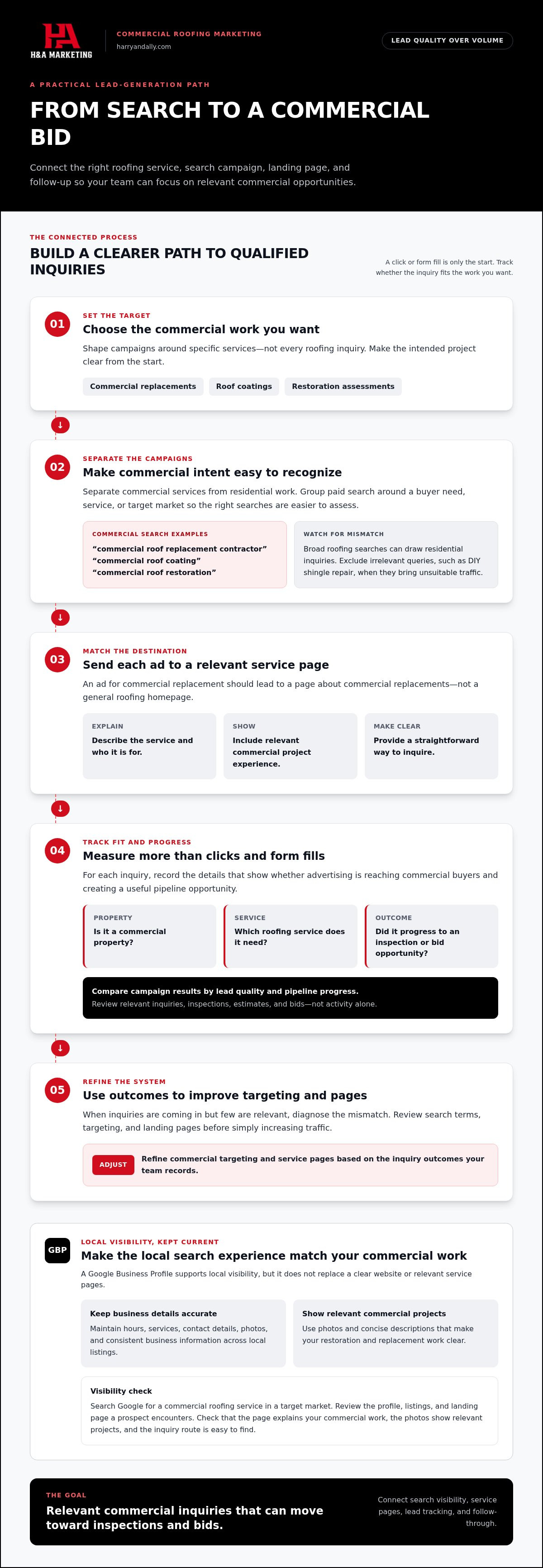
A common mistake is treating every roofing inquiry as a good lead. A homeowner searching for shingle repair has different needs from a facility manager planning a commercial restoration. Shape campaigns around the work you want, such as commercial replacements, coatings, or restoration assessments. Otherwise, broad advertising can generate activity without creating a useful path to the commercial bids your team wants.
Google Search campaigns can reach people looking for a roofing contractor, but broad keywords may attract residential inquiries. Separate commercial services from residential work in your campaign structure, then match each ad to a page focused on that service. For example, an ad for commercial replacement should lead to information about commercial replacements, not a general roofing homepage. Review search terms and exclude irrelevant queries, such as DIY shingle repair, when they attract unsuitable traffic.
Local Services Ads and Performance Max also need lead-quality tracking. Don’t judge campaigns only by clicks, calls, or form submissions. Record whether each inquiry concerns a commercial property, which service it needs, and whether it progresses to an inspection or bid opportunity. Compare results across campaigns to see which advertising reaches commercial buyers rather than simply generating online activity.
Local SEO can lose effectiveness when a roofing business treats its Google Business Profile as a one-time setup. Claim the profile, then keep its hours, services, contact details, and photos current. Describe commercial restorations and replacements clearly, and keep business details consistent across local listings. On your website, connect service keywords with the markets you serve. Avoid awkwardly repeating place names; publish useful information that reflects each market’s commercial roofing needs.
A Google Business Profile supports local visibility, but it can’t replace a clear website or relevant service pages. Keep the profile accurate and add project photos showing commercial properties and completed work. Include concise descriptions that identify the service and, where appropriate, the location. This context helps potential customers compare local listings and decide whether your company handles the property and project they need.
Try a simple visibility check: search Google for a commercial roofing service in a target market. Review the profile, listings, and landing page a prospect encounters. If the page doesn’t explain your commercial work, the photos show unrelated projects, or the inquiry route is difficult to find, prioritize those fixes. A coordinated commercial roofing marketing approach connects local search visibility with pages designed for qualified commercial inquiries.
2. What Makes a Great Roofing Digital Marketing Agency?
For paid search, prioritize phrases that identify a commercial service, buyer need, or target market. Examples include “commercial roof replacement contractor,” “commercial roof coating,” and “commercial roof restoration.” These terms make the intended project clearer than a broad search for “roofing company.” Separate campaigns by service so you can see which searches produce relevant commercial inquiries.
A capable agency connects campaigns to a website that supports commercial buyers’ decisions. Pages should explain the service, show relevant project experience, and make it easy to start a conversation. A property manager researching replacement needs a different next step from someone comparing coating options. Clear page structures help visitors find useful information without sorting through unrelated residential content.
Strong SEO also requires a content plan built around real commercial questions. A page about warehouse roof restoration should explain the service in terms that fit the property and the buyer’s intent. Related articles can answer questions about project planning, roof condition, or comparing restoration with replacement. Each page should have a distinct purpose and lead naturally to an appropriate service page.
When reviewing an agency’s paid-search work, ask how it defines a qualified lead. Raw cost per lead can hide whether inquiries concern commercial buildings, services you offer, or viable project scopes. Compare costs with lead quality and progress through your pipeline. Discuss how the agency handles unqualified inquiries and whether reporting connects advertising activity to inspections, estimates, and bids.
A useful agency report should help you make decisions, not just display campaign activity. Look for clear distinctions between commercial and residential leads, service categories, and inquiry outcomes. Ask how the team uses those findings to refine targeting and landing pages. If a campaign brings inquiries but few relevant opportunities, diagnose the mismatch instead of simply increasing traffic.
Social media advertising can reinforce search efforts with project-focused content. A commercial roof walkthrough or completed-job post can show the work’s scope and help buyers recognize relevant experience. The agency should explain how each piece supports a specific audience and action, such as visiting a service page or starting an inquiry. Track meaningful responses rather than relying on views alone.
Assess whether the agency can connect website structure, search visibility, advertising, and lead reporting under one plan. A coordinated commercial roofing marketing strategy should make it clear how each channel supports qualified project opportunities and what the team will adjust when results point to a gap.
3. Online reviews and reputation management
For commercial roofing contractors, reviews help property owners understand what working with your team may involve. Encourage customers to describe their experience, including how your crew handled communication, coordination, and project closeout. Those details give future buyers useful context beyond a general statement of satisfaction. Keep the request simple and timely, such as including it in your usual post-project follow-up.
Make review requests part of a repeatable closeout process. Assign a team member to send the request after the customer has had a chance to review the completed work. Use a direct link to the appropriate review page and a brief, neutral message. Don’t suggest what the customer should write. An honest account of the project is more useful than praise that sounds prepared by the contractor.
Respond to feedback with the same professionalism you bring to a jobsite. Thank customers for positive comments and acknowledge specific points they mention. If a reviewer raises a concern, respond calmly and invite them to continue the discussion privately. Don’t argue about the project publicly or disclose information about the customer, building, or contract. A measured reply shows readers that your team takes feedback seriously.
Review platforms can reveal issues that don’t appear in campaign reports. Monitor Google, Yelp, and Facebook for recurring comments about communication, scheduling, or project handoff. If customers repeatedly mention confusion about next steps, clarify those steps in your follow-up process. If they praise a particular part of the experience, use that insight to guide what your team tells future prospects.
Use testimonials with context. With the customer’s permission, pair a relevant comment with a project description identifying the work completed, such as a commercial roof replacement or restoration. Explain the challenge and scope without sharing private property details. A specific testimonial helps prospective buyers understand what the feedback refers to, rather than treating it as a stand-alone endorsement.
Keep review activity organized across the platforms your customers use. Track the date of each request, whether a review appeared, and any response that needs follow-up. This simple record helps your team maintain a steady process instead of requesting feedback only when someone remembers. It also makes unanswered comments easier to spot and prevents public conversations from going stale.
Use reputation feedback as an operating signal, not just a marketing asset. Share recurring themes with the people responsible for estimating, project coordination, and customer communication. For example, if reviewers often mention unclear schedule updates, decide who owns those updates and how customers receive them. Improving the customer experience gives future reviews a stronger foundation.
4. How does commercial roofing marketing differ from residential?
Commercial roofing marketing speaks to a buying group and a building, not just one homeowner and one roof. A property manager may gather information, an owner may approve the budget, and an operations lead may assess disruption. Content should help each person understand the project, compare options, and move toward a qualified conversation.
Commercial roofers can reach property managers through LinkedIn, useful email updates, and search-focused educational content. Share a practical post about signs a warehouse roof may need assessment, then link to a detailed service page. Follow up with an email explaining restoration, replacement, or coating options in clear terms.
Residential buyers often respond to immediate household concerns, such as a leak or visible storm damage. Commercial clients may need to plan around tenants, operations, budgets, and approval processes. A useful article could explain what information to gather before evaluating a commercial roof replacement, while a project page could describe how restoration work fits a building’s needs.
Educational content earns visibility by answering real questions before a prospect contacts a contractor. Build a content plan around the services you want to sell and the questions clients ask during sales conversations. For example, explain the differences between a roof coating and a full replacement, then describe the conditions that make each option worth discussing.
Search intent should shape every page. A visitor searching for “commercial roof restoration” needs a clear explanation of that service, while someone researching “commercial roof replacement cost factors” needs decision-making guidance. Use a focused page for each major service, supported by articles that answer related questions. This gives organic visitors a relevant next step instead of sending everyone to the homepage.
Thought leadership doesn’t require broad claims or constant publishing. Use project experience to explain a challenge, the options considered, and the reasoning behind the completed scope. A facility manager evaluating a roof coating project can learn from a clear explanation of the property’s needs and the work performed. Keep customer and building details private unless you have permission to share them.
Repurpose useful topics across channels without copying the same post everywhere. Turn a maintenance article into a LinkedIn summary, an email for existing contacts, and a reference for your sales team. Track which topics lead to replies, assessment requests, and bid conversations. Those signals show whether your content attracts qualified clients, not just page traffic.
Plan content around commercial services, buyer questions, and the next sales step. A coordinated commercial roofing marketing strategy can connect educational pages with search visibility and outreach to property decision-makers.
5. Customer referrals and maintenance marketing
Past commercial customers can create a valuable path to the next roof project. Make referrals part of project closeout, not an occasional request. Ask property owners who know your work to introduce you to another owner or facility manager with similar roofing needs.
Keep the request direct and easy to act on. After completing a restoration, replacement, or coating project, thank the customer and ask whether they know another property team that may need an assessment. Give them a short description of the projects you handle and the best way to reach you. A clear request helps customers recognize relevant contacts instead of asking them to promote your company broadly.
A referral program can formalize the process. Set out who may refer a prospect, what counts as a qualified introduction, and when you’ll follow up. Track the source in your lead records, from initial contact through inspection and bid. This helps you see which relationships generate commercial opportunities and follow up consistently with customers who send qualified introductions.
Maintenance marketing creates another reason to stay active with past clients. Build a follow-up schedule around the services you provide, such as roof inspections, maintenance planning, and future restoration discussions. A commercial property owner who isn’t ready for a replacement today may still need ongoing attention. A useful reminder or seasonal update keeps your company connected without pushing an unnecessary project.
Its separate maintenance-plan example generates $120,000 in annual revenue from 400 customers paying $299 per year. Treat the figures as an illustration, not a forecast for your business. The broader point: a maintenance relationship can create value beyond one project and keep future roofing needs visible.
Video can make both referrals and maintenance outreach more tangible. Record a short customer testimonial describing the property’s challenge, the work completed, and the communication experience. A 15-30-second project walkthrough can show the roof condition and finished scope. Share suitable clips on Facebook, then use them in follow-up with permission. Clear, specific examples help a potential referral understand the kind of work you want.
Connect each activity to a next step. A maintenance email might invite a property manager to discuss an assessment; a testimonial might lead to a commercial service page. Track referral sources, maintenance inquiries, and bid progress together. This makes it easier to see which relationships support growth and where follow-up needs attention.
Build a stronger commercial roofing referral and maintenance pipeline
H&A Marketing: Website Design
H&A Marketing helps commercial roofing contractors connect website design with search visibility and lead generation to support bid opportunities. Turn to the team when your site doesn’t clearly distinguish commercial restorations and replacements, or when prospects can’t find a useful next step. Construction Website Design can organize services, project information, and inquiry paths for property owners and facility managers. SEO for Construction Companies aligns those pages with relevant searches, while Construction Branding and Logo Design creates a consistent presentation across your digital presence. Request a free quote to build a practical foundation around the work you want to win and make it easier for qualified prospects to take action.
To discuss a marketing approach for your commercial roofing business, contact H&A Marketing.
Make Your Next Marketing Move Count
Choose one commercial project type you want more of, then make it the focus of your next marketing decision. That focus can guide which page needs improvement, which questions your content should answer, and how your team qualifies inquiries. It also gives sales and marketing a shared reference point: the property, project scope, and buyer your business is equipped to serve.
Effective digital marketing for commercial roofers isn’t a collection of disconnected tactics. It’s a working process that connects the right audience with useful information, then gives your team a clear way to move each opportunity forward. Start with the gap most likely to affect your bid pipeline, make a practical improvement, and track what happens next.
Build steadily, stay focused on opportunity quality, and give the right commercial projects a clearer path to your team.
Frequently Asked Questions
How does commercial roofing marketing differ from residential?
Commercial marketing must help several decision-makers evaluate a project for one property. Digital marketing for commercial roofers should address building owners, facility managers, and operations teams with different concerns. An owner may approve spending while a facility manager coordinates access and staff weigh disruption. Create materials for each role, such as a project overview for decision-makers and a scope explanation for property staff.
What Makes a Great Roofing Digital Marketing Agency?
A strong agency understands commercial roofing sales and connects marketing activity to qualified opportunities. It should distinguish restoration, coating, and replacement inquiries, then report how those opportunities progress through your sales process. Look for clear strategy, useful reporting, and coordinated execution across your website, search presence, and advertising. The work should help your team identify which project types and audiences deserve more attention.
What common mistakes do commercial roofers make in digital marketing?
One costly mistake is treating every inquiry as equally valuable. A request from a commercial property owner needs different qualification and follow-up from a residential repair call. Another is failing to record where an inquiry came from or what happened after the first conversation. Track the property type, requested service, next action, and outcome so your team can identify wasted effort and stronger opportunities.
What metrics should be tracked for ROI?
Track qualified inquiries, sales opportunities, proposals submitted, projects won, and revenue attributed to marketing. Pair those outcomes with channel spending and the time each opportunity takes to advance. For example, compare commercial replacement leads from search with referral opportunities, then review which produced viable proposals. Clicks and impressions can help diagnose campaign activity, but they don’t show whether marketing supports profitable work.
What’s the best way to advertise your roofing company?
The best approach depends on the commercial project and audience you want to reach. Use paid search to appear for specific service needs, then direct visitors to a page that matches their intent. Support this with educational content and project examples that build familiarity before a buyer is ready to talk. Review inquiries with your sales team and shift effort toward campaigns producing suitable commercial opportunities.
What digital marketing strategies work best for commercial roofing companies?
Effective digital marketing for commercial roofers connects service-specific website pages, search visibility, paid promotion, project content, and lead tracking. Start with the service line that best fits your business goals, such as roof restoration, and create a clear path from discovery to inquiry. Then review lead quality with sales regularly. This keeps marketing focused on business opportunities rather than disconnected channel activity.
How much does digital marketing cost for a commercial roofer?
Digital marketing costs depend on the work involved and the mix of channels. A plan may include website design, search optimization, advertising management, content creation, or lead generation. The scope also depends on how many services and markets the contractor wants to promote. H&A Marketing provides a quote after reviewing the requested work, so the investment reflects the project’s actual requirements.
Which marketing channels generate the most qualified commercial roofing leads?
No single channel is best for every contractor. Referrals can connect you with buyers who already know your work, while search can reach people researching a specific roofing need. LinkedIn and direct email can support relationships with property professionals. Track each source through qualification and proposal stages, then compare project fit and outcomes. That reveals which channels deserve more consistent attention in your market.
