
Sales Pipeline for Custom Home Builders: Turn More Leads Into Projects

Article by
Harry Stanley III
Harry Stanley III is a construction marketing strategist and fractional CMO at H&A Marketing. He has helped construction companies grow through website strategy, SEO, paid advertising, branding, lead generation, CRM systems, and professional content. His past work includes helping Meraki Solar generate an additional $3.7 million in revenue in his first year and supporting American Builders as a fractional CMO. Today, Harry works directly with custom home builders and construction companies to build marketing systems designed to generate qualified leads and measurable growth.
What if a full inbox is hiding the projects your team is best equipped to build? A sales pipeline for custom home builders should show which inquiries are worth pursuing, not just how many came in. Referrals, search traffic, and other channels can bring steady interest, but without consistent tracking, a promising homeowner can look like someone who is only beginning to explore.
Custom home decisions take time, and lead volume alone won’t tell you whether a prospect’s goals, budget expectations, land situation, and timing fit your business. You need a clear way to track each opportunity, assess project fit, and agree on the next step.
This guide shows you how to map a pipeline around the homeowner’s journey, from first inquiry through consultation, project development, proposal, and contract. You’ll learn what to record at each stage, how to assign an owner and next action, and which measures connect marketing activity to qualified opportunities and signed projects. The goal is a practical system that helps your team focus on the right conversations and see what’s moving forward.
Key Takeaways
- A sales pipeline for custom home builders gives your team a shared view of each opportunity, its current stage, and the next action.
- Use stages that reflect how your homeowners make decisions, then adapt the sequence to your sales process.
- Qualify inquiries by project fit and readiness so your team can focus attention where it matters.
- Track stage movement, time in stage, next actions, and outcomes to spot where opportunities stall.
- Connect marketing and lead capture with sales follow-up, using relevant project visuals to help homeowners evaluate your work.
What a Sales Pipeline for Custom Home Builders Actually Tracks
A useful pipeline is a shared working view of potential projects. For each opportunity, your team can see its current status, who owns the follow-up, what the homeowner has shared, and what action or decision comes next. That context helps prevent an inquiry from disappearing between the first conversation and a later project discussion.
Think of it as a record of a relationship moving toward a project decision, not simply a list of names. A practical opportunity record might include the homeowner’s goals, project type, land status, expected timing, and questions still to resolve. Focus on details that help your team decide whether and how to move forward.
Pipeline, sales funnel, and lead generation: what is the difference?
These terms describe connected parts of the sales process, but they aren’t interchangeable. A funnel gives a broad view of how an audience moves from awareness toward inquiry. Lead generation brings inquiries into the business through channels such as referrals and search, including construction lead generation. A pipeline tracks the specific opportunities your team is actively managing. The sales pipeline concept focuses on visibility into potential sales and their progress.
An inquiry is a starting point, not proof of project fit or readiness. For example, someone may submit a website form after viewing a portfolio. After a conversation, the builder learns that the homeowner has land, wants a home aligned with the builder’s design strengths, and is ready to discuss the scope. The inquiry can then be recorded as a qualified project opportunity, with an owner and a clear next step. The exact stage names should fit your process.
Why custom-home sales need project-level visibility
A homeowner is choosing more than a construction service. They’re assessing whether the builder understands their goals, can deliver the kind of home they envision, and communicates in a way that builds confidence. Those judgments develop over multiple conversations, so a new-inquiry and closed-won tally leaves out the decisions happening in between.
A qualified pipeline opportunity is a potential project with enough known information to show a plausible fit with the builder’s work and capacity, plus an agreed next step to clarify or advance the decision.
That definition keeps qualification practical without relying on a universal score. One inquiry may involve a project outside your typical scope; another may be early but closely aligned with the homes you build. Record the distinction and the reason. Then your team can prioritize relevant conversations, revisit early interest at the right time, and avoid treating every new contact as an equally ready prospect.
The Sales Pipeline Stages That Move a Custom Home Project Forward
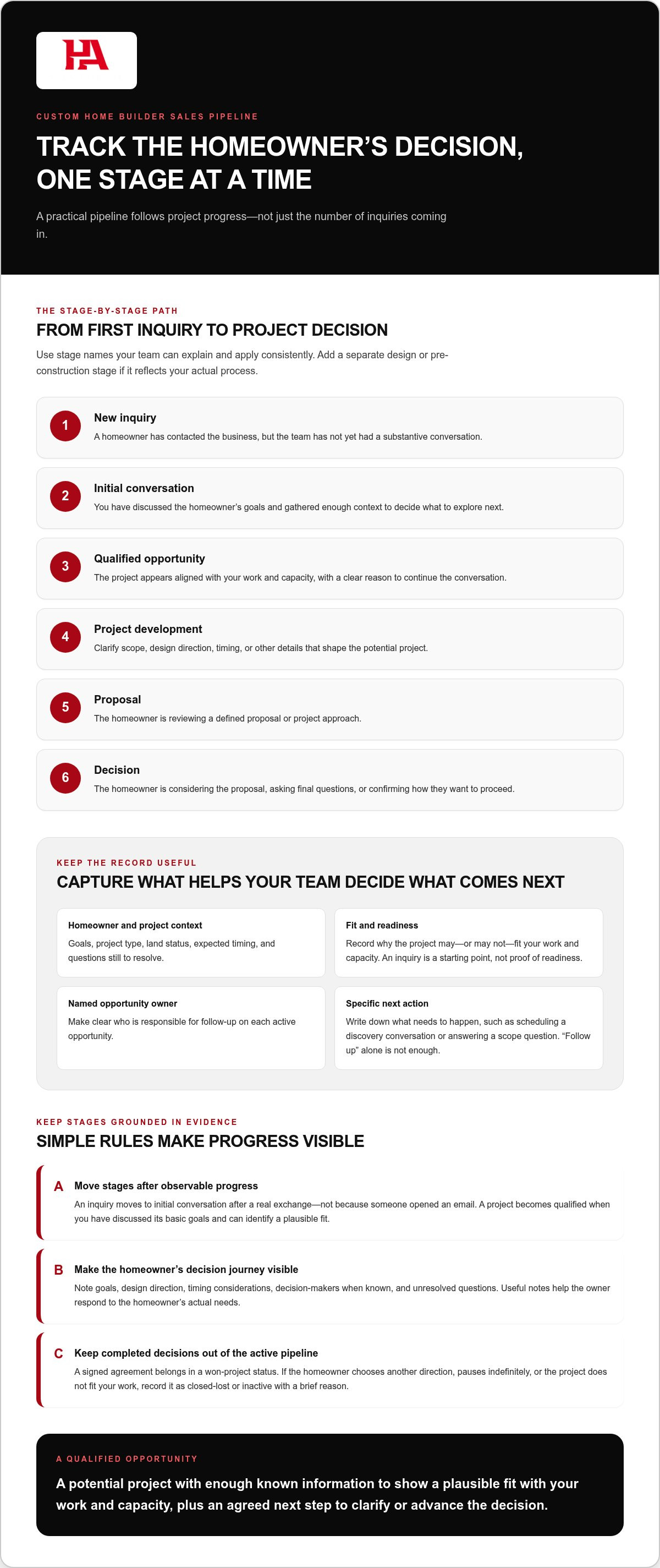
A useful sales pipeline for custom home builders follows the homeowner’s decisions, not a generic sales template. Choose a sequence your team can explain and apply consistently. One practical starting point is:
- New inquiry: A homeowner has contacted the business, but the team hasn’t had a substantive conversation yet.
- Initial conversation: You’ve discussed the homeowner’s goals and gathered enough context to decide what to explore next.
- Qualified opportunity: The project appears aligned with your work and capacity, and there’s a clear reason to continue the conversation.
- Project development: You’re clarifying scope, design direction, timing, or other details that shape the potential project.
- Proposal: The homeowner is reviewing a defined proposal or project approach.
- Decision: The homeowner is considering the proposal, asking final questions, or confirming how they want to proceed.
Adapt these labels to your actual process. If your team uses a separate design or pre-construction step, make it visible rather than squeezing it into a vague stage. Each active opportunity also needs a named owner and a specific next action, such as scheduling a discovery conversation or answering a scope question. “Follow up” alone isn’t enough. Record what needs to happen.
Set practical entry and exit criteria for each stage
Stage criteria keep the pipeline grounded in evidence. An inquiry enters “initial conversation” after a real exchange, not because someone opened an email. A project moves to “qualified opportunity” when the team has discussed its basic goals and can identify a plausible fit. It advances to “proposal” when the homeowner is reviewing a defined approach. Keep each rule simple, observable, and easy for everyone to apply.
Use the same discipline at the end. A signed agreement belongs in a won-project status, outside the active pipeline. If the homeowner chooses another direction, pauses indefinitely, or the project doesn’t fit your work, record it as closed-lost or inactive with a brief reason. Don’t leave completed decisions mixed with active opportunities.
Make the homeowner decision journey visible
Stages show progress; useful notes explain what’s shaping it. Capture the homeowner’s goals, design direction, timing considerations, and key decision-makers when known. Also note unresolved questions, such as whether the proposed scope fits their vision or which project details still need discussion. For example, record whether the next conversation is about a design preference or a scope question.
Good notes make follow-up personal and useful. Instead of sending a generic check-in, the opportunity owner can respond to the homeowner’s actual question or recap the agreed next step. For a practical way to connect inquiry capture with the sales handoff, explore lead generation for construction companies.
How to Qualify Custom Home Leads Without Chasing Every Inquiry
Consistent qualification doesn’t make custom-home sales impersonal. It gives your team a fair way to understand each homeowner’s goals and decide what kind of attention makes sense. A thoughtful process also protects the relationship: the aim is to find the right next conversation, not push someone into a decision before they’re ready.
Assess inquiries by project fit and readiness, not just by where they came from or how enthusiastic the first message sounds. A referral may still describe a project outside your scope. A homeowner who found you through search may be a strong fit but still be gathering ideas. Use the same core questions across sources, then tailor follow-up to what each person shares.
Assess fit, readiness, and decision context
Start with what the homeowner wants to build and whether that goal aligns with the kinds of projects your team takes on. Explore their design direction, timing considerations, and who else is involved in the decision. Ask about constraints and open questions with care. If budget or land details are not clear yet, record the gap and plan a conversation to understand it. Incomplete information alone isn’t a reason to disqualify someone.
The signals below are adaptable examples, not fixed rules. Your team’s project type, capacity, and process should shape how you use them.
| Working category | Possible signals | Useful next step |
|---|---|---|
| Strong fit | The goals appear aligned with your work, the homeowner is willing to discuss scope, and key decision-makers are engaged or identified. | Advance the conversation and agree on what information or discussion will move the project forward. |
| Nurture | The project may fit, but the homeowner is still exploring, timing is uncertain, or important details remain unresolved. | Clarify what they need next and when it would be useful to reconnect. |
| Poor fit | The requested project conflicts with your scope or capacity, or the homeowner’s stated expectations don’t align with what your team can deliver. | Close the opportunity respectfully or explain the mismatch clearly, rather than letting it sit as active work. |
Prioritize opportunities while preserving trust
Qualification should guide effort, not manufacture urgency. Advance an opportunity when the homeowner’s answers support a clear next step. Pause or nurture it when the project could fit but the person needs time, information, or input from another decision-maker. Mark it lost only when the homeowner declines, chooses another direction, or the mismatch is clear. A slow decision isn’t automatically a poor-fit project.
For a sales pipeline for custom home builders, this approach keeps follow-up focused on real project context. It helps your team invest attention where goals, expectations, and capacity appear aligned, while leaving room for a considered homeowner decision. Better qualification isn’t about pursuing fewer people at any cost. It’s about using each conversation to understand whether the potential project can be a good fit for both sides.
Measure Pipeline Health and Find Where Custom Home Opportunities Stall
A pipeline report should help you decide what to do next, not just show activity. Track a few measures consistently: how many opportunities are in each stage, how long they’ve been there, whether each has a next action, and how they end. Compare results with your own baseline over time. A stage that usually moves steadily for your team may need attention if opportunities begin pausing there.
Pipeline health depends on visible progression, not lead count alone. A high inquiry total can hide weak project fit, missing follow-up, or opportunities that never move beyond an early conversation. Source reporting becomes more useful when it shows which inquiries turn into qualified opportunities and which appear aligned with the projects your business can take on.
Read stage movement before changing the marketing plan
Look for repeated patterns before drawing conclusions. If opportunities regularly stall after a consultation, expectations or unanswered questions may need attention. If a proposal sits without a decision, the homeowner may need clarification, more time, or input from another decision-maker. Review the notes and next-action status before assuming the issue is marketing.
Source comparisons need the same care. Referrals, search, and paid traffic may bring different kinds of inquiries, so compare their movement into qualified opportunities and later outcomes, not just raw volume. A small or incomplete sample can be misleading. Treat early patterns as prompts for investigation, not proof that a channel is working or failing.
Use a simple recurring pipeline review
Review active opportunities on a consistent cadence your team can maintain. For each one, confirm its stage, owner, next action, and any change since the last review. Keep the discussion focused on decisions the team can act on, such as clarifying scope, following up on an open question, or moving an opportunity to a more accurate status.
- Advance: Record what the homeowner has agreed to discuss or provide next.
- Pause: Note the reason, such as a timing change or an unresolved project question.
- Close: Capture whether the project moved forward, was declined, or no longer fits, along with the reason when known.
Keep the reporting lean. A brief reason attached to a pause or outcome is often more useful than a long list of fields nobody maintains. Over time, these notes can help distinguish a follow-up gap from a project-fit issue or a point in the homeowner journey that needs clearer communication.
Use what the pipeline shows to guide questions for your connected marketing system. If a source produces inquiries but few suitable opportunities, review whether the message and lead capture set the right expectations. If qualified prospects advance but stall later, examine what information they need to make a confident decision. Pipeline data can point to friction, but it can’t by itself prove what caused it.
Discuss your construction lead generation strategy
Build a Connected Marketing System Around Your Custom Home Pipeline
A connected marketing system links what homeowners see before they inquire with what your team learns after they reach out. Your website, search visibility, branding, social media, lead capture, and project photography or video should support the same business priorities. When those pieces work together, you can better understand whether marketing is attracting people whose goals align with the homes you build.
Connect marketing touchpoints to the project decision
Homeowners researching builders need more than a contact form. Clear project messaging helps them assess whether your work fits their design preferences and expectations. A well-organized portfolio gives them relevant examples to consider, while professional photography and video can show details, spaces, and finished work that are difficult to convey in a short description. A website designed for custom home builders can bring those elements together and give prospective clients a clear path to learn more about your work.
Different touchpoints serve different moments. Organic search can help homeowners find relevant information as they research. Social content and project visuals can show how your work aligns with their interests. Website pages and lead capture give interested homeowners a clear next step. To make that handoff useful, capture enough context for your team to understand what prompted the inquiry and what the homeowner wants to discuss.
Use your pipeline to see whether those touchpoints are bringing inquiries that become relevant project conversations. That’s more useful than judging a channel by inquiry volume alone. Builders reviewing construction lead generation strategies can connect that work to the project fit and progression their team tracks.
Turn pipeline insight into a focused growth conversation
Patterns in opportunity stages can help you decide where to focus. If homeowners arrive but don’t understand your project approach, refine the website messaging or portfolio presentation. If the inquiries you receive rarely match your project type, review how your site and search presence describe your work. If prospects need more confidence while considering a project, stronger project photography or video can help address the questions they bring to the conversation.
Keep track of the original source and details captured at inquiry, then connect them with the opportunity’s later progress. This gives your team a clearer view of the handoff without treating attribution as proof that one marketing activity caused a signed project. This is where marketing for custom home builders can be planned around the real homeowner journey and the patterns your team observes.
A sales pipeline for custom home builders becomes more useful when strategy, creative, search visibility, and lead capture support the same business priorities. H&A Marketing provides website design, branding, SEO, lead generation, social media management, and photo and video production for construction companies. Explore H&A Marketing to see how those services can support a connected marketing system while your team stays focused on building.
Make Your Next Pipeline Decision Count
Use your sales pipeline for custom home builders as a planning tool, not just a record of past conversations. The patterns you notice can help you decide which project types to pursue, where your team needs clearer information, and how to focus future marketing around the work you’re best positioned to take on.
You don’t need to overhaul everything at once. Choose one practical improvement, such as clarifying what qualifies an opportunity to advance or making the next step easier for homeowners to understand. Then watch how that change affects the conversations your team is having and adjust from there.
If you’re ready to align your builder pipeline with a coordinated marketing approach, request a free quote from H&A Marketing to discuss the right next steps.
Build a process that gives your team greater clarity and helps the right projects move forward with confidence.
Frequently Asked Questions
What is the difference between a sales pipeline and a sales funnel for home builders?
A funnel helps you assess broad audience movement, while a pipeline helps manage individual opportunities. For example, a builder might use funnel reporting to compare how website visitors respond to different project pages, then use pipeline records to manage specific homeowner conversations. The funnel helps review marketing reach and interest. The pipeline helps the team decide who should follow up and what project information to clarify.
Can a sales pipeline predict when a custom home project will close?
A pipeline can help you assess progress, but it can’t promise an exact closing date. A homeowner may be waiting on a design decision, coordinating with family, or revisiting project timing. Use the sales pipeline for custom home builders to identify known next steps and compare how similar opportunities have moved in your own records. Treat any timing estimate as a planning aid, not a commitment to the homeowner.
Should a custom home builder have separate pipelines for different project types?
Usually, start with one pipeline if the project types follow the same decision path. Use labels or filters to distinguish projects, such as new builds and major renovations, then compare whether each group advances differently. Separate pipelines may help when the steps, decision-makers, or proposal process truly differ. Avoid splitting records just to make the board look organized; fragmented views can make workload and opportunity status harder to understand.
How should referral inquiries enter a custom home builder sales pipeline?
Enter referral inquiries through the same intake process as other leads, and record the referral source so your team can understand how the connection began. A personal introduction may provide useful context, but it doesn’t automatically establish project fit or readiness. For example, note what the referrer shared, then confirm the homeowner’s own goals and expectations directly. This keeps follow-up respectful while applying consistent standards to every potential project.
How often should a builder review the sales pipeline?
Choose a recurring review schedule your team can maintain, then add a check-in when a decision or project issue needs attention. A regular meeting can focus on opportunities with no clear next step, unexpected stage changes, or proposals awaiting a homeowner response. Keep the review short and practical. If the team leaves knowing who owns each follow-up and what needs clarification, the meeting is doing useful work.
Can a small custom home building company use a sales pipeline without a large sales team?
Yes. A pipeline can be useful even when the owner handles sales alongside construction responsibilities. Start with a simple shared record that captures the homeowner, project type, current status, source, and next action. Keep the process easy to update from the office or field. The goal isn’t to add administration; it’s to make sure a promising conversation doesn’t depend on one person remembering every detail.
